Home › A › Amaryllideæ (Sp or my jn S or my jn S C G H)
Amaryllideæ (Sp or my jn S or my jn S C G H)
Sp. 1. or 1½ my.jn S ✓ or 1 my.jn S C. G. H.
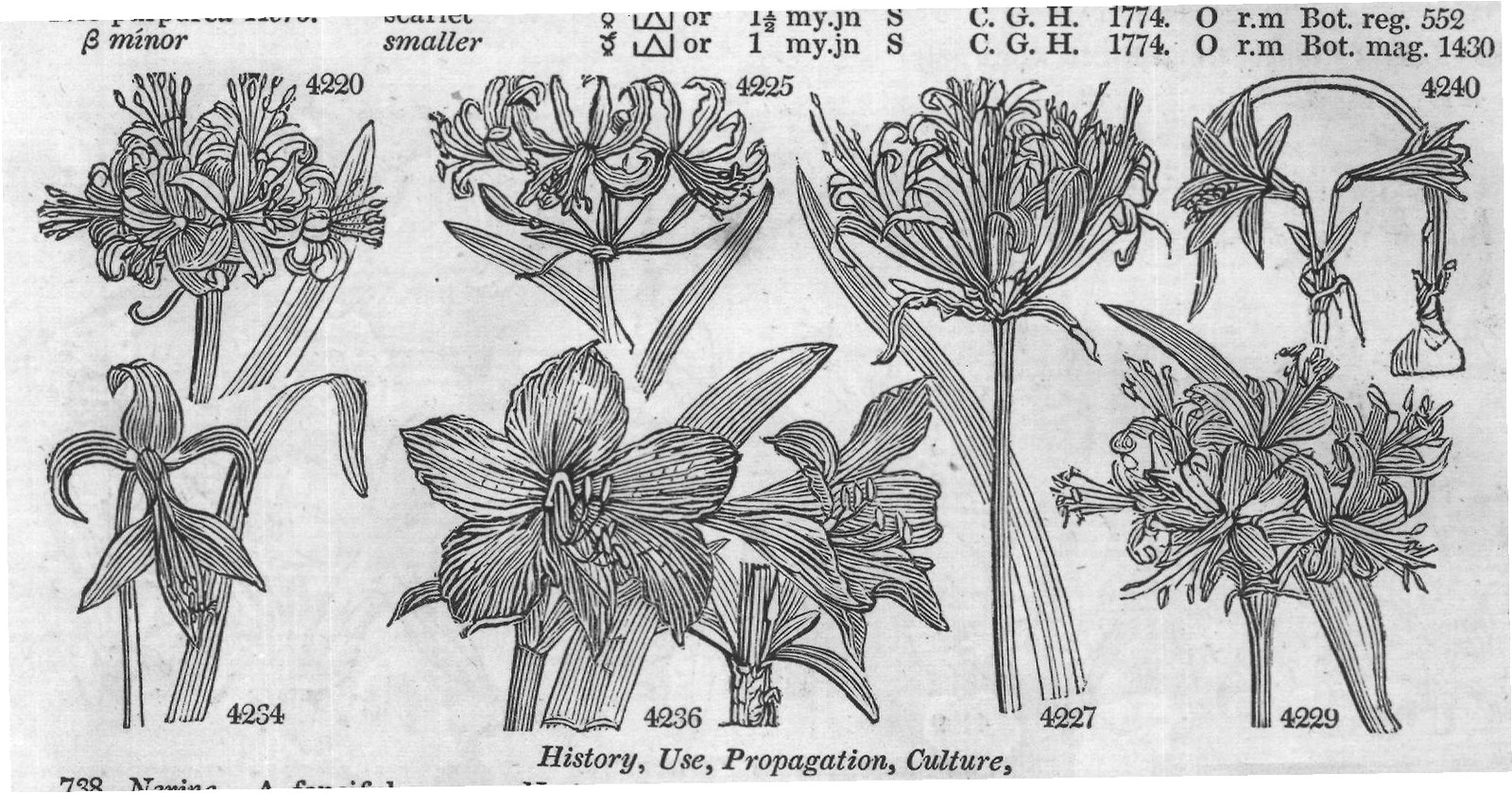
C. G. H. 1774. O r.m Bot. reg. 552 1774. O r.m Bot. mag. 1430 4220 4225 4240 4234 4236 History, Use, Propagation, Culture, 4227 4229 738. Nerine. A fanciful name. Nerine was the daughter of Nereus. The plant has become naturalized coast in Guernsey, of the island. having been part of the cargo of a Cape ship, which was cast away many naturalized the Guernsey, having been part of the cargo of a Cape ship, which was cast away many years ago on the coast of the island. N. sarniensis is a popular autumnal bulb, imported annually from the islands of Jersey and Guernsey, where it is grown in the open air in a sandy soil. Here it requires the protection of a frame to perfect the bulbs, so as it may flower the following year.
The reason is, that the leaves on which the perfection and future flowering of every bulb depends, are protruded in the beginning of winter, and our winters_are too long, gloomy, and severe, to admit of these leaves performing their functions properly. Hence two or more winters in a very mild situation in the open air are required to do what in Jersey is done in one winter; or two winters (as W. Williamson experienced) in a cold frame, or one winter only (agreeably to Knight's experience) in a frame with artificial heat. (Hort. Trans. iii. 450. iv. 177, and Caled. Mem. ii. 62.) ORDER 1.
HEXANDRIA MONOGYNIA. 4220 Leaves narrow sub-involute glaucous falcate, Petals lin.-lanc. wavy, Stamens erect sub-exserted 4221 A mere variety of the foregoing, from which it differs in having crimson flowers 4222 Many-fi. Leaves many narrow sub-involute not glaucous upright 4223 Like the last, but the flowers are scarlet and appear at the same time as leaves 4224 Lvs. very narrow obt. min. pustulate, Sepals recurved divaricating: the one bearing the stamens remote divaricati 4225 Leaves few ligulate channelled, Sepals turned upwards oblique, Stam. declinate shorter than cor. 4226 Laxly many-fl. Lvs. few lin. Cor. recurved stel. irreg irregular, Sepals curled; the lowest placed under the stam. 4227 Fl. stalked erect, Cor. infundibulif. clavate, Sepals linear lanceolate, Stamens straight, Leaves quite blue 4228 Five sepals, or all rising in a semicircular ray wavy, Stam. deflexed twice as long as cor. 4229 Leaves broad nerved lying on the ground, Sepals equally revolute, Stamens very long 4230 Leaves linear lorate, Scape flat smooth, Peduncles upright hispid 3-cornered twice as long as flower 4231 Leaves glaucous, Cor. deformed pale streaked with red 4232 Flower sessile, Leaf one linear, Sepals longer than tube ovate obl. reflexed acute, Stamens inclined 4233 One-flowered, Cor. regular erect turbinate conniving, One sepal pushed aside by the stamens 4234 Tube fringed, Cor. nodding with a very ringent limb, Stam. included in the involute lower segments 4235 Tube crowned by a short entire green membrane 4236 Two-flowered half ringent, Membrane of the tube very short two-colored toothletted, Stamens included 4237 Mem. of orifice entire, Limb half ringent nodding with outer seg. incurved at end, the inner recurved 4238 Tube fringed, 2-3-fl. Stalks shorter than the erect spatha, Tube horizontal, Limb curved upwards 4239 Tube fringed, 2-4-fl. Lvs. few lorate acum. with a keeled rib, Cor. cernu. deeply turbin. Tube short thick 4240 Many-fl. Tube fringed, Leaves 1 or more linear ligulate involute glaucous, Stalks as long as nodding cor. 4241 Flowers about 2 with a very long tube and a nearly regular limb 4242 Leaves long strap-shaped with the scape very cœsious, Flowers 4 ringent with taper pointed segments 4243 Cor. funnel-shaped campanulate drooping, Stamens straight exserted, Leaves green lorate obtuse 4244 Umbel 6-fl. Sepals rolled into a cylindrical tube, Flower-stalks the length of flowers, Stigma simple 4245 Flower solitary erect, Sepals conniving, Stamens ascending, Anthers innate, Leaves linear fleshy 4246 Flower nodding ringent, Outer sepals broadest, Throat naked, Tube the length of the ovary 4247 Leaves several lorate-oblong narrow. towards the base, Flower cernuous cucull. tubular obliquely ringent 4248 Leaves linear very long and weak, Limb nodding 2-lipped, Flower-stalks many times longer than ovary 4249 Lvs. numerous spreading flat with rough edge, Fl. about 10 with nodd. spreading obsoletely 2-lipped limb 4250 Bulb spherical, Spathe bifid erect obtuse, Flowers sessile, Leaves with a long point wavy downwards 4251 Spathe withered scarcely as long as stalks, Cor. cern. uneq. Tube as long as germen, Upper sepal remote 4252 About 2-fl. Spathe arid refl. Limb turbin. bilabiate: three upper sep. conniv. recurv. lower narr. remote 4253 Leaves obl. lanc. not glaucous, Flowers nodding with an oblique mouth, the upper one much reflexed 4254 Lvs. many obl. obtuse, Pedunc. divaricating as long as fl. Tube short turbin. Limb recurved spreading 4255 With many fl. on stalks, Lvs. ligul. Cor. regular turbin. nodd. Sepals recurv. at end, Tube scarcely any 4256 Cor. cucul. campanulate, Outer sepals separate to the bottom; inner united half way by the interior ribs 4257 Lvs. altern. turn. both ways fal. Scape flat, Cor. regul. Tube twice as short as revol. limb. Stam. erect spread. 4258 Umb. many-fl. shortly stalked, Leaves attenuated glaucous, Tube about twice as long as limb 4259 Many-fl. Leaves acuminate glaucous, Flowers erect recurved stalked cucullate, Limb spreading revolute 4260 Leaves many lorate lanceolate wavy thick in the middle, Limb cernuous as long as tube 4261 Lvs. many lorate atten. channelled rough at edge, Limb obsoletely 2-lipped shorter than tube nodding 4262 Leaves obl. lanceolate narrowed both ways wavy rough at edge, Limb nodding shorter than tube 4263 Spathe many-fl. Flowers stalked tubular at base, Leaves obl. lanceolate 4264 Spathe 2-fl. Cor. campan. deeply 6-parted, Upper seg. very narr.; lower ob. acum. Lvs. lin. longer than scape 4265 The only species, Amaryllis purpurea of Willd 4255 4258 4251 4249 4253 4265 β 4256 and Miscellaneous Particulars. 739. Amaryllis. Name of a nymph celebrated by the poets, and especially by Virgil. Derived from aμaρύσσω, to be resplendent. This is a superb genus: the greenhouse sorts thrive best in a rich loamy soil, and should have but little water given them after they have done flowering, so that the bulbs may harden, to produce more flowers the following season. Most of them are increased freely by offsets, and ripen plenty of seed. A shell taken from the bulb, with a leaf on it, and planted in a pot of mould, will produce a bulb; as will almost any bulbous-rooted plant. (Bot. Cult. 131.) The stove Amaryllises grow best in light loam and rich soil, and the strong growing kinas require large pots to flower in perfection; they are increased by offsets and by seeds, which they bear plentifully, if care be taken to shake some pollen on the stigma at the proper period. 740. Vallota. A name of unknown meaning. The only species of this genus is a beautiful Cape plant, with bright purple flowers, of which two varieties are known in gardens, 741. GRIFFI'NIA. Ker. GRIFFINIA. 4266 hyacinthina Ker. blue or 4267 parviflóra Ker. small-flowered or 742. STERNBERGIA. W. STERNBERGIA. 4268 colchiciflóra W.& K. Colchicum-fl. or 4269 clusiana Ker.
Ecluse's or 4270 lútea Ker. yellow or 4271 chloroleúca Ker. one-leaved or au.s au.s au.s my.au P.Gr HEXANDRIA MONOGYNIA.