Home › B › Bot (Mag History Use Propagation) (IV)
Bot (Mag History Use Propagation) (IV)
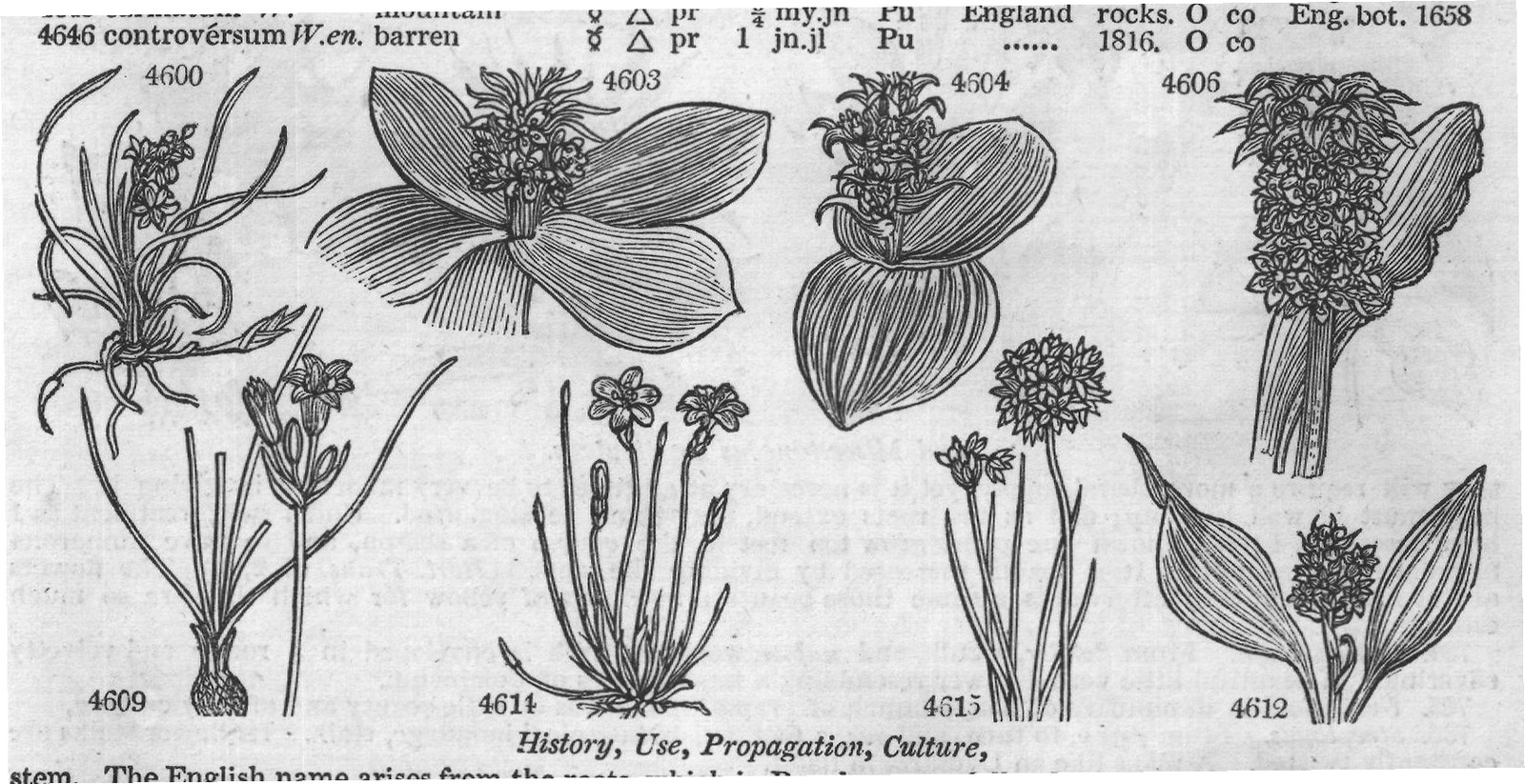
mag. 1764 4609 4614 4615 4612 History, Use, Propagation, Culture, stem. The English name arises from the roots, which in P. vulgare are full or knots, and a transverse section of them shews characters which dreamers have discovered to represent the impress of the famous seal of Solomon. 790. Ophiopogon. From opis, a snake , and πωγov, a beard: snake's-beard. This plant is best grown in pots, as requires the protection of a frame during severe frosts. it requires the protection of a frame during severe frosts. 791. Eucomis. From ἐv, well, and κoμη, hair; on account of the fine tuft of leaves, in botanical language called coma, by which the stem is surmounted. Handsome herbaceous plants which are nearly hardy. 792. Brodiea. Named by Sir James Smith, after James Brodie, Esq. of Brodie House, a gentleman to whom the botany of Scotland is indebted. Highly curious little plants with blue flowers. botany of Scotland is indebted. Highly curious little plants with blue flowers. 793. Peliosanthes. From πελioς, livid, and avθoς, a flower, in allusion to the color of the flowers. Teta is the name of the plant in India; and having been adopted by Dr. Roxburgh, ought not to have been neglected in this country.
ORDER 1.
HEXANDRIA MONOGYNIA. 4600 Scape naked, Leaves linear thrice as long as scape 4601 Scape naked, Raceme spiked, Flowers aggregate 4602 Scape clavate, Leaves broad lanceolate acute 4603 Scape clavate, Leaves multifarious expanded 4604 Scape clavate, Leaves elliptical acute twin lying on the ground 4605 Scape cylindrical, Leaves tongue-shaped obtuse lying on the ground 4606 Scape cylindrical, Leaves ovate oblong wavy spreading, Crown as long as raceme 4607 Scape cylindrical, Leaves oblong lanceolate channelled spreading, Crown short, Racemes long 4608 Scape cylindrical, Leaves lanceolate spreading striped, Crown short, Raceme long 4609 Flowers large lax, Leaves of corona lanceolate undivided 4610 Leaves of the corona subulate 4611 Flowers clustered, Leaves of corona bifid 4612 Scape shorter than ovate-lanceolate leaves 4613 Scape branched longer than leaves 4614 The only species 4615 The only species A. Stem leafy. Leaves not fistular.
Umbel not bulbiferous. Leaves flat. 4616 Umb. globose, Stam. 3 cusp. Sepals with a rough keel 4617 Stam. tricuspidate, Root tunicated 4618 Umb. globose, Stam. tricuspidate twice as long as flower 4619 Umb. capitate, Stam. subulate twice as long as flower 4620 Umb. capitate, Stam. lanceolate longer than flower, Leaves elliptical 4621 Umb. fastigiate, Stam. subulate, Leaves linear ciliated 4622 Stam. filiform thrice as long as flower, Leaves oblique 4623 Cauline leaves lanceolate, Umbel dense depressed, Stamens subulate shorter than flower 4624 Umb. fastigiate, Sepals emarginate, Stamens very short simple 4625 Stam. 3-pointed as long as flower, Leaves very narrow, Scape declinate 4626 Very upright, Leaves channelled 4627 Umb. loose few-flowered, Leaves smooth 4628 Very like Allium subhirsutum differing only in the smallness of the flowers, Sepals 3 lines long Umbel not bulbiferous. Leaves not flat. 4629 Stamens simple, Umbel flat, Leaves half-rounded 4630 Outer peduncles shorter than the rest, Stamens 3-pointed 4631 Flowers pendulous, Sepals ovate, Stam. longer than flower 4632 Flowers pendulous truncated, Stam. simple as long as flower 4633 Pedunc. capillary effuse, Stam. simple, Spathe very long 4634 Stam. simple twice as long as flower, Spathe as long as flower-stalks: one valve shorter 4635 Umbel globose, Stam. 3-pointed, Flowers lateral nodding, Leaves half-round 4636 Stamens simple twice as long as flower, Umbel globose, Spathe subulate very long 4637 Umbel fastigiate about 6-flowered, Sepals acute, Stamens simple, Leaves setaceous 4638 Umbel globose very dense, Spathes lanc, as long as flow.-stalks, Stam. 3-pointed longer than fl. Lvs. round 4639 Flower-stalks nearly equal, Sepals ovate conniving as long as simple stamens, Style longer than stamens 4640 Spathe ovate shorter than umbel, Stamens simple shorter than flower 4641 Leaves half-round, Stamens 3-pointed longer than flower 4642 Umbel globose, Stamens simple longer than flower, Spathe subulate 4643 Umbel sub-globose, Stamens 3-pointed shorter than flower Umbel bulbiferous. Leaves flat. 4644 Sheaths of leaves rounded, Spatheblunt, Stamens 3-pointed 4645 Umbel spreading, Peduncles nodding, Stamens subulate, Spathes with very long points 4646 Flowers all male, Stamens 3-pointed, Spathe with a very long point 4616 4621 4624 4629 4645 4644 4641 4634 and Miscellaneous Particulars. 4632 794. Aphyllanthes. From a, privative, φuλλov, leaf, and avθoς, a flower; leafless flower. Its stems are naked, like a rush, and bear on their summit a little tuft of blue flowers. 795. Sowerbæa. So named in honor of the late James Sowerby, an excellent draughtsman and ingenious naturalist. The power he possessed of representing the general features of plants within the compass of a few inches, as in his English Botany, has never been possessed in the same degree by any other individual than the late Sydenham Edwards . His execution as an artist is fully attested by the superb plates of the Flora Londinensis, of his own Fungi, and indeed of almost every botanical work of merit which appeared during his life. His talents and his reputation are inherited by his sons. This plant requires plenty of water, and is easily increased by dividing the roots 796. Allium. From the Celtic all, which signifies hot or burning. This is a genus of strongly scented bulbous plants, all of them edible, and some of them of the greatest antiquity as potherbs.
T violet 4651 fœtidum W. stinking 4652 vineále W. crow 4653 oleráceum W.
HEXANDRIA MONOGYNIA. 4647 satívum W. cultivated 4648 Scorodoprásum W. Rocambole 4649 monspessulán. W.en. Montpellier 4650 violáceum W. en. purple-striped OF YOYO cul 1 jn.jl cul 3 jl Apr 1 jn Apr 1 jn Apr 1 jl Apr 1 jn Apr 1 jl W Sicily CLASS VI. 1548. O r.m Moris.s.4.t.15.f.9 L.Pu Denmark 1596. co a.pu S. France Pa.pu S. France 1822. O co V S. Europe 1823. O co D.Pu co ...... ...
Pu Britain mea. O co Eng. bot. 1974 Pa.pu England corn fi. O co Eng. bot 488 4654 odórum L. sweet-scented 4655atropurpúreum w.&k.dark-purple 4656 nigrum L. black 4657 cáspium Bieb.
Caspian Amaryllis caspia L. 4658 álbidum Fisch. whitish 4659 saxátile Bieb. strong you you you you yoyo pr 1 jn Apr 1 jl pr jl.au Apr 1 ap W W S. Europe 1820. O co D.Pu Hungary 1821. O co W Barbary 1818. O co Crimea 1822. O co Wald.& K.1. t.17 pr jn.jl W Crimea 1820. co 4660 Cowáni Lindl.
Cowan's A Apr 1 jl.au W Crimea 1823. O co pr jn W Chili 1823. co