Bot (XIII)
mag. 554 806. EREMU'RUS. Bieb. EREMURUS. channelled-lvd.or Asphodelcæ. 1 my.jn Y Sp. 1 Siberia 4746 4756 1800. O s.l Bieb. cent. t. 61 4763 4743 4754 4753 4759 4765 History, Use, Propagation, Culture, dropsy it has long been esteemed the most certain and effectual diuretic with which we are acquainted, and it is usually employed in asthma. 803. Scilla. From σκuλλω, to injure, according to Miller, because its root is a violent poison as well as an article of medicine. In Arabic it is called ásqyl; has not the name scilla been obtained rather from this root? The genus is so ill defined that botanists are more guided by their blue colour than by any precise mark, in referring plants to this rather than Ornithogalum.
S. peruviana or hyacinth of Peru is erroneously named, being a native of Spain. It is valuable as an evergreen, or rather wintergreen, its fine lucid green leaves appearing before winter and continuing through that season, till it sends up its thick succulent scapes about the end of April. There are two varieties, one with a deep blue, and the other with a white flower. Like other Spanish bulbs it is liable to be destroyed by an extraordinary severe winter.
S. verna is a maritime plant found on the coast of Cornwall, Wales, the Isle of Man, and the Hebrides. S. non-scripta is the Hyacinthus of that name of Linnæus, the Jacinte des bois, of the French, and Niederlandische or Englische Hyacinthe, of the Germans. The fanciful specific name of non-scriptus was ORDER I.
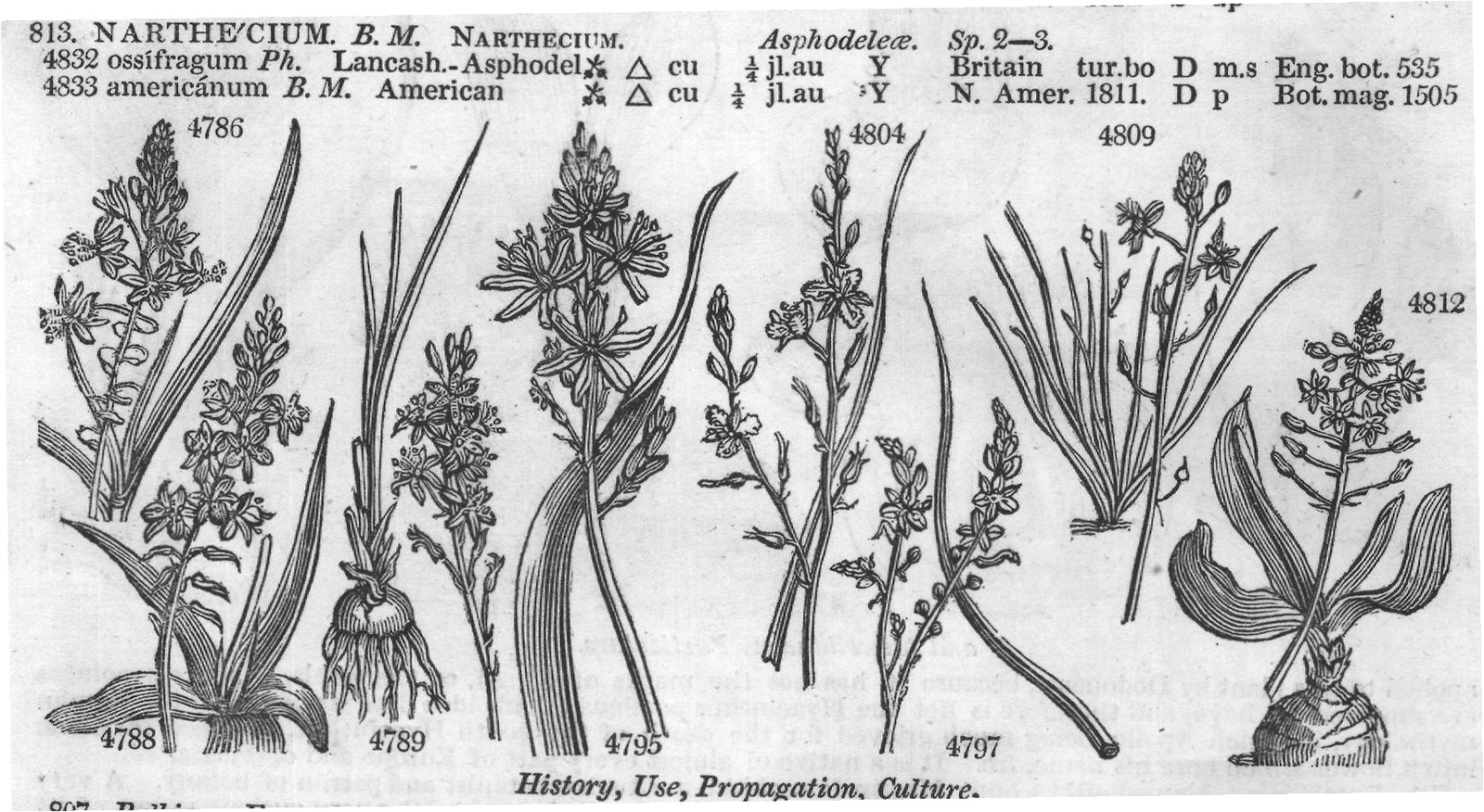
HEXANDRIA MONOGYNIA. 4742 Raceme long, Filam. subul. Sepals lanc. at the end callous inflexed, Leaves linear depressed flat 4743 Raceme few-fl. Filam. subulate, Sepals lin. obtuse 3 outer bearded at end; inn. mucron. Leaves filiform lin. obtuse: 3 outer bearded at end; inn. mucron. Leaves filiform 4744 Raceme long many-fl. Filam. subulate, Sepals lanc. acute, Leaves filiform subulate 4745 Leaves filiform fleshy, Scape few-flowered 4746 Corymb many-flowered, Filam. subulate, Cor. broadly campan. Outer sepals obsoletely 3-toothed 4747 Corymbs many-fl. racemose, Filam. alternately forked, Leaves lanceolate 4748 Raceme contracted corymbose, Filam. alternately emarg. Leaves lanc. with cartilaginous teeth 4749 Like the last, but the flowers very yellow, and the bractes very narrow the length of the flower-stalk 4750 Raceme many-fl. contracted, Altern. filam. emarginate, Leaves linear channelled 4751 Raceme very long, Leaves lanc. linear, Flowers spreading, Stam. dilated alternately wedge-shaped 4752 Leaf solitary longer than scape, Flowers few spiked sessile 4753 Flowers without the leaves, Bractes reflexed 4754 Raceme conical oblong 4755 Corymb clustered conical 4756 Raceme oblong conical, Sepals lined 4757 Raceme few-flowered, Peduncles without bracteæ, Leaves lanceol. lying on the ground 4758 Scape angular, Peduncles alternate shorter than flower, Bractes obtuse very short 4759 Four-leaved, Scapes many half-rounded striated 2-flowered decumbent after flowering 4760 Scape angular, Raceme corymbose, Peduncles twice as long as fl. Bractes obsolete 4761 Raceme few-flowered with bractes, Flowers campanulate, Leaves linear channelled: radical many 4762 Leaf roundish somewhat spiked on one side 4763 Raceme cylindrical many-flowered, Sepals half as long again as the ovaries, Peduncles colored 4764 Leaves filiform linear, Flowers corymbose, Peduncles naked ascending the length of the flower 4765 Flowers racemose, Leaves lanceolate linear about two elevated on a scape 4766 Scape rounded, Corymb few-flowered umbelled, Bractes filiform the length of peduncles 4767 Flowers campanulate 6-parted, Raceme cernuous 4768 A species which has not yet been seen in flower, nor described 4769 Raceme many-fi obl. conical, Flowers campan. erect, Bractes 2-parted longer than pedunc. Lvs. lanceol. 4770 Flowers campanulate 6-parted revolute at end 4771 Flowers 6-parted, Raceme cernuous, Leaves shorter than scape 4772 Flowers funnel-shaped corymbose erect, Scape shorter than the leaves 4773 Scape longer than keeled linear leaves, Spike racemose, Five sepals ascending; the lower deflexed 4774 Flowers campanulate half six-cleft racemose, Stamens membranous 4775 The only species, like a pale-flowered variety of Scilla sibirica 4776 Leaves roundish smooth 4777 Leaves lanceolate oblong acuminated 4778 Leaves roundish smooth towards the end muricated 4779 Leaves roundish veiny warted rough 4780 Leaves ovate and lanceolate with hairy tubercles, Sepals filiform 4781 Leaves lanceolate and elliptical veinless warted, Warts naked, Sepals ovate Warts naked, Sepals ovate 4782 Leaves oblong lanceolate flat smooth 4783 Leaves lanceolate wavy smooth 4784 Leaves lanceolate, Sepals much shorter than the tube, Filam. capillary alternately longer 4785 Scape naked simple, Stamens twice as long as flower, Leaves linear channelled 4775 4776 4782 D 4784 4774 4778 4779 and Miscellaneous Particulars. 4785 applied to this plant by Dodonæus, because it has not the marks of Ai, Ai, on the petals, as other hyacinths are supposed to have, and therefore is not the Hyacinthus poeticus. This idea has its origin in the Roman are mythology, in which Apollo, being much grieved for the death of the youth Hyacinthus, changed his blood into a flower which bore his name, &c.
It is a native of almost every part of Europe and of Persia. 804. Puschkinia. Named after Count Mussin Pouschkin, a Russian botanist and patron of botany. A very remarkable little plant, resembling a Scilla in appearance, but well defined by the very curious union of its stamens into a cup. 805. Massonia. So named by Thunberg, after Mr. Francis Masson, author of Stapeliæ Novæ; a successful botanical collector at the Cape of Good Hope , Madeira, the West Indies, and finally North America, into whose wildernesses he went to die. Very singular plants, with broad leaves lying flat on the ground, and complants, with broad leaves lying flat on the ground, and com. pact umbels of flowers. 806. Eremurus. From έρημoς, desert, and έρa, a tail: tail of the desert. Its long spikes of yellow flowers may be easily imagined to merit such an appellation in their native abodes. T4 HEXANDRIA MONOGYNIA.
CLASS VI, 807. BULBINE. W. en. 4786 frutescens W. en.
BULBINE.
Asphodeleæ.
Sp.7-19. 4787 rostráta W. en. 4788 alooídes W. en. 4789 pugionifórme Lk. 4790 longiscápa W. en. 4791 ánnua W.en. 4792 ciliáta Lk. 808. ASPHODELUS. W. ASPHODEL. 4793 lúteus W. shrubby beaked or 2 mr.au Y C. G. H. 1702. C s.l