Home › B › Bot (Mag History Use Propagation) (VI)
Bot (Mag History Use Propagation) (VI)
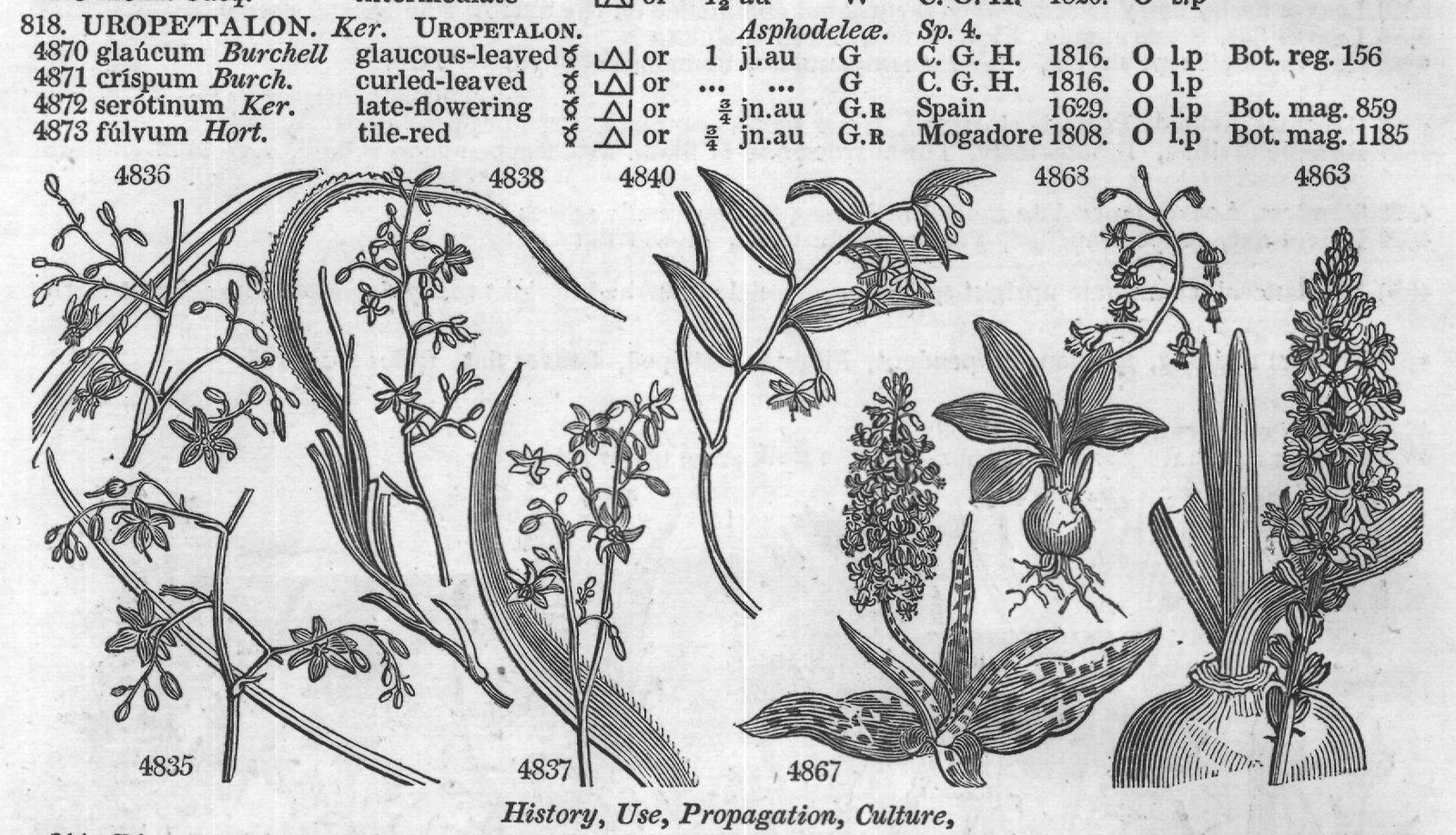
mag. 1185 4863 4835 4837 4867 History, Use, Propagation, Culture, 814. Dianella. A diminution of Diana, the name which the genus originally received from Commerson. The species are found in the recesses of forests, where the goddess of hunting may be supposed to inhabit. 815. Eustrephus. From εv, well, and 5ξεφω, to turn, in allusion to the twining habit of the species. 816. Asparagus. From σπaρaσσω, to tear, on account of the strong prickles with which some of the species are armed. Some are diœcious, and others are prickly evergreen climbers. A. officinalis, Asperge, Fr., Spargel, Ger., and Asparago, Ital., is one of the oldest and most delicate of culinary vegetables. It is found on the sea-shores in different parts of Britain and in many parts of Europe, and is abundant in the inland sandy plains in Russia, Turkey, and Greece. Aspa Asparagus was in much esteem both among the Greeks and Romans. It is much praised by Cato and Columella, and Pliny mentions a sort which grew near Ravenna, a deep sandy country, three shoots of which would weigh a pound. It is equally admired by the moderns, and assiduously cultivated in private gardens everywhere, and to a great extent round London, Paris, and Vienna. In no part of the world is it grown to such perfection as in the market gardens round London. That of the parish of Mortlake is particularly strong and succulent: the soil is a sandy loam, deeply trenched, and well manured; the seed is sown in drills and thinned out till the plants stand six inches apart in the row, and the rows are a foot asunder. Round Paris and Vienna more pains are taken in preparing the soil, by forming excavations and filling them with layers of turf, durable manure, as bones, wood-chips, &c., sand, manure, loam, &c.; but though plantations on such beds last longer than on our's, they do not yield better shoots, and it may justly be questioned whether they are equally profitable to the cultivator. The culinary preparations of asparagus are few, its very delicate flavor rather being deteriorated than improved by powerful tastes. It is best boiled and served alone, to be eaten with butter and salt; or with the points of the shoots cut in small pieces, and served up as green pease. It is esteemed diuretic, and in Paris ORDER I.
HEXANDRIA MONOGYNIA. 4834 Radical leaves sword-shaped flat shorter than the stem with the keel and edges smooth, Panicle simple 4835 Radical leaves ensiform long smooth at the edge and keel, Panicle upright 4836 Leaves bright-green smooth, Panicle lax decomp. Sepals of pendulous flower reflexed, Filam. strumous 4837 Leaves linear-lanceolate at the edge prickly, Keel smooth 4838 Stem leaves numerous long ensiform rough at the edge and keel, Branches of panicle short 4839 Leaves radical lin.-lanceolate at the keel and edges smooth, Panicle decompound straggling 4840 Leaves ovate or elliptical-lanceolate, Anthers after flowering twisted 4841 Leaves linear or linear-lanceolate, Anthers after flowering straight 4842 Stem herbaceous round erect, Leaves setaceous 4843 Stem herbaceous erect rounded, Leaves setaceous-whorled and whorled, Stipules solitary unarmed 4844 Stem half-climbing, Branches straggling, Leaves setaceous curved, Flowers globose 4845 Stem unarmed rounded, Branches declinate, Leaves setaceous 4846 Stem much branched wavy, Leaves setaceous pungent, Flowers campanulate 4847 Stem herbaceous unarmed decumbent much branched, Branches wavy, Leaves setaceous 4848 Herbaceous unarmed twining, Leaves lanceolate falcate 4849 Stem herbaceous erect, Branches straight, Leaves bundled setaceous long, Pedunc. sol. nodding 4850 Prickly solitary recurved, Branches round, Leaves fascicled linear falcate, Pedunc. 1-fl. clustered 4851 Prickles solitary, Branches striated, Leaves bundled linear-subulate falcate, Racemes many-fl. axillary , Leaves bundled linear-subulate falcate, Racemes many-fl. axillary 4852 Branches striated, Leaves linear falcate unequal, Flowers few 4853 Prickles solitary, Branches round reflexed bent back, Leaves setaceous bundled 4854 Prickles solitary, Stem erect, Branches filiform, Leaves bundled setaceous 4855 Prickles solitary reversed, Branches angular, Leaves lanceolate linear 4856 Prickles solitary, Branches angular wavy, Leaves bundled 3-cornered blunt deciduous 4857 Stem unarmed angular shrubby, Leaves needlelike rigid perennial mucronate equal 4858 Herbaceous unarmed, Branches wavy, Leaves lanceolate 4859 Stem unarmed angular shrubby, Leaves subulate striated unequal diverging 4860 Unarmed, Branches bent back, Leaves rounded subulate 4861 Spines 4, Branches clustered rounded, Leaves setaceous 4862 Leaves solitary linear lanceolate, Stem wavy, Prickles recurved 4863 Leaves oval sub-erect plain, Raceme long cylindrical, Bractes hooked back upon themselves 4864 Leaves linear lanc. obliquely bent smooth, Flowers nodding 4865 Leaves linear keeled ciliated 4866 Leaves lanceolate smooth channelled at base, Flowers erect 4867 Leaves wedge-shaped smooth, Scape few-flowered 4868 Leaves lanceolate smooth wavy, Peduncles horizontal 4869 Leaves linear lanceolate half-round 4870 Leaves broad lanceolate erect much shorter than scape, Peduncles very long 4871 An undescribed species, said to be in the gardens about London 4872 Leaves bright green channelled striated, Sepals oval the length of stamens oval the length of stamens 4873 Leaves glaucous, Raceme lax, Sepals linear much spreading longer than stam. spreading longer than stam. 4842 4847 4850 4861 4853 4854 4873 4870 and Miscellaneous Particulars. is much resorted to by the sedentary operative classes, as taylors, weavers, &c. when they are troubled with symptoms of gravel or stone.
There are some varieties and subvarieties of asparagus, but excepting the red-topped and green-topped, the others are merely local varieties, and can hardly be said to be obtainable by seed.
In the kitchen garden asparagus is generally grown in beds four feet broad, and in rows a foot or eighteen inches apart by nine inches in the row. The plants are either raised from seed where they are to remain, or raised on a seed-bed the preceding year and transplanted. The value of the crop depends on the soil being dry, sandy, trenched two and a half or three feet deep, and powerfully manured. During winter the beds are covered with dung or litter to protect them from the frost. In spring this is raked off into the alleys and dug in, while the beds are stirred with a fork, to admit the air, heat, rain, &c. to stimulate the risi rising shoots. Asparagus from seed will be fit to cut the third year, in perfection the fifth, and will continue good for ten or twelve years. The season for cutting is from the middle of April to the middle of June.
Asparagus is extensively forced, generally by taking up the roots and placing them on dung or tan beds; but sometimes a more gentle forcing is given by covering the beds with dung in the manner of forcing sea-cale.
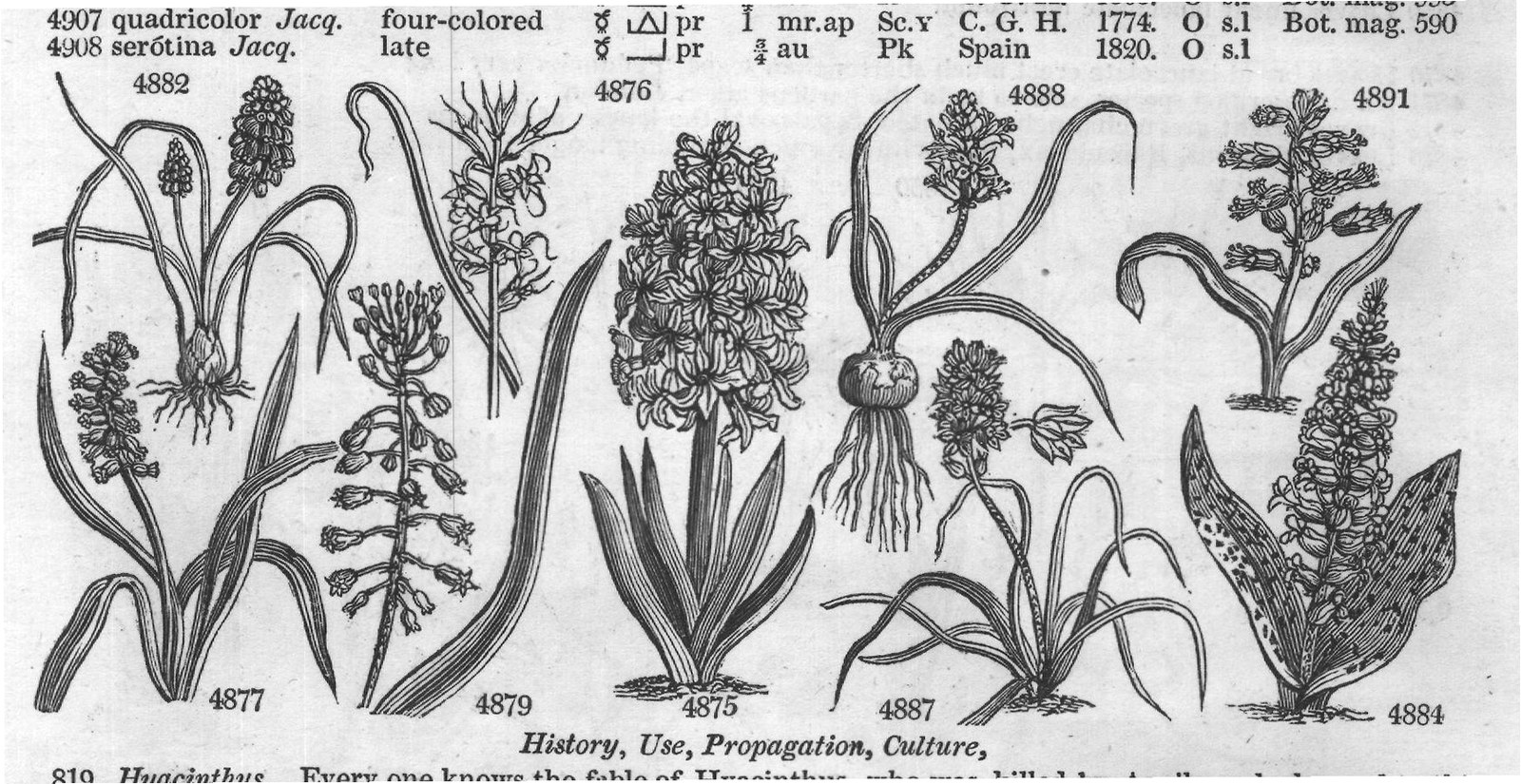
By the former mode earlier crops are obtained, but the roots are lost ; by the latter, the crop is only forwarded a week or two, but the roots remain to produce the following year. 817. Drimia. So called from the Greek word δρiμuς, caustic, because the juice of the roots is so very acrid, as, when applied to the skin, to cause inflammation and even blisters 818. Uropetalon. From ça, a tail, and πετaλov, a petal, in allusion to the manner in which the divisions of the flower are lengthened out. Curious and rare bulbous plants, very nearly related to Zuccagnia perhaps not generically distinct. garden green HEXANDRIA MONOGYNIA. 819. HYACINTHUS. B. M. HYACINTH. 4874 amethystinus W. Amethyst-col.or 4875 orientális W. 820. ZUCCAG'NIA. Thunb. ZUCCAGNIA. 4876 víridis Thunb. or or Asphodeleæ. Sp. 2-3.
CLASS VI. 821. MUSCA'RI. B. M.
GRAPE-HYACINTH. 4877 moschátum B. M. musk or flávum B. M. yellow or 4878 ciliátum Cyr. ciliated or 1 my 4879 comósum R. L. purple or ẞ monstrósum feathered or 4880 pállens Fisch. pallid or 4881 botryoídes B. M. blue or 4882 racemósum B. M. starch or ap.my B S. Europe 1759. O l.p mr.ap B Levant 1596. O r.m Asphodeleæ. Sp. 1-2. au Red. lil. 14