Home › B › Bot (Cab paucifl rus W History Use)
Bot (Cab paucifl rus W History Use)
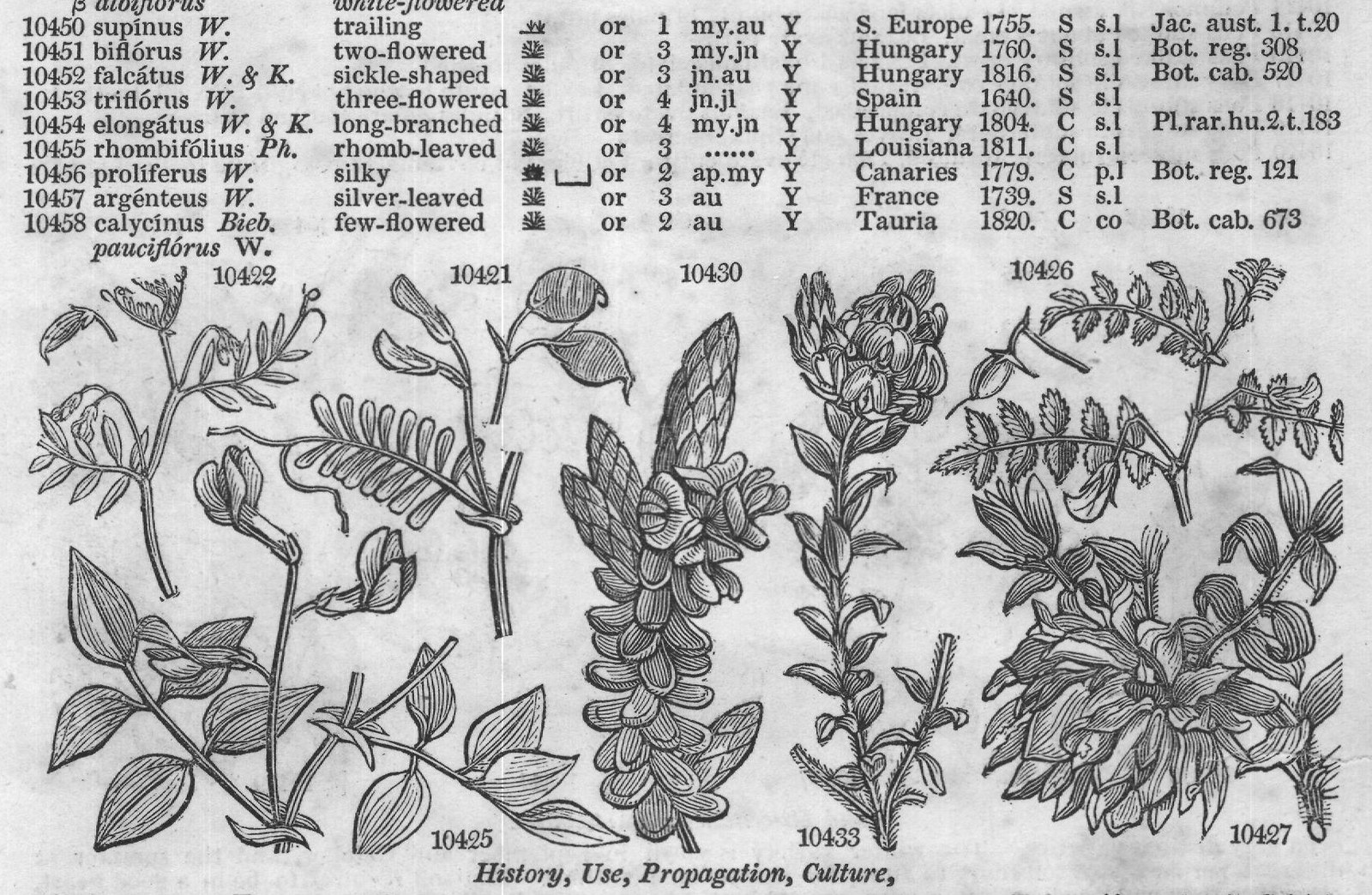
cab. 673 pauciflórus W. 10422 10421 10430 10426 10425 10433 10427 History, Use, Propagation, Culture, 1562. Ervum. From erw, tilled land, in Celtic; to which this plant is a pest. E. lens (from lentil, Celtic), Lentille, Fr., Lentze, Ger., and Lenticcia, Ital., is a legume of the greatest antiquity, being in esteem in Esau's time, and much prized in eastern countries ever since. In Egypt and Syria they are parched in a frying-pan and sold in the shops, and considered by the natives as the best food for those who undertake long journies. There are three varieties of lentils cultivated in France and Germany; the small brown, which is the lightest flavored, and the best for haricots and soups; the yellowish, which is a little larger, and the next best; and the lentil of Provence, which is almost as large as a pea, with luxuriant straw, and more fit to be cultivated as a tare, than for the grain as human food. A dry warm sandy soil is requisite for the lentil; it is sown rather later than the pea, at the rate of a bushel, or one and a half bushel, to the acre; in other respects its culture and harvesting are the same, and it ripens sooner. The produce of the lentil in grain is about a fourth less than that of the tare; and in straw it is not a third as much, the plants seldom growing above one and a half foot high. The straw is, however, very delicate and nourishing, and preferred for lambs and calves; and the grain, on the continent, sells at nearly double the price of pease. Einhoff obtained from 3840 parts of lentils, 1260 parts of starch, and 1433 of a matter analogous to animal matter. 1563. Ervilia. A word with the same meaning as Ervum. See that word. 1564. Cicer. All authors agree in deriving the name from κiκuς, force; on account of the eminent qualities the ancients attributed to it. It grows naturally in the South of Europe, and is cultivated there for the same purposes as the lentil, but it is too delicate for field culture in this country. It is called Arietinum, because the young seed bears a very curious resemblance to a ram's head. 1565. Liparia. From λiπaρoς, brilliant, in allusion to the surface of the leaves. "The species," Sweet observes, "thrive very well in a mixture of loam and peat, and do not require so much water as some other genera of the order, L. villosa, vestita, sericea, and some others, if they get too much water over their leaves ORDER IV.
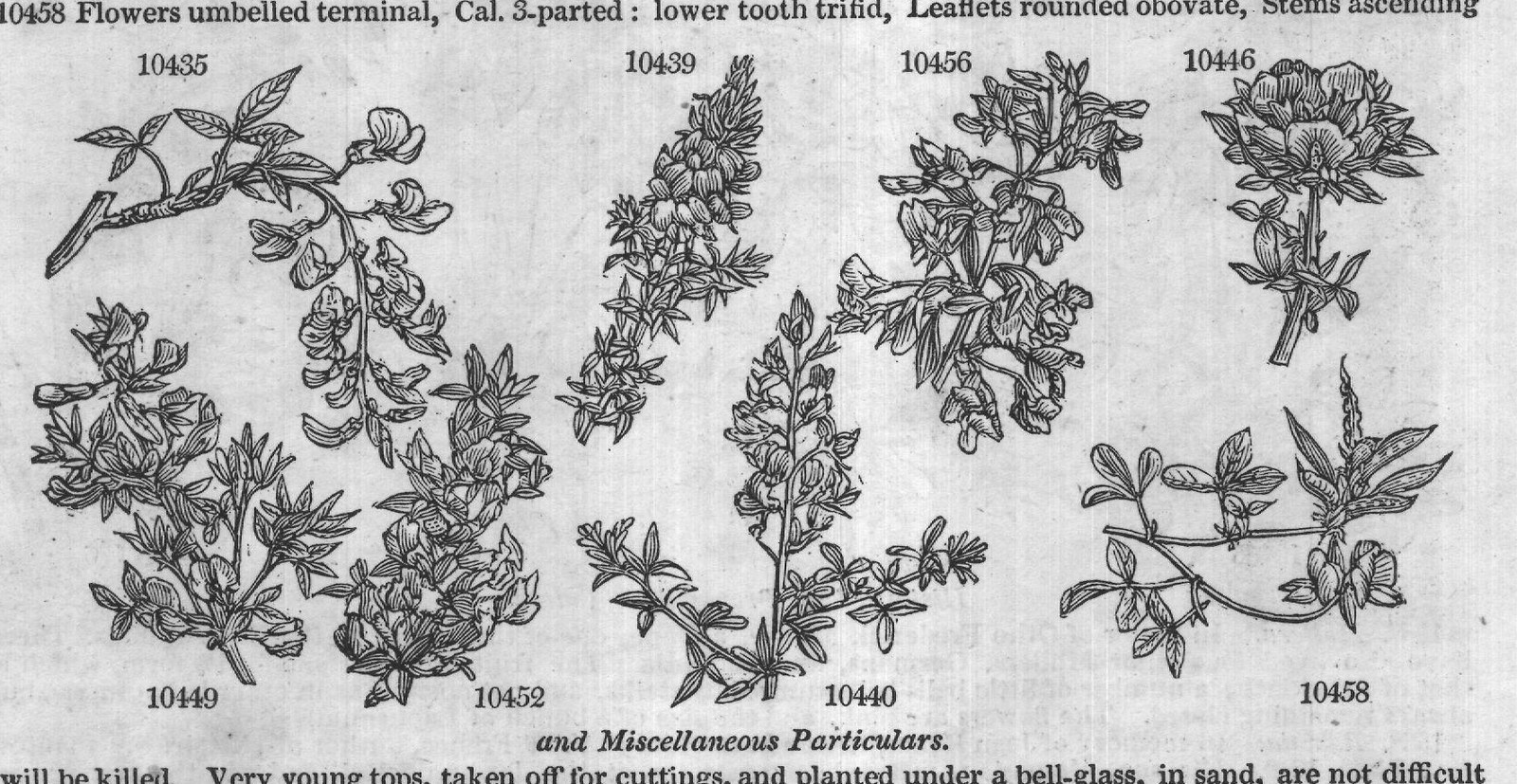
DIADELPHIA DECANDRIA. 10421 Pedunc. 2-fl. Seeds compressed, Leaflets entire 10422 Pedunc. about 2-fl. Pods smooth 4-seeded, Leaflets oblong truncate 10423 Pedunc. many-fl. Pods hairy 2-seeded, Leaflets lin. blunt 10424 Pedunc. 2-fl. awned, Pods smooth 2-seeded, Leaflets lin. lanceolate downy 10425 Pedunc. awned shorter than leaf, Leaflets obl. truncate smooth, Stipules hastate 10426 Pedunc. 1-fl. Seeds globose gibbous, Leaflets serrated 10427 Flowers capitate, Leaves lanceolate nerved smooth 10428 Flowers capitate: head erect, Leaves lanceolate smooth 10429 Flowers capitate, Leaves lanceolate downy 10430 Flowers capitate, Leaves ovate concave woolly beneath 10431 Flowers spiked hairy, Leaves lanceolate, and angular stem smooth 10432 Flowers fascicled, Leaves ovate villous downy 10433 Flowers racemose, Leaves obovate oblong smooth, Stem hairy 10434 Flowers somewhat spiked, Leaves ovate villous downy 10435 Racemes simple pendulous, Leaflets ovate oblong, Pods hairy 10436 Racemes simple pendulous, Leaflets ovate oblong rounded at base, Pods quite smooth 10437 Racemes lateral erect, Branches round spreading, Leaflets ovate downy 10438 Racemes terminal erect, Calyxes hairy: teeth minute, Leaflets ellipt. hairy 10439 Racemes terminal erect, Calyxes villous: segments falcate, Leafl. obovate oblong 10440 Racemes terminal erect, Calyxes and pods viscid, Leaflets oblong 10441 Racemes erect, Calyx with a triple bractea, Floral leaves sessile 10442 Racemes terminal 1-sided, Leaves pinnated hoary, Leaflets roundish elliptical 10443 Racemes axillary erect, Leaflets sublanceolate downy: the middle one in a long stalk 10444 Raceme term. 1-sided 4-fl. Leaflets obovate downy beneath, Calyxes deeply 3-parted 10445 Pedunc. aggregate subterminal, Calyxes hairy trifid, Leaflets obov. mucronate hairy beneath 10446 Flowers capitate, Branches straight round villous, Leaflets ovate ellipt. villous, Bract linear 10447 Fl. in term. umbels, Stems erect, Leaflets lanc. strigose pubescent 10448 Fl. umbelled term. Stems erect, Leaflets ellipt. smooth acute 10449 Fl. axillary solitary stalked, Stems procumbent, Leaflets obovate, Pods linear repand 10450 Fl. stalked sub-binate axillary, Stem decumbent, Leaflets obovate blunt 10451 Pedunc. sub-binate axillary, Stems diffuse-erect, Leaflets oblong lanceolate 10452 Flowers stalked lateral about 3 erect, Stem declinate branched, Leaflets obovate mucronate 10453 Flowers stalked axillary about 3, Calyxes campanulate, Leaflets obovate blunt hairy 10454 Flowers stalked lateral about 4, Stem erect, Branches long, Cal. tubular, Leaflets obovate 10455 Racemes term. erect, Leaflets obl. rhomboid blunt, Stipules rounded ovate oblique 10456 Flowers in lateral umbels, Stems erect, Leaves ellipt. erect silky beneath, Calyxes woolly 10457 Pedunc. about 3 term. Leaflets oblong lanceolate silky, Pods linear silky, Stems decumbent 10458 Flowers umbelled terminal, Cal. 3-parted: lower tooth trifid, Leaflets rounded obovate, Stems ascending 10435 10449 10452 10439 10440 10456 10446 10458 and Miscellaneous Particulars. will be killed. Very young tops, taken off for cuttings, and planted under a bell-glass, in sand, are not difficult to root. (Bot. Cult. 217.) 1566. Cytisus. Pliny says it was so called because found in Cythnus, one of the Cyclades. The Cytisus of the ancients is believed to have been our Medicago arborea. A genus of ornamental trees and shrubs, of which the Laburnums, Cytise des alpes, Fr., Bohnenbaum, Ger., are well known and universally admired examples. There are two species of Laburnum, which are so much alike, that in most nurseries they are confounded together, or only one in cultivation. C. alpinus is the tree Laburnum, whose timber (the false ebony of the French) is much prized by cabinet-makers and turners, for its hardness, beauty of grain, and durability. The tree is frequently sown in plantations infested with hares and rabbits, who will touch no other tree as long as a twig of laburnum remains. "Though eaten to the ground in winter," as Boutcher observes, "it will spring again next season, and thus afford a constant supply for these animals, so as to save the other trees till of a size to resist their attacks. The timber has been sold for upwards of half a sovereign per foot." It becomes most valuable in light loams and sandy soils.
C. wolgaricus and purpureus are very handsome shrubs; and make a fine appearance when grafted on stocks of laburnum five or six feet in height.
C. cajan (an alteration of the Malay name, Catjang), Pois d'Angola, Fr., is frequently planted in the West India Islands, chiefly in rows as a fence to the sugar plantations, and will thrive on barren land. The seed is much eaten by poor people and negroes, and is esteemed a wholesome pulse. In the island of Martinico even the better sort of people hold it in estimation, and prefer it to the European pea. The chief use of it in Jamaica is for feeding pigeons, whence its name. The branches, with the ripe seed and leaves, are given to feed hogs, horses, and other cattle, which grow very fat on them. (Sloane and Jacq. Obs.) Ss bracelet 오 or 20 1568. ROBI'NIA. W.
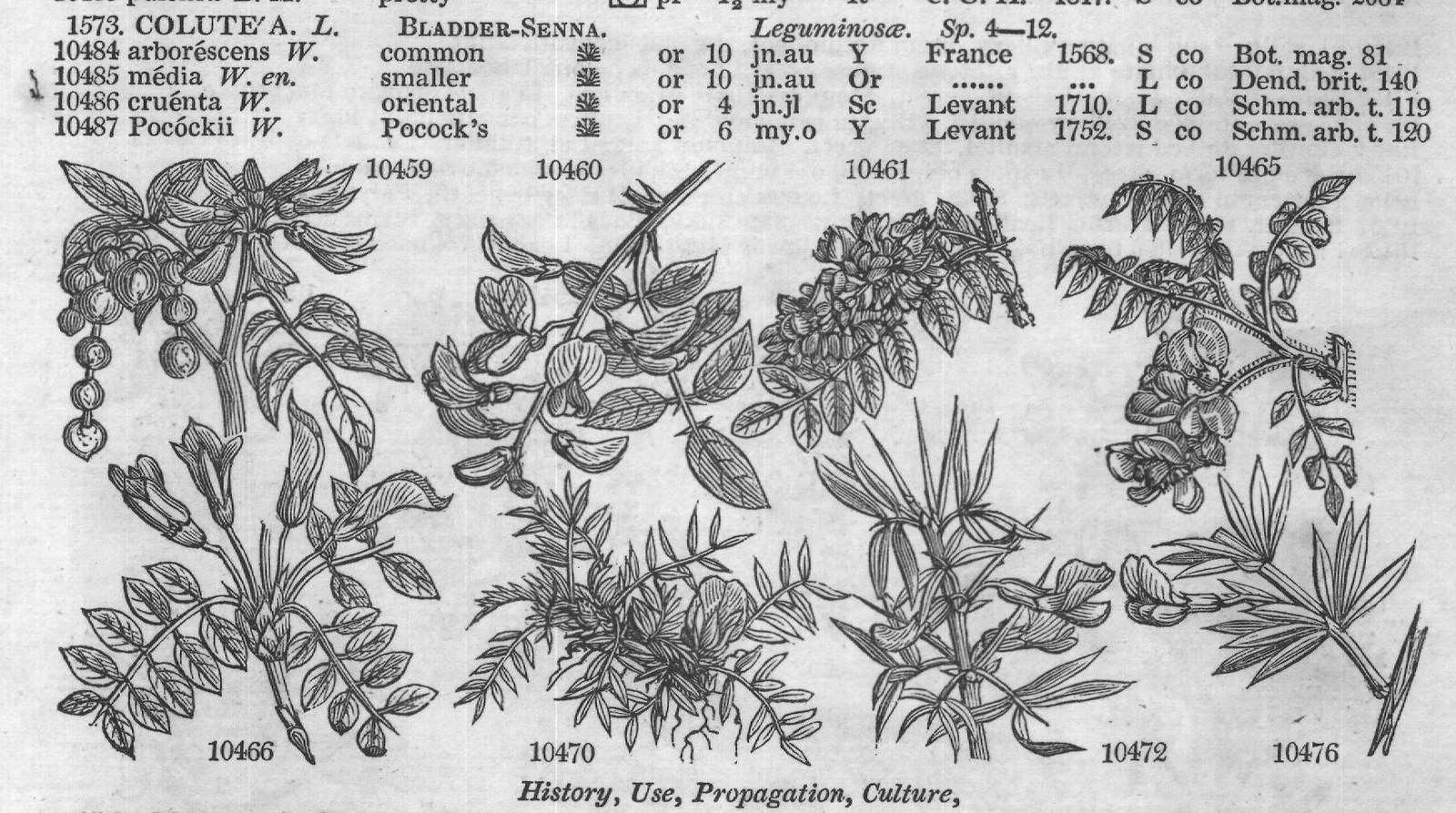
ROBINIA. 10460 Pseudacácia W. comm. Acacia ẞinérmis W. 10461 viscósa W. smooth large-lv. clammy 10462 violácea W.
Ash-leaved 10463 purpúrea Link. purple or 15 jl.au 数 or 6 10465 híspida W.
Rose-acacia ẞ rósea upright 1569. CARAGA'NA. Royen. SIBERIAN PEA-TREE.
DIADELPHIA DECANDRIA. 1567. MULLERA. W. MULLERA. 10459 monilifórmis W. 10464 guineen'sis W. en. Guinea Leguminosæ. Sp. 1.
Y Guiana 1792. C 1.p Leguminosæ. Sp. 6-10. ... tm 40 my.jn Pa.pu N. Amer. 1640. S s.1 tm 40 my.jn Pa.pu N. Amer.
S s.l tm 30 jn.au Pk N. Amer. 1797. G s.l or 12 W. Indies 1759. S p.l 1810. G co S. Leone 1822. C p.l ......
CLASS XVII.
Merian, sur. t.35 Schmid.ar.1.t.32