Home › B › Bot (Cab heterom llum B R variable)
Bot (Cab heterom llum B R variable)
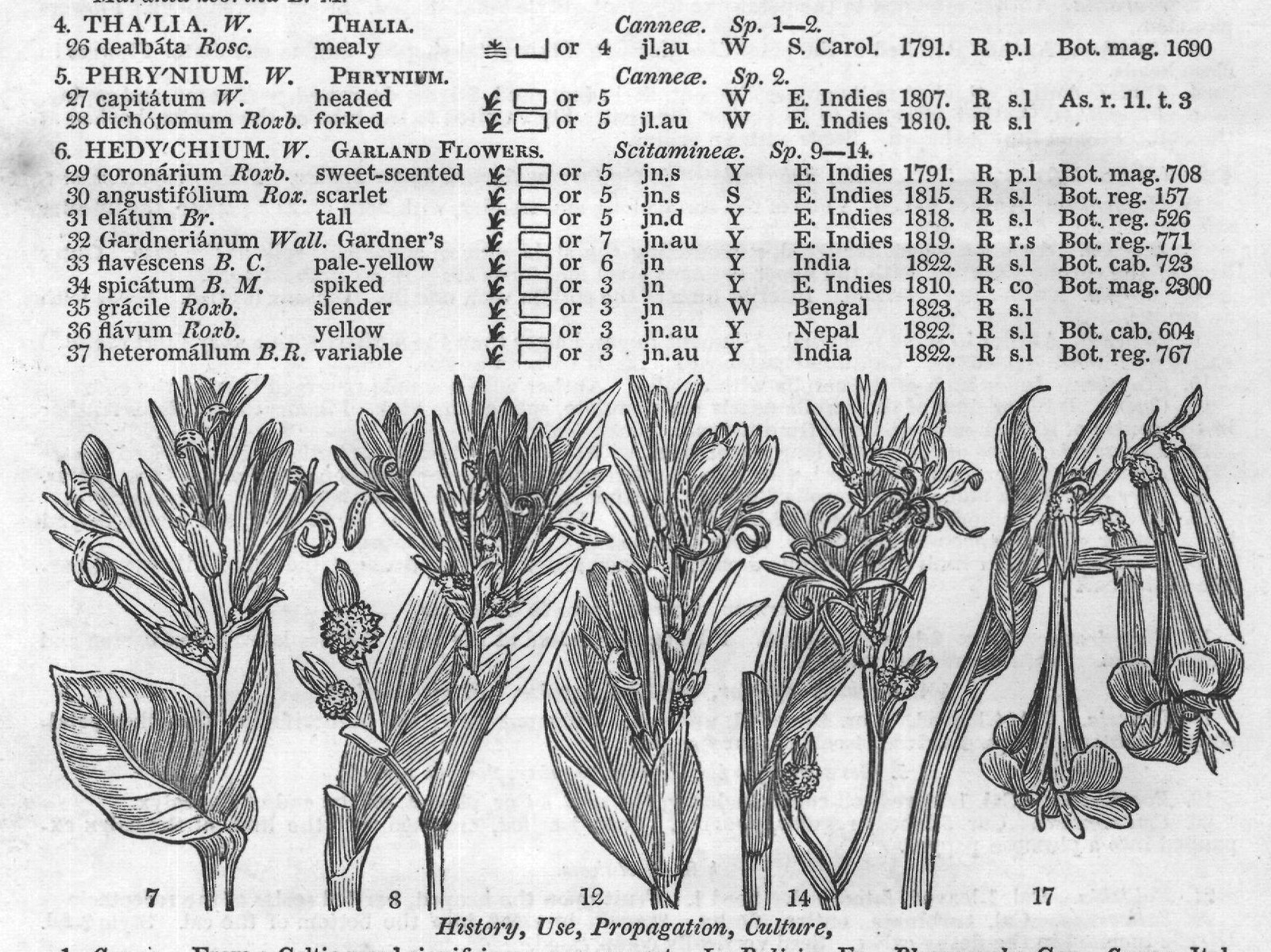
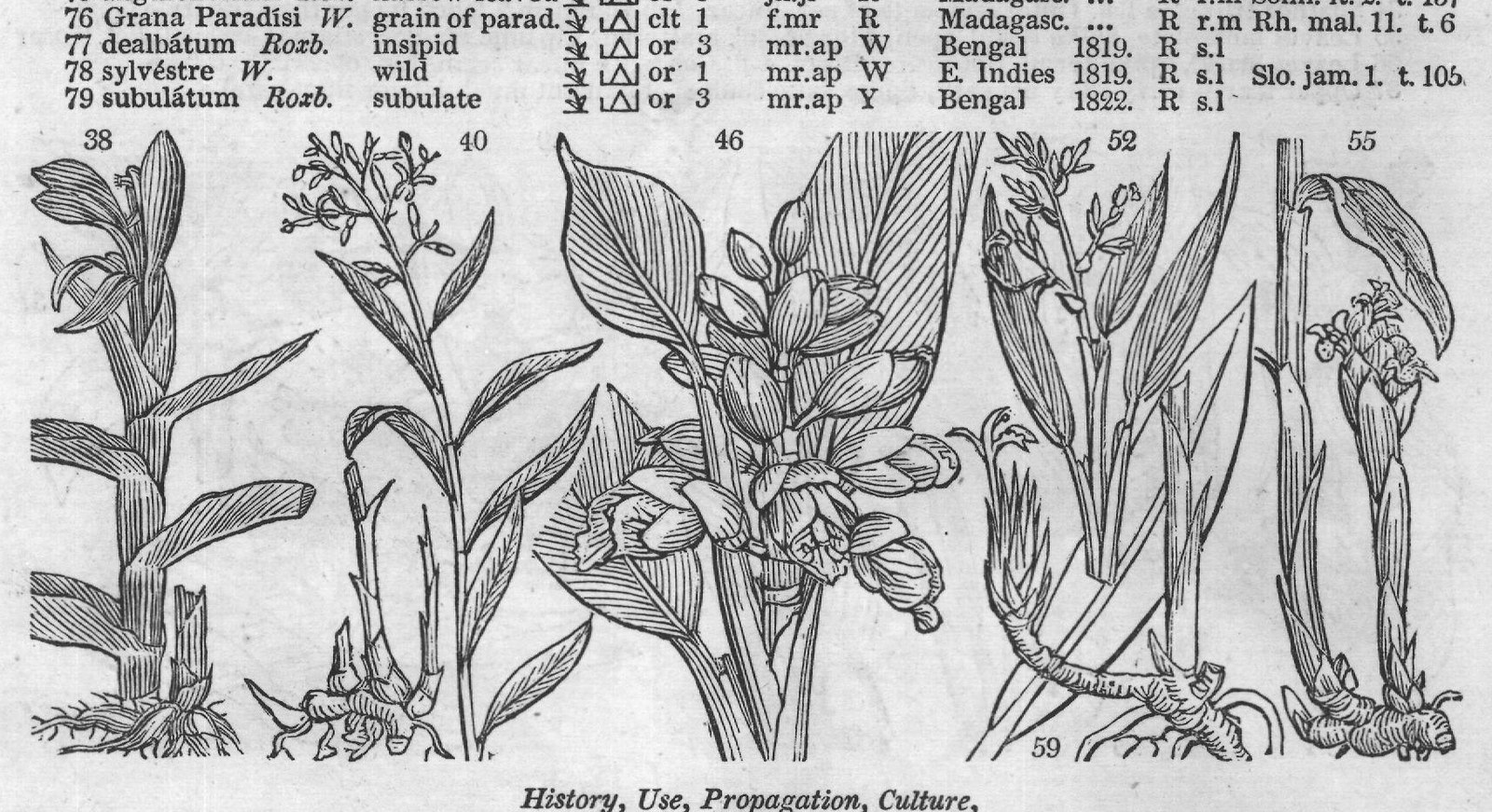
cab. 604 37 heteromállum B.R. variable or 3 jn.au Y India 1822. Rs.1 Bot. reg. 767 7 8 12 17 14 History, Use, Propagation, Culture, 1. Canna. From a Celtic word signifying a cane or mat. Le Balisier, Fr. Blumenrohr, Ger. Canna, Ital. The first three species are found wild within the tropics on all the continents, and chiefly in moist woods, or spongy woody wastes: in America and the Brazils, they are known by the name of wild plantain, and their leaves are used as envelopes for many objects of commerce; from which circumstance, the French name of the plant (balisier) is said to have arisen; balija being Spanish for an envelope. Clusius says he saw the C. lutea flowering by house-sides in Spain and Portugal, and that the inhabitants there use the seed for making their rosaries: in the East Indies the seeds are sometimes used as shot. The roots of C. edulis are eaten, dressed in various ways, in Peru. The seeds of most of the species are round, hard, black, shining, heavy, and about one sixteenth of an inch diameter. These grow readily, or the plants may be propagated by dividing the roots; Miller recommends rich garden earth; Sweet (Bot. Cultiv. p. 34.) light rich soil for all the species. Most of these, if planted in a warm border early in summer, will flower there during the season. 2. Maranta. So named from Bartholomeo Maranti, a Venetian physician, who wrote three books chiefly to illustrate Diosc.; died 1554. Galangre, Fr. Galgant, Ger. The M. arundinacea is called Indian arrow-root, because its thick fleshy root was thought to extract the poison from wounds inflicted by the poisoned arrows of the Indians. In the West Indies it is used as an alexipharmic, to resist the force of poisons; کہ ORDER I.
MONANDRIA MONOGYNIA.
Essential specific Character. 1 Inner limb of the corolla 3-fid, Seg. ovate equal sprdg. with long claws, Lip bifid, rev. Leaves ovate lanc. 2 Inner limb of the corolla trifid, Segments lanceolate acuminate straight 3 Inner limb of the corolla trifid, Segments straight emarginate 4 Inner limb of the corolla bifid 5 Peduncle short inclosed in the upper leaf, Inner limb of the corolla trifid, Segments ovate lanceolate suberect, Lip erect spreading entire 6 Peduncles elong. Inner limb of corolla 3fid, Seg. lanceol. spathul. reflexed spreading, Lip oblong entire 7 Segments of cor. 2 entire ovate unequal, Lip bifid bent down 8 Segments of cor. 3 broad emarginate and crenate: the claws long, Lip. 2-fid bent down 9 Leaves of cal. lanceolate acute, Cor. 5 parted, Leaves ovate-obl. acute at both ends cordate 10 Leaves of cal. oblong obtuse, Cor. 6 parted, Leaves ovate-obl. acute at both ends cordate 11 Leaves sessile ovate with the sheaths and nerves very red, Inner limb 4 parted 12 Leaves smooth and stems colored at the base, Roots tuberous and large, Middle seg. of corolla very short 13 Flowers sessile in pairs, Segments of cor. 2 erect bifid, Lip spotted revolute 14 Flowers on stalks: outer segments reflexed, inner 3 erect, Leaves lanceolate pointed at each end 15 Inner limb of the corolla trifid, Segments flaccid 16 Inner limb of the corolla trifid, Segments ovate straight, Lip three-lobed fringea 17 Stem and Leaves beneath downy, sheaths curled and colored at the edge, Flowers cernuous 18 Culm branched herbaceous, Leaves ovate lanceolate somewhat hairy underneath 19 Leaves ellipt. oblique at end, Spikes elong. in fasc. Bract. erect, 2-fid. imbricate acute pubesc. 20 Culm branched knotty ovate smooth, Spikes terminal subternate, Bracteas colored 21 Stem knotty, Leaves lanc. narrow, Panicle wavy, Inner braits colored, Calyx ovate 22 Stem shrubby branching, Leaves ovate smooth 23 Leaves oblong lanc. pubesc. Fl. stalks 2-fid. Germ very hairy 24 Stemless, Scape naked, Spikes comose, Bracteas reflexed 25 Flowers in dense heads shorter than the leaves which are striped with purple 26 Calyx two-flowered, Culm reedy powdered, Leaves ovate revolute at the apex 27 Stemless, Leaves radical 28 Shrubby, dichotomous, Leaves cordate 29 Leaves lanceolate, Spikes compact imbricated, Segments of the cleft lip of the corolla lunulate 30 Leaves linear lanc. Spikes open, Fasc. of flowers subtern. Seg. of cleft lip obl. the other 5 segs. of cor. lin. 31 Leaves obl. lanc. smooth, Spikes loose, Fascic. tern. 3 fid. Inner segs. of the cor. linear-cuneate, Lip bifid 32 Spike many-fl. loose, Fascicles many-fl. distant, Lip obovate bifid, Filament colored longer than corolla 33 Leaves lanceolate, Spike loose ovate, Petals linear, Lip ovate 2-lob. Fil. the same length as petals 34 Spathes truncate 1-fl. Outer segments of cor. linear, Lip roundish 2-lobed longer than the style 35 Leaves lanceolate, Spike terml. open, Flowers sol. scattered, Lip bifid sessile: stigm. -lanceol. Pet. linear 36 Leaves broad, Spike terml. imbricate, Bract. 4-fl. Cor. with linear segm. Lip. obcordate retuse 37 Upper leaves wavy silky beneath, Spike loose conical, Filament much longer than corolla 21 18 25 26 27 29 30 37 and Miscellaneous Particulars. washed, pounded, and blanched, it makes a fine powder and starch, and may be used as food, resembling in many respects the salep. A light loamy soil suits all the species, which, though tender, are readily propagated by dividing the root. 3. Calathea. So named by Meyer, probably from the cup-like stigma of the genus. It is much admired on account of its singularly striped foliage, to which the specific name alludes, and its ovate spike of purple flow. ers, about the size of a large pine.cone. 4. Thalia. In memory of John Thalius, a German physician, at Nordhuys, author of Plantæ Hercynæ, 1588. An aquatic, and if planted two or three feet under water, will survive our winters, in the open air. It flowers beautifully. 5. Phrynium. Φρύviov, a plant which grows in marshes, the habitation of frogs, from φρuvoς, a frog. The leaves are used in Malabar and China, for wrapping up cakes in the oven; before expansion they infuse them in spirit of rice or sugar diluted with three times its quantity of water, to make vinegar. Loureiro. 6. Hedychium. From a Greek word signifying sweet, from the grateful odour it emits. This beautiful genus requires a light rich soil, and large pots to make the plants flower freely. H. angustifolium deserves a place in every collection.
B2 7. ROSCOEA. Sm. 38 purpúrea Sm.
MONANDRIA MONOGYNIA.
CLASS I.
ROSCOEA.
Scitamineæ. Sp. 1-5. purple or 1 P Nepal 8. ALPINIA. W.
ALPINIA.
Scitamineæ. Sp. 13-19. 39 comósa Jacq. close-spiked or 1 40 Galánga W. loose-flowered clt 6 oc.f W.Y E. Indies ... 41 racemósa Ros. clustered or 5 jl.s W 42 occidentális Sw. occidental or 6 W 1820. R s.l Ex. b. t. 108 Caraccas 1752. R s.l Rs.1 W.Indies 1752. Rs.1 Jamaica 1793. R s.l Ja. ic. rar. v. 3 Ru. am. 5. t. 63 Pl. ic. 11. t. 20 43 nútans Ros. nodding or 13 ap.jn Pk 44 cérnua B.M. drooping or 6 45 calcaráta Ros. upright or 3 S ap.jn Pk W E. Indies 1792. R s.l E. Indies 1804. Rs.1 E. Indies 1800. R s.l Ex. b. 2. t. 106