Home › B › Bot (Mag Dend brit Schm arb t Poc)
Bot (Mag Dend brit Schm arb t Poc)
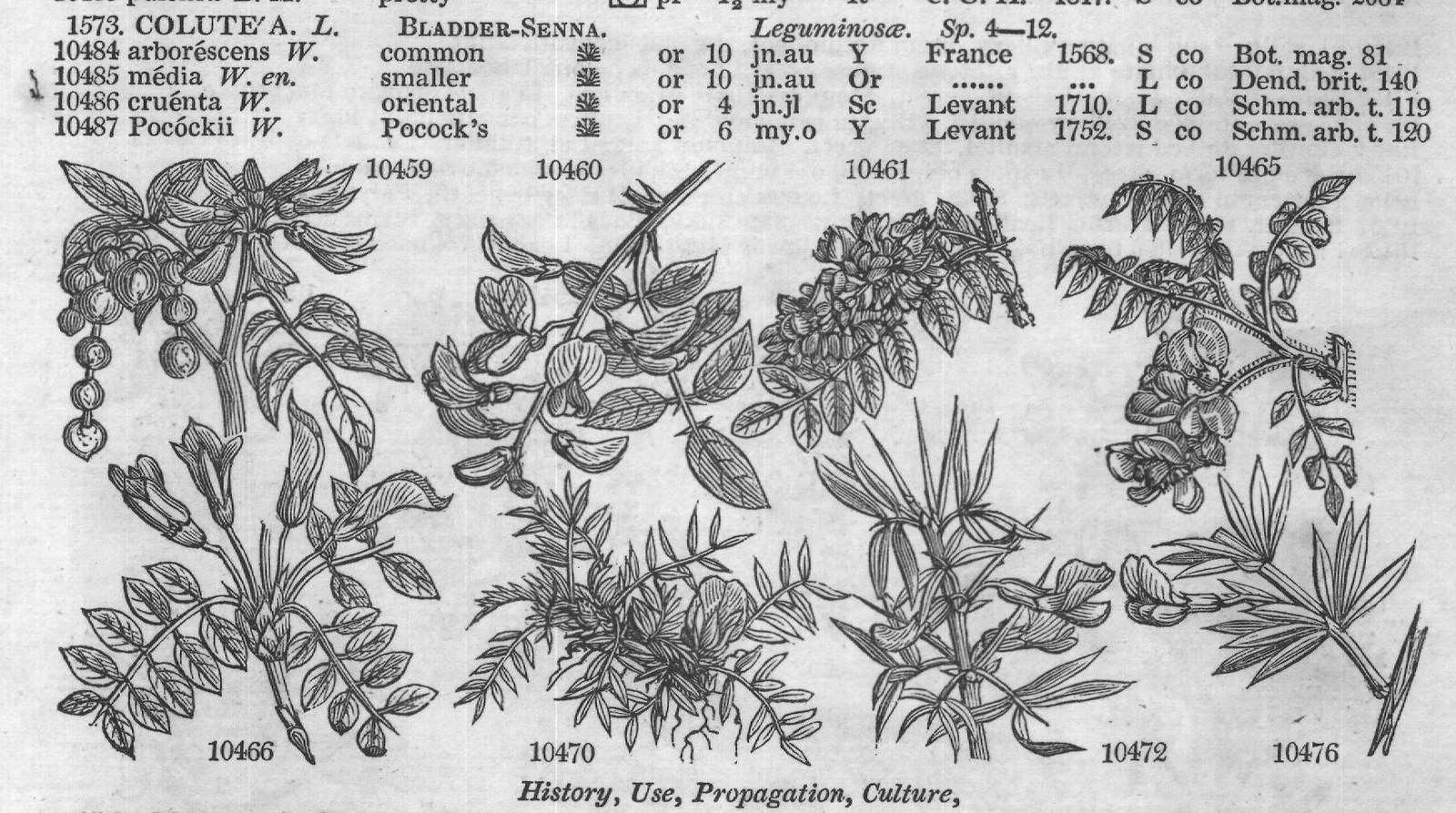
mag. 81 Dend. brit. 140 Schm. arb. t. 119 10487 Pocóckii W.
Pocock's or 6 my.o Y Levant 1752. S co Schm. arb. t. 120 10459 10460 10461 10465 10466 10470 History, Use, Propagation, Culture, 10472 10476 1567. Mullera. In honor of Otho Frederick Müller, a Dane, one of the editors of the Flora Danica. There have also lived four other Müllers, Germans, and botanists. The fruit is remarkable for its form, which is that of a necklace; a number of little balls being united by stalks, and not opening as in other leguminosæ, but always remaining closed. The flowers are pink, and the size of a bunch of Laburnum. 1568. Robinia. In memory of Jean Robin, herbarist to Henry IV. of France, author of Histoire des Plantes, &c., Paris, 1620. His son, Vespasian, was subdemonstrator at the Jardin de Roi, and was the first person who cultivated the R. pseudacacia in Europe.
R. pseudacacia is a thorny fast-growing tree, of middling stature, of no great beauty as a tree, but ornamental when young, and very well adapted for copse-wood and rough timber. The leaves come out late in spring, and fall off early in autumn, like those of the ash. The timber is much valued in North America, and said to be superior to that of the laburnum; "being close-grained, hard, and finely veined; and in America more valued by the cabinet-maker than any other native timber whatever. Pursh, in his Flora, asserts, that being nearly incorruptible, it is equally useful for posts and gates. We are informed by a friend, that gateposts of this timber, on a property near Baltimore, have remained fresh for nearly a century. The finest pinnated leaves, and pendulous white odorous flowers, add greatly to its beauty. Its value is scarcely known in this country." (Caled. Mem. ii. 414.) It prefers a deep sandy soil, and rather sheltered situation; being very apt to throw up suckers from the running roots, and as it stoles freely, it seems peculiarly calculated for coppice-woods. Beatson (Com. to Board of Agr.) has cultivated it in this way to great advantage. In North America the use of the locust-tree has hitherto been confined to trenails, on account of its scarcity, but were it as plentiful as oak, it would be applied for more purposes by the shipwright, such as knees, floortimbers, and foot-hooks, being much superior to oak for its strength and duration, and, from the tree spreading into branches, affords full as large a proportion of crooks or compass timber as oak. A cubic foot of acacia, in a dry state, weighs from 48 to 53 pounds avoirdupois. If we compare its toughness in an unseasoned condition with that of oak, it will not be more than 8-100 less. Its stiffness is equal to 99-100 of oak; and its strength nearly 96-100; but were it properly seasoned, it might, possibly, be found much superior to oak in strength, toughness, and stiffness. A piece of unseasoned acacia, two feet six inches long, and an inch square in the vertical section, broke when loaded with a weight of 247 pounds avoirdupois. Its medium cohesive force is about 11,500 pounds. (Dict. of Archi.) ORDER IV. 10459 The only species DIADELPHIA DECANDRIA. 10460 Racemes with 1-fl. pedicels, Leaves pinnated with an odd one, Stipules spiny, Pods smooth 10461 Racemes with 1-fl. pedicels, Leaves pinnated with an odd one, Branches and pods viscid with glands 10462 Racemes with 2-fl. pedicels, Cal. truncate, Leaves pinnated with an odd one, Stem unarmed 10463 Petioles somewhat spiny, Leaflets lanceolate mucronate downy, downy, Pedic. 1-flowered 10464 Racemes axillary few-flowered, Calyxes and branchlets finely bristly 10465 Racemes axillary, Leaves pinnate with an odd one, Stem hispid 10466 Pedunc. simple several, Leaves in 4 pairs, Petioles unarmed, Pods cylindrical 10467 Leaves about 4 pair; leaflets obcordate, Peduncles twin shorter than flower 10468 Pedunc. simple, Leaves 4 stalked hoary terminated by a weak spine, Pods downy 10469 Pedunc. simple solitary, Leaves in about 8 pairs, Stipules spiny, Pods compressed 10470 Pedunc. simple, Leaves in many pairs downy, Petioles filiform spiny, Branches villous 10471 Pedunc. simple, Leaves in 2 pairs, Leafl. obl. lanc. silky, Stipules and petioles spiny 10472 Pedunc. simple, Leaves in 4 pairs, Leafl. cuneate smooth, Stipules and petioles spiny 10473 Pedunc. 3 -fl. Leaves in 2 pairs silky, Petioles spiny persistent, Pods bladdery 10474 Pedunc. simple, Leaves in 2 pairs, Leaflets obovate shining, Stipules and petioles spiny 10475 Pedunc. simple, Leaves about 4 somewhat petiolated terminated by a weak spine 10476 Pedunc. simple, Leaves 4 sessile 10477 Stalk of pod longer than persistent filaments 10478 Stalk of pod shorter than persistent filaments 10479 Leaflets obl. blunt hoary beneath, Stem shrubby, Branches silky with down 10480 Leaflets linear emarginate smooth, Stem weak, Raceme axillary 10481 Leaflets linear emarginate hairy, Cal. without bractes with black hairs 10482 Leafl. obl. downy, Stem erect, Racemes terminal 10483 Leaflets in 7 pairs ovate acute smoothish, Racemes axillary subcapitate 1-sided 10484 Leaflets ellipt. retuse, Prominences of the standard short 10485 Leaflets obcordate glaucous, Pedunc. about 6-flowered, Pods closed at end 10486 Leafl. obovate emarginate glauc. Prom. of standard blunt very small, Pods open at end 10487 Leafl. roundish ellipt. very blunt mucronate, Prom. of standard long ascending, Stem shrubby 10477 10478 10479 10481 10485 10483 and Miscellaneous Particulars. 10484 R. hispida is a very handsome shrub, but it requires a sheltered situation, otherwise the branches are very liable to be shattered or blown off by high winds. In young trees grafted above ground, the fracture commonly takes place at the graft, so that a good preventative is to graft on the root a little below the surface. Grafts in this manner are also much more certain of success. R. viscosa resembles, in its leaves and flowers, the common acacia; but is, altogether, a much handsomer tree. 1569. Caragana. This genus has been confounded by Linnæus and his followers with Robinia. The name is derived from the appellation of the most common species in Tartary, where it is called among the Moguls, Carachaná. Altagana, the name of another species, is in like manner a slight alteration of the Tartar name Aldachaná.
C. spinosa, on account of the length and toughness of the branches, and its large stout thorns, is admirably adapted to form impenetrable hedges, and is sufficiently hardy to bear our climate. About Pekin, they stick the bushes in clay on the tops of their walls, to prevent persons from getting or looking over them. (Pallas.) C. Halodendron is a handsome shrub, and grows in Siberia on dry naked salt-fields, and it is probably from the want of this principle in our garden soils, that it so seldom flowers here. C. pygmæa is a weak low shrub, with a shining yellow bark, with wood of a deep bay, almost as hard as horn. C. frutescens is used by the Tartars for the same purposes as osiers, for which its tough shoots render it proper.
C. jubata is remrakable plant, its shoots always remaining covered by the persistent brown stipulæ of the fallen leaves. It is extremely difficult to propagate, and is rarely even seen in this country. The most successful cultivators of it are Messrs. Loddiges and Son. 1570. Swainsonia. Named after the late Mr. Isaac Swainson, who had a botanic garden at Twickenham. 1571. Sutherlandia. In honor of Mr. James Sutherland, who published, in 1683, an 8vo. catalogue of the Physic Garden at Edinburgh. This and the former genus seed freely, and may also be readily increased by cuttings. 1572. Lessertia. Named by Decandolle in honor of M. Stephen Delessert, to whose mother Rousseau's Letters on Botany were addressed. 1573. Colutea. An ancient name of a bush with sweet-scented flowers; probably similar to the genus now Ss 2 DIADELPHIA DECANDRIA. 1574. GLYCYRRHIZA. W. GLYCYRRHIZA.
CLASS XVII.
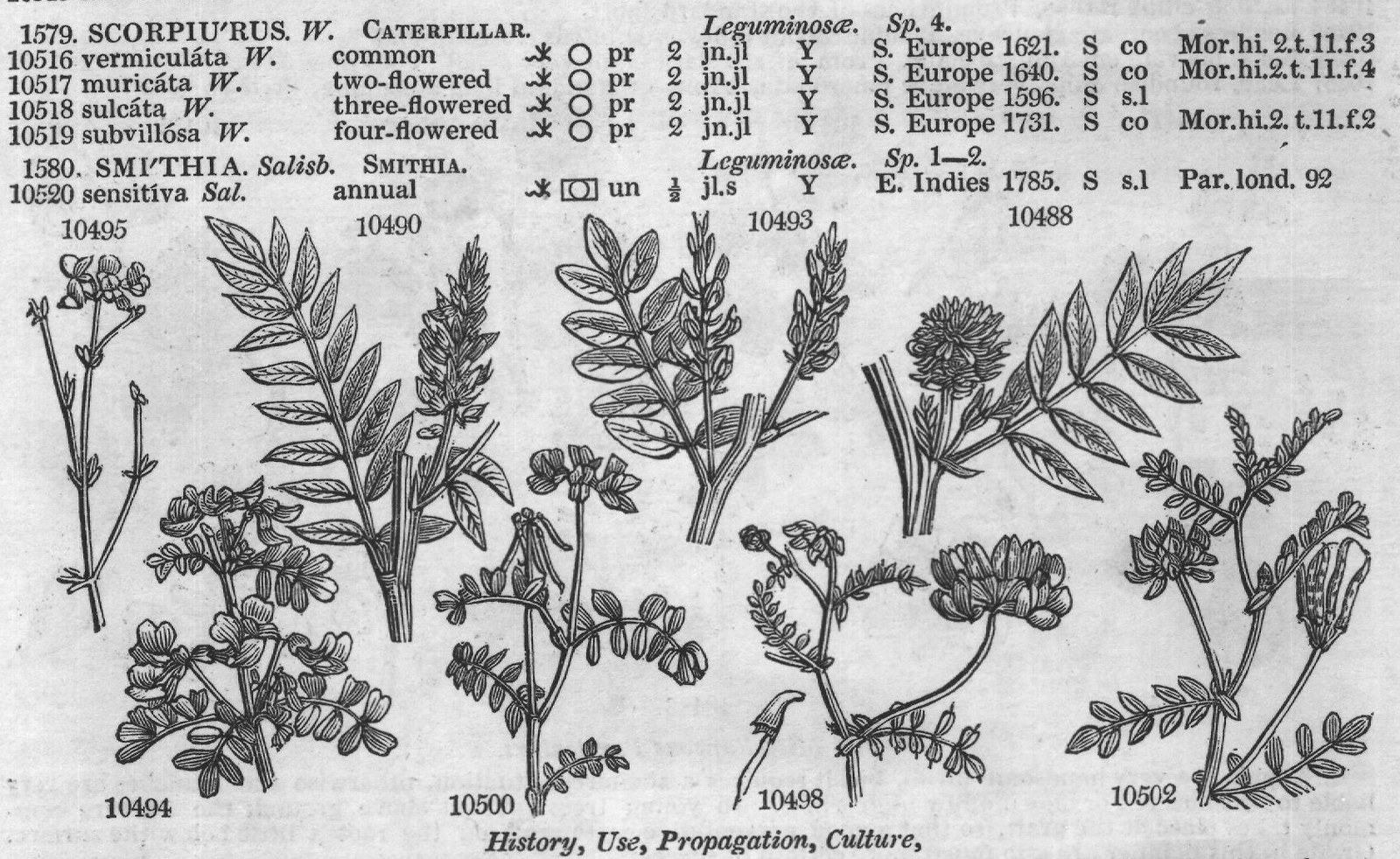
Leguminosæ. Sp. 5-6. 10488 echináta W. prickly-headed or 3 jn.s Pa Italy 1596. R s.p 10489 glandulífera W. glandulous or 3 jn.au Pa 10490 lepidóta Ph. silky-leaved or 3 jl.au Pa Hungary 1805. R 1.p Missouri 1811. R s.l rough ✓ clt hairy clt Scorpion Senna or Rush or nine-leaved or 10491 aspérrima W. 10492 hirsúta W. 1575. LIQUORI'TIA. Mönch. LIQUORICE. 10493 officinalis Mönch. common 1576. CORONIL/LA. H. K. CORONILLA. 10494 E'merus W. 10495 júncea W. 10496 valentína W. clt 4 jl.au L.B S. Europe 1562. R r.m Lam. ill.t.625.f.2 2 jl.au L.B Siberia 1795. R s.p