Home › B › Bot (Mag pr au Pk Spain O s History)
Bot (Mag pr au Pk Spain O s History)
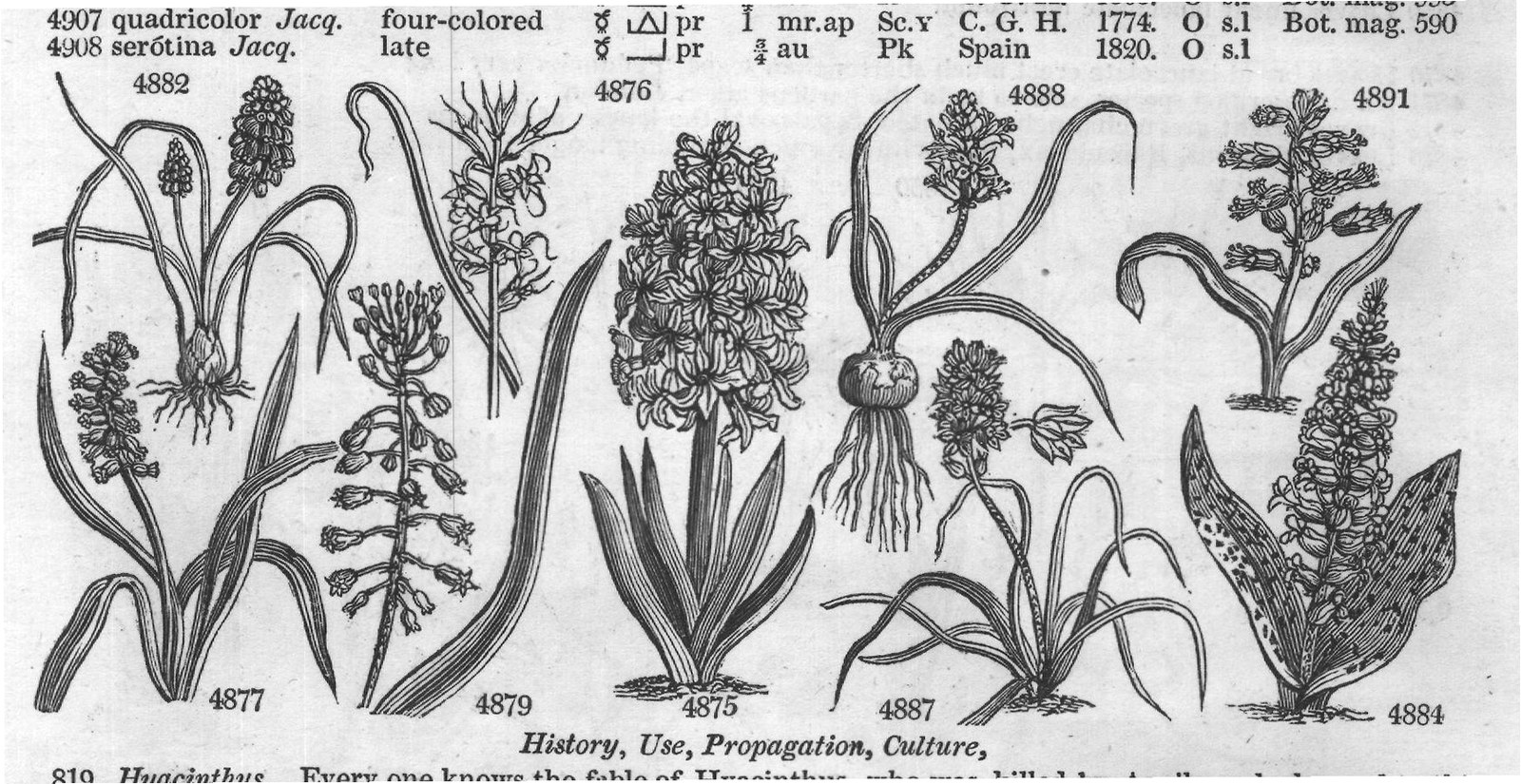
mag. 590 pr au Pk Spain 1820. O s.1 4882 4876 4888 4891 4877 4879 4875 4887 4884 History, Use, Propagation, Culture, 819. Hyacinthus. Every one knows the fable of Hyacinthus, who was killed by Apollo and changed to this flower. Bochart, however, remarking that the ancients applied the name to a red flower, concludes that the . Bochart, however, remarking that the ancients applied the name to a red flower, concludes that the Arabic yagdut, which signifies red, has something to do with the name. A conjecture certainly sufficiently learned, but less plausible.
H. orientalis is the origin of one of our finest florist's flowers, and, like the tulip and narcissus, of a considerable commerce to the Dutch. It is a native of the East, and abundant about Aleppo and Bagdat, where it flowersin February. It seems to have been first cultivated as a flower by the Dutch; but when is unknown. Most probably in the beginning of the sixteenth century, soon after the revival of commerce in the west of Europe, when the merchants of Holland traded to the eastern shores of the Mediterranean and the Archipelago. About the end of the sixteenth century there were seven or eight varieties known in England. In 1620, Swertius, in his Florilegium, figured forty varieties; Miller says the Haarlem florists in his time (say 1720) had above 2000 varieties, and though the passion for this flower has greatly declined, they have still upwards of half that number . In England three or four hundred sorts are annually imported from the Dutch florists by the seedsmen.
A fine double hyacinth is characterized by strength and enlargement of all the parts, and by bright distinct colors. The fundamental varieties are double, semidouble, single, red, white, purple, blue, and yellow, in mary different shades and variegations. A variety degenerates in a few years; but some have existed undeteriorated upwards of a century. Varieties are raised from seed, and flower the fourth or fifth year: their names are after the growers or their patrons, favorite friends, public characters, or the celebrated names of history and antiquity.
The seeds of the hyacinth are sown in October, after they have ripened, or in the following March. They remain three years with no other culture than covering with a little earth in autumn, but the fourth season they are transplanted into beds, where they remain two or three years longer till all the bulbs have flowered. The soil is essentially a very sandy loam and vegetable mould; and if in forming the beds this soil can be made to the depth of two feet, and at the bottom of the bed a layer of six or nine inches of cow-dung :
ORDER I.
HEXANDRIA MONOGYNIA. 4874 Flowers campanulate half 6-cleft cylindrical at base 4875 Flowers funnel-shaped half 6-cleft ventricose at base 4876 Leaves linear channelled longer than scape 4877 Flowers cylindrical ovate uniform horizontal subsessile 4878 Flowers camp. cylindrical half 6-cleft, Pedunc. in fruit very long and horizontal 4879 Flowers cylindrical angular on long stalks, the upper sterile on very long stalks 4880 Flowers campan. cylindrical, Limb erect shorter than tube, Leaves lin. lanc. erect 4881 Flowers globose uniform: the lower remote, Leaves linear upright channelled 4882 Flowers ovate uniform clustered: the upper sessile, Leaves lax dependent linear 4883 Flowers campanulate sessile, Inner sepals longer spreading obtuse, Leaves lin. lanc. smooth 4884 Flowers campanulate sessile, Inner sepals longer spreading obtuse, Lvs. obl. lanc. with cartila. cren. edge 4885 Flowers campanulate sessile, Inner sepals longer spreading obt. Scape ang. at end short. than lin. obl. lvs. 4886 Fl. campanulate sessile, Inner sepals longer spreading emarg. Lvs. lin. chann. lax twice as long as scape 4887 Fl. campan. sessile, Inner sepals longer spreading obov. obt. Lvs. lin. channelled lax longer than scape 4888 Fl. camp. cylind. on short stalks erect, Inner sep. long lanc. obt. erect, Lvs. lin. chann. lax long. than scape lax long. than scape 4889 Flowers camp. stalked, Inner sepals longer obovate spreading, Lvs. lanc. channelled shorter than scape 4890 Fl. camp. stalked horizontal, Inner sep. longer obt. Stam. longer than fl. Lvs. lanc. twice as short as scape as short as scape 4891 Leaves two, Scape not longer than leaves, Fl. short horizontal, Stamens long declinate 4892 Leaves two oblong, Raceme compact, Flowers short campanulate nearly as long as stamens 4893 Leaves three lanceolate blistered shorter than scape, Flowers campanulate erect 4894 Flowers camp. on short stalks, Inner sep. long. obtuse, Scape 3 cornered reclinate, Leaves blistered 4895 Fl. camp. stalked, Inner sep. long obt. revol. Stam. longer than fl. Scape angular at end, Leaves blistered angular at end, Leaves blistered 4896 Leaves two oval-edged, Flower erect conical shorter than spreading stamens 4897 Fl. camp. flat at base length of stalk, Inner sep. long. obt. Stam. longer than fl. Scape ang. at end, Lvs. obl. 4898 Leaves lanceolate erect unequal: the larger cucullate at base, Scape few-flowered shorter than leaves 4899 Lvs. lin. lanc. two-spreading, Flowers whole-colored with the outer sepals nearly as long as the inner 4900 Flowers cylindrical length of stalks, Inner sepals longer obtuse unequal, Leaf one lin. lanceol. 4901 Lvs. two lin. lanc. spreading, Fl. erect sessile clust. ovate with inner sep. much the narrowest and longest 4902 Flowers cylind. stalked, Sepals linear obtuse equal, Scape angular at end, Leaves lanc. deflexed 4903 Flowers cylind. stalked pendulous, Inner sepals longer emarginate, Leaves lanceolate 4904 Flowers cylind. stalked pendulous, Inner sepals longer emarginate spreading, Leaves obl. spreading 4905 Leaves twin obl. not spotted, Scape erect not spotted, Flowers cylindrical pendulous 4906 Flowers cylind. on short stalks pendulous, Inner sepals longest, Leaves oblong 4907 Leaves twin lin. lanc. spotted, Scape erect, Flowers pendulous with the inner limb of sepals spreading 4908 Flowers camp. stalked, Outer sepals long spreading: inner connate, Leaves long channelled 4899 4894 4885 4896 4906 4904 4901 4907 and Miscellaneous Particulars. deposited, the plants will thrive the better. The season of planting is from the middle of October to the middle of November. The bed should be protected from heavy rains and severe frosts by the usual means ; and about the beginning of April, when the flowers begin to open, an awning of canvass should be fixed over them, to exclude all extremes of weather, and the more brilliant moments of sunshine. In three weeks or a month after blooming the bulbs should be taken up, unless they are intended to remain for seed. They should be dried in the shade, or under a few inches of dry earth, kept dry, and afterwards cleaned and wrapped up in separate papers, or laid on open airy shelves till wanted for replanting. The hyacinth forces well, especially some of the blue sorts; it also does better than most bulbs when planted on water. 820. Zuccagnia. This plant was named in honor of Attili Zuccagni, superintendant of the garden at Florence. It is scarcely a different genus from Uropetalon. 821. Muscari. Something which smells of musk, called μoσχoς in Greek, muscus in Latin, misk in Arabic. (Forskahl.) M. comosum, ẞ monstrosum, is a most ornamental border flower. The bulb is large, ovate, and solid: the leaves narrow, a foot long, with obtuse points: the flower-stalks rise near a foot and a half high; they are naked at the bottom for about seven or eight inches, above which the panicles of flowers begin, and terminate the stalks. The flowers stand upon peduncles which are more than an inch long, each sustaining three, four, or five flowers, whose petals are cut into slender filaments like hairs; they are of a purplish blue color, and, having neither stamina nor germ, never produce seeds. The other species are very pretty hardy flowers.
M. racemosum was named starch hyacinth by William Curtis, from the smell of the flower. 822. Lachenalia. So named in honor of Wernerus de la Chenal, of Switzerland, author of some medical and botanical tracts printed at Basle. The numerous species of this genus were chiefly introduced from the Cape by Masson: they bear a strong general resemblance, and are yet individually different; they may be styled diminutive, but pretty; they grow readily in sand and peat, and may be forced or retarded so as to flower at almost any season. They must be very sparingly watered when not in a growing state. 823. PHOR'MIUM. W. FLAX-LILY.
Asphodeleæ. Sp. 1. 4909 tenax W.
Iris-leaved ec HEXANDRIA MONOGYNIA. 6 au G.w N. Zeal. 1788. R L.s.p Cook. it. v.2. t.96 CLASS VI. 824. CYANEL/LA. W.
CYANELLA.
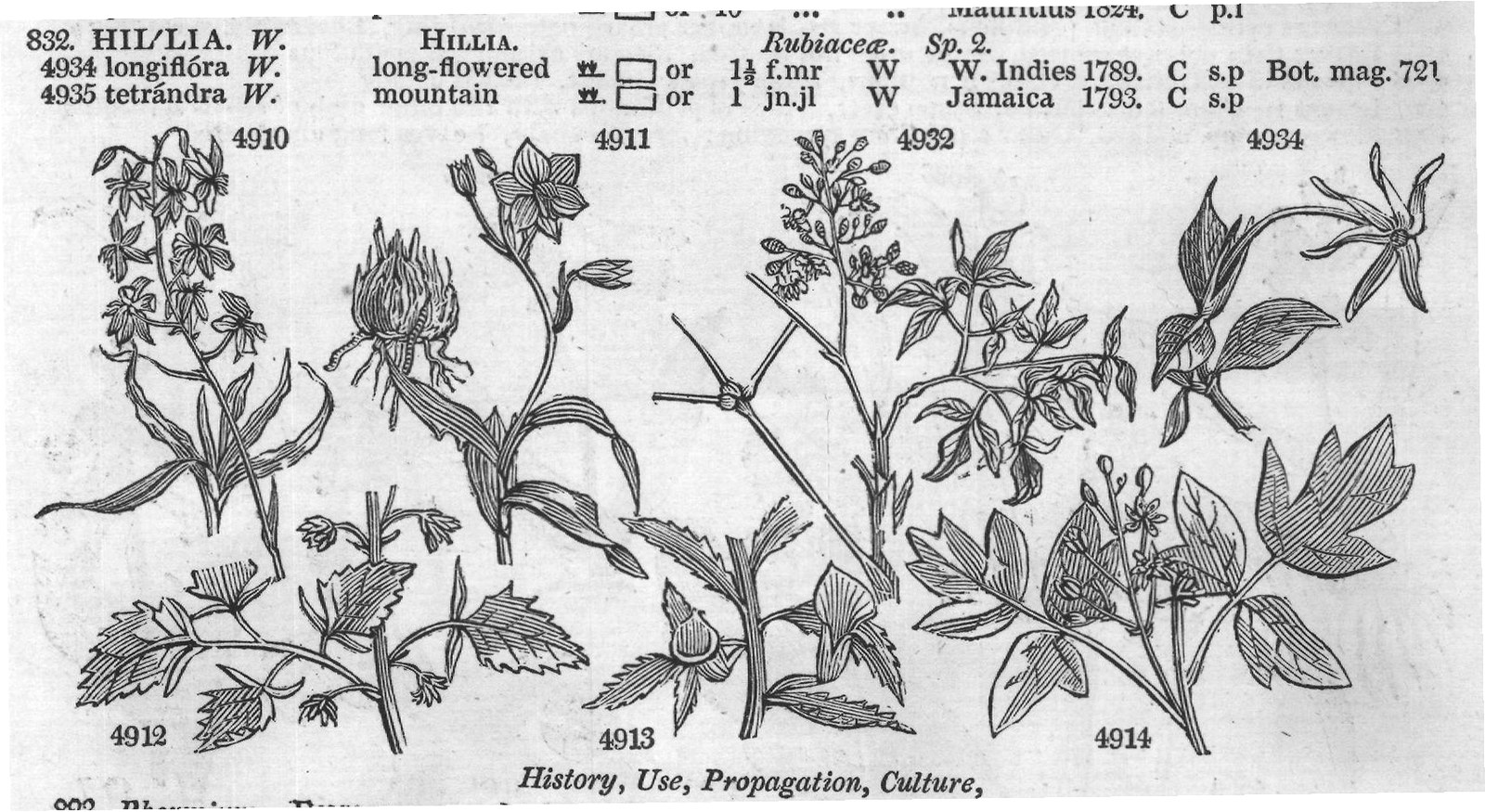
Asphodeleæ. Sp. 2-4. 4910 capénsis W. purple-flower. pr 1 jl.au B C. G. H. 1768. O s.p Bot. mag. 568 4911 lútea W. yellow-flowered pr 1 jl.au Y C. G. H. 1788. O s.p Bot. mag. 1252 825. LEON'TICE. W.
LEONTICE.
Berberideæ.
Sp. 2-3. 4912 chrysógonum W. oak-leaved cu 1 mr.jn Y Levant 1740.
D s.l.p M. his. 3. t.15. f.7 4913 Leontopétalon W. Lion's-leaf cu 1 ap.my Y Levant 1597.
D s.l.p M. his. 3. t. 15. f.6 826. CAULOPHYL/LUM. Mich. CAULOPHYLLUM. 4914 thalictroides Ph. Columbine-lvd. cu Berberideæ. Sp. 1-2. my Y.G N. Amer. 1755.
D s.p Mic. Am. 1. t. 21 827. DIPHYLLEIA. Mich. DIPHYLLEIA.
Berberideæ. Sp. 1. 4915 cymósa Mich. blue-berried pr my.jn W N. Amer. 1812.
Dl.p