Home › B › Bot (Mag verticill tum Desf)
Bot (Mag verticill tum Desf)
mag, 899 4593 verticillátum Desf. whorl-leaved 4595 pubéscens Ph. 4596 vulgáre Desf. 4598 latifólium Desf. 789. POLYGONA TUM. Desf. SOLOMON'S SEAL. 4594 canaliculátum Ph. channelled 4597 multiflórum Desf. common 4599 oppositifólium Lodd. opposite-leaved or 1 ap Smilaceæ.
Sp.7-8. or 1 my.jn W Scotland woods. R s.l Eng. bot. 128 or 1 jn W N. Amer. 1812. R s.l pubescent or 1 my.jn W N. Amer. 1812. R s.l Willd. ber. 45 angular or 2 my.jn W.G England moun. R s.l Eng. bot. 280 broad-leaved Aor A Aor 2 my.jn W Britain woods. R s.l Eng. bot. 279 1 my.jn W W Germany 1802. R s.l Nepal 1822. R s.1 Jac. aus. 3. t. 232 Hook. ex. fl. 125 4572 4573 4576 4580 4577 4574 4569 4582 History, Use, Propagation, Culture, 782. Erythronium. From ερuθρoς, red, in allusion to the color of the flower and leaves. Beautiful little vernal bulbs, the favorites of gardeners, from the cottager's border to the nobleman's flower garden. The E. , the favorites of gardeners, from the cottager's border to the nobleman's flower garden. The E. americanum runs very much at the root, and will not flower unless confined and prevented wasting its vigour in long subterraneous surculi. 783. Gloriosa. So named on account of the glorious colors of its flowers, and the elegance of their form. This is a splendid and curious genus, which requires considerable care in its treatment so as to make it flower is a splendid and curious genus, which requires considerable care in its treatment so as to make it flower freely. The late John Sweet, of Bristol, has given the following directions; "When the stalks and foliage have decayed in the autumn, and left the root, like a well-ripened potatoe, in a dormant state, the pot in which it is, must be removed from the bark-bed (to a dry part of the house) at some distance from the fire: all the warmth at this time necessary being merely what is sufficient to keep the earth in the pot free from damp: and to prevent the waterings of the house, or other moisture, falling on the earth in the pot, it should be covered, by inverting upon it another pot of the same size; or if larger, it will hang over its edges, and more effectually exclude the wet. If the roots are small, two or three may be placed together in the same pot, whilst in their dormant state; but if they are thus shifted, the mould must be well shaken down in the pot, in order to prevent the access of air to them: the old mould in which they grew must also be used; for fresh earth or sand would stimulate them to move too early. About the second week in March, the roots must be replanted, putting one or two, according to their size, into pots measuring six inches over. The best compost for them is fresh loam, mixed with an equal quantity of peatmould, of good quality; the loam should be good, not over rich with dung, nor too heavy. The roots are to be covered about two inches deep; and care must be taken not to break them, unless nature has shown where it is practicable to divide them casily. The pots, when filled, must be plunged into the bark-bed, where the easily. The pots, when filled, must be plunged into the bark-bed, where the heat should be equal to ninetyfive degrees of Fahrenheit's scale. Water is to be given very sparingly at first; and though, as they grow, ORDER I.
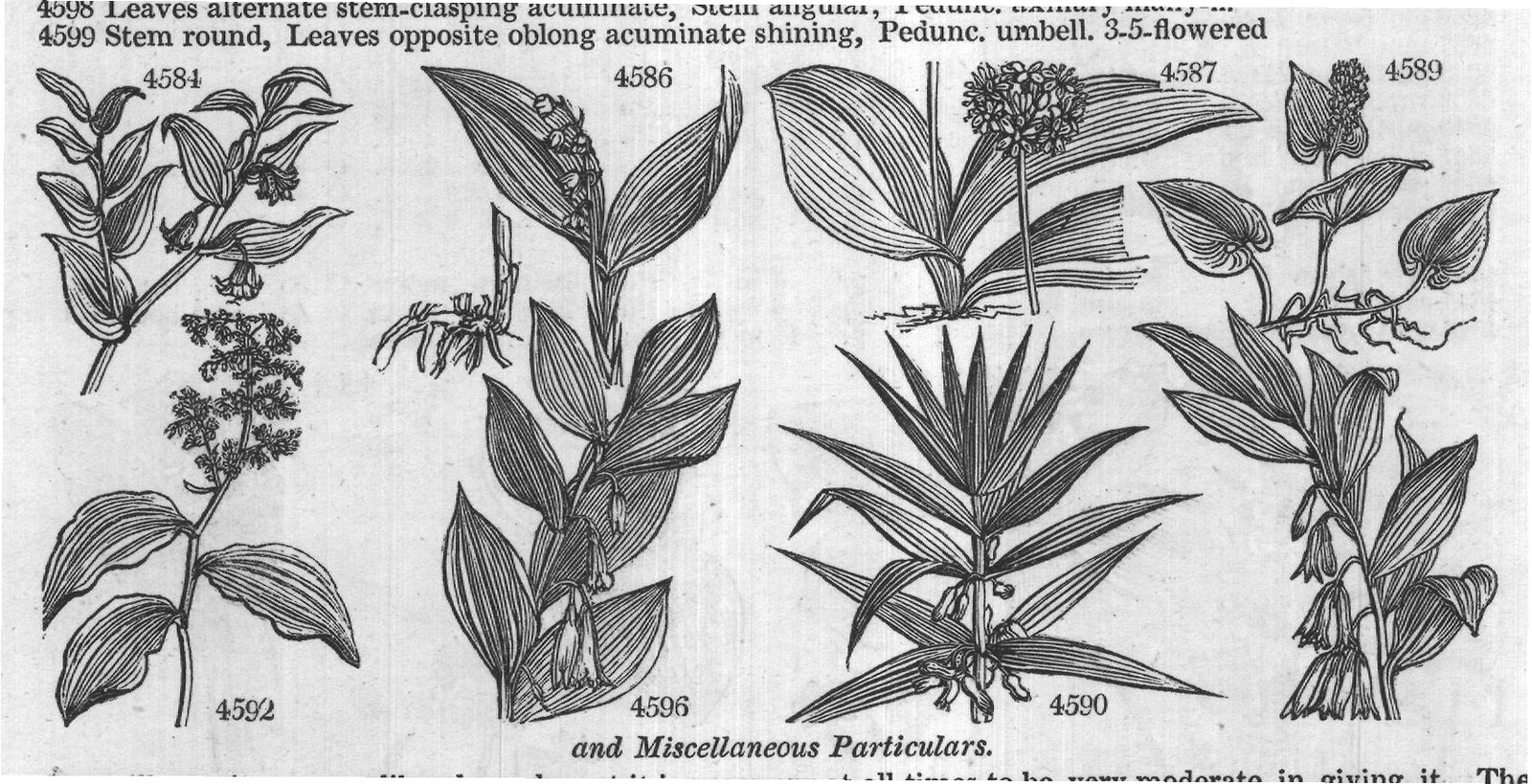
HEXANDRIA MONOGYNIA. 4566 Leaves erect lin. lanc. flaccid glaucous green quite smooth with a slight red edge 4567 Stemless, Leaves linear very straight, Scape branched at base, Cor. round campanulate 4568 Leaves few loosely headed long lanceolate, their edges rough 4569 Leaves erect rigid narrow ensiform glaucous with a broad white edge and a few threads 4570 Leaves a little recurved glaucous lin. lanc. at the edge and keel rough, beneath glaucous beneath glaucous 4571 Leaves lin. lanceolate recurved almost into a circle deep green 7-8 lines broad roundish at edge 4572 Style filiform 4573 Style clavate 3-cornered 4574 Leaves cirrhiferous 4575 Leaves acuminate 4576 A small plant like a Crocus 4577 Leaves perfoliate ovate 4578 Leaves perfoliate elliptic oblong obtuse, Cor. narrowed at base scabrous within, Anthers cuspidate 4579 Leaves perfoliate ovate lanceolate acute 4580 Leaves perfoliate oblong acute, Petals smooth on both sides, Nect. roundish 4581 Leaves sessile 4582 Leaves stalked 4583 Leaves stem-clasping and stem smooth 4584 Smooth shining, Leaves stem-clasping serrulate ciliated, Anthers short 2-horned 4585 Downy hoary, Leaves sessile cordate acuminate, Pedicels in pairs on a very short stalk 4586 Scape naked smooth, Leaves ovate 4587 Leaves ovate oblong obtuse ciliated, Scape leafless, Umbel capitate 4588 Leaves radical elliptical, Umbel terminal 4589 Leaves cordate, Flowers tetrandrous 4590 Leaves stem-clasping in threes, Raceme terminal simple 4591 Leaves alternate stem-clasping elliptical acute, Raceme terminal simple 4592 Leaves alternate sessile ovate acuminate, Panicle terminal naked 4593 Leaves whorled 4594 Stem furrowed, Leaves alternate amplexicaul. oblong pubescent at edge, Pedunc. axillary 2-fl. 4595 Stem rounded furrowed, Leaves amplexicaul. ovate downy beneath, Pedunc. axill, about 2-fl. 4596 Leaves alternate stem-clasping, Pedunc. axillary 1-fl. 4597 Leaves alternate stem-clasping, stem-clasping, Stem round, Pedunc. axillary many-fl. 4598 Leaves alternate stem-clasping acuminate, Stem angular, Pedunc. axillary many-fl. 4599 Stem round, Leaves opposite oblong acuminate shining, Pedunc. umbell. 3-5-flowered 4584 4592 4586 4596 4590 4587 4589 and Miscellaneous Particulars. they will require a more liberal supply, yet it is necessary at all times to be very moderate in giving it. The heat must be well kept up; and as the roots extend, they must be supported. Under such treatment as I have described, I have known one plant grow ten feet in the course of a season, and to have numerous blossom-stems upon it." It is readily increased by dividing the roots. (Hort. Trans. iii. 2, 3.) The flowers are at first green, they afterwards assume those beautiful markings of yellow for which they are so much esteemed. 784. Bulbocodium. From βuλβoς, a bulb, and κωδiov, wool; its bulb is enveloped in a rough and velvetty covering. A beautiful little vernal flower resembling a small species of Colchicum. 785. Uvularia. A diminutive of uva, a bunch of grapes. A genus of little beauty and of easy culture, 786. Streptopus. From to turn, and 785, a foot, or, in botanical language, stalk. Its flower-stalks are constantly twisted. A plant like an Uvularia in habit. 787. Convallaria. From convallis, a valley, in allusion to the places where it grows. (Muguet, Fr.) C. majalis is an elegant and delicate scented plant, which has long been a favorite of the florist; though, as it is not a native of hot countries, it is not likely to be the Lily of the Valley of Solomon. Notwithstanding the fragrance of the flowers when green, yet when dried they have a narcotic odour, and if reduced to powder excite sneezing. An extract prepared from the flowers or from the roots partakes of the bitterness, as well as of the well as of the purgative properties, of aloes. A beautiful and durable green colour may be prepared from the leaves with lime The plant is very common in the woods about Woburn in Bedfordshire, and from thence the London markets are supplied with the flowers. It forces freely, and few plants are more eligible for that operation. 788. Smilacina. A diminution of Smilax, another genus of plants, which see in its place. These are very These are very pretty little hardy American flowers, requiring some delicacy in their management. 789. Polygonatum. From πoλuς, many, and γovu, a knee; on account of the numerous articulations of its Japan HEXANDRIA MONOGYNIA. 790. OPHIOPO'GON. Ker. SNAKE'S BEARD. 4600 japónicus Ker.
Smilaceæ. Sp. 2-3.
CLASS VI.
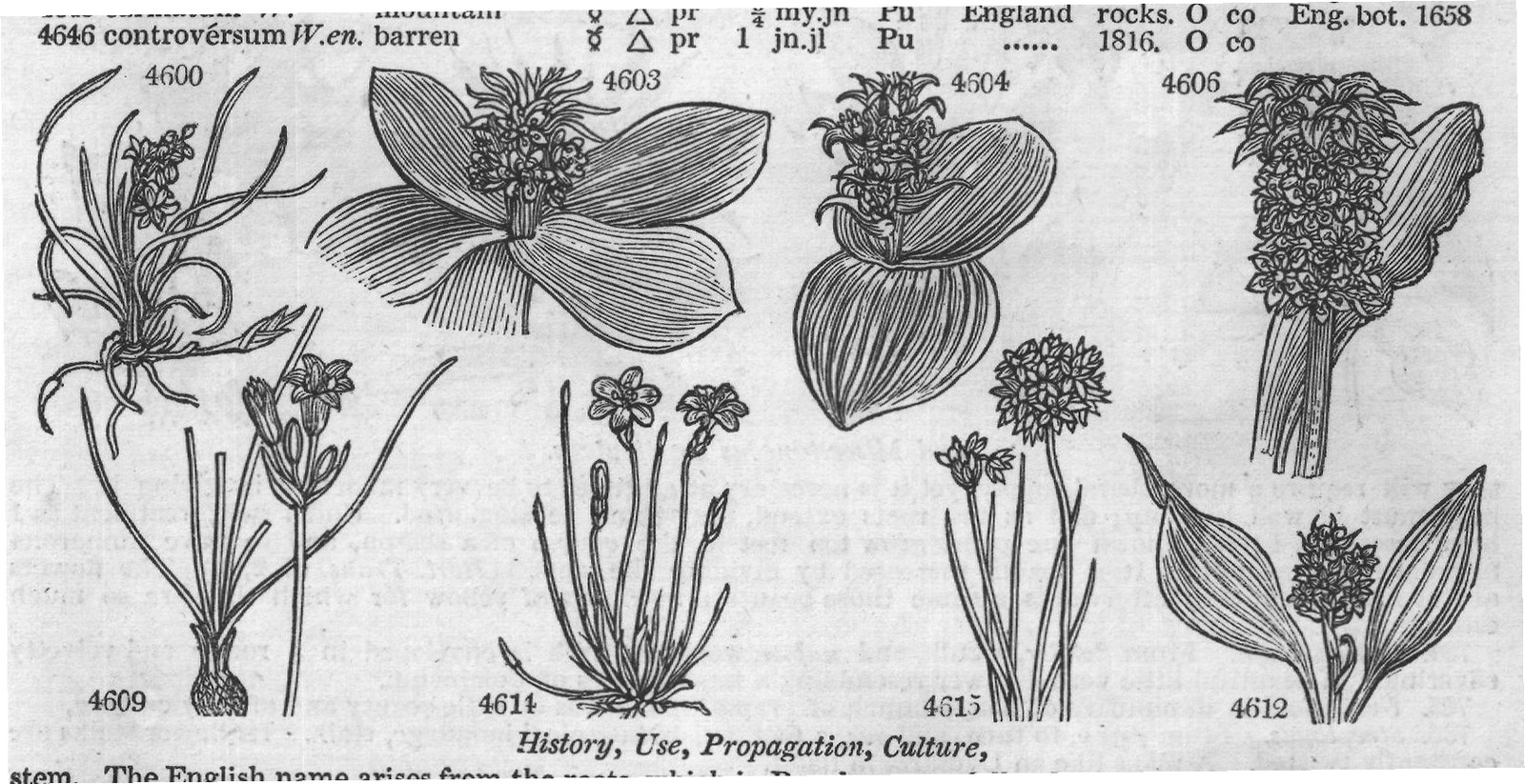
A cu 1 jn L.Y Japan 1784. D s.p.l Bot. mag. 1063 4601 spicátus Ker. spiked cu 1 au.s V China 1820. D s.p.l Bot. reg. 593 4602 nána W. 791. EUCO'MIS. W. 4603 purpureocaúlis H.K. purple-stalked EUCOMIS.
Asphodeleæ. Sp. 7-9. dwarf or my Br C. G. H. 1774.
O r.m Bot. mag. 1495 or 2 mr.ap G.B C.G.H. 1794. 4604 bifólia W. two-leaved or ap.my L.G C. G. H. 1792. 4605 régia W. tongue-leaved or 2 mr.ap G C. G. H. 1702. 4606 unduláta W. waved-leaved or 2 mr.ap GC. G. H. 1760. 4607 punctáta W. spotted or 2 jl G.B C. G. H. 1783.
O r.m Bot. rep. 369 O r.m Bot. mag. 840 Or.m Di. el. t.92. f.109 O r.m Bot. mag. 1083 O r.m Bot. mag. 913 4608 striáta H. K. streaked or 2 jn.d G C. G. H. 1790.
O r.m Bot. mag. 1539 792. BRODIÆ'A. L. T.
BRODIÆA.
Hemerocallidea? Sp. 3. 4609 grandiflóra L. T. large-flowered or jn B Georgia 1806. O p.l Par. lond. t. 98 4610 ixioídes Sims.
Ixia-like or jl B Chili 1821. O p.l