Br C
G. H.
D.V C. G. H. 3239 3250 3253 1820. C s.l 1819. C s.l 1817. C s.l 1795. C s.l 1795. C's.l 3260 3256 Jac. misc. 1. t. 3 Bot. reg. 756 Bot. cab. 242 Bot. cab. 239 Bot. mag. 1240 3243 3255 3257 History, Use, Propagation, Culture, dried and reduced to powder, is frequently used by the negroes as a vomit, and hence its name of wild or bastard Ipecacuanha.
A. vincetoxicum (tame-poison) is so named because it was formerly esteemed an alexipharmick; and it is called swallow-wort from the fancied resemblance of the follicles or seeds to a swallow flying. 589. Gonolobus. The derivation and meaning of this word have not been explained. The genus consists chiefly of climbers of little beauty but easy culture. 590. Pergularia. From Pergula, trellis-work, which the plants are very proper for covering. This is a climbing genus, much valued for the fragrance of its flowers. It grows well in loam and peat, and cuttings root freely in sand under a hand-glass. 591. Marsdenia. So named by Mr. R. Brown, after William Marsden, Esq. the author of the excellent ORDER II.
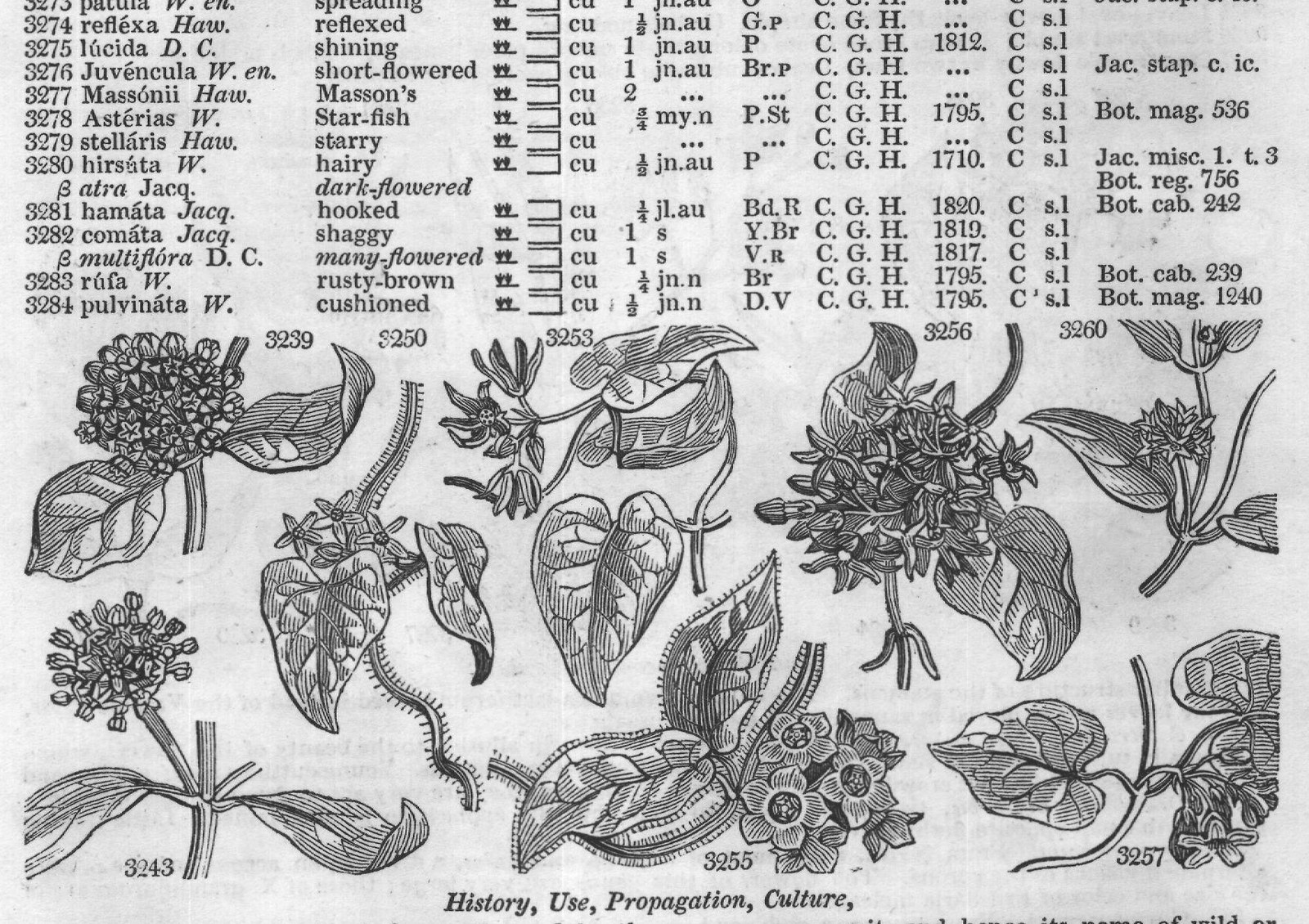
PENTANDRIA DIGYNIA. 3238 Stem simple, Leaves ovate villous beneath, Umbels erect, Necť. resupinate 3239 Leaves ovate rugose naked, Stem simple, Umbels subsessile, Flower-stalks downy 3240 Leaves stalked lanceolate smooth shining, Stem simple, Umbels erect solitary lateral 3241 Leaves ovate-lanceolate smooth, Stem simple, Umbels erect lateral solitary 3242 Leaves lanceolate acuminate smooth narrowed at base, Stem half shrubby erect, Umbels lateral solitary 3243 Leaves lanceolate smooth, Stem divided upwards, Umbels erect in pairs 3244 Leaves lanceolate pubescent beneath, Stem divided upwards, Umbels erect in pairs 3245 Leaves villous, Stem decumbent 3246 Stem erect simple downy in lines, Leaves very narrow linear mostly whorled 3247 Stem decumbent and leaves very long linear pubescent, Appendages of crown without horns 3248 Stem erect hairy with spreading branches at end, Leaves scattered lanceolate hairy 3249 Leaves linear subulate channelled, Umbels stalked nodding: lateral many-flowered 3250 Runners and leafstalks very hairy, Lvs. acum. by degrees perceptibly hairy on both sides, Foll. muricated 3251 Runners smoothish, Leaves conical cordate acute by degrees, Flowers and follicles smooth 3252 Leaves cordate acuminate with the sinus open 3253 Leaves cordate, Corymbs axillary, Common flower-stalk longer than the leafstalks Cor. discolored 3254 Leaves oblong cordate with the sinus closed, Petals crisp at end 3255 Villous, Leaves oblong elliptical lanceolate cordate, Crown at bottom of tube 3256 Leaves cordate acuminate, Cal. shorter than tube of cor. 3257 Leaves cordate obtuse with a point, Cal. as long as tube of cor. 3258 Leaves ovate lanc. very smooth, Cymes shorter than leaves, Sap blood-colored 3259 Stem erect, Leaves cordate ovate acute, Cymes umbellate, Flowers not bearded 3260 Stem somewhat erect, Leaves oval-lanceolate smooth veinless, Tube inflated, Orifice bearded 3261 Leaves ovate, Flowers bearded 3262 Leaves ovate-lanceolate acute small 3263 Leaves obovate obtuse very thick 3264 Leaves cordate 3265 Leaves oblong slightly cordate at base with 3 distinct nerves 3266 Stems upright jointed rounded, Leaves linear acute 3267 Leaves lanceolate sessile, Peduncles 2-flowered, Stem fleshy 3268 Leaves smooth with an edge, Peduncles simple, Calyx very smooth §1. Cor. 5-cleft with no ball. Crown double: the outer with the ligules united at base; inner with the appendages united upwards into a beak, downwards expanded into a wing. (TRUE STAPELIA.) 3269 Branches quadrangular clavate: angles with remote incurved teeth, Seg. of cor. lanc. acute fringed at edge 3270 Segments of cor. fringed with white covered at base with very close long red hairs black at end, beyond mid. striped with pale 3271 Branches erect 4-ang. clav. Angles toothed rem. incurv. Cor. large flat with lanc. hisp. seg. fring. at edge 3272 Branches spreading 4-ang. Angles toothed, Teeth remote acute incurved, Cor. whole color. vil. in middle 3273 Cor. flat cil. rugose above in mid. hairy otherwise smooth, Beak sub. ac. Wings obl. obt. 1-tooth. inside 3274 Stam. deltoid with inner process recurved unguiculate, Top of style impressed with the mark of a cross 3275 Branches sq. erect velvety, Teeth erect, Disc. of fls. shining hairy with ovate-acum. revolute ciliated seg. 3276 Fls. flat smooth rugose crosswise, Beaks subul. gibb. Ligules lanc. acum. Bran. fl.-bearing about the mid. 3277 Branches four together large equal sided with flat pubescent angles 3278 Branches several erect square toothed, Teeth short erect, Fl. large, Segm. lanc. ciliated revolute at edge 3279 An obscure species said to be cultivated in the gardens, but of which nothing is known 3280 Flowers flat ciliated hairy all over the disk, Beaks subulate acute with a broad acute wing at the back 3281 Fls. flat cil. rugose above hairy in centre, One or more of teeth hooked, Wings parallel with erect beaks 3282 Fl. cil. Disk flat shaggy in mid. Segm. at first deflexed afterwards spreading, Wings obl. trunc. crenulate ẞ Differs chiefly in the dark color of the flowers which are clustered and not solitary 3283 Segm. of fl. lanc. acum. Ligules linear lanc. wavy, Branches erect square with erect teeth 3284 Branches reclinate, Segm. of fl. rounded rugose acuminate ciliated: the bottom elevated closely hairy 3261 3267 3269 3271 3283 3280 3 3281 and Miscellaneous Particulars.
History of Sumatra, in which one species, used as Indigo in the island is figured. Little neat shrubs, with axillary bunches of small white sweet-scented flowers. 592. Hoya. Named after Mr. Thomas Hoy, for many years gardener to the Duke of Northumberland. He died about 1821. H. carnosa is of easy culture, flowers freely, and is propagated by cuttings in a moist heat. Its flowers are very mellifluous, and it has been said that one or two plants, placed when in flower in a vinery of ripe grapes, will entice the wasps from eating the fruit. 593. Ceropegia. From κηρoς, wax, and πηγη, a fountain; literally, a fountain of wax, poetically, a candelabre; on account of the umbels of bright yellow flowers. Curious naked plants with tumid fleshy stems. Same culture as Hoya. 594. Stapelia. So named by Linnæus, in memory of Bodæus à Stapel, a physician of Amsterdam, com- 3285 fissiróstris Jacq. 3286 concínna W.
PENTANDRIA DIGYNIA.
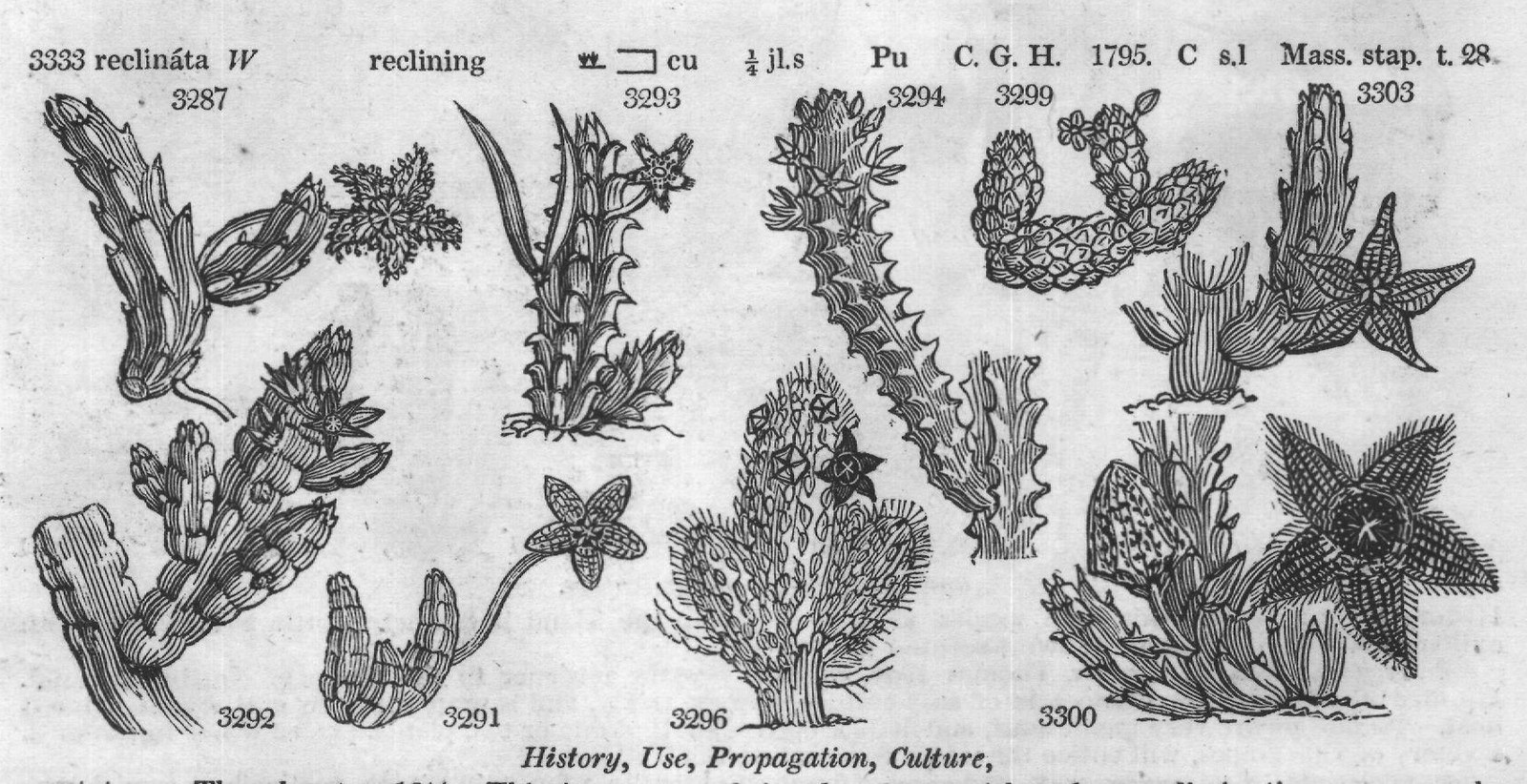
CLASS V. split-beaked cu 2 Y.G C. G. H. 1823. C s.l Jac. stap. c. ic. spruce cu jn.au Gr C. G. H. 1795. C s.1 Mass. stap. t. 18 3287 glanduliflóra W. 3288 glandulífera Haw. gland-flowered hairy-glanded cu au.n Br C. G. H. 1795. Cs.l Mass. stap. t. 19 cu au.n Br C. G. H.
Cs.l 3289 acumináta W. acuminated cu jl.s P.St C. G. H. 1795. C s.1 Mass. st. 15. t. 17 3290 hispidula Horn. hispid 业 cu jl.au Gr C. G. H. 1824. C s.l 3291 apérta W. open-flowered cu 2 jl.au Y.P C. G. H. 1795. C s.l Mass. stap. t. 37 3292 ramósa W. branched 业 cu 1 jn.jl D.P C. G. H. 1795. C s.1 Mass. stap. t. 32 3293 árida W. dry cu au Y C. G. H. 1795. C s.l Mass. stap. t. 33 3294 incarnáta W. flesh-colored cu 1 ap.au FC. G. H. 1793. C s.l Mass. stap. t. 34 3295 parviflóra W. small-flowered cu 1 jn.au Y. Gr C. G. H. 1795. C s.l Mass. stap. t. 35 3296 pilífera W. hairy-tubercled cu 1 jn.au D.P C. G. H. 1790. C s.l Mass. stap. t. 23 3297 Gordoni Mass.
Gordon's cu 1 Y.Br C. G. H. 1796. C s.l Mass. stap. t. 40 ... 3298 mammillaris W. prickly 业 cu 1 jn.jl Br C. G. H. 1774. C. s.l