Home › B › Burm (Zeyl t or jl au Pa Y C co)
Burm (Zeyl t or jl au Pa Y C co)
zeyl. t. 32 or 3 jl.au Pa.Y 1820. C co ......
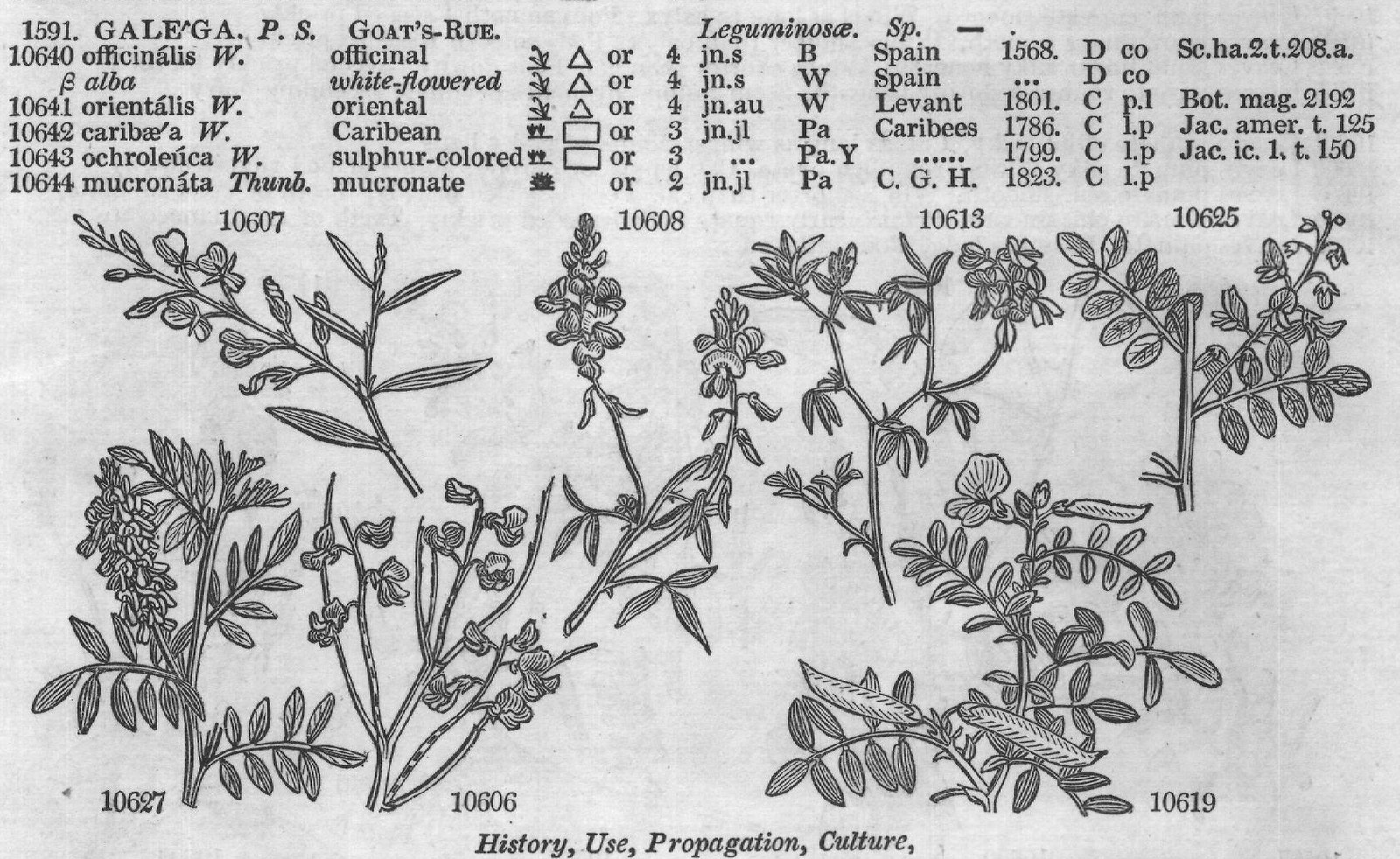
Leguminosæ. Sp. officinal or 4 jn.s B Spain white-flowered or 4 jn.s W oriental or 4 jn.au W Caribean or 3 jn.jl sulphur-colored or 3 ... or 10608 2 jn.jl Pa Pa.Y Pa Spain Levant Caribees ... ... ..
C. G. H. 1568. D co 1801. C p.l 1786. C 1.p 1799. C 1.p 1823. C 1.p Sc.ha.2.t.208.a.
Bot. mag. 2192 Jac. amer. t. 125 Jac. ic. 1. t. 150 10613 10625 10627 10606 10619 History, Use, Propagation, Culture, 1589. Indigofera. That is to say, a plant bearing indigo. The species are elegant little shrubs, freeflowerers, and of easy culture. Most of them will yield the dye, but those chiefly cultivated for this purpose are the I. Anil (Alnyl, Arab.), in the West Indies, and the I. tinctoria, argentea, and some other species in the East Indies. The indigo is one of the most profitable articles of culture in Hindustan; because an immense extent of land is required to produce but a moderate bulk of the dye; because labor and land here are cheaper than any where else; and because the raising of the plant and its manufacture may be carried on without even the aid of a house. The first step in the culture of the plant is to render the ground, which should be friable and rich, perfectly free from weeds, and dry if naturally moist. The seeds are then sown in shallow drills about a foot apart. The rainy season must be chosen for sowing, otherwise if the seed is deposited in dry soil, it heats, corrupts, and is lost. The crop being kept clear of weeds, is fit for cutting in two or three months, and this may be repeated in rainy seasons every six weeks. The plants must not be allowed to come into flower, as the leaves in that case become dry and hard, and the indigo produced is of less value; nor must they be cut in dry weather, as they would not spring again. A crop generally lasts two years. Being cut, the herb is first steeped in a vat till it has become macerated and parted with its coloring matter; then the liquor is let of into another, in which it undergoes the peculiar process of beating, to cause the fecula to separate from the water. This fecula is let off into a third vat, where it remains some time, and is then strained through cloth bags, and evaporated in shallow wooden boxes placed in the shade. Before it is perfectly dry, it is cut in small pieces of an inch square; it is then packed in barrels, or sowed up in sacks for sale. Indigo was not extensively cultivated in India before the British settlements were formed there; its profits were at first so considerable, that, as in similar cases, its culture was carried too far, and the market glutted with the commodity. The indigo is one of the most precarious of oriental crops; being liable to be destroyed by hail storms, which do comparatively little injury to the sugar-cane and other plants. The indigo cultivated in the West Indies, thrives best in a free rich soil, and a warm situation, frequently refreshed with moisture. Having first chosen a proper piece of ground, and cleared it, hoe it into little ORDER IV.
DIADELPHIA DECANDRIA. 10606 Leaves simple filiform, Flowers racemose 10607 Leaves simple linear hoary, Pods globose 10608 Leaves ternate lanc. silky beneath, Racemes longer than leaf, Pods pendulous 10609 Leaves ternate lin. lanc. silky beneath, Racemes longer than leaf few-fl. Pods straight 10610 Leaves ternate oblong downy beneath, Racemes longer than leaf, Pods reflexed appressed 10611 Leaves ternate obovate silky beneath, Raceme term. long, Stem decumbent 10612 Leaves ternate, Leafl. ovate mucronate sessile, Pedunc. axill. about 2-fl. Branches filiform spreading 10613 Leaves ternate obcordate smooth, Racemes longer than leaf, Pods pendulous 10614 Leaves ternate ovate acute, Racemes short, Stem erect 10615 Leaves ternate obovate on short stalks, Pedunc. long filiform, Pods pendulous 10616 Leaves quinate obovate mucronate hairy, Stipules subulate, Pods straight smooth 10617 Leaves pinnate cuneate 7, Racemes as long as leaves, Pods 4-cornered 2-seeded 10618 Leaves pinnate 5 or 7 oblong narrowed at each end, Racemes longer than leaf 10619 Leaves pinnate 7 or 9 oblong downy beneath, Racemes about 5-flowered sessile, Stem straight 10620 Leaves pinnate of 4 or 5 pairs hoary beneath, Racemes length of leaves spiked, Pods 4-cornered villous , Pods 4cornered villous 10621 Leaves pinnate linear, Racemes axillary, Stem shrubby downy 10622 Leaves pinnate smooth of many pairs oblong, oblong, Racemes shorter than leaf, Standard smooth 10623 Leaves pinnate of 6 pairs obovate strigose, Racemes shorter than leaf, Pods pendulous, Stem viscid than leaf, Pods pendulous, Stem viscid 10624 Leaves pinnate oblong of 3 pairs, Racemes shorter than leaf, Pods falcate 10625 Leaves pinnated obl. smooth of 4 pairs, Racemes shorter than leaf, Pods round arcuate 10626 Leaves simple ternate and pinnate silky, Pods torulose pendulous 10627 Leaves pinn. obl. smooth, Racemes spiked shorter than leaf, Pods 4-cornered reflexed 10628 Stem muricate downy, Leafl. oval hairy, Stip. oval acute, Racemes longer than leaves than leaves 10629 Leaves about 3, Leafl. lanc. blunt mucronulate smooth deciduous, Petioles persistent 10630 Leafl. obl. lanc. blunt downy beneath, Raceme terminal long, Pods round spreading 10631 Pods falcate backwards compressed villous spiked, Calyxes woolly, Leafl. oval-obl. acuminate oval-obl. acuminate 10632 Leafil. obl. mucronate downy beneath, Stip, ovate acuminate, Raceme 4-fl. terminal, Pods pendulous 10633 Leafl. cuneate-obl. recurved mucronate villous beneath, Stipules subulate, Raceme few-fl. 10634 Pods straight spreading ciliated, Stip. subulate, Leafl. 9-11 obl. acute downy beneath 10635 Leafl. lanc. cuneate retuse silky beneath, Stip. setaceous, Pods falcate backwards villous pendulous backwards villous pendulous 10636 Pods straight ascending villous, Stip. subulate, Pedunc. 2-edged, Leafl. obl. blunt , Leafil. obl. blunt 10637 Leafl. obl. cuneate emarg. mucronate smooth, Stip. subulate, Pods racemose straight ascending , Pods racemose straight ascending 10638 Leafl. inversely lanc. obtuse emarg. silky beneath, Racemes terminal short 10639 Leafl. inversely lanc. emarg. mucronate hairy, Stip. subulate, Racemes terminal 10640 Leafl. lanc. mucronate smooth, Stip. lanc. sagittate, Pods erect straignt 10641 Leafl. ovate acuminate smooth, Stip. ovate, Flowers cernuous 10642 Leafl. obl. acute downy beneath, Stip. subulate, Pods smooth racemose pendulous 10643 Leafl. ovate acute downy, Stip. subulate, Pods straight pendulous smooth racemose 10644 Leaves pinn. ovate mucron. villous, Stem erect, Branches downy 10632 10637 10643 10630 10640 and Miscellaneous Particulars. 10641 10642 trenches, not above two inches, or two inches and a half in depth, not more than fourteen or fifteen inches asunder. In the bottom of these, at any season of the year, strew the seeds pretty thick, and immediately cover them. As the plants shoot, they should be frequently weeded, and kept constantly clean, until they spread sufficiently to cover the ground. Those who cultivate great quantities, only strew the seeds pretty thick in little shallow pits, hoed up irregularly, but generally within four, five, or six inches of one another, and covered as before Plants raised in this manner, are observed to answer as well, or rather better, than the others; but they require more care in the weeding. They grow to full perfection in two or three months, and are observed to answer best when cut in full blossom. The plants are cut with reaping hooks, a few inches above the root, tied in loads, carried to the works, and laid by strata in the steeper. Seventeen negroes are sufficient to manage twenty acres of indigo; and one acre of rich land, well planted, will, with good seasons and proper management, yield five hundred pounds of indigo in twelve months, for the plant ratoons (i. e. it sends out stolones), and gives four or five crops a year; but must be replanted afterwards.
Indigo has long been cultivated in Spain, but is on the decline in that country, owing to the more favorable circumstances of the East and West Indies. It was tried in the south of France and Italy, during the Buonaparte dynasty, but found not worth following for the same reason. 1590. Tephrosia. From τεφρoς, ash-colored, in allusion to the color of the foliage. T. toxicaria is a spreading shrubby plant. The leaves and branches, well pounded, and thrown into a river or pond, very soon affect the water, and intoxicate the fish, so as to make them float on the surface, as if dead; most of the large ones recover after a short time, but the greatest part of the small fry perish on these occasions. It has been introduced to Jamaica, and cultivated there, on account of its intoxicating qualities. (Browne) 1591. Galega. A name of unexplained meaning. Ruellius says, it is the word Glaux, Italianized! G. officinalis was formerly accounted cordial and sudorific, but is now out of repute. The species are handsome border flowers.
BASTARD VETCH. hairy small pr 1 trailing sand procumbent 10651 montána Dec. mountain 10652 Lambérti Ph.
Lambert's 10653 uralénsis P. S. silky pr 10654 sórdida P. S. hairy-mountain pr field Aleppo Altaic O pr 1 jl.au boat-podded pr pale-flowered mealy pr jn.au small-flowered pr pr 1592. PHA'CA. W. 10646 frígida W. 10645 bœ'tica W. 10647 alpína W. 10648 austrális W. 10649 arenária W. 10650 astragalína P. S.
DIADELPHIA DECANDRIA.
Leguminosæ. Sp. 6-14. smooth-Alpinepr 2 ji 1593. OXY'TROPIS. Dec. OXYTROPIS.
Astragalus uralensis E. B. 10655 campestris Dec. 10656 uncáta Dec. 10657 altáica Dec. 10658 cymbicárpos Dec. 10659 pilósa Dec. 10660 dealbáta Dec. 10661 defléxa Dec.
Apr 1 jn.jl W.B Leguminosæ.
Spain 1640. Rs.1 Austria 1795. P. s.l Austria 1759. Rs.1 S. Europe 1779. R s.l Siberia 1796. R s.l N. Europe 1771.
Sp. 12-21.
Austria 1581. D s.l prjl.au Pu pr 1 au.s Pu Missouri 1811. D s.l 1 Pu jl my.au Y.Pu Scotland Apr jn.jl prjl.s Siberia 1800. D s.l Ds.l ...
Germany 1778. S s.l Aleppo 1768. D co Siberia 1802. S co Portugal 1800. S co Pa. Y Siberia 1732. D s.l Caucasus 1803. D s.l Siberia 1800. D s.l CLASS XVII.
Moris, s. 2.t.8.f.1 Jac. aust. t. 166 Jac. ic. 1. t. 151 Bot. cab. 490 Pal.it.3. t.cc.f.1.2 Bot. cab. 429 Bot. mag. 843 Bot. mag. 2147 Pall. astrag. t. 42 Eng. bot. 466 Pl.rar.hu.2.t.130 Pall. astrag. t. 45 Apr 4 jl R Y Y Apr my.jn B pr jlau B Pu W B jl.au Pa Bot. cab. 544 jl.au jn.jl Pu Pal. ast.t.23.f.2,3 Pu Jac. ic. 1. t. 153 10662 dichóptera Dec. pubescent pr jn.jl Pu Siberia 1815. D s.l Pall. astrag. t.39 1594. ASTRA GALUS. Dec. MILK VETCH.
Leguminosæ. Sp. 63-110. 10663 christiánus W. great-yellowor 3 jl Y Armenia 1737. D s.l Tourn. it.2.t.254 10664 tomentósus W. downy-leaved or 3 jl Y Egypt 1800. C p.1 Dec. astrag. t.29 10665 alopecuroídes W.
Fox-tail-like or 2 jn.jl L.Y Spain • 10666 vulpínus W. 1737. C s.l Pall. astrag. t. 8 Fox-tail or 2 jn.jl L.Y Siberia 10667 narbonénsis W. 1815. C s.l Pall. astrag. t. 7 French or 3 jn.jl 10668 capitátus W.
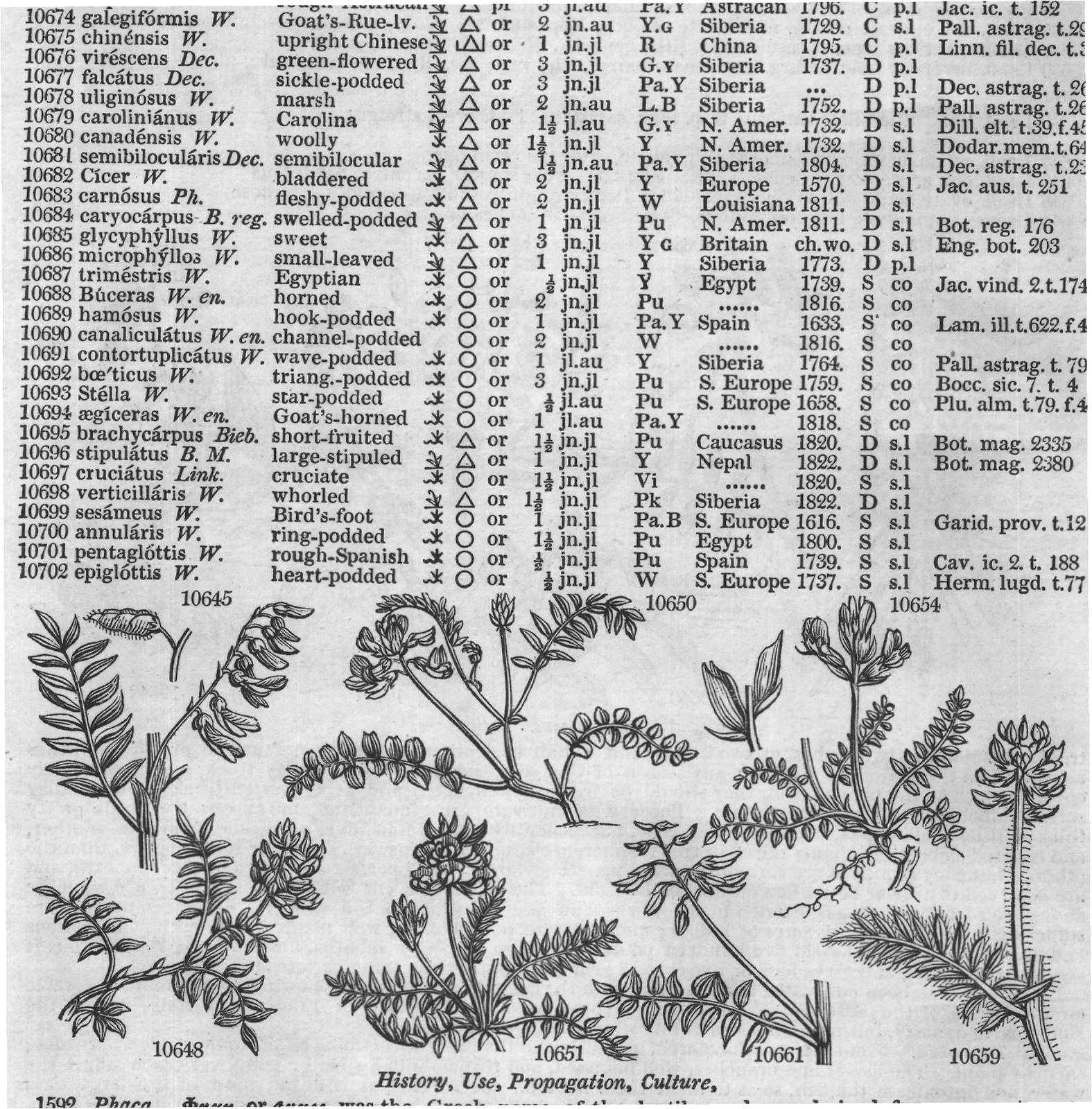
Pa.Y S. Europe 1789. Cs.l Pall. astrag. t.10 headed or 3 jl.au Pa.Y Levant 1759. C s.l 10669 sulcátus W. 10670 melilotoídes W. 10671 virgátus W. furrowed Melilot-like Apr 4 jl L.B Siberia 1785. C co Jac. vind. 3. t. 40 Apr 3 jn.jl Pu Siberia 1785. C co Pall. astrag. t.41 10672 tenuifólius W. 10673 as'per W. twiggy fine-leaved pr 3 my.au Vi Siberia 1806. C co Pall. astrag. t.18 Apr 1 jl.au Pu Siberia 1780. C p.l Sweet fl. g. 73 rough Astracan Apr 3 jl.au Pa. Y Astracan 1796. C p.l Jac. ic. t. 152 10674 galegifórmis W. 10675 chinénsis W.
Goat's-Rue-lv.or 2 jn.au Y.G Siberia 1729. C s.l Pall. astrag. t.29 upright Chinese or 1 jn.jl R China 10676 viréscens Dec. green-flowered or 3 jn.jl G.Y Siberia 1795. C p.l 1737. D p.l Linn. fil. dec. t.3 10677 falcátus Dec. sickle-podded or 3 jn.jl Pa. Y Siberia ...
D p.l 10678 uliginósus W. marsh or 2 jn.au L.B Siberia 10679 caroliniánus W. 1752. D p.l Carolina or 1½ jl.au G.Y 10680 canadénsis W. woolly Aor 1 jn.jl Y 10681 semibiloculáris Dec. semibilocular or 1 jn.au Pa. Y Siberia 10682 Cícer W. bladdered or 2 jn.jl Y Europe 1570. D s.l N. Amer. 1732. D s.1 N. Amer. 1732. D s.l 1804. D s.1 Dec. astrag. t. 26 Pall. astrag. t.26 Dill. elt. t.39.f.45 Dodar.mem.t.64 Dec. astrag. t.23 Jac. aus. t. 251 10683 carnósus Ph. fleshy-podded or 2 jn.jl W Louisiana 1811. D s.1 10684 caryocarpus B. reg. swelled-podded or 1 jn jl Pu N. Amer. 1811. D s.1 Bot. reg. 176 10685 glycyphýllus W. sweet or 3 jn.jl 10686 microphýllos W.
YG Britain ch.wo. D s.l Eng. bot. 203 small-leaved or 1 jn.jl Y Siberia 1773. D p.l 10687 triméstris W.
Egyptian or jn.jl Y Egypt 1739. S co Jac. vind. 2.t.174 10688 Búceras W. en. horned or 2 jn.jl Pu 1816. S co 10689 hamósus W. hook-podded or 1 jn.jl 10690 canaliculátus W. en. channel-podded Pa.Y Spain 1633. S co Lam. ill.t.622.f.4 or 2 jn.jl W 1816. S co 10691 contortuplicátus W. wave-podded or 1 jl.au Y Siberia 1764. S co 10692 bœ'ticus W. triang.-podded or 3 jn.jl Pu S. Europe 1759. S co Pall. astrag. t. 79 Bocc. sic. 7. t. 4 10693 Stélla W. star-podded or jl.au Pu 10694 ægíceras W. en.
Goat's-horned or 1 jl.au Pa.Y ...... 10695 brachycárpus Bieb. short-fruited or 1½ jn.jl Pu 10696 stipulátus B. M. large-stipuled or 1 jn.jl Y 10697 cruciátus Link. cruciate or 1½ jn.jl Vi ...... 10698 verticilláris W. whorled or 1 jn.jl Pk 10699 sesámeus W.
Bird's-foot or 1 jn.jl 10700 annuláris W. ring-podded or 1 jn.jl 10701 pentaglóttis W. rough-Spanish or Pu jn.jl 10702 epiglóttis W. heart-podded or jn.jl W 10645 S. Europe 1658. S co 1818. S co Caucasus 1820. D s.1 Nepal 1822. D s.l 1820. S s.l Siberia 1822. D s.l Pa.B S. Europe 1616. S s.l Pu Egypt 1800. S s.l Spain 1739. S s.l S. Europe 1737. S s.l 10650 Plu. alm. t.79. f.4 Bot. mag. 2335 Bot. mag. 2380 Garid. prov. t. 12