Home › B › Burm (Ind t History Use Propagation)
Burm (Ind t History Use Propagation)
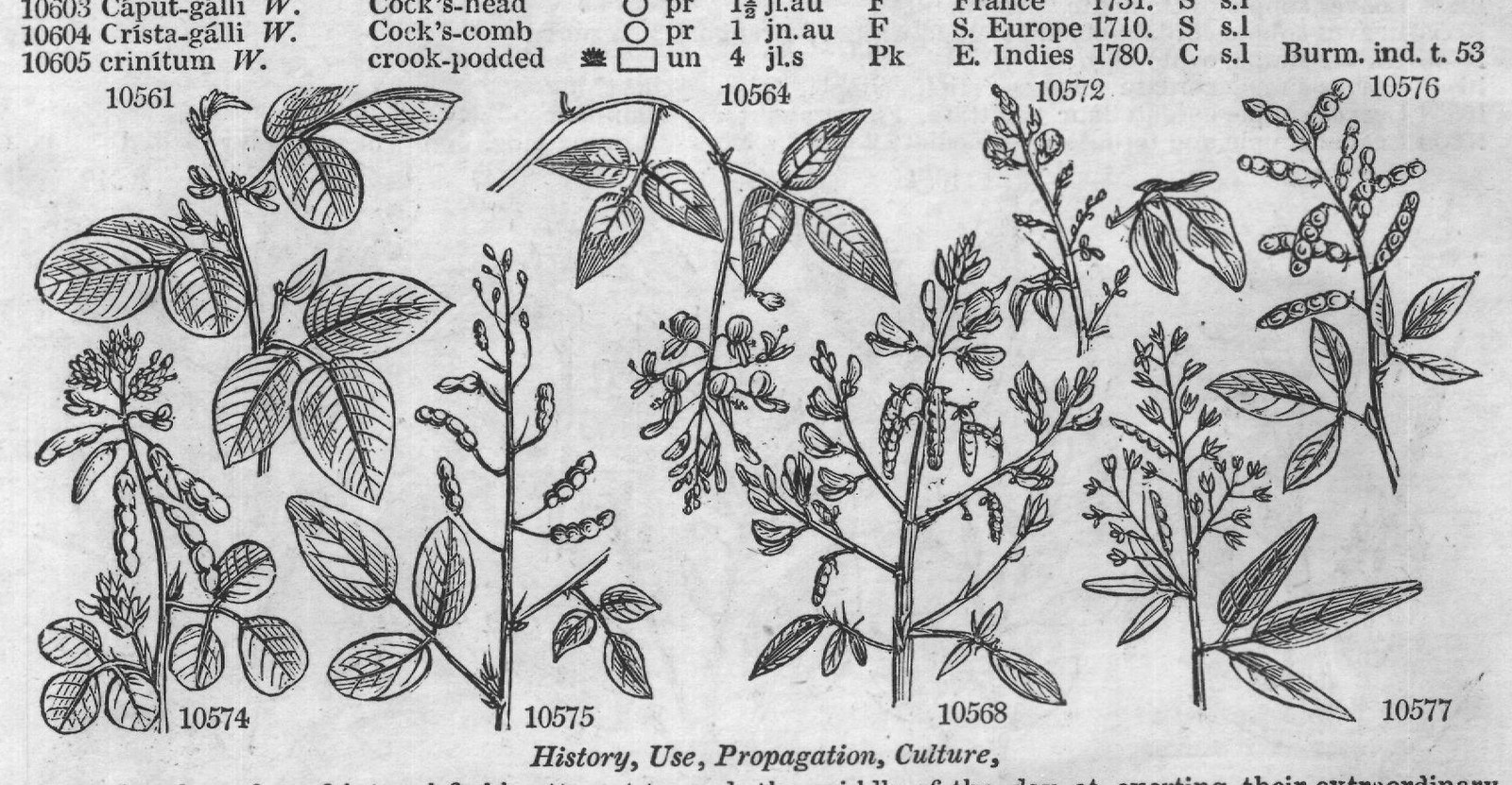
ind. t. 53 10576 10574 10575 10568 10577 History, Use, Propagation, Culture, general, only make a faint and feeble attempt towards the middle of the day at exerting their extraordinary faculty. (Shaw.) This motion does not depend upon any external cause that we can trace, and we are not able to excite it by any art that we possess. It is not the action of the sun's rays, for this plant is fond of shade, and the leaves revolve well on rainy days, and during the night: exposed to too much wind or sun, it is quiet. Perhaps, says Linnæus, there may be some part in vegetables, as in animals, where the cause of motion resides. H. coronarium, Sulla, or Sainfoin à bouquets, Fr., is an esteemed border biennial, and some speculative agriculturists recommend it for cultivation as a field plant. In Calabria it grows wild in great luxuriance, near four feet high, affording excellent nourishment to horses and mules, both green and made into hay: but it does not well bear the spring in the north of Italy: we may presume, therefore, that it will scarcely bear our climate well enough to answer the purposes of husbandry. Osbeck mentions, that he saw it brought into Cadiz in great bundles, as food for cattle.
H. Onobrychis, L'esparcet, Fr., Esparzette, Ger., and Cedrangolo, Ital., is a deep rooting perennial, with branching spreading stems, compound leaves, and shewy red flowers. It is a native of many parts of Europe, but never found but on dry warm chalky soils, where it is of great duration. It has been long cultivated in France, and in other parts of the continent, and as an agricultural plant, a good deal in England, in the chalky districts; and its peculiar value is, that it may be grown on soils unfit for being constantly under tillage, and which would yield little undergrass. This is owing to the long and descending roots of the saint-foin, which will penetrate and thrive in the fissures of rocky and chalky understrata. Its herbage is said to be equally suited for pasturage or for hay, and eaten green it is not so apt to swell or hove cattle as the clovers or lucern. Arthur Young says, that upon soils proper for this grass no farmer can sow too much of it, and in ORDER IV.
DIADELPHIA DECANDRIA. 10560 Leaves ternate downy beneath, Stem angular downy, Racemes axillary 10561 Leaves ternate roundish ovate and branches 3-cornered hairy, Pedunc, umb. axill. shorter than petiole 10562 Leaves ternate oblong, Stem branched, Raceme terminal, Pods with 2 joints strigose 10563 Leaves simple reniform cordate repand, Racemes axillary with hooked hairs 10564 Leaves ternate ovate villous, Stem climbing, Racemes terminal 10565 Leafl. roundish hairy beneath, Panic. term. contracted bracteate, Pedunc. and cal. very hairy 10566 Leaves tern. Stem hairy rough, Leafl. roundish and obl. pale beneath somew. hairy, Racemes terminal 10567 Leaves tern. obl. subcordate pale and soft beneath, Raceme terminal 10568 Leaves tern. oval-lanc. blunt: lateral very minute, Panicle terminal, Pods repand below pendulous 10569 Leaves tern, ovate acute hairy, Stem climbing 3-cornered, Racemes very long axillary 10570 Leaves tern. obl. lanc. Stipules filiform, Fl. racemose, Pods hispid 10571 Leaves tern, roundish downy beneath, Stipules ovate acuminate, Stem angul. cil. hispid 10572 Leaves tern. oblong villous beneath, Stipules subulate, Racemes panicled, Pods with 3 joints 10573 Leaves tern, ovate blunt subcordate at base, Stipules lanc. subulate, Panicle terminal 10574 Leaves tern. roundish obovate downy beneath, Stipules lanc. Racemes axillary 10575 Leaves tern. ovate-obl. blunt smoothish, Racemes erect axillary, Pods tortuous 10576 Leaves tern. ovate-obl. rough beneath, Stip. lanc. cuspid. Racemes panicled with bractes 10577 Leaves tern. oblong lanc. smooth, Panic. term. Joints of pod rhomboid downy 10578 Leaves tern. ovate acute, Raceme term. very long, Pods repand villous 10579 Leaves tern. ovate acum. Panicle term. Joints of pod netted downy at edge 10580 Leaves tern. roundish ovate acuminate, Panicle scape-like from the base of stem, Peduncles viscid 10581 Leaves tern. ellipt. blunt beneath and petioles hirsute, Raceme term. simple 10582 Leaves tern. obcordate, Stem procumb. Pedunc. 1-fl. axillary, Pods with upper edge repand 10583 Leaves tern. lanc. blunt, Racemes axillary, Stem twining 10584 Leaves pinnate lanc. Raceme very long spiked, Joints of pod ellipt. plaited 10585 Leaves pinnate oval broader at base silky beneath, Cal. shorter than corolla, Joints of pod downy rough 10586 Leaves pinnate, Leafl. ellipt. blunt downy beneath alternate, Joints of pod netted. 10587 Leaves pinn. Leafl. altern. smooth obovate retuse, Racemes axill. few-fl. 10588 Leaves pinn. ovate lanc. smooth, Racemes long axill. Bractes shorter than peduncle 10589 Leaves pinn. ovate smooth, Racemes axill. Bractes longer than peduncle 10590 Leaves pinn. lanc. linear downy beneath, Joints of pod roundish roughish 10591 Leaves pinn. in 7 pairs ellipt. Racemes capitate axillary stalked, Standard striped 10592 Leaves pinn. roundish ellipt. Joints of pod roundish aculeate naked 10593 Leaves pinn. oblong, Pods flexuose, Joints prickly 10594 Leaves pinn. linear cuneiform, Wings very short, Joints of pod roundish hairy prickly 10595 Leaves pinn, obovate emarg. hispid at edge, Raceme term. Pods with many joints muricated 10596 Leaves pinn. obovate emarg. Flowers in capitate racemes, Joints of pod round villous acuminate 10597 Leaves pinn. cuneate smooth, Wings as long as calyx, Pods smooth 1-seeded prickly 10598 Leaves pinn. linear smooth, Wings shorter than calyx, Pods smooth 1-seeded prickly 10599 Leaves pinn. linear silky beneath, Wings shorter than cal. Pods downy 1-seeded prickly-toothed 10600 Leaves ternate roundish downy beneath, Stem round, Branches declinate ascending hairy 10601 Leaves pinnate ellipt. silky, Cal. as long as wings, Joints of pod villous 10602 Leaves pinnate silky shining roundish ovate, Cal. length of corolla, Joints of pod rugose downy 10603 Leaves pinnate obl. smooth, Wings shorter than cal. Pods 1-seeded prickly, Teeth of crest subulate 10604 Leaves pinnate obl. smooth, Petals nearly equal, Pods 1-seeded prickly, Teeth of crest lanceolate 10605 Leaves pinnate, Racemes long, Pods inflexed 10597 10600 10572 10588 10595 10589 10605 and Miscellaneous Particulars.
The Code of Agriculture, it is said to be " one of the most valuable herbage plants we owe to the bounty of providence."
The deeper the soil is stirred previously to sowing the better; the seed is generally put in broad cast, at the rate of three or four bushels the acre, and sometimes a little red clover is sown afterwards to produce a crop the second season, when the saint-foin plants are but small. When saint-foin is annually mown, it should be top-dressed with manure; but if only occasionally mown, the benefits derived from the grazing of sheep or cattle will, to a considerable extent, answer for surface dressings in a plant that derives a part of its nutriment from the subsoil. Saint-foin is highly nutritive, either cut green or made into hay. The produce, on a medium of soils and cultivation, may probably be estimated at from about one and a half to two tons the acre. And on the poorer and thinner staple sorts of land, it will perhaps seldom afford less than from a ton to a ton and a half on the acre. One thousand parts of saint-foin afforded Sir H. Davy thirty-nine of nutritive matter, which is the same as that afforded by the red and white clover. The usual duration of saint-foin, in a profitable state, is from eight to ten years. It usually attains its perfect growth in about three years, and begins to decline towards the eighth or tenth on calcareous soils, and about the seventh and eighth on gravels. There are instances, however, of fields of saint-foin, which had been neglected and left to run into pasture, in which plants have been found upwards of fifty years from the time of sowing. It has been cultivated upwards of a century on the Cotswold hills, and there roots of it have been traced down into stone quarries from ten to twenty feet in length, and in Germany, Von Thaer found them attain the length of sixteen feet. In general, the great enemy to the endurance of saint-foin, is the grass which accumulates, and forms a close turf on the surface, and thus chokes up the plant. DIADELPHIA DECANDRIA. 1589. INDIGOFERA. W. INDIGO.
CLASS XVII.
Legumínosæ. Sp. 10606 filifólia W. naked-stalked or 1 jl.o Pu C. G. H. 1812. C s.l Bot. reg. 104 10607 linifólia W.
Flax-leaved or 1 jl.au Pu E. Indies 1792. S s.l Rox. cor. 2.t.194 10608 psoraloídes W. long-piked or jl.s R C. G. H. 1758. S s.p Bot. mag. 476 10609 cándicans W. white-leaved or my.s R C. G. H. 1774. C s.p Bot. mag. 198 10610 amœ'na W. scarlet-flowered or mr.ap Sc C. G. H. 1774. C s.p Bot. reg. 300 10611 incána W. hoary or 2 my.jl Pu C. G. H. 1812. C s.p 10612 sarmentósa W. dwarf or jn.jl Pu C. G. H. 1786. C s.p 10613 denudáta W. smooth-leaved or my.jl C. G. H. 1790. C s.p Bot. cab. 500 10614 tríta W. oval-leaved or 1 jn.jl Pk E. Indies 1802. C s.p 10615 microphýlla Lam. small-leaved or ja.d Pu C. G. H. 1812. C s.p 10616 coriácea W. leathery-leaved or 3 jl.au Pu C. G. H. 1774. C s.p 10617 enneaphýlla W. trailing or 4 jlau Pu E. Indies 1776. C s.p Bur. ind. t. 55.f.1 10618 cytisoídes W. angular-stalked or jl.au R C. G. H. 1774. C s.p Bot. mag. 742 10619 strícta W. upright 10620 hirsúta W. hairy-leaved or or 3 jlau Pu C. G. H. 1812. C s.p Jac. schœ.2.t 236 3 Pu ...
E. Indies 1759. C s.p