Conifera
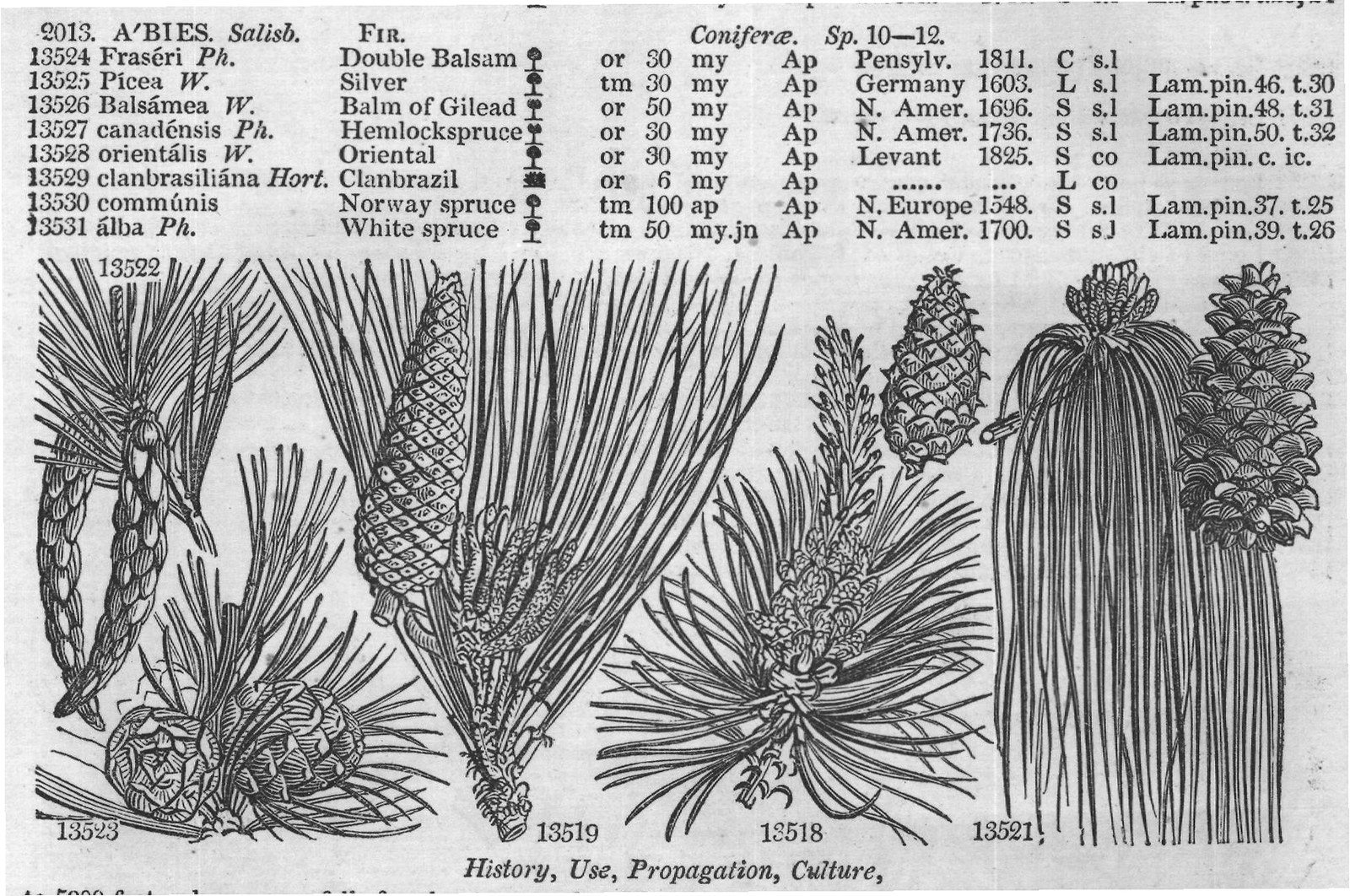
Sp. 10-12. 13524 Fraséri Ph.
Double Balsam or 30 my Ap Pensylv. 1811. Cs.l 13525 Pícea W.
Silver tm 30 my Ap Germany 1603. L s.1 Lam.pin.46. t.30 13526 Balsámea W.
Balm of Gilead or 50 my Ap N. Amer. 1696. S s.1 Lam.pin.48. t.31 13527 canadénsis Ph.
Hemlockspruce or 30 my Ap N. Amer. 1736. S s.1 Lam.pin.50. t.32 13528 orientális W.
Oriental or 30 my Ap Levant 1825. S co Lam.pin. c. ic. 13529 clanbrasiliana Hort. Clanbrazil or 6 my Ap ..
L co 13530 commúnis Norway spruce tm 100 ap Ap N. Europe 1548. S s.1 Lam.pin.37. t.25 13531 álba Ph.
White spruce tm 50 my.jn Ap N. Amer. 1700. S SJ Lam.pin.39. t.26 13522 13523 13519 13518 13521 History, Use, Propagation, Culture, to 5900 feet, where snow falls for about a month. The temperature of the zone M. Decandolle estimates to be similar to that of Scotland, or to the north of France, or of Germany. The wood is resinous, highly inflammable, and is excellent for constructing buildings, being known to continue sound for ages. The Pinus inops, Jersey pine, pitch or scrub pine, is of middle size, straggling growth, and full of resin. Its branches are tougher than those of any other pine, and might be used for many purposes if its wood were not subject to so early a decay. The pitch pine, P. resinosa, is generally known in its native country by the name of Norway pine; sometimes, particularly among the Canadian French, red pine. It grows in close forests, is very tall, and its bark remarkably smooth and red: the timber is very heavy; for which reason it is rejected for masts, though its shape and size appear to recommend it for that purpose. The scrub pine, P. Banksiana, is a small straggling tree, which in some instances, when growing among barren rocks, does not rise above five or eight feet high, though it will grow to a considerable size when by accident or culture it is brought on good eight feet high, though it will grow to a considerable size when by accident or culture it is brought on good soil: trees of this species now in England exude a great quantity of resin from their branches. The yellow pine, P. variabilis, is most in use for building houses as well as shipping. P. tæda, the loblolly or Oldfield pine, is found in large tracts in the southern states of North America: all the woods seem to be filled with its seeds; for when any piece of cleared land is neglected for any space of time, it will be covered with these pines. It is difficult, and in some cases almost impracticable, to recover lands so run over, as the ground appears to have lost all fertile properties for other vegetation. The long leaved, yellow, pitch, or brown pine, P. palustris, is a beautiful as well as very useful tree. The white or Weymouth pine grows in the state of Vermont to an enormous size; it is the best timber in America for masts. 2013. Abies. According to Bullet, this name is derived from one of the dialects of the Celtic, abetoa, whence abete, Italian, abeto, Spanish, &c. Hesychius, the Greek grammarian, calls it aβiv. Abies communis, Sapin, Fr., Fichtenbaum, Ger., and Abiete, Ital., is one of the tallest of European firs, with a very straight but not thick trunk. It is a native of the north of Germany and Russia, and particularly abundant in Norway; its timber being the white deal, and, at an earlier age, the long spars imported from that country and the Baltic. The timber is inferior to that of the common pine in durability and bulk; and being often knotty, is not proportionally strong for horizontal bearings with that timber. White Norway deal, however, is used for a great variety of purposes in building; and the entire trees are more prized than any other for masts for small craft, for spars both for marine purposes and on land. What constitutes the value of this fir is, that its timber is equally durable at any age, like that of the larch; and what renders it peculiarly adapted for masts, spars, scaffolding, poles, &c. is its habit, almost in every case, whether standing single or detached, of growing perfectly erect and straight. The tree may be cut for rods, stakes, and scythes, or other implement handles, when the trunk at the base is not more than two inches in diameter, and the bark being kept on it, it will prove almost as durable as the larch. Pontey says, that poles of spruce are so far inferior to those of larch, that they are more apt to crack when exposed whole to the influence of the sun and air: but in all other respects they are nearly equal to it, and in straightness surpass it. The tree is peculiarly valuable as a nurse, from being evergreen and closely covered with branches, by which radiated heat is retained from a nurse, from being evergreen and closely covered with branches, by which radiated heat is retained; from its conical shape and rigid stem, by which it does not suffocate or whip the adjoining trees; from its being valuable at whatever age it is thinned out; and from its being an excellent shelter for the most valuable game. It will not, however, grow in elevated situations, where the common pine and larch will flourish. It is also an excellent hedge plant for shelter, but is deficient in point of defence and durability. By incision, it yields a resin, from which, by various preparations, turpentine and Burgundy pitch are formed. The tops or sprouts give the flavor to what is called spruce beer.
A. alba, rubra, and nigra, are American firs of the spruce kind, resembling in their general properties those of Europe. The black spruce is reckoned the most durable in America it is used for knees for ship-building, Europe. The black spruce is reckoned the most durable: in America it is used for knees for ship-building, where neither oak nor larch can be easily obtained. These knees are not prepared from two diverging branches, as in the oak, but from a portion of the base of the trunk connected with one of the largest diverging roots. The timber of the red spruce is universally preferred throughout the United States for sail yards, and, indeed, imported for this purpose into Liverpool from Nova Scotia, where it is also used for constructing casks for salted fish. It is chiefly from the decoction in water of young shoots of the black spruce, and not exclusively from those of the white species, as supposed by Lambert, that the celebrated beer is prepared by fermentation, with a due proportion of sugar and molasses. The essence of spruce of the dealers is prepared by evaporating this decoction to the consistence of honey.
A. picea displays a more stable and majestic form than any of the firs. The upper surface of the leaves is of a fine vivid green, and their under surface has two white lines running lengthwise on each side of the ORDER VIII.
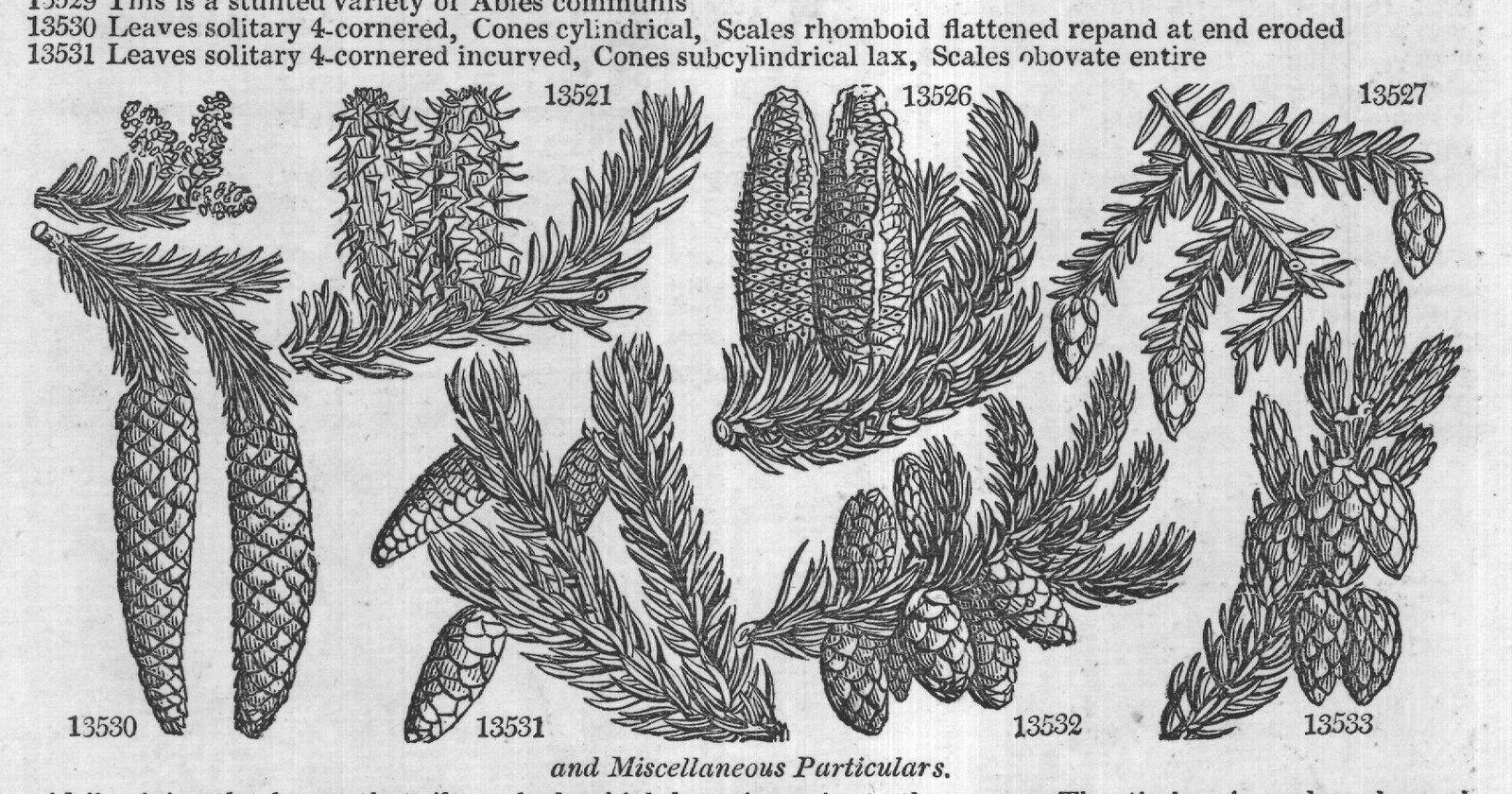
MONECIA MONADELPHIA. 13519 Leaves 8 very long, Cones subcylindrical muricated, Stipules pinnatifid ragged persistent 13520 Lvs. very fine and slender of a bright glaucous green, Cones oblong pendulous, Scales obtuse spreading 13521 Leaves 3 very fine very long, Sheath long, Stipules entire deciduous, Crest of anthers convex entire 13522 Leaves quinate, Cones cylindrical longer than leaf lax 13523 Leaves quinate, Cones ovate obtuse, Scales appressed, Nuts hard 13524 Leaves solitary glaucous beneath emarginate, Cones ovate obl. erect, Bractes oblong reflexed emarginate 13525 Leaves solitary flat emarginate pectinate, Scales of cone very blunt appressed 13526 Leaves solitary flat emarginate subpectinate suberect above, Scales of the cone in fl. acuminate reflexed 13527 Leaves solitary flat toothletted somewhat distichous, Cones ovate terminal scarcely longer than leaf 13528 Leaves solitary 4-cornered, Cones ovate cylindrical, Scales rhomboid 13529 This is a stunted variety of Abies communis 13530 Leaves solitary 4-cornered, Cones cylindrical, Scales rhomboid flattened repand at end eroded 13531 Leaves solitary 4-cornered incurved, Cones subcylindrical lax, Scales obovate entire 13530 13531 13521 13526 13532 13527 13533 and Miscellaneous Particulars. midrib, giving the leaves that silvery look which has given rise to the name. The timber is reckoned much inferior in value to that of the common pine, or of the white spruce. It should not be cut till after forty or fifty years growth; at this age, if it has grown in a sheltered rocky steep or dell, it will be found to have produced a great bulk of timber. It is more prolific in resinous matter than any other tree of the fir kind. A. balsamea is a tree of more delicate habits than the silver fir: its timber is of little value, and the balm or resin procured from it possesses no medical properties superior to those of common turpentine. During summer, the tree sends out a pleasing terebinthinate odor. A. canadensis is a drooping low evergreeu tree, elegant in appearance, and valuable as growing under the shade or drip of other trees.
All the species of the pine, fir, and larch families, with the exception of one or two, as yet rare in this country, are raised from seeds. The cones are gathered in the winter season, and exposed to the sun, or to a gentle heat on a kiln, in order to facilitate the separation of the seeds. The cones of the cedar should be kept for a year at least after they are taken from the tree, before the seed be attempted to be taken out. This is necessary on account of the soft nature of the seeds, and the great quantity of resinous matter which the cones contain when growing, and which is discharged by keeping. Cedar cones are generally imported from the Levant, and the seeds retain their vegetative powers for many years. The cones of the Scotch pine, spruce, and larch, are the principal kinds which are opened by kiln heat. The cones of the Weymouth pine, silver fir, and balm of Gilead fir, give out their seeds with very little trouble. April is the best season for sowing all the species. The soil should be soft and rich, well mellowed by the preceding winter's frost and snow, carefully dug and raked with a long toothed rake as finely as possible. The rarer sorts are generally sown in pots, but the more common in beds. The manner of sowing is by first drawing off the surface of the bed to the depth of half an inch; then drawing a light roller along it to render the surface perfectly even; next depositing the seed; and afterwards replacing the earth drawn off with a spade as evenly as possible. This is what is technically called bedding in, and is one of the nicest operations of nursery culture. The seed of the Scotch pine and Pinaster require a covering of half an inch in depth; those of the Weymouth pine, three quarters of an inch; and those of the stone pine, an inch and a quarter. The Cedar is generally sown in broad pots, or boxes of light sandy loam, and covered half an inch. The seeds of the larch require a covering of only a quarter of an inch; those of the spruce fir, an inch; those of the silver fir and balm of Gilead fir, from half to three quarters of an inch. The seeds of the American spruce fir are smaller than those of any of the preceding kinds, and therefore require a lighter covering than any of them; one-fifth of an inch is quite sufficient. The strictest attention is required, both in regard to quality of soil, and thickness of covering the seed; for though resinous trees are extremely hardy when grown up, yet they are all very tender in infancy. In sowing the seed, a considerable loss will be sustained by the suffocation of young plants if it is deposited too thick, and by the want of plants if too thin. The judicious gardener will be regulated by the goodness of the seed, and the size of the foliage of the different species. The raising regular crops of the pine family is reckoned a master piece of nursery culture in the open ground; and as it has been most extensively practised in the Scotch nurseries, it is generally considered as best understood there. (See Sang. Plant. Kal.) The pine, fir, and larch families benefit less by transplanting in the nursery than the non-resinous trees. And in general, where circumstances admit, the better plan is to remove them at once from the seed-bed at two years old, to where they are finally to remain. The more delicate species, including the cedar and most of the pines, are best transplanted into pots, unless they can be placed at once where they are to remain. The more common pines and firs are transplanted at two years of age into nursery lines, about the middle of April for all the tribe, excepting the larch, which, being deciduous, should be transplanted in February. No description of tree-plants receive so much injury as this tribe from the loss of roots, from the roots being exposed to the air by being kept long out of the soil, or from compression and exclusion of air and moisture by being kept in close bundles, or thick layers. They should, therefore, be finally planted as soon as possible after removal from the nursery; and, indeed, whenever it is practicable, no more should be taken up in one day than can be planted that day or the next. Nor are any plants more easily deprived of the vital principle, by packing and carriage either by sea or land; though, being all evergreens, excepting the larch, they do not readily show it. This has been stated to us by experienced planters in Wales and different parts of England, as the reason why so few trees are finally produced from the immense numbers of Scotch pine and larch fir annually sent to the south by the Scotch nurserymen. Abies Balsamea forms an elegant tree forty or fifty feet high. It grows in high and cold situations in the northern states of North America, where it is called balsam of Gilead fir, fir balsam, and American silver fir. 3F3 MONECIA MONADELPHIA.
CLASS XXI. 13532 rúbra Ph. 13533 nígra Ph.
Red spruce tm 50 my Ap N. Amer. 1755. S s.1 Lam.pin.43. t.23 Black spruce tm 50 my Ap N. Amer. 1700. S s.l Lam.pin.41. t.27 2014. LA'RIX. Salisb.
LARCH.