Home › C › Cruciferæ (Sp water cu jl W Britain al)
Cruciferæ (Sp water cu jl W Britain al)
Sp. 1. water cu jl W Britain al.lak. Sm.s Eng. bot. 732 CLEOME.
Capparideæ. Sp. 15-53.
Celandine-flow. viscid pr 1 jn.jl R E. Indies 1790. S s.p pr 2 jn.jl F three-leaved pr 1 jn.jl W five-leaved pr 2 jn.jl W gigantic pr 6 jn.jl G white-fl. prickly pr 2 jn.jl W red-fl. prickly pr 2 jl.au R spinósa B. M. 1640. 9330 Houstóni H. K.
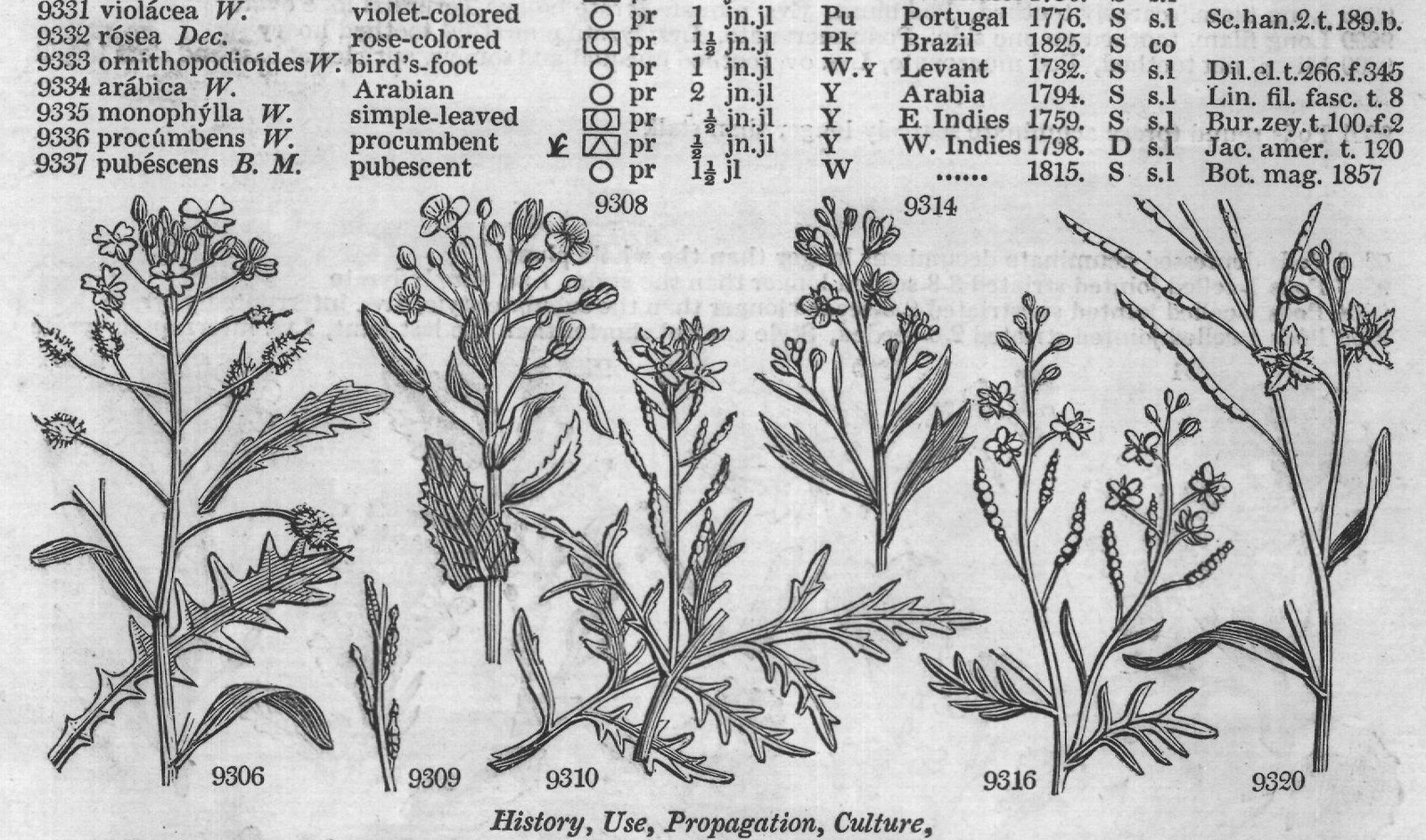
Houstoun's pr jl 9331 violácea W. violet-colored pr 1 jn.jl Pu 9332 rósea Dec. rose-colored pr1 jn.jl Pk 9333 ornithopodioídes W. bird's-foot pr 1 jn.jl W.Y 9334 arábica W.
Arabian 9335 monophýlla W. simple-leaved pr 2 jn.jl prjn.jlY Y 9336 procúmbens W. procumbent pr jn.jl Y 9337 pubescens B. M. pubescent pr W Ceylon 1730. S s.p Rhee.mal.9. t.23 India 1795. S s.p India 1640. S s.p S. Amer. 1774. C s.p W. Indies 1731. S s.p W. Indies 1812. S s.I W. Indies 1730. S s.l Portugal 1776. S s.l Brazil 1825. S co Levant 1732. S s.1 Arabia 1794. S s.1 E. Indies 1759. S s.1 W. Indies 1798. D s.l 1815. S s.l ......
Bur.zey.t.100.f.1 Jac. vind. 1. t. 21 Jac. obs. 4. t. 761 Marcg.bras. t.34 W.ho.ber.1. t.18 Sc.han.2.t.189.b.
Dil.el.t.266.f.345 Lin. fil. fasc. t. 8 Bur.zey.t.100.f.2 Jac. amer. t. 120 Bot. mag. 1857 9308 9314 9306 9309 9310 9316 9320 History, Use, Propagation, Culture, 1444. Bunias. From Cέvoς, a hill, because the plants grow upon exposed open situations. Linn. 1445. Erucaria. See Eruca, No. 1437. Plants with the habit of Cakile. 1446. Heliophila. From ήλios, the sun, and φiλεω, to love; a plant loving heat. All the species grow upon These are mostly beautiful annual or perennial plants. dry hot plains at the Cape of Good Hope.
CLASS XV.
TETRADYNAMIA. 9306 Pods 4-cornered: angles crested, Radical leaves runcinate 9307 Pods 4-cornered: angles crested, Leaves all lanceolate 9308 Pods ovate 2-celled not crested somewhat warted 9309 Pod style-bearing, Lvs. pinnated, Lobes linear: of the lower pinnatifid; of the upper entire 9310 Stigma sessile, Beak longer than pod, Lvs. pinnated thick, Lobes linear 9311 Smooth, Pods rounded narrowed at each end, Leaves linear subulate 9312 Smooth, Pods moniliform, Lower lvs. opp.: upper altern. cord. stem-clasping obl. entire 9313 Smooth, Pods moniliform pendulous, Lvs. pinnated in 3-5-pairs, Lobes linear entire 9314 Hispid, Pods linear, Lvs. hairy either linear entire or trifid at end and cuneate at base 9315 Hispid, Pods linear, Lvs. oval entire or here and there coarsely cut-toothed 9316 Smooth, Pods linear, Leaves pinnated, Lobes and rachis linear entire 9317 Downy, Pods linear spreading, Lvs. pinnated or bipinnated: lobes filiform 9318 Velvety, Pods linear nodding, Lvs. pinnated somewhat fleshy: lobes subfiliform furrowed above 9319 Smooth, Pods linear erect or pendulous, Lvs. fleshy half round 9320 Pods linear compressed velvety, Style thick conical smooth, Leaves oblong 9321 Pods compressed stalked, Leaves linear lanceolate 9322 The only species 9323 Polyandrous hairy, Lvs. 5-7 cuneiform rough, Racemes term. Pods filiform 9324 Flowers dodecandrous, Leaves quinate and ternate 9325 Flowers dodecandrous, Leaves ternate 9326 Flowers gynandrous, Leaves quinate, Stem unarmed 9327 Flowers hexandrous, Leaves 7, Stem unarmed 9328 Flowers hexandrous, Leaves 7-5, Stem spiny 9329 Flowers hexandrous, Leaves quinate viscid, Stem spiny 9330 Prickly hexandrous, Leaves quinate and ternate: floral simple, Stigma dilated 9331 Flowers hexandrous, Leaves ternate and solitary, Leaflets lanc. lin. entire 9332 Unarmed, Lvs. 5: lower and floral 3; upper sessile ovate, Pod smooth as long as its stalk 9333 Flowers hexandrous, Leaves ternate, Leaflets oval-lanceolate 9334 Flowers hexandrous, Leaves ternate lanceolate blunt, Pods fusiform viscid 9335 Flowers hexandrous, Leaves simple ovate-lanceolate stalked 9336 Flowers hexandrous, Leaves simple lanceolate stalked, Stems procumbent 9337 Unarmed pubescent, Leaves 5-7: floral simple cordate, Pod the length of the stalk 9322 9331 9324 9333 9327 9336 9329 9337 and Miscellaneous Particulars. 1447. Subularia. From subula, an awl, on account of the form of the leaves. A curious little aquatic, not of common occurrence. . 1448. Cleome. A name employed by Octavius Horatius, a Latin physician, who lived in the fourth century, to designate a plant resembling Sinapis, and growing in humid places. It appears to have had no relation to designate a plant resembling Sinapis, and growing in humid places. It appears to have had no relation to the modern plant. bill #301 @status rabari site since gas a dein to mohil MONADELPHIA.
CLASS XVI.
CLASS XVI. - MONADELPHIA.
THIS class is distinctly characterized by the filaments being united together throughout the whole or a part of their length; and for the most part consists of plants belonging to the natural orders of Malvaceæ and Geraniaceæ. Of the former, the major part are of little moment, consisting, in a great measure, of weeds or worthless shrubs of various parts of the world. Among them, however, are some plants both of interest and ornament, especially the beautiful Astrapæa, and the various species of Bombax and Hibiscus. The Gossypium, so important as producing the material of cotton, and the Adansonia or Baobab tree of Africa, remarkable for its immense size and use as an article of food, are found in this class. The Geranium, Camellia and Passion flower are also genera of much beauty; the latter yielding the well known West Indian fruit called the Granadilla. The common Tamarind, with which this class commences, would more properly be placed in the next, and the succeeding genera of Patersonia, Tigridia, Ferraria, and Galaxia, are in every respect, except the union of their filaments, referable to the third class. Order 1. TRIANDRIA.
Stamens 3. 1449. Tamarindus. Petals 3, ascending. Three filaments longer than the others and fertile. Legumen 1-3-celled, pulpy inside. 1450. Patersonia. Cor. tubular. Limb 6-parted, with 3 small segments. Caps. 3-celled, inferior. 1451. Ferraria. Spatha 2-leaved.
Caps. 3-celled, inferior. 1452. Tigridia. Spatha 2-leaved. Cal. O. Petals 6, the 3 outer large. Filaments united into a very long Petals 6, wavy, curled.
Filaments united at base. Style 1. tube. 1453. Galaxia. Spatha 1-leaved. sule 3-celled, inferior.
Corolla monopetalous, 6-cleft, with a long tube. Style 1. Cap- Order 2. PENTANDRIA.
Stamens 5. 1454. Waltheria. Cal. 5-fid, with a lateral deciduous 3-leaved involucre. Petals 5. Style 1. Stigma pencilled. Caps. 1-celled, 2-valved, 1-seeded. 1455. Hermannia. Cal. nearly naked, campanulate, 5-fid. Pet. 5. Stamens 5. Filaments united at base, lanceolate, frequently winged. Styles 5, cohering in one. 1456. Melochia. Cal. 5-fid, naked, or with 1-3 bracteæ. Petals 5, spreading. Stam. 5, monadelphous at base. Styles 5. Caps. 5-celled. Seeds 1-2 in each cell. Caps. 5-celled, 5-valved, 1457. Melhania. Cal. 5-parted, persistent, with a 3-leaved involucre on one side. Pet. 5. Stam. 10, alternately sterile: the fertile ones bearing from 1-2 anthers each. 1458. Ochroma. Cal. double, outer 3-leaved. Petals 5. Anthers anfractuose. Capsule 5-celled, manyseeded. Seeds involved in wool. 1459. Passiflora. Cal. 5-parted, colored. Petals 5 or o, inserted in the calyx. Crown of many filiform rays. Fruit stalked, fleshy. 1460. Erodium. Cal. 5-leaved. Petals 5. of the stamens. Cocci 5, 1-seeded, awned, at the base of a rostrate receptacle. many-seeded.
Scales 5, alternate, with filaments and honey glands at the base Order 3. HEPTANDRIA.
Stamens 7. 1461. Pelargonium. Cal. 5-parted, the upper segment ending in a nectariferous tube running down the peduncle. Cor. 5-petalous, irregular.
Order 4. OCTANDRIA.
Stamens 8. 1462. Aitonia. Cal. 4-parted. Cor. 4 petals. Style 1. Berry dry, quadrangular, 1-celled, many-seeded. Order 5. DECANDRIA. 8 Stamens 10. 1463. Geranium. Cal. 5-leaved. Petals 5, regular. Glands 5, honey-bearing, united to the base of the longer filaments. Cocci 5, 1-seeded, awned, at the base of a beaked receptacle. Order 6. DODECANDRIA.
Stamens 12. 1464. Brownea. Cal. tubular, bifid. Cor. double: outer 5-fid; inner of 5 petals. Legumen 1-celled. 1465. Monsonia. Sepals 5. Pet. 5. Stamens 15, united; their cup 5-fid. Style 5-fid. Cocci 5, 1-seeded awned, at the base of a beaked receptacle. 1466. Helicteres. Cal. tubular, obliquely 5-fid. Petals 5, Germen on a long stalk. Style about 5-fid. Caps. 5, 1-celled, many-seeded, spirally twisted. 1467. Dombeya. Cal. double, outer 3-leaved, deciduous. Petals 5. Stamens 20, of which 5 are sterile. Style 5-fid. Caps. 5, united, 1-celled, 1-many-seeded. 1468. Pentapetes. Cal. double, outer 3-leaved, deciduous. Petals 5. Stamens 20, of which 5 are barren. Style obsoletely 5-toothed, Caps. 5-celled, many-seeded, with contrary dissepiments. 1469. Astrapæa. Flowers umbellate, with an involucre. Involucre many-leaved, unequal. Cal. simple, 5-leaved, with 1 bract. Petals 5, convolute-closed. Stamens 25, united into a tube bearing the corolla: 5-sterile. 1470. Pterospermum. Cal. simple, 5-parted. Petals 5. Stamens 20, of which 5 are sterile. Style cylindrical, Stigma thickish, Caps, woody, 5-celled. Seeds winged. CLASS XVI.
MONADELPHIA.
Order 7. POLYANDRIA. 1471. Malope. Cal. double, outer 3-leaved. Capsules heaped without order, 1-seeded. 1472. Malva. Cal. double, outer 3-leaved. Capsules many, 1-seeded. 1473. Kitaibelia. Cal. double, outer 7-9-fid. 1474. Althæa. Cal. double, outer 6-9-fid. Capsules many, 1-seeded. 1475. Lavatera. Cal. double, outer 3-fid. Capsules many, 1-seeded. 1476. Malachra. Common calyx 3-leaved, Stamens indefinite in number.
Caps. clustered in a 5-lobed head, 1-seeded. many-flowered, large. Caps. 5, 1-seeded. 1477. Urena. Cal. double, outer 5-fid. Capsule 5-celled, 5-partible, with close 1-seeded cells. 1478. Pavonia. Cal. double, outer many-leaved. Stigmas 10. Capsules 5, 2-valved, 1-seeded. 1479. Achania. Cal. double, outer many-leaved. Cor. convolute, closed. Stigmas 10. Berry 5 celled, 5-seeded. 1480. Hibiscus. Cal. double, outer many-leaved. Stigmas 5. Capsule 5-celled, many-seeded. 1481. Gossypium. Cal. double, outer 3-fid. Caps. 5-celled. Seeds enwrapped in wool. 1482. Redoutea. Cal. 5-parted, surrounded by a 10-12-leaved involucre. Stigmas 3. Capsules 3-celled, 3-valved, many-seeded, with three placentas alternate with the valves, and bearing on each side woolly seeds. 1483. Palavia. Cal. naked, 5-fid. Capsules many, 1-seeded, united in a head without order. 1484. Cristaria. Cal. naked, 5-fid. Fruit orbicular, depressed, covered with a skin, and consisting of several carpella, 2-winged in the centre, and many-seeded. 1485. Anoda. Cal. naked, 5-fid. Lobes acuminate, much spreading in fruit. Caps. hemispherical beneath, depressed and stellate above, many-celled, with 1-celled, 1-seeded divisions. 1486. Periptera. Cal. naked, 5-fid. Petals erect, spirally twisted in the tube, at length distinct. Capsule stellate, many-celled, with 1-seeded cells. 1487. Sida. Cal, simple, angular. Style many-parted. Capsules several, 1 or 3-seeded. 1488. Lagunea. Cal. simple, 5-fid. Style 5-fid. Capsule 5-celled, with contrary dissepiments. 1489. Ruizia. Cal. double, outer 3-leaved. Styles 10. Caps. 10, 1-celled, 2-seeded, closely cohering. 1490. Carolinea. Cal. simple, subtruncate. Filaments branched. Style very long. Stigmas 6. Caps. woody, 1-celled, many-seeded. 1491. Adansonia. Cal. simple, deciduous. Style very long. Stigmas many. Caps, woody, 10-celled, manyseeded, with a farinaceous pulp. 1492. Bombax. Cal. 5-fid. Stamens 5, or many. Caps. woody, 5-celled, 5-valved. Seeds woolly. Receptacle 5-cornered. 1493. Myrodia. Cal. naked, tubular, 4-5-toothed, bursting laterally. Petals oblong, linear. Stamens with a long column. Anthers 10-15. Capsule drupaceous, 2-3-celled, with 1-seeded cells. leafy wing. 1494. Gordonia. Cal. simple. Style 5-cornered, with a 5-fid stigma. Caps. 5-celled. Seeds twin, with a 1495. Stuartia. Cal. simple, rotate, Petals 5. Styles 5, united or distinct. Caps. 5-celled, 5-valved. Seeds 1496. Camellia. Cal. imbricated, many-leaved, the inner leaflets largest. solitary or twin. 1497. Barringtonia. Cal. 2-leaved, superior. Petals 4. Drupe dry, large, quadrangular, with a 4-celled ut. 1498. Gustavia. Cal. 4-6-fid. Petals 4-6. Berry dry, 4-5-celled. 1499. Careya. Cal. superior, 4-fid. Petals 4. Berry many-seeded. Seeds nestling in pulp. MONADELPHIA TRIANDRIA.
CLASS XVI.
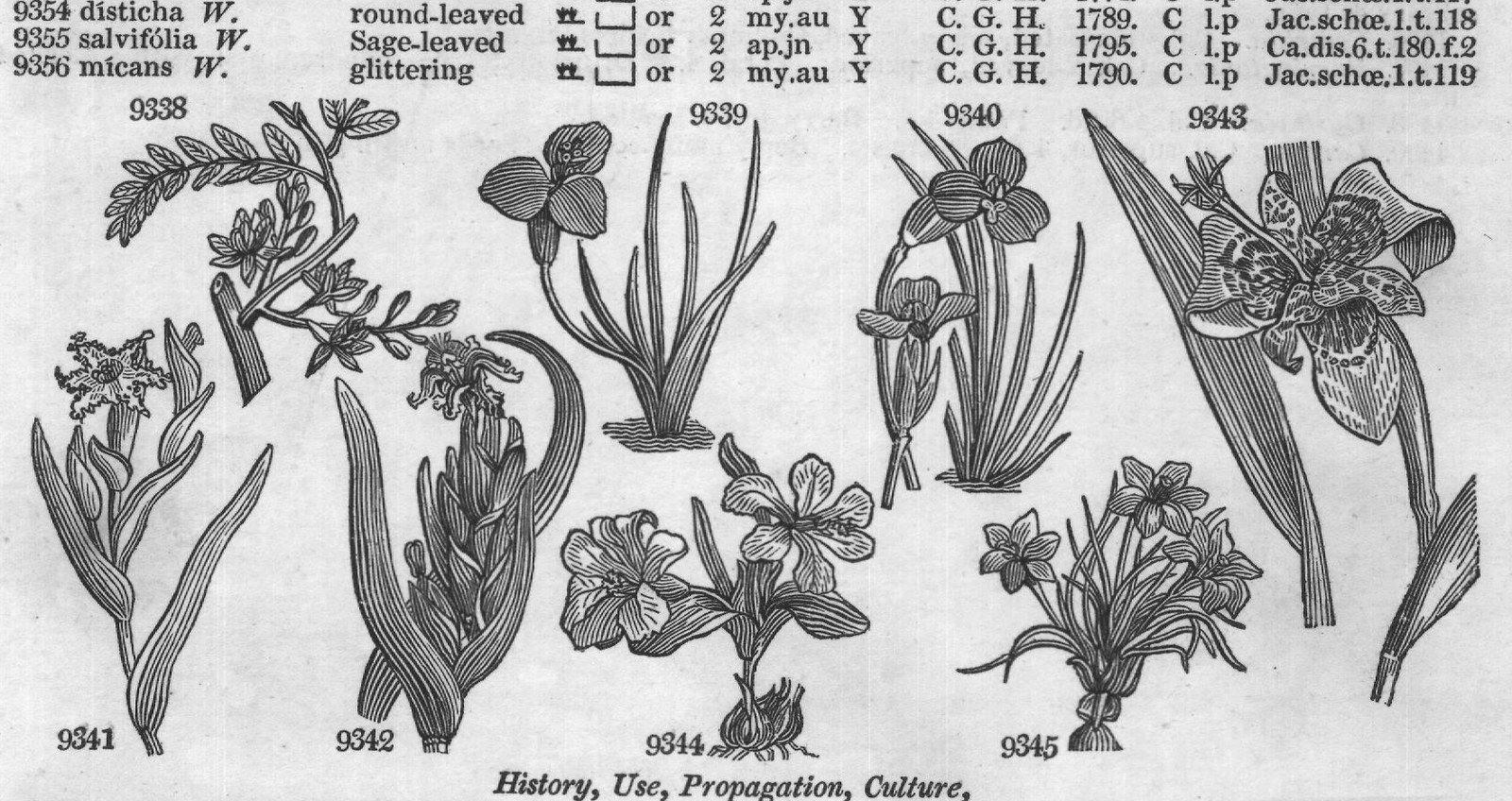
TRIANDRIA. 1449. TAMARIN'DUS. W. TAMARIND TREE. 9338 índica W. common fr 60 jn.jl Leguminosæ. Sp. 1.
Y India 1633. Cr.m Jac. amer. t. 10 9339 serícea R. Br. silky 9340 glabráta R. Br. smooth 1450. PATERSONIA. R. Br. PATERSONIA. 1451. FERRA'RIA. Ker. FERRARIA. or 1 my.jl B 2 Aor 1 my.jl Pu N. S. W.
Irideæ. Sp. 2-7.
N. S. W. 1803. R s.p 1814. C s.p Bot. mag. 1041 Bot. reg. 51 9341 unduláta W. curled or 9342 antherósa Ker. variegated or Irideæ. Sp. 2-4. mr.ap G.Br C. G. H. mr.jl G.Br C. G. H. 1755. O s.p 1800. O s.p Bot. mag. 144 Bot. mag. 751 1452. TIGRI DIA. J.
TIGER FLOWER.
Irideæ. Sp. 1-2. 9343 Pavónia P. S.
B leóna Hort. 1453. GALAXIA. W. 9344 ováta W.
Mexican whole-colored YO YOU or my.s O.R Mexico 1796. O s.p Bot. mag. 53 or my.s O.R Mexico 1823. O s.p ẞ grandiflóra B. R. y mucronuláris Sal. versicolor Sal.
GALAXIA. oval-leaved great-flowered mucronated Irideæ. Sp.2-3. or my.s D.Y C. G. H. 1799. s.p Bot. rep. 94 or my.s D.Y C. G. H. 1799. or my.s Pu C. G. H. 1799. various-colored Aor my.s Pu C. G. H. 1799. 9345 gramínea W. narrow-leaved or jlau LY C. G. H. 1795. s.p Bot. rep. 164 s.p J.ic. t.291.f.in.si. s.p Jac. f. inf. dextr. s.p Bot. mag. 1292 1454. WALTHERIA. W. WALTHERIA.
PENTANDRIA.
Byttneriace.
Sp.4-12. 9346 americána W.
American un 2 my.o Y S. Amer. 1691. C 1.p Jac. ic. 1. t. 130 9347 índica W.
Indian 9348 ellíptica W. woolly un 9 jn.au Y un 3 E. Indies 1799. L p.l Burm. zeyl. t. 68 ...
Y 9349 læ'vis Schrank. smooth un 3 jl Y E. Indies 1812. C s.p Guadalou.1823. C s.p Ca.dis.6.t.171.f.2 Schrank mon.55 1455. HERMAN'NIA. W. HERMANNIA.
Byttneriaceæ. Sp. 34-42. 9350 althæifólia W.
Althæa-leaved or 2 mr.jl Y C. G. H. 1728. C l.p Bot. mag. 307 9351 plicáta W. plaited-leaved 2 or 2 n.d Y C. G. H. 1774. C 1.p Jac.schœ.2.t.213 9352 glandulósa Link. glandular or 2 ...
C. G. H. 1822. C 1.p 9353 cándicans W. white or 2 ap.jn Y C. G. H. 1774. C 1.p Jac.schœ.1.t.117 9354 dísticha W. round-leaved ☐ or 2 my.au Y C. G. H. 1789. C 1.p Jac.schœ.1.t.118 9355 salvifólia W.
Sage-leaved or 2 ap.jn Y C. G. H. 1795.
Cl.p Ca.dis.6.t.180.f.2 9356 mícans W. glittering or 2 my.au Y C. G. H. 1790. C 1.p Jac.schœ.1.t.119 9338 9339 9340 9343 9341 9342 9344 9345 History, Use, Propagation, Culture, 1449. Tamarindus. Latinized from the Arabic name Tamer-hindy, or Indian date. This tree is a native of the East and West Indies, of Arabia, and Egypt. It is a large beautiful spreading tree. The leaves are abruptly pinnate, composed of sixteen or eighteen pairs of sessile leaflets, half an inch only in length, and one sixth of an inch broad, of a bright green color, downy, oblong, entire, and obtuse: the flowers are in loose bunches of five or six, which come out from the sides of the branches: the calyx is of a straw yellow color, and deciduous: the petals also yellowish, and beautifully variegated with red veins; ovate, concave, acute, indented, and plaited at the edge; and the filaments purplish, bearing incumbent brownish anthers: the pods are thick, compressed, and of a dull brown color when ripe: those from the West Indies from two to five inches long, with two, three, or four seeds: those from the East Indies are twice as long, and contain five, six, or seven seeds: the seeds in both are flat, angular, shining, and lodged in a dark pulpy matter. In the West Indies, the pods are gathered in June, July, and August, when fully ripe; and the fruit being freed from the shelly fragments, is placed in layers in a cask, and boiling syrup poured over it, till the cask is filled; the syrup pervades every part quite down to the bottom; and when cool the cask is headed for sale. (Long's Jamaica, iii. 729.) The East India tamarinds are darker colored and drier, and are said to be preserved without sugar. Tamarinds are inodorous, and have an agreeable acid sweetish taste. The acid taste chiefly depends on the citric acid, the quantity of that being greater than of the other. The pulp is refrigerant, and gently laxative. The simple infusion of the pulp in warm water, or a whey made by boiling it in milk, forms a very grateful refrigerant beverage, which is advantageously used in febrile diseases. The dose of the simple fruit required to act upon the bowels is so large, that it is seldom given alone as a purgative, but is generally combined with cassia or manna, the action of which it augments, or with such of the neutral purgative salts as are not decomposed by it; which is the case with those that have potass for their base, and are therefore incompatible in mixtures with this fruit. (Thompson's London Dispensatory, 534.) The plants thrive in loam and peat, and root under a glass in sand. They form handsome objects, but in our stoves are seldom allowed sufficient room to flower. Miller says, he had several plants twenty years old, and upwards, of fifteen feet high, which never had shewed blossoms. ORDER I.
MONADELPHIA TRIANDRIA. 9338 The only species 9339 Stigma deflexed, Scape and spathes silky, Leaves ensiform straight striated 9340 Stigma deflexed, Scape and spathes smooth shining, Keel of leaves woolly at base 9341 Stem branched, Leaves equitant ensiform equal wavy; inner twice as narrow as the outer 9342 Stem simple, Leaves equitant ensiform; lower narrow 9343 Stem simple wavy, Leaves ensiform nerved. Petals flat; inner small panduriform 9344 Almost stemless, Leaves oblong, Spathe 1-valved 1-flowered 9345 Almost stemless, Leaves linear filiform dilated at base, Spathe 1-valved 1-flowered PENTANDRIA. 9346 Leaves oval plicate acutely and unequally toothed downy, Heads stalked 9347 Leaves oval plicate bluntly toothed downy, Heads sessile 9348 Leaves lanceolate oblong blunt plicate toothed downy, Heads sessile 9349 Leaves ovate mucronate serrate and stem quite smooth, Heads stalked, Calyxes ciliated 9350 Leaves ovate downy plicate crenate, Lower stipules ovate; upper broad lanceolate, Cal. angular 9351 Lvs . downy hairy ovate subcord. rugose denticulate, Stipules ovate acute, Cal. in fl. cylind. finally inflated 9352 Leaves oval unequally crenate subpubescent, Stipules ovate acute often cut, Stem glandular pubescent 9353 Leaves whitish downy round ovate crenate, Stipules lanceolate subulate, Cal. campanulate spreading 9354 Leaves hispid-villous roundish-ovate blunt toothed, Stipules subovate acuminate, Cal. angular 9355 Leaves downy hispid rugose oblong blunt entire subsessile, Stipules long lanceolate subulate, Fls. naked 9356 Lvs. downy hispid somew. rugose obl. very blunt a little toothed at end with short stalks, Stip. lanc.subul. 9346 9353 9348 9354 9350 9356 9351 and Miscellaneous Particulars. 1450. Patersonia. Named after Colonel William Paterson, a gentleman whose remarks on the Cape of Good Hope, New Holland, and Norfolk Island, have been of much service to botany. Handsome plants, which grow readily in loam and peat, and are increased like other herbaceous vegetables. 1451. Ferraria. Named after Jean Baptiste Ferrari, an Italian botanist, author of a work on the culture of flowers, published in 1633, &c. According to Sweet, " a mixture of sandy loam and peat is the best soil for the species, and they should be kept without water, after they have done growing, till they begin to grow again, when they may be planted in fresh pots and regularly watered: they are increased by offsets from the bulbs, or by seeds." (Bot. Cult. 192.) 1452. Tigridia. In allusion to the spotted flowers, which are marked something like the skin of a tiger. Splendid plants, and tolerably hardy. They do best when planted in the soil and protected by a frame or hand-glass; but will also thrive in sheltered borders, provided they are protected from the winter's frost. They ripen seeds, from which, or from offsets, they may be readily increased. 1463. Galaxia. Thunberg, the author of the name, has not explained its meaning. Like other plants of the bulbous kind, these should be kept dry after flowering and seeding. At the return of the growing season, they should be fresh potted, and kept in a cool part of the greenhouse till they are well rooted, when they may be put into a warmer situation and regularly watered. They seed freely. 1454. Waltheria. In memory of Augustin Frider. Walther, professor of medicine at Leipsic; author of Hortus Proprius, 1735. The species grow in any light rich soil, and are readily propagated. They are of no importance. 1455. Hermannia. In memory of Paul Hermann, who practised physic in Ceylon, and at the Cape of Good Hope, and was afterwards professor of botany at Leyden. He was born in 1640, at Halle, in Saxony, Hope, and was afterwards professor of botany at Leyden. He was born in 1640, at Halle, in Saxony, and died in 1695. The species are low shrubs, for the most part, with wrinkled leaves and yellow flowers, which they produce in abundance. They grow freely in any light rich soil, and are readily increased in the same soil. 9357 frágrans Link. 9358 involucráta W. 9359 scordifólia W. 9360 mollis W.
MONADELPHIA PENTANDRIA.
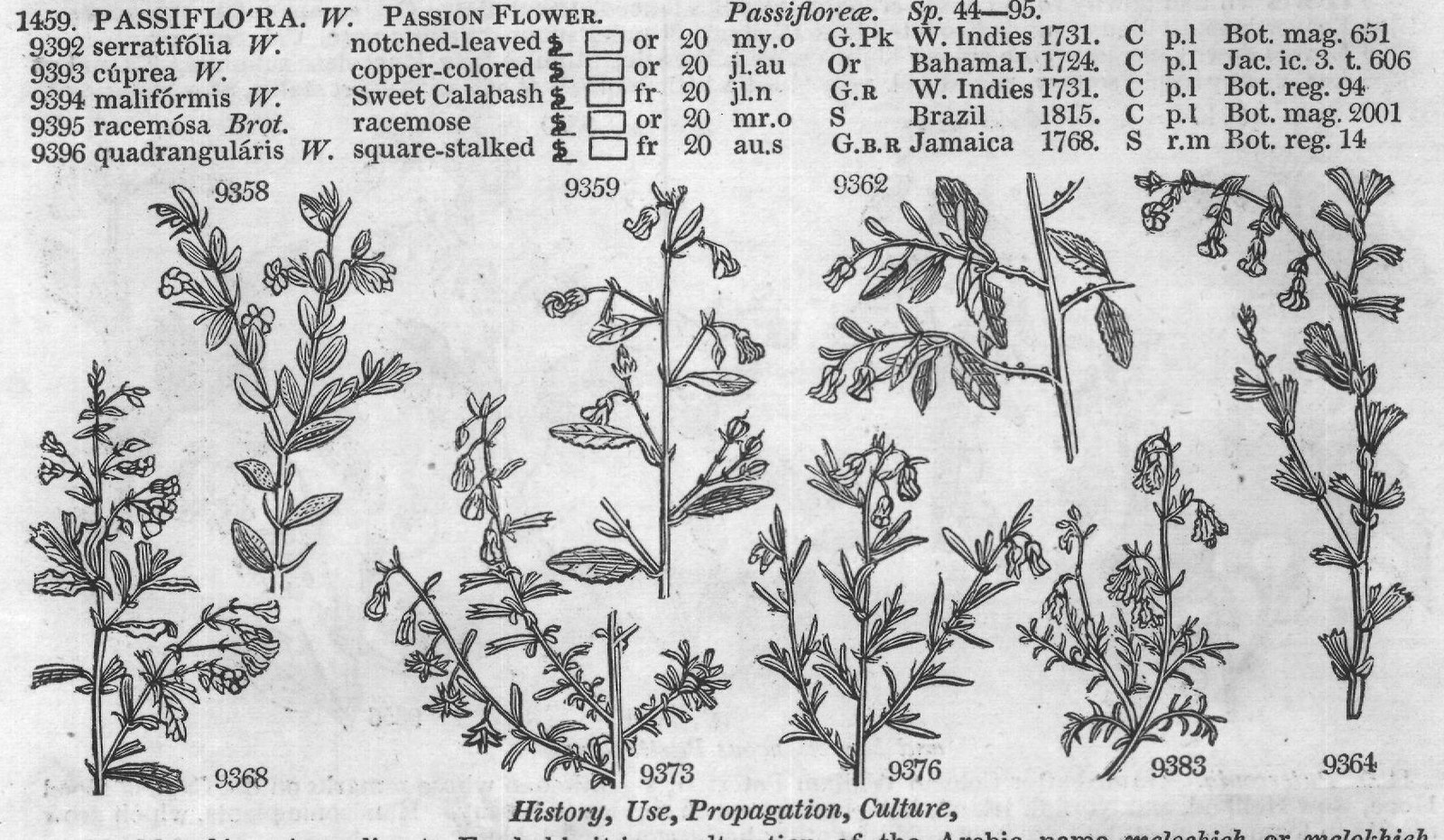
CLASS XVI. fragrant or 2 C. G. H. 1822. C l.p involucred or 2 my.jn Y C. G. H. 1794. C 1.p Ca.dis.6.t.177.f.1 Germander-lv. or 2 ap.n Y C. G. H. 1794. C 1.p Jac.schœ.1.t.120 soft-leaved wor 2 my.jn Y C. G. H. 1814. C l.p 9361 denudáta W. smooth or 2 my.jl Y C. G. H. 1774. C 1.p Jac.schœ.1.t.122 9362 disermæfólia W. simple-flower'd or 2 mr.ap Y C. G. H. 1795. C 1.p Jac.schœ.1.t.121 9363 alnifólia W.
Alder-leaved or 7 f.my Y C. G. H. 1728. Cl.p Bot. mag. 299 9364 cuneifólia W. wedge-leaved or 2 au.s Y C. G. H. 1791. C l.p Jac.schœ.1.t.124 9365 holosericea W. velvet-leaved or 2 my.jn Y C. G. H. 1792. C l.p Jac.schœ.3.t.292 9366 decúmbens W.en. decumbent or 1 my.jn Y C. G. H. 1821. C 1.p 9367 hirsúta W. hairy-branched or 2 my.jn Y C. G. H. 1790. C 1.p Schr. s. han.1.t.4 9368 scábra W. rough-leaved or 3 mr.ap Y C. G. H. 1789. C 1.p Jac.schœ.1.t.127 9369 multiflóra W. many-flowered or 3 mr.my Y C. G. H. 1791. C 1.p Jac.schœ.1.t.128 9370 flámmea W. flame-flowered or 3 ja.d Or C. G. H. 1794. C 1.p Bot. mag. 1349 9371 anguláris W. angular or 3 ap.my Y C. G. H. 1791. C 1.p Jac.schœ.1.t.126 9372 hyssopifólia W.
Hyssop-leaved or 7 ap.jn Str C. G. H. 1725. C 1.p Ca.dis.6.t.181.f.3 9373 trifurcata W. three-forked or 3 ap.jl B C. G. H. 1789. C l.p Jac.schœ.1.t.125 9374 odoráta W. sweet-scented or 3 f.o Y C. G. H. 1780. C l.p 9375 lavandulifólia W. Lavender-leav. or 1 my.s Y C. G. H. 1732. C 1.p Bot. mag. 304 9376 filifólia W. thread-leaved 2 or 1 my.au Y C. G. H. 1816. C l.p Jac.schœ.1.t.123 9377 trifoliáta W. three-leaved or 2 my.au Y C. G. H. 1752. C l.p Ca.dis.6.t.182.f.1 9378 procúmbens W. procumbent or 1½ my.jn Y C. G. H. 1792. C l.p Ca.dis.6.t.177.f.2 9379 grossularifólia W. gooseberry-lvd.or 2 ap.my Y C. G. H. 1731. C l.p 9380 pulverulénta B. R. powdered or 2 my.au Y C. G. H. 1800. C 1.p Bot. rep. 164 9381 incísa W. cut-leaved or 2 jn.jl Y C. G. H. 1806. C 1.p 9382 coronopifólia Link. buckshorn-lvd.or 2 jn.jl Y C. G. H. 1823. C l.p 9383 tenuifolia B. M. slender-leaved or 2 jn.jl Y C. G. H. ...
Cl.p Bot. mag. 1348 1456. MELO'CHIA. W. MELOCHIA.
Byttneriaceæ. Sp. 4-28. 9384 pyramidáta W. pyramidal 9385 tomentósa W. downy 9386 caracásana Jacq.
Caraccas 9387 corchorifólia W.
Corchorus-lvd. 0000 or 1 jl.au Pu Brazil 1768. C p.1 Jac. vind. 1. t. 30 or 2 my.jn Pu or 2 my.jn Y W. Indies 1768. C p.1 Caraccas 1820. C p.l Ca.dis.6.t.172.f.2 Jacq. ic. 507 or 1 jl.au Y E. Indies 1732. S 1.p Dil.el.t.176.f.217 1457. MELHA'NIA. J. MELHANIA. 9388 Erythroxylon H.K. red-wood 9389 Melanóxylon H. K. black-wood