Important: Safety Warning
This page states that certain wild plants are safe to eat. Its identifications and edibility claims are more than a century old and in some cases simply wrong, and deadly look-alikes exist for many edible species. Never eat a wild plant on the strength of this text.
This information has been left in for historical purposes but should not be acted upon.
Cult
371.) G. lutea has a thick root of a yellowish brown color, and very bitter taste. In Switzerland and Germany it occupies extensive tracts of ground untouched by any cattle. It was formerly used as hops in brewing, and is extensive tracts of ground untouched by any cattle. It was formerly used as hops in brewing, and is at present the principal European bitter used in medicine. The root of G. purpurea is as thick as a man's arm and two feet long; it is extremely bitter, and used as a substitute for G. lutea.
G. acaulis and verna are two beautiful edging plants, and answer well in pots. 601. Hydrolea. From ύδωρ, water, and ελaia, oil. It is a water plant, and its leaves are viscous, as if they were smeared with old oil. A very pretty plant with bright blue flowers. smeared with old oil. A very pretty plant with bright blue flowers. 602. Falkia. Named after John Falk, a Swede, born in 1725, died in 1774. He was professor of botany in the apothecaries' garden at St. Petersburg, and followed Pallas during a part of his journey in Siberia. Upon his instance upon record of suicide among naturalists. 603. Dichondra. From dis, double, and χovδρoς, grain; on account of the double nature of the capsule. Little inconspicuous trailing plants, seldom seen or desired in collections. inconspicuous trailing plants, seldom seen or desired in collections. 604. Velezia. So named by Linnæus, in memory of Christoval Velezius, examiner, first physician, and demonstrator of botany in the college of apothecaries at Madrid. A small weed, native of the south of France, resembling a dried up Gentiana. 605. Bumalda. Named after Ovide Montalban, better known under the name of Jean Antoine de Bumalda, born at Bologna, published in 1657 a Bibliotheca Botanica, and in 1668 a Dendrologia. at Bologna, published in 1657 a Bibliotheca Botanica, and in 1668 a Dendrologia. 606. Heuchera. In memory of Jean Henry de Heucher, archiater, and professor of medicine at Witteberg, ORDER II.
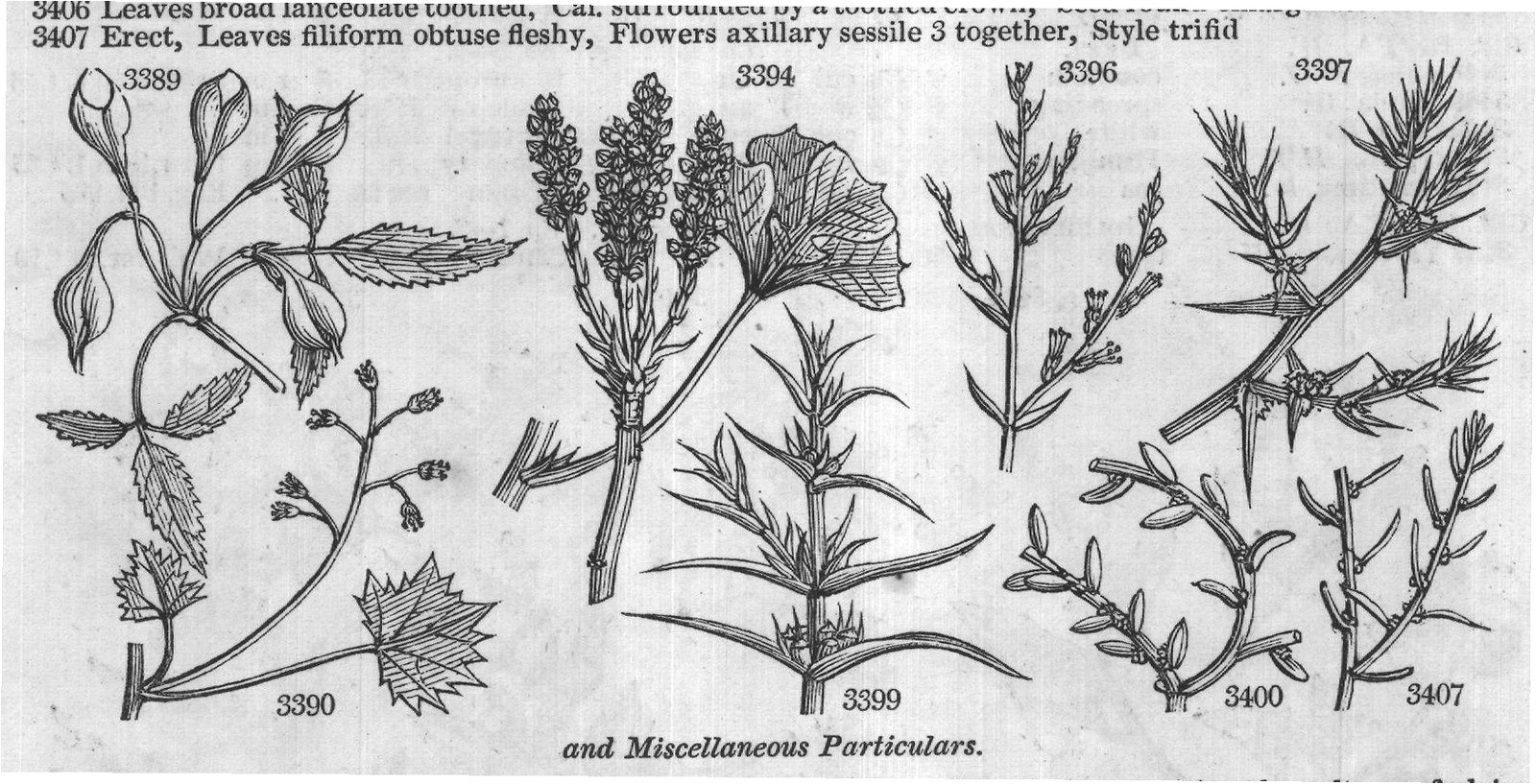
PENTANDRIA DIGYNIA. 3378 Leaves obovate oblong 3-nerved, Flowers terminal clustered, Cor. ventricose not opening 3379 Cor. campanulate 5-cleft terminal and axillary clustered, Intermed. segm. torn, Leaves lanc. 3-nerved Intermed. segm. torn, Leaves lanc. 3-nerved 3380 Cor. 5-cleft hypocrateriform bearded, Segm. lanc. acute, Leaves lanc. Branches shorter than joints 3381 Cor. 4-cleft hypocrateriform obtuse, Orifice bearded, Two outer sepals very large 3382 Cor. 4-cleft, Segm. serrated finely cut in the middle, Leaves lanceolate and linear, Stem flexuose angular 3383 Cor. 4-cleft, Segm. finely cut, Leaves lanceolate acute, Stem erect rounded 3384 Leaves lanceolate, Flowers terminal corymbose, Capsules a little hairy 3385 A creeping plant with cordate obtuse stalked leaves 3386 Pubescent, Leaves reniform retuse and emarginate 3387 Leaves reniform emarginate pubescent beneath 3388 The only species 3389 A slender branched purple shrub 3390 Viscid, Scape and leaves roughish, Leaves rounded lobed toothed, Pet. lanc. Stam. much exserted 3391 Powdery, Scape and lvs. below smooth, Lvs. acutely lobed toothed, Pet. spatulate, Stam. scarcely exserted spatulate, Stam. scarcely exserted 3392 Very villous, Leaves acutely lobed, Pet. shorter than calyx, Stamens exserted 3393 Shrubby at base, Lvs. smooth above acutely lobed toothed, Cal. short villous, Pet. linear, Stam, exserted 3394 Leaves digittate, Leaflets sessile wedge-shaped truncate 3-toothed, Flowers racemose 3395 Leaves digittate, Leaflets 7-3-parted wedge-shaped acuminated serrated at end, Flowers spiked 3396 Leaves subulate, Pericarps not juicy 3397 Spreading hairy, Leaves subulate mucronate, Calyxes solitary, Appendages opened out colored 3398 Leaves subulate mucronate, Calyxes opened out 3399 Smooth, Branches ascending, Lvs. half round acute, Cal. in fruit keeled across the middle membranous 3400 Herbaceous, Leaves rounded smooth, Flowers clustered 3401 Erect spreading hairy, Leaves oblong half round obtuse, Flowers twin axillary 3402 Leaves rounded pubescent, Flowers axillary, Anthers colored 3403 Pubescent, Branches panicled, Leaves filiform with an axillary tuft, Floral very short, Cal. solitary 3404 Tomentose, Cal. with 5 angles and 5 awns, Leaves lanceolate flat 3405 Pubescent, Leaves linear flat, Cal. clustered woolly with a hooked dorsal spine 3406 Leaves broad lanceolate toothed, Cal. surrounded by a toothed crown, Seed round emarginate on one side 3407 Erect, Leaves filiform obtuse fleshy, Flowers axillary sessile 3 together, Style trifid 3389 3390 3394 3399 and Miscellaneous Particulars. 3396 3397 3400 3407 author of Hortus Wittebergensis, 1711-13. Very neat North American plants, requiring the culture of alpine plants. 607. Cussonia. In memory of Cusson, a celebrated botanist, who after laboring to complete the order of umbellate plants, had all his labor annihilated by his wife, who in his absence used the paper upon which his plants had been glued for household purposes. It is a genus of easy culture, and readily increased by cuttings planted in sand and placed under a hand-glass. 608. Anabasis. One of the names given by the Greeks to the Equisetum. A small plant, quite similar to some species of Chenopodium. 609. Salsola. From salsus, salt. From these plants, which are chiefly maritime, is obtained the kelp of our shores. This is a genus of plants producing the alkaline salts called barilla, soda, potash, and kelp. Most of . Most of them are herbaceous and annual, but some have shrubby stems. S. kali, (Qaly or âlqaly, Arabic. Bochart,) is found on the sandy shores of most parts of the world, and is very generally burned for soda for the glass manufacture. S. soda is cultivated in Languedoc and also in Spain for making barilla; but is reckoned inferior to S. sativa, which grows on the Spanish shores of the Mediterranean, and affords all the best soda consumed in Europe. It is called by us Spanish or Alicant soda. In September, the crop is cut and laid in small heaps to dry. These to dry.
These heaps are then collected and burned, forty or fifty of them in a hole, in the ground. Soda is in common use in the manufacture of glass and soap; with sulphuric acid, it forms Glauber's salts; with marine acid, common salt; with the salt of Homberg, borax; and with cream of tartar, Rochelle salt. 610. Kochia. Á genus divided from Salsola by Roth, and named by him after his friend Koch, a German botanist. trailing sand stonecrop 3411 erióphora Schr. woolly 3412 serícea Schr. silky 3413 scopária Schr. summer Cypress cu 3415 úrbicum W. 3408 prostráta Schrad. 3409 arenária Roth. 3410 sedoídes Schr.
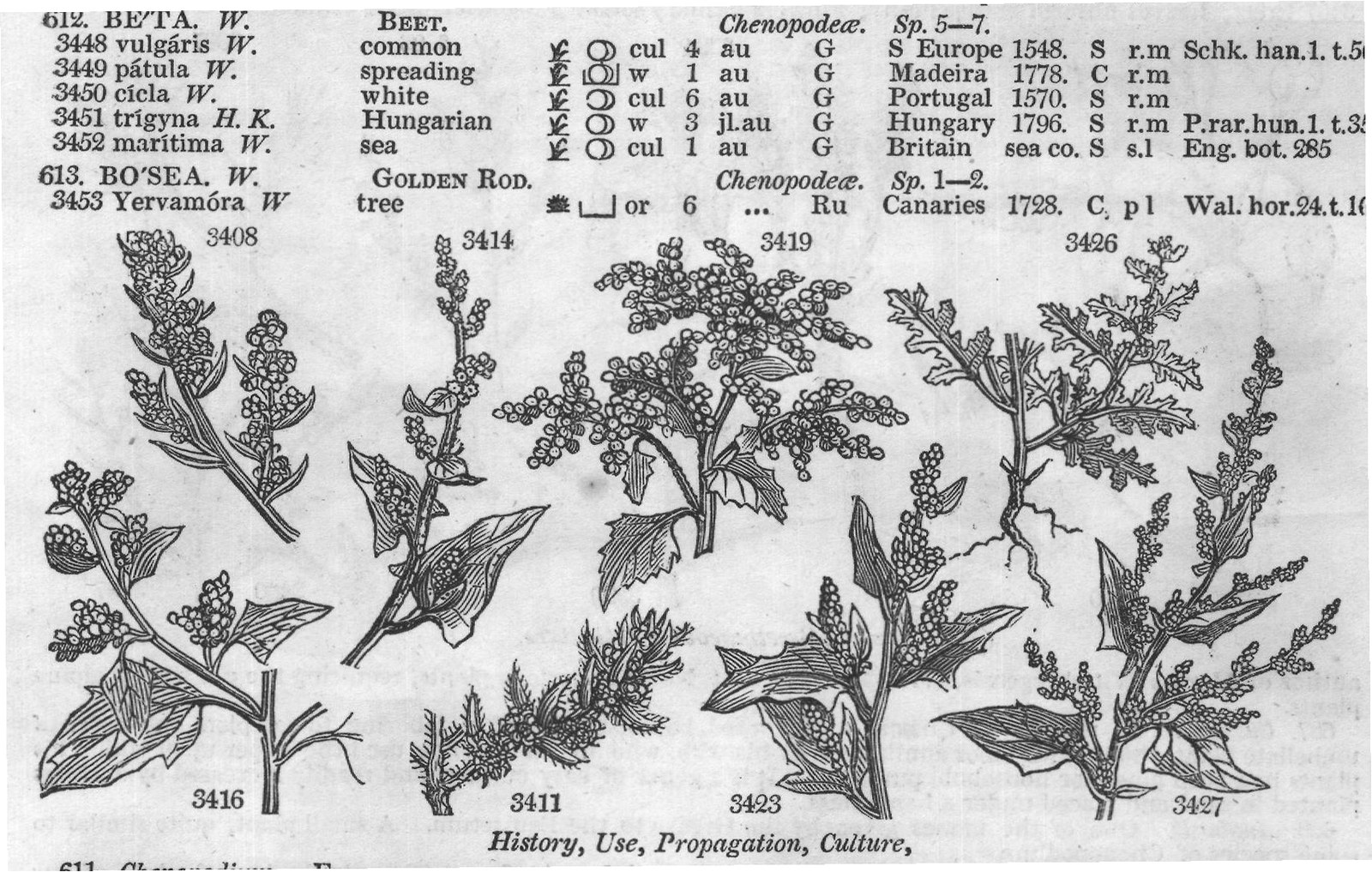
PENTANDRIA DIGYNIA. 611. CHENOPODIUM. W. GOOSE-FOOT. 3414 Bónus-Henrícus W. Engl. Mercury ○[○○○[ W W cu W 2 jn.au G 1 my.jn W.G 2 jn G jn.jl G G cujl Oor 3 jn.s G S. Europe 1780. C s.l Hungary 1822. S s.l Crimea 1821. S s.l CLASS V.
Jac. aust.3. t.294 Pall. ill. t. 35 Schrad. hal. t. 3 Schrad. hal. t. 2 Schr. hal. t.1. f.1 Eng. bot. 1033 Spain C. G. H.
Greece 1823. S s.1 1824. C s.l 1629. S co Chenopodeæ.
Sp. 34-72. 1 my.au G Britain rub. D co upright W 1 au G 3416 Atríplicis W.
Britain dungh. S co Eng. bot. 717 purple W 3 au.s S China 1780. S co 3417 rúbrum W.
Jac. vind. 3. t. 80 red W 2 au.s R 3418 guineénse W.
Britain dungh. S co Eng. bot. 1721 Guinea W 2 au.s G Guinea 1790. S co Jac.ic.rar.2.t.345 3419 murále W. nettle-leaved Ow 1½ au.s G Britain 3420 Quinoa W. rub. S co Eng. bot. 1722 green Quinoa cul 3 jl G Peru 1822. S co ẞ rubrum red Quinoa cul 3 jl G Peru 3421 rhombifólium W.en. angular-leaved 3422 serotínum L. 3423 ficifólium H. K. 3424 álbum W. 3425 hýbridum W. 3426 Bótrys W. 1822. S co Feuill. per. t. 10 Ow 1 jl.s G N. Amer. 1807. S co late W 2 jl.s G Spain 1821. S co Fig-leaved W 2 au.s G England dungh. S co Eng. bot. 1724 white W 1½ jl.s G Britain rub. Sco Eng. bot. 1723 Maple-leaved cut-leaved 3427 botryoídes Sm. many-clustered 3428 fœ'tidum Schr. fetid 3429 multífidum W.
Buenos Ayresw 3430 ambrosioídes W.
Mexican B suffruticósum half shrubby 3431 anthelminticum W. American 3432 gravéolens W. strong-smelling 3433 glaúcum W.
Oak-leaved 3438 laterále W. 3434 crassifólium Par. thick-leaved 3435 ólidum Sm. 3436 polyspérmum W. 3437 caudátum W. 3439 lanceolátum W.cn. 3440 aristátum W. stinking Allseed oval-leaved oblong-leaved spear-leaved bearded 3441 sépium Mayer. hedge 3442 acutifólium E. B. acute-leaved 〇〇〇〇〇〇〇〇○○○○○○○ Ow1au.s G Britain 2 rub. Sco fr 1 jn.s G S. Europe 1548. S co W 1 jn.au R Britain W 4 jn.au G ...... sea sh. S co 1823. S co Eng. bot. 1919 Fl. græc. t. 263 Eng. bot. 2247 2 jn.o G fr 1½ jn.o G Buenos A.1732. D co Mexico 1640. S co Dill.elt. t.66.8.77 Moris.s.5.t.35.f.8 W 3 jl.au G W 4 jl.au G W 1½ jl.au G America 1732. C co Mexico 1823. S co England rub. S co Dill.elt. t.66.f.76 Eng. bot. 1454 W 2 jl G ...... 1809. S co W 1 jl.au G Britain rub. S co Eng. bot. 1034 W 1 jl.au G Britain rub. S co Eng. bot. 1480 W 2 jl.au G Guinea 1806. S co Jac. ic. 2. t. 344 w 1 au.s G ...... 1781. S co W 2 jl G Pensylva. 1809. S co W 1 jn.s G Virginia 1771. S co Gm.sib.3.t.15.f.1 W 2 jn.jl G Moravia 1823. S co W 1 jl.au G.
Britain unc.gr. S co Eng. bot. 1481 3443 marítimum W.
Sea Blite W 3 au 3444 fruticósum W. en. shrubby ec 2 au.s டுரு G Britain G sal.m. S co England sea sh. C co Eng. bot. 633 Eng. bot. 685 Salsóla fruticosa E. B. 3445 altíssimum W.en. grass-leaved W 6 jl.au G 3446 sálsum R. Br.
Saltwort W 1 au.s G Italy 1775. S co Astracan 1782. S co Schr. halop. 1. f.3 Jac.vind. 3. t. 83 3447 setígerum D. C. bristly W 2 jn.jl G S. Europe 1822. S co 612. BETA. W.
BEET.
Chenopodeæ.
Sp. 5-7. 3448 vulgáris W. common স cul 4 au G 3449 pátula W. spreading w 1 au G Madeira 1778. Cr.m 3450 cícla W. white cul 6 au G Portugal 1570. Sr.m 3451 trígyna H. K. 3452 marítima W.
Hungarian w 3 jl.au G S Europe 1548. Sr.m Schk. han.1. t.56 Hungary 1796. Sr.m P.rar.hun. 1. t.35 sea cul 1 au G Britain sea co. S s.l Eng. bot. 285 613. BO'SEA. W.
Chenopodeæ.
Sp. 1-2. 3453 Yervamóra W tree or 6 ...
Ru Canaries 1728. C. pl Wal. hor.24.t.10 3408 3414 3419 3426 3416 3411 3423 History, Use, Propagation, Culture, 3427 611. Chenopodium. From χηv, a goose, and πouς, foot; many species having large angular leaves extremely similar to the webbed feet of a water-fowl. This is a genus of succulent herbs, with their similar to the webbed feet of a water-fowl. This is a genus of succulent herbs, with their leaves for the most part covered with powdery granules; the whole plant of no beauty, but generally edible as a pot-herb.
C. Bonus Henricus is cultivated in some gardens as a perennial spinage, it being hardy and of early growth. The leaves are sometimes applied to wounds, and for cleansing old ulcers. leaves are sometimes applied to wounds, and for cleansing old ulcers.
C. album is the most common of the species, and used to be boiled and eaten as greens; but C. maritimum is preferred to all the species for this purpose. The foreign species are of the easiest culture, and increased either by seeds or cuttings. preferred to all the species for this purpose. The foreign species are of the easiest culture, and increased either by seeds or cuttings.
C. maritimum, where it abounds, is burned with Salsola kali and other marine plants, to produce soda. 612. Beta. From bett, red, in Celtic. B. vulgaris, Betterave, or beet-radish, Fr.; Rothe Rübe, Ger.; and Barba Brettola, Ital., is a well known culinary root, used in salads either raw or boiled forming a beautiful Brettola, Ital., is a well known culinary root, used in salads either raw or boiled; forming a beautiful varnish; very much used as a pickle; preserved as a confiture; made a substitute for coffee; and yielding a ORDER II.
PENTANDRIA DIGYNIA. 3408 Hoary, Leaves linear flat, Calyxes about 3 downy with opened obovate appendages 3409 Leaves linear somewhat fleshy pubescent, Flowers axillary about 3 together, Cal. with blunt appendages 3410 Herbaceous very hairy, Leaves linear fleshy, Dorsal spine of cal. straight 3411 All woolly, Leaves linear fleshy spreading, Cal. in fruit stellate with 5 prickles hooked at end 3412 Branches diffuse, Leaves lanceolate silky, Calyxes not prickly 3413 Pubescent, Leaves linear lanceolate ciliated, Čal. in pairs, Appendages very short acute §1. Leaves flat angular. 3414 Leaves triangular hastate entire, Spikes compound clustered leafless axillary and terminal 3415 Leaves triangular toothed, Racemes clustered very upright close to the stem very long and leafless 3416 Leaves rhomboid-ovate and lanceolate: the lower sinuate toothed, Pan. axillary branched, Stem erect 3417 Leaves cordate triangular rather obtuse toothed, Racemes erect compound leafy shorter than the stem $418 Leaves ovate unequally toothed acute, Racemes branched naked and simple stem erect 3419 Lvs. ov. uneq. tooth. acute shining, Race. corym. naked shorter than the leaf, Stem branched spreading 3420 Lvs. triangular ovate obsoletely toothed the younger powdery, Racemes clustered shorter than leafstalk 3421 Leaves triangular acute repand toothed, Racemes axillary erect nearly leafless, Bractes minute inflexed 3422 Leaves deltoid sinuate toothed rugose smooth uniform, Racemes terminal 3423 Leaves hastate sinuate eroded entire behind, Upper oblong entire, Seeds dotted 3424 Leaves rhomboid ovate eroded entire behind, Upper oblong entire, Seeds smooth 3425 Leaves ovate-acuminate subcordate angular toothed, Racemes panicled naked terminal and axillary 3426 Leaves oblong sinuated, Racemes naked multifid, Upper bractes entire lanceolate 3427 Leaves ovate acute entire, Stem erect, Racemes cymose elongated nearly leafiess 3428 Leaves oblong sinuated, Racemes naked many-cleft, Upper bractes S-lobed at end 3429 Leaves pinnatifid, Segm. linear the lower toothed, Clusters of flowers axillary sessile 3430 Leaves lanceolate remotely toothed, Racemes leafy simple paringly toothed, 3431 Leaves ovate lanceolate sparingly toothed, Spikes simple slender long leafless, Flowers trigynous 3432 Leaves oblong sinuate-toothed wedge-shaped at base, Clusters of flowers axillary 3433 Leaves oblong repand glaucous beneath, Spikes clustered simple naked axillary and terminal 3434 Leaves thick rhomboid-angular somewhat sinuated entire behind, Racemes erect compound leafy §2. Leaves flat entire. 3435 Leaves rhomb-ovate, Flowers clustered axillary 3436 Leaves ovate, Stem decumbent, Cymes dichotomous leafless axillary 3437 Leaves ovate obtuse entire, Panicle terminal naked elongated, Stem simple erect *3438 Cauline leaves lanceolate obtuse, Branch-leaves oblong, Peduncles lateral solitary 1-flowered 3439 Leaves ovate lanceolate acute entire, Racemes axillary compound naked, Stem divaricating 3440 Leaves lanceolate fleshy entire, Corymbs dichotomous aristate axillary 3441 Leaves ovate sinuate, Racemes leafy simple 3442 Leaves wavy half-round, Flowers axillary sessile §3. Leaves rounded. 3443 Stems diffuse, Leaves oblong rounded, Flowers axillary clustered 3444 Erect shrubby, Leaves semicylindrical obtuse blunt 3445 Quite smooth, Branches panicled erect, Leaves filiform acutish, Flowers in threes stalked 3446 Herbaceous nearly erect, Leaves linear fleshy unarmed, Cal. succulent transparent 3447 Leaves rounded thick smooth terminated by a straight long bristle 3448 Flowers clustered, Lower leaves ovate, Root fleshy 3449 Flowers clustered, All the leaves linear-lanceolate, Branches divaricating 3450 Leaves with very thick ribs, Flowers three together, Root scarcely any 3451 Racemes erect panicled leafless, Flowers trigynous twin and solitary, Lvs. cordate acute unequal at base 3452 Flowers in pairs, Stem diffuse, The branches much interwoven, Root scarcely any 3453 Leaves alternate stalked ovate acute with the veins and nerves purple 3433 3429 3443 3435 3440 3453 3450 3451 and Miscellaneous Particulars. sugar equal to that of the cane. There are several varieties; those most esteemed for salads are the small red and Castelnaudary, and for extracting sugar, the green-topped. The seed is sown in March or April, on deep well comminuted soil. When the plants show two or three proper leaves they are thinned out, so as that each plant may occupy or be allowed a square foot of surface. By September or October the roots are fit for use, and may either be taken up as wanted, or taken up and buried in sand in the root-cellar. B. Cicla, (Cicla is said by De Théis, to be a corruption of sicula, under which name it is spoken of by Catullus,) Bette, or Poirée à cardes, Fr.; Mangold Kraut, Ger.; and Biettola, Ital., is employed in horticulture as a spinage plant, and for being used as chard or asparagus; and in foreign agriculture cure for the production of sugar. It is much grown in the south of Germany and Switzerland, where the lamina of the leaves is used as spinage or put in soups, and the midrib is boiled and eaten with melted butter or gravy as chard. The culture is the same as for the red beet; but, as the leaves are larger, the space allowed each plant is proportionally increased. B. maritima is or may be used as a spinage plant or as greens. 613. Bosea. Ernest Gottlieb Bose, a German, published at Leipsig, in 1775, a work upon the secretions of 3454 glábra W. smooth 3455 hirsúta W. hairy 3456 fruticosa L. shrubby 3458 incána Bieb. hoary PENTANDRIA DIGYNIA. 614. HERNIA'RIA. W. RUPTURE-WORT. 3457 polygonoídes Cav. Knot-grass Amaranthacea. Sp. 6-11. jl G jlau G my.au G my.au G jl.au G CLASS V, W W 业 W W 3459 alpína Vill. alpine A W W my.au G England sa. gr. S co England sa.gr. S co Spain 1814. C l.p S. Europe 1752. C l.p S. Europe 1822. C 1.p S. Europe 1822. C l.p Eng. bot. 206 Eng. bot. 1379 Lob. ic. 85 Cav. ic. 2. t. 131 Pl. alm. t. 53. f.3 615. UL/MUS. L.
ELM-TREE.
Ulmaceæ.
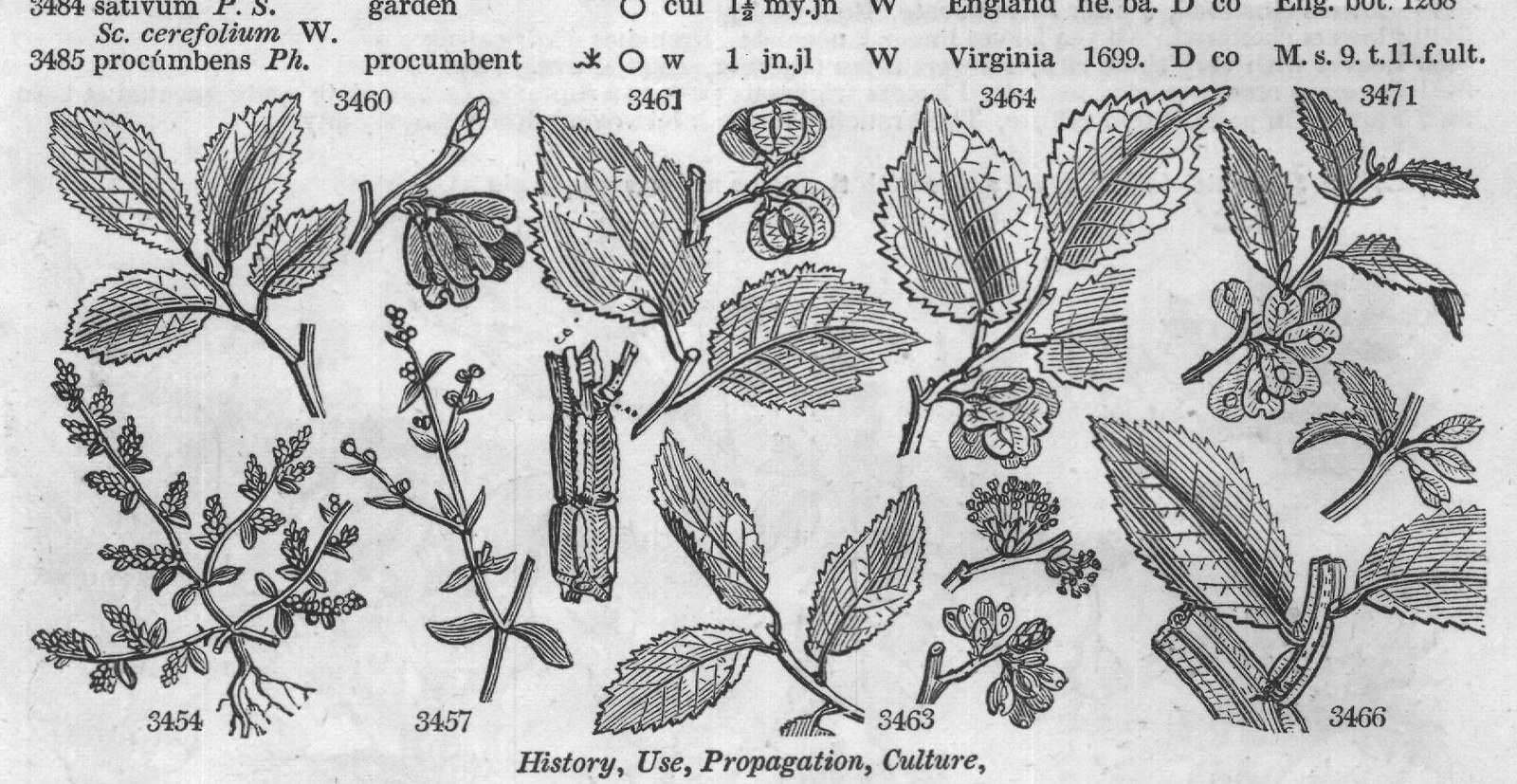
Sp. 13. 3460 campéstris L. comm. English tm 80 ap.my Br Britain hed. L co Eng. bot. 1886 3461 suberósa Mönch cork-barked tm 40 ap.my Br Britain hed. Lco Eng. bot. 2161 3462 fruticosa W. shrubby or 8 ap.my Br Europe Gco ... 3463 glábra E. B. smooth tm 60 ap.my Br Britain hed. L. co Eng. bot. 2248 3464 montána E. B.
Wych tm 40 ap.my Br Britain hed. S co Eng. bot. 1887 3465 americána Ph. white Amer. 3466 aláta Mich. winged tm 40 ap.my Br tm 30 ap.my Br N. Amer. 1752. G co 3467 álba Kit. white Hungar. tm 30 ap.my Br N. Amer. 1820. G co Hungary 1824. G co Mich. arb. 3. t. 5 3468 húmilis Amm. low 3469 críspa W. curled * 3470 fúlva Ph. slippery or 6 ap.my Br or 20 ap.my Br tm 60 ap.my Br Siberia Gco ...
N. Amer. ...
N. Amer.
G co G.co ...
Mich. arb. 3. t. 6 U. pendula W. 3471 púmila Pall. dwarf or 2 ap.my Br 3472 chinensis P. S.
China or 3 ... ... ...
Siberia 1771. L p.l Pall. ross. 1. t. 48 China C 1.p 616. PLANERA. Mich. 3473 Richardi Mich.
PLANERA.
Hornbeam-lvd.
Ulmaceæ.
Sp. 2. or 12 ap.my Br N. Amer. 1760. G co Pall. ross. 2. t. 10 Ulm. nemoralis W. 3474 parvifólia small-leaved or 12 my Br ...... 1822. G co Jacq. schö. t. 262 U. parvifólia Jacq. 617. PHYL/LIS. W. 3475 Nóbla W.
BASTARD HARE'S EAR.
Canary Rubiaceæ. Sp. 1. cu 3 jn.jl G Canaries 1699. Cr.m D. el. t. 299. f.386 618. CORIAN DRUM. W. CORIANDER. 3476 satívum W. common 3477 testiculátum W. twin-fruited W clt 2 jn Umbelliferæ. W Sp. 2-3.
England fields. S co Eng. bot. 67 2 jn.jl W S. Europe 1640. S co Pl. al. t. 169. f. 2 619. SCAN DIX. P. S.
SCANDIX.
Umbelliferæ.
Sp. 3-10. 3478 pécten W.
Venus's Comb W jn.jl W 3479 austrális W. radiated W 1 my.jn W 3480 pinnatífida Vent. cut-leaved W 1½ my.jn W Britain co. fi. S co S. Europe 1713. S co Persia 1805. S co Eng. bot. 1397 Col. ecph. 1. t. 90 Vent. cels. 14 620. ANTHRISCUS. P. S. ROUGH CHERVIL.
Umbelliferæ.
Sp. 2-9. 3481 vulgáris P. S. 3482 nodósa P. S. common Knotted W 1 my.jn W Britain he. ba. S co Eng. bot. 818 W 1 my.jn W Sicily 1656. D co Jac. vind. 3. t. 25 621. CHÆROPHYLLUM. P. S. CHERVIL.
Umbelliferæ. Sp. 11-8. 3483 sylvéstre W. smooth W 3 my.jn W Britain hed. D co Eng. bot. 752 3484 sativum P. S. garden cul 1½ my.jn W England he. ba. D co Eng. bot. 1268 Sc. cerefolium W. 3485 procúmbens Ph. procumbent wk W 1 jn.jl W 3460 3461 Virginia 1699. D co 3464 M. s. 9. t. 11.f.ult. 3471 3454 3457 3463 History, Use, Propagation, Culture, 3466 plants. Another Bose (Caspar) was a professor of botany at Leipsig, where he published, in 1728, a dissertation upon the motions of plants. Ripened cuttings root freely in sand under a hand-glass, without heat. 614. Herniaria. From hernia, a rupture, for which disorder it was formerly imagined to be a cure, but has long since been rejected even by the herbalists. H. fruticosa is well adapted for growing in pots or for rockwork, and is readily increased by seeds or cuttings; cuttings of the greenhouse species root freely under a hand-glass. 615. Ulmus. From Elm, its name in Anglo-Saxon, Teutonic, Gothic, and nearly all the dialects of Celtic. This is a genus of hardy trees, most of them valued for their timber. The species, like those of the genus Salix, are so nearly related as to be often confounded. Linnæus considered all the European elms as forming only one species. The U. campestris and glabra are those most generally cultivated in Europe. U. campestris grows also in Palestine, and Dr. Walker conjectures that it was originally brought from that country by the Crusaders. It is a tall elegant tree, but produces much less valuable timber than the U. glabra. U. suberosa, often called the Dutch elm, is frequently grafted on the U. glabra, as is also the U. campestris in the Scotch nurseries. 616. Planera. In honor of John James Planer, a German botanist, who published in 1788 an Index Plantarum Agri Erfordiensis, in one volume 8vo. A genus closely related to Ulmus, from which it is perhaps scarcely distinct. 617. Phyllis. From φuλλov, a leaf: the plant is remarkable for the beauty of its leaves. Phyllis, who was ORDER II.
PENTANDRIA DIGYNIA. 3454 Smooth, Clusters many-flowered 3455 Hairy, Clusters few-flowered 3456 Leaves obovate acute hairy, Flowers clustered 4-cleft hispid, Stem shrubby 3457 Smooth, Stem erect dichotomous, Leaves ovate cuspidate, Flowers terminal and axillary 3458 Half shrubby, Leaves ovate oblong hoary, Calyxes hairy 3459 Clusters few-flowered hairy, Root thick woody 3460 Leaves doubly serrate unequal at base, Flowers subsessile clustered 5-andr. Fruit smooth 3461 Lvs. doubly serr. nearly equal at base, Fl. subsessile clustered 4-andr. Fruit smooth, Bark corky winged 3462 The branches only corky not the stem, Stature little more than that of a man, otherwise like the last 3463 Leaves doubly serrated smooth unequal at base, Flowers nearly sessile 5-cleft, Fruit obovate naked 3464 Leaves doubly serrated unequal at base, Flowers 6-8-andr. stalked, Fruit fringed at edge 3465 Lvs. nearly doubly serr. uneq. at base, Axil. of veins ben. unit. by a membr. Fls. 5-8-andr. stalked, Fruit vil. 3466 Br. with cork. wing here and there on each side, Lvs. obl. ov. by deg. ac. nrly eq. at base, Fr. hairy closely frin. 3467 Leaves doubly serrated unequal at base acuminated pubescent beneath 3468 Leaves equally serrated equal at base 3469 Leaves irregularly doubly serrated equal at base with a long point rough above beneath soft downy 3470 Lvs. doubly ser. uneq. at base, Axil. of veins bearded beneath, Fl. clust. 5-andr. Fruit pubes. not fringed 3471 Decumbent, Branches smooth, Leaves very small equal at base 3472 Leaves small coriaceous shining shortly serrated ovate oblique at base 3473 Leaves subsessile oblong-cordate subcrenately coarsely toothed emarginate at base, Caps. short 3474 Leaves lanc. equally serrate equal at base shining, Flowers stalked tetrandrous, Fruit smooth 3475 The only species. Leaves lanceolate entire opp. 4 inches long, Corymbs axillary 3476 Fruit globose 3477 Fruit twin 3478 Seeds with a very long beak, Leaflets many-cut 3479 Seeds subulate hispid, Flowers radiant, Cauline leaves smooth 3480 Stem scabrous, Leaves decompound smooth, Umbels fascicled with a single leaf 3481 Seeds ovate hispid, Cor. of one shape, Stem smooth 3482 Seeds cylindrical hispid, Stem hispid, Joints tumid 3483 Stem striated with tumid joints 3484 Seeds shining ovate subulate, Umbels lateral sessile 3485 Stem hairy decumbent, Leaves bipinnatifid, Umbel simple few-flowered 3476 3474 3478 3484 3482 3475 3481 and Miscellaneous Particulars. 3483 turned to a bare tree by the gods for having hung herself for love of the absent Demophoon, became a tree covered with verdure upon receiving in that form the embraces of her lover returned. 618. Coriandrum. From κoρiς, a bug, in allusion to the smell of the leaves of the plant. C. sativum has been long cultivated, chiefly in Essex, and is considered as naturalized. The leaves are strongly scented; the seeds, which are slightly aromatic, are used to cover the taste of senna, and in spices as currie powder, and seasoning for black puddings: also, covered with sugar, as a sweetmeat; formerly they were steeped in wine or vinegar, and then dried, to render them milder. 619. Scandix. A name given by the Greeks to a plant used as an eatable, which appears to be that now called Scandix pecten. It is derived from σκεω, to prick, on account of the sharp points of the seeds. 620. Anthriscus. The name of a plant resembling Scandix, described by Pliny. A. vulgaris bears a near resemblance to the common chervil (Chærophyllum sativum), and being gathered as such, and put into soups, by the Dutch soldiers who were in England in 1745, some of them were poisoned by it. 621. Chœrophyllum. An ancient Greek name of the Chervil, derived from χaiρω, to rejoice, and φuλλov, leaf, that is to say a plant whose leaves have an agreeable smell. C. sylvestre has poisonous roots; though the leaves are occasionally used as a pot-herb, and are much liked by cows. The stems and leaves dye a beautiful green, and the umbels a yellow: the plant in a wild state is found only on fertile soils. C. sativum is cultivated in gardens for the leaves, which are used in soups and salads. To have a succes. sional supply, sow in February and August in shallow drills from six to nine inches apart. P 3486 bulbósum W. 3487 témulum W. 3488 hirsútum W. 3489 aromáticum W. 3490 canadénse Ph.
Síson canadénse W. 3491 Claytóni Ph. 3492 colorátum W. 3493 aúreum W. 622. ERYN GIUM. W. bulbous-rooted rough W 1½ jn.jl W w hairy-leaved W 1 jn.jl aromatic or 3 jl.au W W 3 jn.au W three-leaved W 1½ jl.au W sweet-rooted yellow cu 2 jl.au W cu 1 jl.au Y golden cu 1 jl.au Pk PENTANDRIA DIGYNIA. વાત્માત્ર સ્ત્રાવા Europe 1726. D co Britain hed. D co Switzerl. 1759. D co Germany 1726. D co N. Amer. 1699. D co N. Amer. 1806. D co Illyria 1806. D co Scotland b. offi. D co CLASS V.
Jac. aust. 1. t. 63 Eng. bot. 1521 Jac. au. 2. t. 148 Jac. au. 2. t. 150 Mor. h. s. 9. t. 11 Spr. umb. t. 3. f.6 Mor. s. 9. t.10.f.6 Eng. bot. 2103 ERYNGO.
Umbelliferæ.
Sp. 16-55. 3494 fœ'tidum W. stinking or 1 av.o W W. Indies 1714.
D s.l Her. lugd. t. 237 3495 aquáticum W. marsh or 4 jl.s W N. Amer. 1699.
D s.l Bot. reg. 372 3496 virginiánum Ph.
Virginian or 2 jl.s GN. Amer. ...
Ds.l