Home › H › Host (Gra t History Use Propagation) (II)
Host (Gra t History Use Propagation) (II)
gra. 2. t.99 1056 1060 1062 1067 1053 1066 History, Use, Propagation, Culture, and wild oat originally the same. The wild oat is remarkable for the length of time the grain will lie in the soil, and retain its vegetative powers; its awns are sometimes used as hygrometers, and its seeds as artificial flies in fishing. Where it abounds naturally it is an inveterate weed.
The oat, in an agricultural point of view, is a grain only calculated for cold climates. In Italy and France, and even in the southern counties of England, the ears are small and husky, and afford little meal; the panicle even in the southern counties of England, the ears are small and husky, and afford little meal; the panicle is open, and the foot stalks of the ears small; and in July and August the heat dries them up, and obstructs the progress of the sap to the grain.
On the other hand, this naked airy panicle is better for drying after rains and dews than the close spikes of wheat and barley, which, while they serve to guard the ears from the extremes of heat in warm climates, are apt to rot or become mouldy (covered with fungi) in cold moist countries or seasons. The grain of the oat, though chiefly used as food for horses, is also more or less a bread corn in every country where it is generally cultivated.
Fourteen pounds of grain yield eight pounds of meal; in some places, as Yorkshire and Aberdeenshire, this meal is ground nearly as fine as flour; in others, as at Edinburgh, it is made of a coarser quality. The kernel freed from the husk, and entire, is used for gruels, and forms an article some towns where the grains are grown to a large size on the variety known as the Friesland oat. The fine powder which is produced by the operation of husking the corn, or making grist, forms a jelly, the sowins of the Scotch, and frumerty of the Irish, an agreeable and wholesome food. Water-gruel from a coarse oatmeal, is esteemed a cooling laxative drink.
A. nuda, the naked, or hill-oat, or peel-corn, when ripe drops the grains from the husks. It was generally cultivated in Worlige's time " in the north of England, Scotland, and Wales, because the kernel threshes clean out of the husk, and need not be carried to the mill to be made into meal or grist." It was made into meal by the lower classes, by drying on the hearth, and bruising in a stone mortar, as still practised in the Highlands of Scotland, in Lapland, Ceylon Ceylon, China, and in every country under certain circumstances of civilization. In the low country of Scotland, the quern mills, as they were called, now no longer in use, may be seen neglected or dilapidated, by the doors or about the gardens of cottages and villages, where they were formerly in use. Avena sterilis is sometimes grown as an object of curiosity, under the name of the animal oat, on account of its singular hygrometrical properties. After the seeds have fallen off, their strong beard is so sensible of alterits singular hygrometrical properties. After the seeds have fallen off, their strong beard is so sensible of alter- ORDER II.
TRIANDRIA DIGYNIA. 1051 Pan. equal, Spikelets 2-fl. Florets smaller than glumes at the base naked 1-bearded, Root fibrous 1052 Pan. equal, Spikelets 3-fl. longer than glumes, Florets naked at base, Root fibrous 1053 Pan. equal, Spikelets 3-fl. Florets less than glumes, hairy at base, all bearded, Root fibrous , all bearded, Root fibrous 1054 Pan. 1-sid. Spikel. 5-fl. Florets less than glumes lower bearded and hairy upper beardless and smooth, Root and hairy upper beardless and smooth, Root 1055 Rac. simp. Spikel. 5-fl. Flor. long. than glms. Lvs. rough in tufts very narrow and complicated, Root fibrous 1056 Pan. sub-spiked, Florets nearly equal to the glume, Beard jointed longer than glume, Leaves setaceous 1057 Pan. spread. Glumes 3-fl. Florets linear 2-bearded at end very hairy below the middle, Beard dorsal jointed 1058 Pan. equal, Spikelets about 3-fl. Florets longer than the glume the lower with a beard under the end 1059 Pan. contracted 1-sided, Spikelets 2-fl. Outer glume bifid 2-bearded, Dorsal beard reflexed 1060 Pan. lax, Outer glume bifid, Spikelets 3-fl. Ligula truncate obsolete, Lower sheaths pubesc. Root creeping pubesc.
Root creeping 1061 Pan. slender, Glumes 2-fl. Seeds villous, Beard twice as long as glume 1062 Pan. sub-spik. equal, Spikelets about 3-fl. Florets longer than cal. hairy at base, Lvs. pubesc. Root creeping 1063 Pan, erect nearly simp. Glumes about 5-fl. Recept. bearded at end, Leaves serrulate naked, Sheaths rough 1064 Pan. equal, Spikel. 3-fl. Flor. as long as glume, Lvs. distichous smth. Mouth of sheaths hairy, Root creeping 1065 Panicle nearly spiked, Beard at length reflexed longer than glume 1066 Panicle one-sided, Spikelets 3-flowered, Florets 3-bearded as long as glume, Root fibrous 1067 Spike jointed brittle 3 or 4 inches long, Leaves flat slightly hairy 1068 Pan. upright sprdg. Glumes acum. Dorsal beard straight shorter than the hairs which are as long as glume 1069 Pan. upright spreading, Glumes acute, Dorsal beard straight as long as palea which is longer than hairs 1070 Panicle sprea spreading, Glumes acute, Hairs very short, Dorsal beard jointed longer than glume 1071 Glumes about 3-5-flowered, Florets as long as the glume, Stem woody at base (Donax. P. de B.) Stem woody at base (Donax. P. de B.) 1072 Glumes 5-flowered, Florets very little longer than glumes 1073 Stems erect, Sheaths very smooth, Ligulas large elongated, Panicle close many-flowered 1074 Pan. contr. ovate, Spikelets bearded, Leaves lanceolate, Bractes pinnate scarious with very long beards 1075 Raceme spiked cylindrical, Spikelets 3-flowered, Outer palea 3-5-bearded, Root stoloniferous 1076 Raceme spiked subovate oblong, Bractes entire, Spikelets 2-3-flow. Outer palea 3-5-bearded, Leaves flat Outer palea 3-5-bearded, Leaves flat 1077 Raceme spiked ovate nearly naked, Spikelets 2-flowered, Bractes toothletted, Outer palea 5-bearded 1078 Raceme in a round head, Outer palea with one beard, Leaves fine keeled 1068 1071 1072 1074 1075 and Miscellaneous Particulars. ation in the atmosphere as to keep them in an apparently spontaneous motion, when they resemble some grotesque insect crawling on the ground. 172. Trisetum. (Three bristles); on account of the three beards or awns of the flower. Trisetum pubescens, according to the Woburn experiments (vii.), possesses several good qualities, which recommend it to particular notice. It is hardy, early, and more productive than many others which affect similar soils and situations. It appears well calculated for permanent pasture on rich light soils. Trisetum flavescens is also a useful grass; but the most valuable as a grass is the Avena elatior, L. the Holcus avenaceus of Eng. Bot., which will be noticed hereafter in its proper place. ( In Polygamia monœcia, under Arrhenatherum). 173. Danthonia. A genus containing some incongruous species of Avena, and named after M. Danthoine, a French botanist. 174. Gaudinia. Named in honor of M. Gaudin, a Swiss botanist, who paid great attention to the study of grasses, and who published an Agrostographia Helvetica in 1811, still a work of reputation. 175. Arundo. An ancient name of doubtful origin; perhaps, as a recent author conjectures, from aru, the Celtic word for water. Phragmites is derived from a hedge or separation. A. donax, Canne, Fr., Rohr, Ger., and Canni di Giardini, Ital. is common in the south of France and Italy, where it is cultivated as fence-wood, for supporting the vine, for fishingrods, and a great variety of purposes. In Spain and Portugal it forms an article of commerce, and supplies materials for the looms, fishing-rods, &c. of this country. The striped-leaved variety (gardener's garters) used formerly to be a common inhabitant of gardens. A. phragmites, Roseau de Marais, Fr. Gemeine Rohr, Ger.; and Canna palustre, Ital. is used for thatching, for protecting embankments or sea-dykes, for ceilings to cottages, verandahs, and rustic buildings; to lay in , for ceilings to cottages, verandahs, and rustic buildings; to lay across the frame of wood work as the foundation for plaister floors, and for screens and hot-bed covers in kitchen gardens. The panicles will dye wool green; and the roots, it is said, are good in liver complaints, like those of Triticum repens. color. 176. Chrysurus. From χρuσoς, gold, and gà, a tail; the compact heads of flowers are of a bright yellow 177. Sesleria. A genus named by Scopoli, after Leonard Sesler, a physician and botanist, who contributed to TRIANDRIA DIGYNIA. 178. CYNOSURUS. P. S. DOG'S-TAIL-GRASS.
CLASS III.
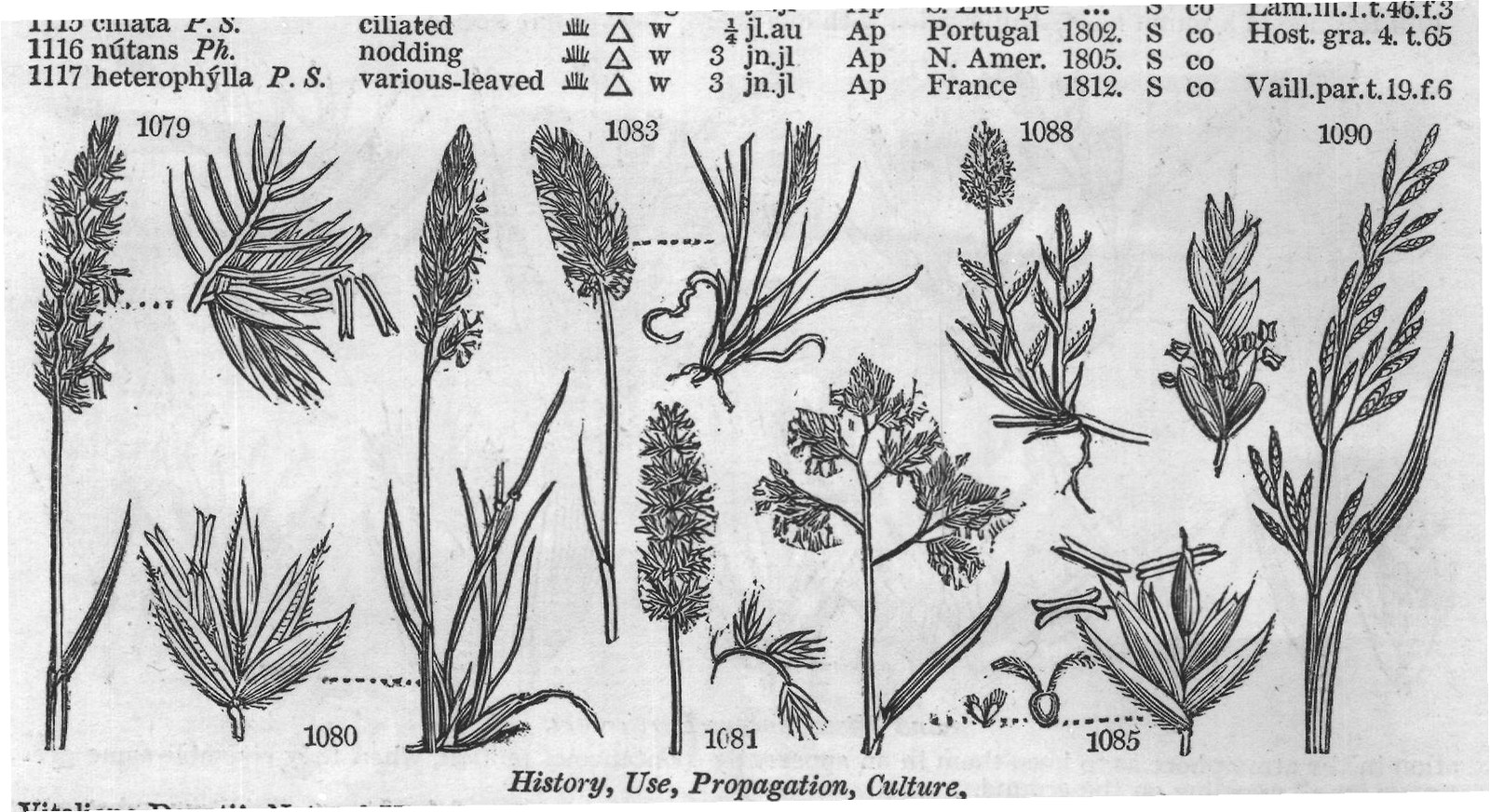
Gramineæ. Sp. 1-8. 1079 cristátus W. crested 179. KÆLERIA. P. S. KELERIA. 1080 cristáta P. S. crested 1081 tuberósa P. S. tuberous 2 au Ap Britain pas. S s.l Eng. bot. 316 Gramineæ. Sp. 5-13. 1082 pubescens P. de B. pubescent 1083 phleoídes P. S. cat's-tail 1084 híspida D. C. hispid A عاد A علا لد عاد لللا 1 jn.au Ap 1 jl.au Ap 1 jn.jl Ap 1 jl.au Ap W jl.au Ap Britain pas. Sco Europe 1802. S co S. Europe 1800. S co Portugal 1802. S co Mediterr. 1819. S co Eng. bot. 648 Lam. ill. t.45. f.4 Ger. prov. t. 1 Desf. atl. 1. t. 23 Savi. pis. t. 1. f. 5 180. DACTYLIS. W.en. COCK'S-FOOT-GRASS.
Gramineæ.
Sp.5-19. 1085 glomeráta W. rough ag2jn.jl Ap Britain mea. Sh.l Eng. bot. 335 1086 hispánica W. en.
Spanish 2 jn.jl Ap Spain 1814. S co 1087 glaúca Rth. glaucous 2 jn.jl Ap Saxony 1800. S co 1088 répens Desf. creeping W jn.jl Ap 1089 pátens H. K.
Barbary 1821. S co Desf. atl. 1. t. 15 spreading A علا 2 au.s Ap N. Amer. 1781. S co 181. GLYCERIA. R. Br. GLYCERIA.
Gramineæ. Sp. 1. 1090 flúitans B. P. floating W 1½ my.au Ap Britain ponds. Sm.s Eng. bot. 1520 182. FESTUCA. W.
FESCUE-GRASS.
Gramineæ. Sp. 27-66. 1091 tenélla Ph. slender 1092 ovína W. sheep's 1093 vivípara E. B. viviparous لا A ag علاا W jl.au ApN. Amer. 1804. S co agjn Ap jl Ap Britain dr. pa. S s.1 Britain Eng. bot. 585 sc. mo. S s.1 Eng. bot. 1355 1094 rúbra W. creeping 1 jl Ap Britain me. pa. S h.l Eng. bot. 2056 1095 duriúscula W. hard ag 1 n Ap 1096 amethýstina W. blue 1 jn.jl Ap Britain me. pa. S s.1 S. Europe 1804. S co Eng. bot. 470