Home › H › Host (Gra t Vaill par t f History)
Host (Gra t Vaill par t f History)
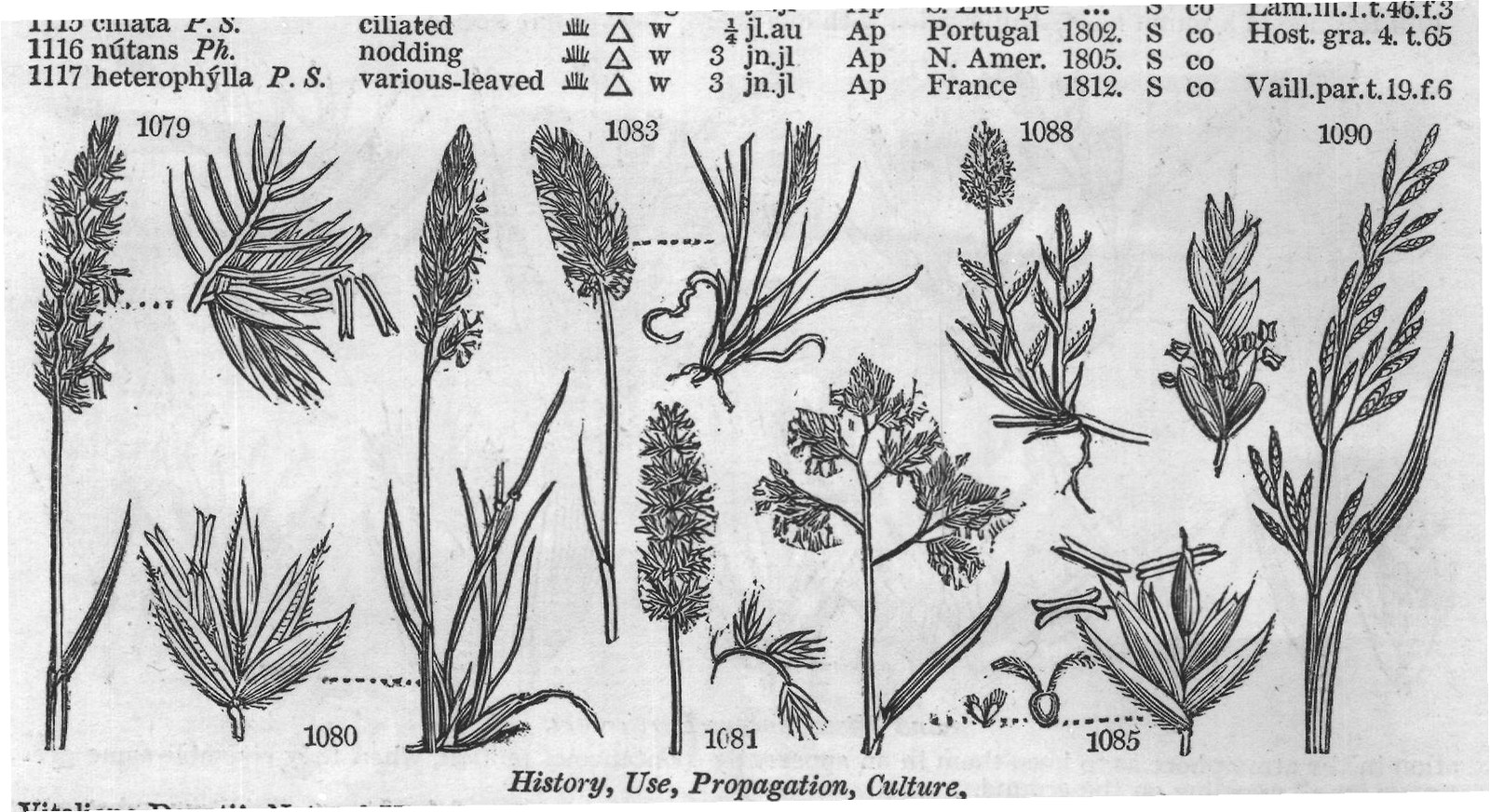
gra. 4. t.65 Vaill.par.t. 19.f.6 1079 1083 1088 1090 1080 1081 History, Use, Propagation, Culture, 1085 Vitaliano Donati's Natural History of the Adriatic sea, published in 1750. The species were formerly part of Cynosurus. 178, Cynosurus. Kuωv κuvoς, a dog, and sea, a tail: dog's-tail. 179. Kæleria. Named after M. Kohler, a professor of natural history at Mayence, and author of some works upon grasses. A pretty genus of grasses, with elegant silky heads. 180. Dactylis. (Δaκτuλoς, a finger: finger-grass). The divisions of its heads may be fancied to resemble the fingers, and the large cluster at the bottom the thumb of an animal. D. glomerata is a coarse grass of early and rapid growth, and considered valuable as a pasture grass on light soils from the quantity of herbage it affords. It comes in from the time turnips are over, till the meadows are fit for grazing; but old and dry, or made into hay, neither horses nor cattle are fond of it. To reap the full benefit of this grass, it must be kept closely cropt. It has been of late strongly recommended by Mr. closely cropt. It has been of late strongly recommended by Mr. Coke of Holkham. 181. Glyceria. (From γλuκuς, sweet, in allusion to the herbage). This is the Festuca fluitans of L.: it is found in stagnant water, and its long narrow leaves float on the surface. Horses, cattle, and swine are fond of this grass, which produces abundance of seeds, which are eaten greedily by geese, ducks, and fish, especially the are collected in some parts of Germany and Poland, under the name of manna seeds, and used in soups and gruels. The plant will not thrive unless on land that is constantly under water. 182. Festuca. In Celtic, the word fest signifies pasture, food. We may be satisfied with this explanation in want of a better. This genus affords some valuable hay and pasture grasses. F. ovina has a fine short sweet of a better. This genus affords some valuable hay and pasture grasses. F. ovina has a fine short sweet foliage, well adapted to the masticating organs of sheep, and for producing delicate mutton: it is totally unfit for hay, and according to Sir H. Davy's experiments, it does not possess the nutritive powers generally ascribed to it. It is an excellent grass for lawns, requiring little mowing , and forming so thick a turf as to suffer few intruding plants. It should be sown about the middle of August, on ground nicely prepared, open, and not too light or dry. The same remarks will apply to F. rubra and amethystina.
ORDER II.
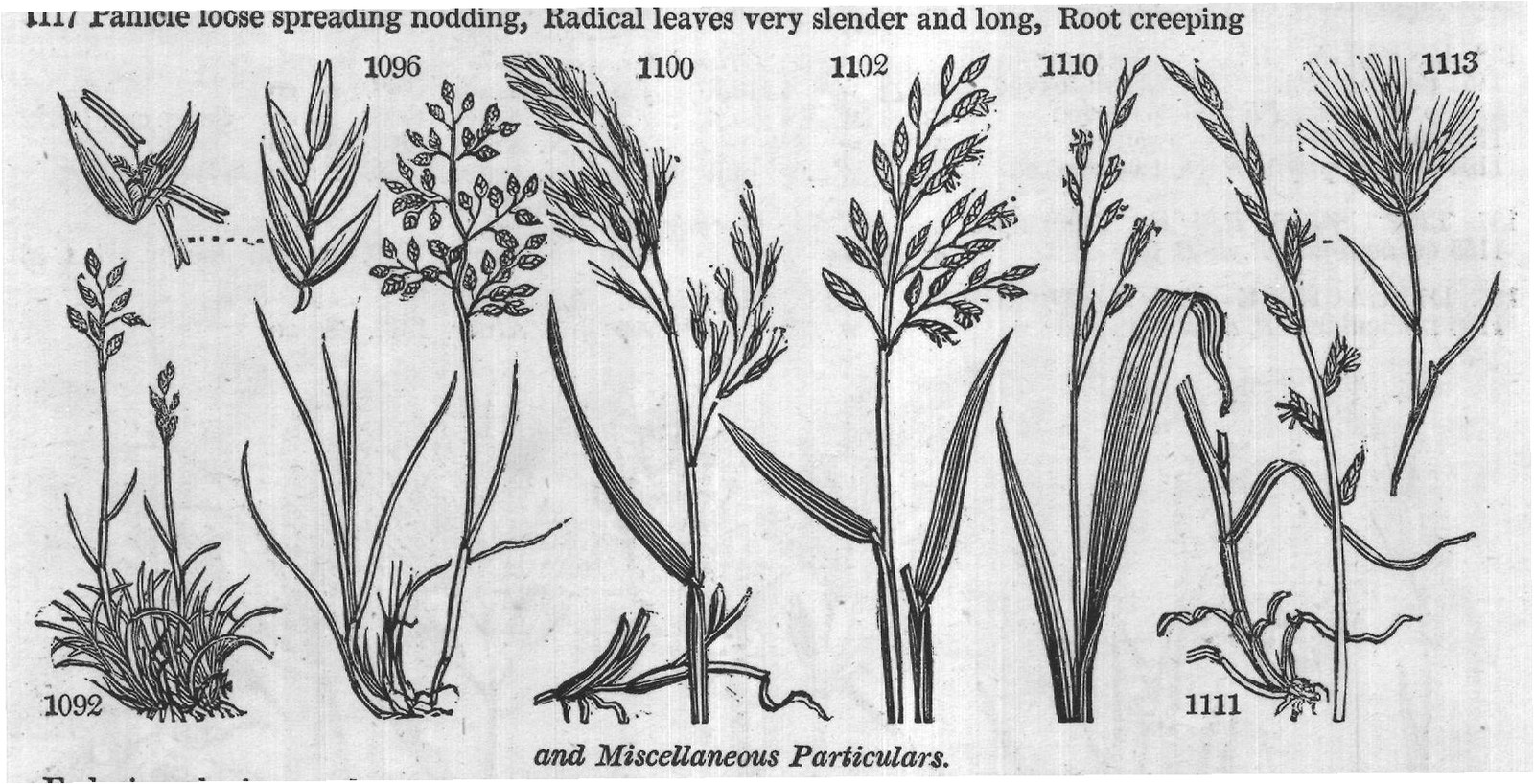
TRIANDRIA DIGYNIA. 1079 Raceme spiked linear, Spikelets beardless, Bractes pinnatifid, Leaves linear 1080 Pan, spikeshaped at the base interrupted and smoothish, Spikelets 3-4-flow. nearly beardless very acute 1081 Pan. closely spiked, Spikel. 2-3-fl. acum. beardless, Glumes fringed at back, Lower leaves conv. setaceous 1082 Pan. spiked oval cylind. Spikelets 2-flowered villous at back acumin. Outer glume bearded under the end 1083 Panicle spiked cylind. Spikel. 2-5-8-flowered, Outer glume rough outside, with a soft beard under the end 1084 Panicle spiked ovate cylind. Spikelets 3-4-flowered, Outer glume hairy with a stiff beard under the end 1085 Panicle one-sided heaped, Leaves keeled 1086 Panicle one-sided headed spiked, Spikelets 3-flowered, Leaves keeled glaucous 1087 Panicle equal before and after flowering contr. spiked, Spikelets 4-fl. beardless, Glumes with a rough keel 1088 Stem creeping, Branches in bundles, Leaves villous subulate stiff, Flowers in spiked one-sided heads 1089 Spikes scattered one-sided few, Flowers closely imbricated, Leaves much spreading, Stem decumbent 1090 The only species is a floating creeping plant very common in ponds 1091 Panicle simple one-sided, Spikelets about 9-flow. bearded, Leaves setaceous, Culm upwards 4-cornered 1092 Panicle contracted, Spikelets ovate 4-flowered, Paleæ roundish, Leaves very narrow rough 1093 Panicle one-sided contracted, Florets compressed beardless pubescent, Leaves setaceous smooth 1094 Pan. one-sided erect spreading, Florets roundish longer than beard, n beard, Leaves pubes. above, Root creeping 1095 Panicle erect spreading, Florets longer than beard, Root fibrous 1096 Pan. sprdg. Spikel. obl. nearly beardl. Outer valve of glume and paleæ ciliated, Lvs. setac. rigid, Lig. 2-eared 1097 Glaucous, Pan. 1-sided contracted, Florets cylind, bearded, Stem square, Leaves compound channelled 1098 Panicle spike-shaped pubescent, Leaves filiform 1099 Panicle one-sided erect branching contracted, Florets oblong angular beardless, Leaves ensiform striated 1100 Panicle spreading, Spikelets 3-flowered with long beards 1101 Panicle erect, Spikelets ovate 4-5-flowered, Glumes acum. beardless, Leaves setaceous smooth pungent 1102 Panicle spreading branched, Spikelets linear beardless many-flowered, Leaves linear, Root fibrous 1103 Pan. sprdg. one-sided, Spikel. about 6-fl. Florets blunt beardless, Leaves lin. conv. glauc. Stem round erect 1104 Panicle spike-shaped, Spikelets slender 11-flowered bearded, Sheaths rough 1105 Culm ascending angular, Leaves rolled together smooth, Pan. nodding close, Spikelets 9-10-flow. pilose 1106 Pan. erect contracted, Spikelets 4-5-fl. very smooth, Paleæ margined membranous, Leaves setaceous 1107 Pan. one-sided oblong, Spikel. 7-fl. bearded, Outer glume and paleæ fringed, Leaves setac. Root fibrous 1108 Panicle one-sided erect branching, Florets ternate oblong angular beardless, Leaves linear striated 1109 Pan. spreading much branched, Spikelets ovate lanc. somewhat bearded 4-5-fl. Leaves linear lanceolate 1110 Pan. close, Branches simple scattered, Spikelets linear 5-fl. Flowers acum. 2-androus, Stem very rough 1111 Raceme spiked elongated, Spikelets remote beardless afterwards spreading, Root fibrous 1112 Panicle simple erect, Spikelets very few about 7-flowered, Florets acute distant 1113 Panicle fascicled, Spikelets subsessile villous, Beard erect 1114 Panicie one-sided spike-shaped, Spikelets 5-fl. smooth somewhat bearded, Leaves glaucous rigid subulate 1115 Culm ascending, Leaves subconvolute, Spike racemose, One glume very small, Outer paleæ fringed 1116 Panicle one-sided erect nodding at the end, Spikelets 5-flowered obtuse beardless 1117 Panicle loose spreading nodding, Radical leaves very slender and long, Root creeping 1092 1096 1100 1102 1110 1111 1113 and Miscellaneous Particulars.
F. duriuscula, is a good grass either for hay or permanent pasture: hares are remarkably fond of it: its produce in the spring is not very great, but the quality is fine, and the quantity is considerable at the time pro- of in the spring is not very great, but the quality is fine, and the quantity is considerable at the time of flowering. F. calamaria is subject to the disease in the grain called clavus, in which the seed swells to three times the usual size, and the kernel is wanting.
F. pratensis is one of the six grasses (Anthoxanthum odoratum, Alopecurus pratensis, Poa pratensis and trivialis, Cynosurus cristatus, and the F. pratensis) which Curtis recommends before all others for laying down , Cynosurus cristatus, and the F. pratensis) which Curtis recommends before all others for laying down meadows or pastures, on soil either moist or moderately dry. According to the Woburn experiments, the value of this grass cut at the time the seed is ripe, is to that of the grass cut at the time of flowering as 6 to 18; one proof, among many others, of the advantage of cutting almost all grasses when in flower rather than later. W. Salisbury says, "if land intended for meadow could be laid down with one bushel of F. pratensis, one of Alopecurus pratensis, three pounds of Anthoxanthum, a little Bromus mollis, with white clover, the farmer will seek no farther."
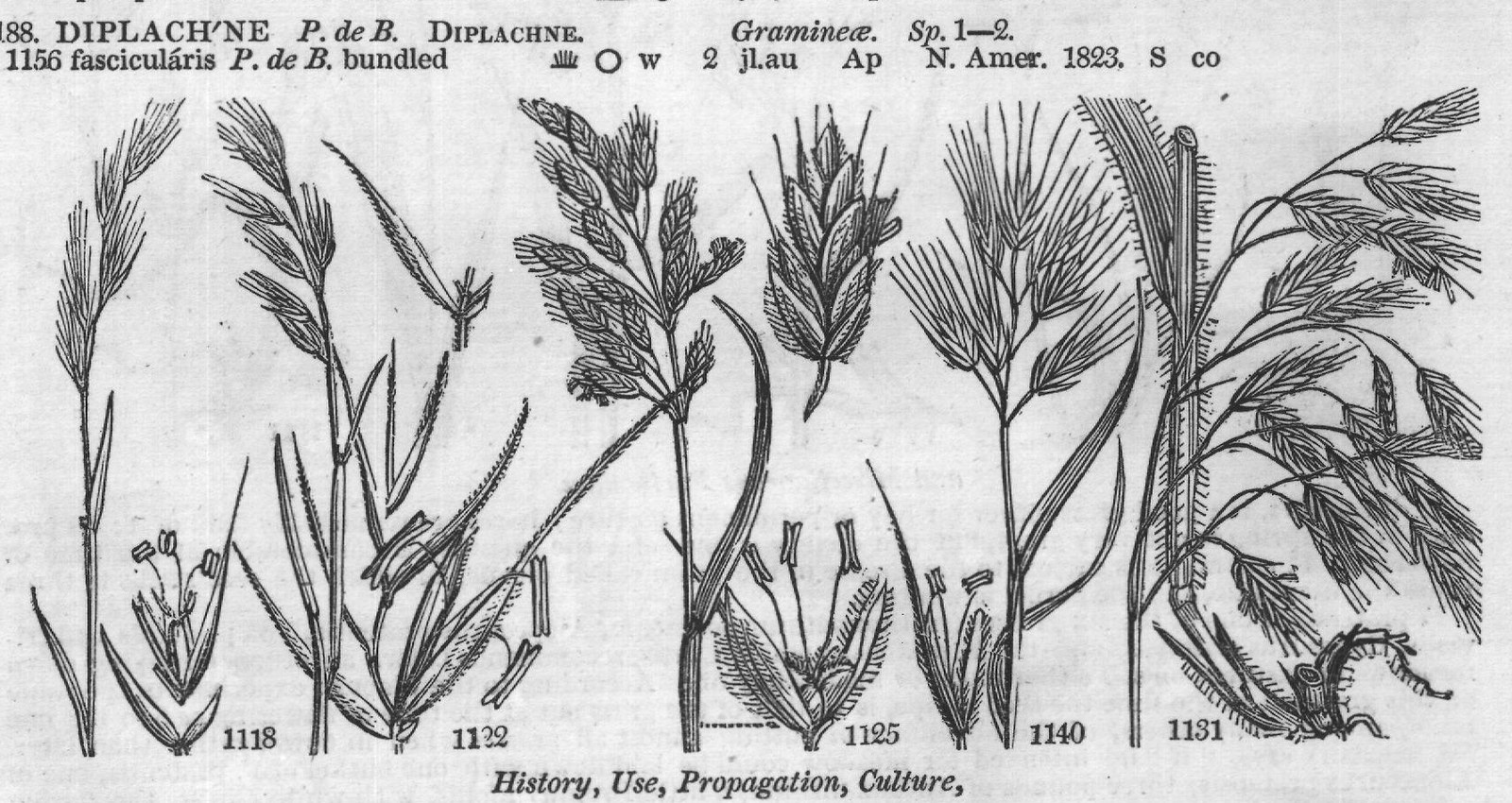
F. elatior differs little from F. pratensis, but in being larger in every respect. According to the Woburn experiments (xl.) "the produce is nearly that of the former, and the nutritive powers superior in the proportion of 8 to 6." F. loliacea greatly resembles the rye-grass in habit and place of growth: "it has excellencies which make it greatly superior to that grass, for the purposes either of hay or of permanent pasture. It improves in proporsuperior to that grass, for the purposes either of hay or of permanent pasture. It improves in proportion to its age, which is directly the reverse of rye-grass." (Wob. exp. xxxiii.) F. glauca, cut at the time of flowering, exceeds in value the same grass cut when the seeds are ripe in the proportion of 6 to 12, a strong proof of the value of the leaves and culm in grasses intended for the scythe, and the loss, as we have before observed, of leaving them for the sake of the seed when they become dry and wiry. After this grass, and indeed most others, are in flower, "the root leaves neither increase in number nor in size; but a total suspension of increase appears in every part of the plant, the roots and seed-vessels excepted. (Wob exper. xii.) TRIANDRIA DIGYNIA. 183. MYGALURUS. Lk. MOUSE-TAIL. 1118 caudátus Lk. wall 1123 secalínus W.
Festuca Myurus E. B. 1119 bromoídes Lk.
Festuca E. B. 1120 stipoídes Lk. 1121 delicátulus Lk. 1122 uniglúmis Lk.
Festuca E. B. 184. BRO'MUS. W. 1124 multiflórus W.en. barren fine-leaved delicate single-husked BROME-GRASS. smooth-rye downy-rye 1125 móllis W. soft 1126 lanceolátus W. spear-leaved 1127 squarrósus W. corn 1128 Alopecúrus W.
Fox-tail 1129 púrgans W. 1130 inérmis W. 1131 ásper W. 1132 pratensis E. B. 1133 stérilis W. 1134 arvensis E. B. purging awnless hairy wood meadow barren field 1135 eréctus E. B. upright 1136 tectórum W. nodding 1137 altíssimus Ph. tallest 1138 racemósus W. smooth 1139 máximus Roth. great 1140 madriténsis W. wall 1141 gigantéus Schr. giant CLASS III.
Gramineæ. Sp. 5. w jn Ap Britain ways. S co Eng. bot. 1412 عاد علا غلااا my.jn Ap Britain walls. S co Eng. bot. 1411 1 jn.jl Ap Majorca 1793. S co Barr. ic. t. 76. f.1 W jn.jl Ap Spain 1817. S co W jn Ap Britain sea co. S co Eng. bot. 1430 Gramineæ. Sp. 19-66. لا علا بلاد 2 jn.au Ap 2 jn.au Ap England cor. fi. S co Britain Eng. bot. 1171 :
Sco ...
Eng. bot. 1884 2 jn.au Ap Britain walls. S co Eng. bot. 1078 علا 3 jn.au Ap Crimea 1798. S co Aw عاد لللا A للاد البلد اد 3 jn.au Ap England cor. fi. S co Eng. bot. 1885 2 jn.au Ap Barbary 1799. S co Desf. atl. 1. t. 25 1½ jn.au Ap Canada 1793. S co 2jn.au Ap Germany 1794. S co