Important: Safety Warning
This page prescribes plants as medicine according to pre-modern medical theory. Several of the plants named are toxic, correct identification is difficult, and the doses given have no scientific basis. Do not ingest or apply any preparation described here.
This information has been left in for historical purposes but should not be acted upon.
Home › J › Jac (Ic t p mila H K dichotoma W)
Jac (Ic t p mila H K dichotoma W)
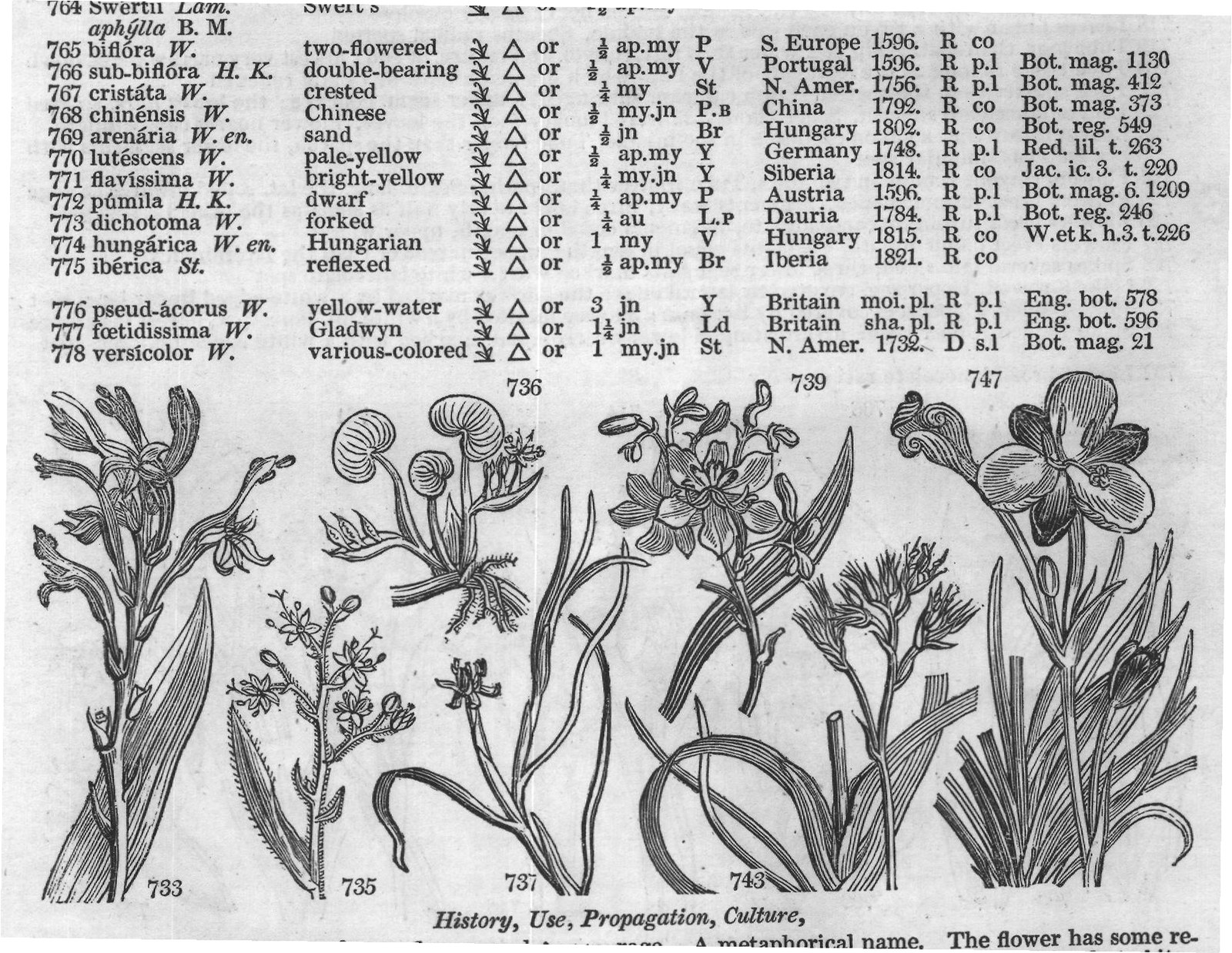
ic. 3. t. 220 772 púmila H. K. 773 dichotoma W. 774 hungárica W. en. dwarf or ap.my P Austria 1596. Rp.1 Bot. mag. 6. 1209 forked or au L.P Dauria 1784. R p.1 Bot. reg. 246 Hungarian or 1 my V 775 ibérica St. 776 pseud-ácorus W. 777 fœtidissima W. 778 versícolor W. reflexed or ap.my Br Iberia Hungary 1815. R co 1821. R co W.et k. h.3. t.226 yellow-water Gladwyn or 3 jn Y or 14 jn Ld various-colored or 1 my.jn St 736 Britain moi. pl. Rp.1 Britain sha. pl. R p.1 N. Amer. 1732. D.s.l 739 Eng. bot. 578 Eng. bot. 596 Bot. mag. 21 747 733 735 737 743 History, Use, Propagation, Culture, 107. Antholyza. From avθiς, a flower, and λuσσa, rage. A metaphorical name. The flower has some resemblance to the mouth of an animal, which by the aid of a little imagination, may be supposed ready to bite. 108. Xiphidium. A name of a similar import with Gladiolus, being derived from Elpos, a sword, in allusion import with Gladiolus, being derived from ξiφoς, a sword, in allusion to its stiff and sword-shaped leaves. 109. Leptanthus. Λεπτoς, slender, and avθos, a flower. The tube of the flower is long and slender. These are aquatic floating plants of little beauty. 110. Wachendorfia. In memory of E. J. Wachendorf, a Dutchman, and professor of botany at Utrecht. 111. Hæmodorum. 'Aiμa, blood, and δωρov , a gift; that is to say, a plant which produces a red flower. ORDER I.
TRIANDRIA MONOGYNIA. 733 Leaves ensiform nerved, Upper segment longest stretched forward, the others recurved. 734 Leaves smooth, Petals linear-lanceolate 735 Leaves hairy, Petals ovate 736 Leaves roundish reniform, Spathes oblong acuminate many-flowered 737 Leaves all linear 738 Scape nearly simple, Panicle contracted, Leaves ensiform 5-nerved perennial plaited smooth 739 Scape many spiked, Panicle spreading, Leaves sword-shaped 3-nerved annual plaited smooth 740 Scape many-spiked, Panicle spreading, Leaves sword-shaped word-shaped channelled smooth sword-shaped 3-nerved plaited villous 741 Scape many spiked, Panicle spreading, Leaves linear swor hairy 742 Leaves elliptic sword-shaped hairy 743 Corymbs compound, Branches spreading, Leaves flat 744 Flowers headed, Spathes many-parted torn 745 Heads of flowers alternate, Spathes entire 746 Flowers alternate, Segments of flower equal 747 Flowers alternate, three of the segments less than the rest 748 Scape about 1-flowered, Leaves linear-lanceolate a little falcate 749 Petals ovate oblong, Corymb level-topped hairy 750 Petals linear, Corymb level-topped villous viscid 751 Leaves ensiform, Scape villous above, Flowers spiked one-sided 752 Leaflets of the crown subulate 1. Flowers bearded. 753 Stem 1-flowered longer than the leaves, Smaller petals deflexed 754 Stem 2-flowered longer than the leaves, Flowers sessile 755 Stem many-flowered longer than the leaves, lower flowers stalked, Spathes colored 756 Stem many-flowered longer than the leaves, Flowers sessile, Spathes white 757 Leaves lanc. rather plaited, half as short again as the branching stem, Spathes leafy, Tube length of germen 758 Stem about 2-flowered the length of the leaves, Germens 3-cornered 759 Stem many-flowered longer than the leaves, Petals emarginate: the outer flat 760 Stem many-flow. longer than the leaves, Outer petals revolute, inner nearly upright, wavy and inflexed 761 Stem many-flowered longer than the leaves, Deflexed petals folded back upright emarginate 762 Stem many-flowered as long as the leaves, Deflexed petals emarginate, erect oblong 763 Stem many-flowered longer than the leaves, Erect petals entire, deflexed rather emarginate 764 Leaves shorter than the 3-flowered stem, Larger petals undulate reflexed, smaller emarginate 765 Scape round about 3-flowered longer than the leaves, Deflexed petals narrower than the erect ones 766 Scape about 1-fl. scarcely shorter than ensiform leaves, Tube of corolla about equal to the 6-streaked germen 767 Stem compressed about 1-fl. the length of leaves, Petals about equal, Beard crested, Germens 3-cornered 768 Scape compressed many-flowered, Stigmas jagged 769 Scape 2-flowered shorter than the ensiform leaves, Upper flower abortive 770 Scape very short about 1-flowered, Spathe erect the length of the tube 771 Scape 2-flowered longer than the leaves, Spathes the length of the tube 772 Scape very short 1-flowered, Spathes shorter than the tube, Reflexed petals narrower than the erect ones 773 Nearly stemless, Scape panicled round, Branches 2-4-flowered 774 Leaves ensiform smooth somewhat falcate nearly equal to the many-flowered scape, Spathes inflated 775 Leaves ensiform falcate smooth, Scape 1-flowered, Petals obovate 2. Flowers beardless. 776 Leaves flat, Inner petals less than the stigma 777 Stem one-angled many-flowered longer than the leaves 778 Stem round flexuose equal to the leaves, Germens nearly 3-cornered 750 752 751 753 756 763 778 and Miscellaneous Particulars. 769 112. Aristea. From arista, a point or beard. The leaves are bearded. 113. Dilatris. A name not satisfactorily explained. 114. Brodiæa. Named in honor of Mr. Brodie, of Brodie House, a Scotch gentleman, who paid great attention to the botany, especially Cryptogamia, of his own country. 115. Iris. The name given by Theophrastus, Dioscorides, and Pliny, from the variety of its colors. According to Plutarch, the word iris signified, in the ancient Egyptian tongue, eye : the eye of heaven. This beautiful genus abounds in Europe, but is rare in America. Some are bulbous, but the greater part tuberous rooted, of easy culture, and propagation by seed or division of the root. The roots of I. florentina, ger- 779 cúprea Ph.
TRIANDRIA MONOGYNIA.
CLASS III copper-colored 780 virgínica W.
Virginian 781 spúria W. spurious 782 ochroleúca W. sulphur-colored বববব or 2 jn.jl N. Amer. 1812.
Rp.1 Bot. mag. 1496 or 1 jn.jl B N. Amer. 1758.
R s.l Bot. mag. 703 or 1 jl SI Siberia 1759. Rco Bot. mag. 875 or 4 jl L.Y Levant 1757. R co Bot. mag. 1515 stenogyna B. Mag. 783 Guldenstadtii W. en. Guldenstadt's or 4 ap.my Y Siberia 1757. R co Bot. mag. t. 61 784 halóphila W. long-leaved Aor 3 jl.s B Siberia 1780. R co Bot. mag. 1131 785 aláta Lam. long-tubed or jn B Algiers 1801. O co Desf. atl. 1. t. 6 786 xíphium W. small-bulbous or 1½ jn B.Y Spain 1596. O co Bot. mag. 686 787 xiphioídes W. great-bulbous or 1 jn B.Y Spain 1571. O co Bot. mag. 687 788 lusitánica H. K.
Portuguese or 2 ap B Portugal 1796. O co Bot. mag. 679 789 tenuifólia W. slender-leavedor 2 my L.B Dauria 1796. D co Pall. it. 3. t. c. f. 2 790 pérsica W.
Persian Aor mr B.Y Persia 1629. O co Bot. mag. 1 791 vérna W. spring or 1 ap.my P Virginia 792 ventricósa W. bellied or 1 jn P.B 793 sibírica W.
Siberian or 2 my.jn L.B 794 prismática Ph.
New-Jersey or 1 my.jn P 795 gramínea W. grass-leaved or 796 húmilis Bieb. low or 1 ap.my B jn St 1748. D co Dauria 1800. D co Siberia 1596. R co N. Amer. 1812. R p.1 Austria 1597. R co Caucasus 1812. R co Pl. alm. t. 196. f.6 Pall. it. 3. t. b. f.1 Bot.mag.50.1163 Bot. mag. 1504 Bot. mag. 681 797 ruthénica Ker. pigmy or my B Siberia 1804. D co 798 tuberósa W. snake's-head or mr.ap G.B 799 reticuláta Ad. netted or mr.ap B Levant Iberia 1597. O s.p Bot. mag. 1123 Bot. mag. 1393 Bot. mag. 531 1821. R co 800 spathuláta spathulate-flow. or 1 jl.au P.B Germany 1759. R co Bot. mag. 58 801 caucásica Hoffm.
Caucasian or mr Y Caucasus 1821. R co 802 furcáta Bieb. forked or mr B Tauria 1822. R co Bot. mag. 2361 803 triflóra W. three-flowered or 1 jn.jl B Italy 1821. R co 804 brachycúspis B. M. short-petalled or 1 jn.jl P Siberia 1819. R co Bot. mag. 2326 805 Pallásii B. M.
Pallas's or 2 jn.jl B Tartary 1820. R co Bot. mag. 2331 116. MORE'A. Ker.
MOREA.
Irideæ. Sp. 23-26. 806 flexuósa H. K. flexuose or 1 ap.my Y C. G. H. 1803.
D s.p Bot. mag. 695 807 collína H. K. equal-flowered or 2 my P C. G. H. 1768.
D s.p Bot. mag. 1033 ẞ miniata B. R. spot-flowered or 2 my.jn P C. G. H. 1768.
D s.p Bot. rep. 404 808 pavónia H. K. 809 tripétala H. K. 810 angústa B. M.
Peacock or 1 my.jn R.B C. G. H. 1790.
D s.p Bot. mag. 1247 three-petalled or 1 ap.my V C. G. H. 1802.
D s.p Bot. mag. 702 narrow-leaved or my.jn Fu C. G. H. 1790.
D s.p Bot. mag. 1276 811 tricúspis H. K. trident-petalled or 1 jn G C. G. H. 1776.
D s.p Bot.mag.696.772 812 ténuis H. K. brown-flowered or 1 my.jn P C. G. H. 1807.
D s.p Bot. mag. 1047 813 unguiculáta H. K. long-clawed or 1 my.jn Va C. G. H. 1802.
D s.p Bot. mag. 593 814 édulis H. K. long-leaved cul 4 my.jn Li C. G. H. 1792.
D s.p B. mag. 613. 1238 815 longiflóra H. K. long-flowered or 2 my.jn Y C. G. H. 1801.
D s.p Bot. mag. 712 816 spicáta B. M. spiked or 1 my.jn Y C. G. H. 1785.
D s.p Bot. mag. 1283 817 trístis H. K. dull-colored or 1 my.jn Br C. G. H. 1768.
D s.p Bot. mag. 577 818 críspa H. K. short-spathed or my.jn B C. G. H. 1803.
D s.p Bot. mag. 1284 819 bituminósa H. K. clammy or 1 ap.my Y C. G. H. 1787.
D s.p Bot. mag. 1045 820 viscária H. K. bird-limed or 1 jn Li C. G. H. 1800.
D s.p Bot. mag. 587 821 ramósa H. K. branching or 3 my.jn Y C. G. H. 1789.
D s.p Bot. mag. 771 822 villósa H. K. villous or 1 ap.my P C. G. H. 1789.
D s.p Bot. mag. 571 823 ciliáta H. K. fringed-leaved or ap.jn P C. G. H. 1587.
D s.p Bot. mag. 1061 barbigera Sal. bearded or ap.my Y C. G. H. ...
D s.p Bot. mag. 1012 824 sisyrinchium H. K. Spanish-nut 825 papilionacea H. K. butterfly cul my.jn B S. Europe 1597.
D s.p Bot. mag. 1407 or my.jn Va C. G. H. 1795.
D s.p Bot. mag. 750 117. MA'RICA. Ker. 829 Northiána H. K. 826 spathácea W. sheathed 827 iridioídes H. K. sword-leaved 828 lúrida B. R. lurid MARICA. or jl Y C. G. H. 1798.
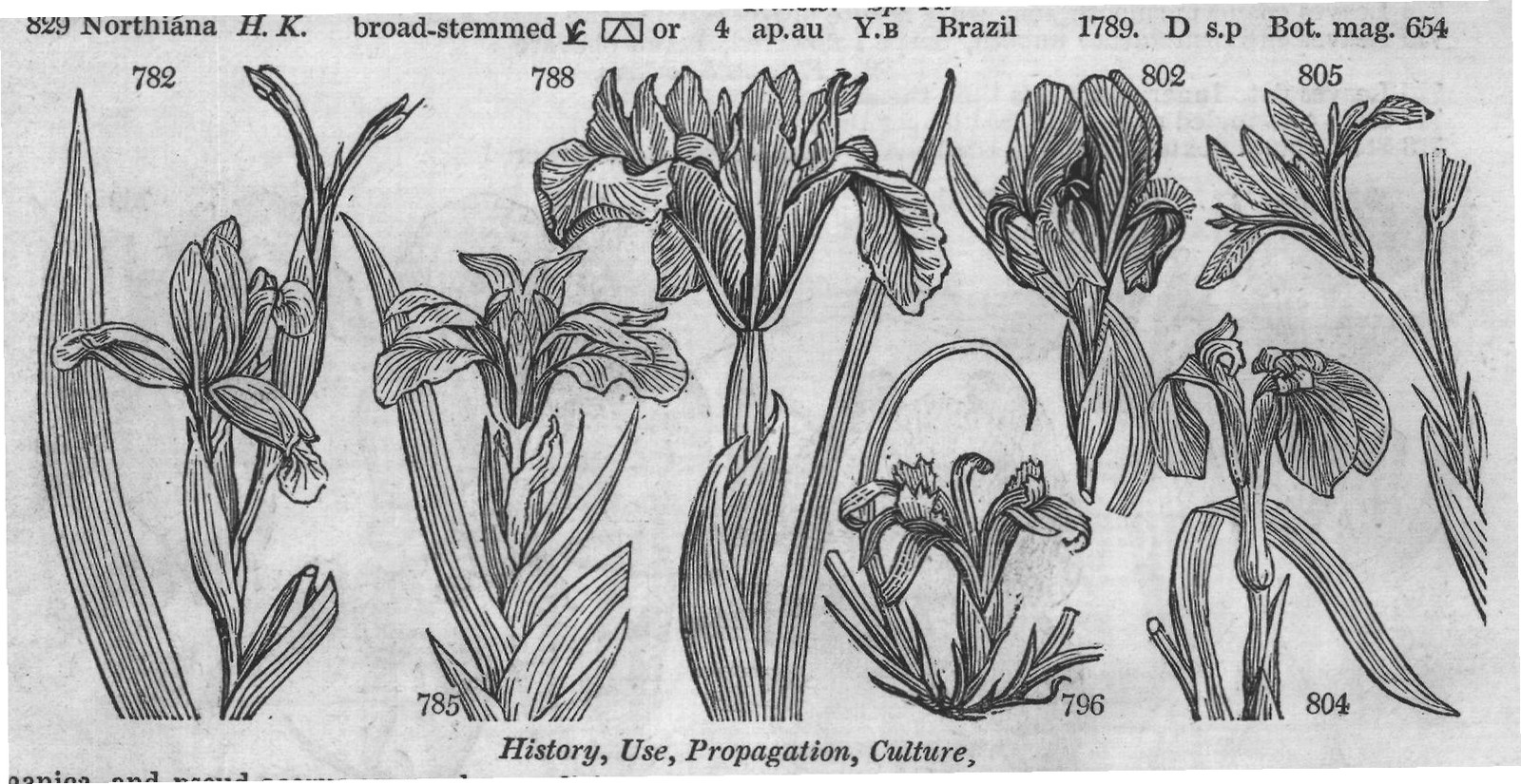
D s.p Thunb. diss. t. 1 or my.jn W C. G. H. 1758. D s.p Bot. mag. 693 or jn Cr C. G. H. 1817. D s.p Bot. reg. 312 Irideæ. Sp. 14. broad-stemmedor 4 ap.au Y.B Brazil 1789. D s.p Bot. mag. 654 782 788 802 805 785 796 804 History, Use, Propagation, Culture, manica, and pseud-acorus are used in medicine; those of the first are remarkable for communicating an odor like that of violets, and are the orrice-root (iris -root) of the shops. The root of I. pseud-acorus, in powder, used as snuff, produces a great heat in the mouth and nose, and occasions discharge from the nostrils: it is astringent, and used instead of galls in making ink or dying black. The fresh juice of the root is one of the most powerful cathartics, and in that way has cured inveterate dropsies. I. germanica possesses similar qualities, and the root of either species suspended in wine or beer, keeps the latter from growing stale, and communicates a pleasant taste and smell to the former. The leaves and roots of I. fœtidissima are steeped in beer by the country people in some places as a purge. I. country people in some places as a purge. I. susiana flowers well in a warm border and loamy soil. I. make it flower freely, it must be planted in a large pot, and have the suckers removed from the roots as soon as they appear. I. orientalis requires a similar treatment, and with the two preceding species requires the protection of a green-house to make it flower in perfection. Of I. xiphioides there are numerous varieties procured from seeds, which are treated much in the same way as those of crocus. This species, and I. tuberosa are very ornamental; they thrive best in a light ORDER I.
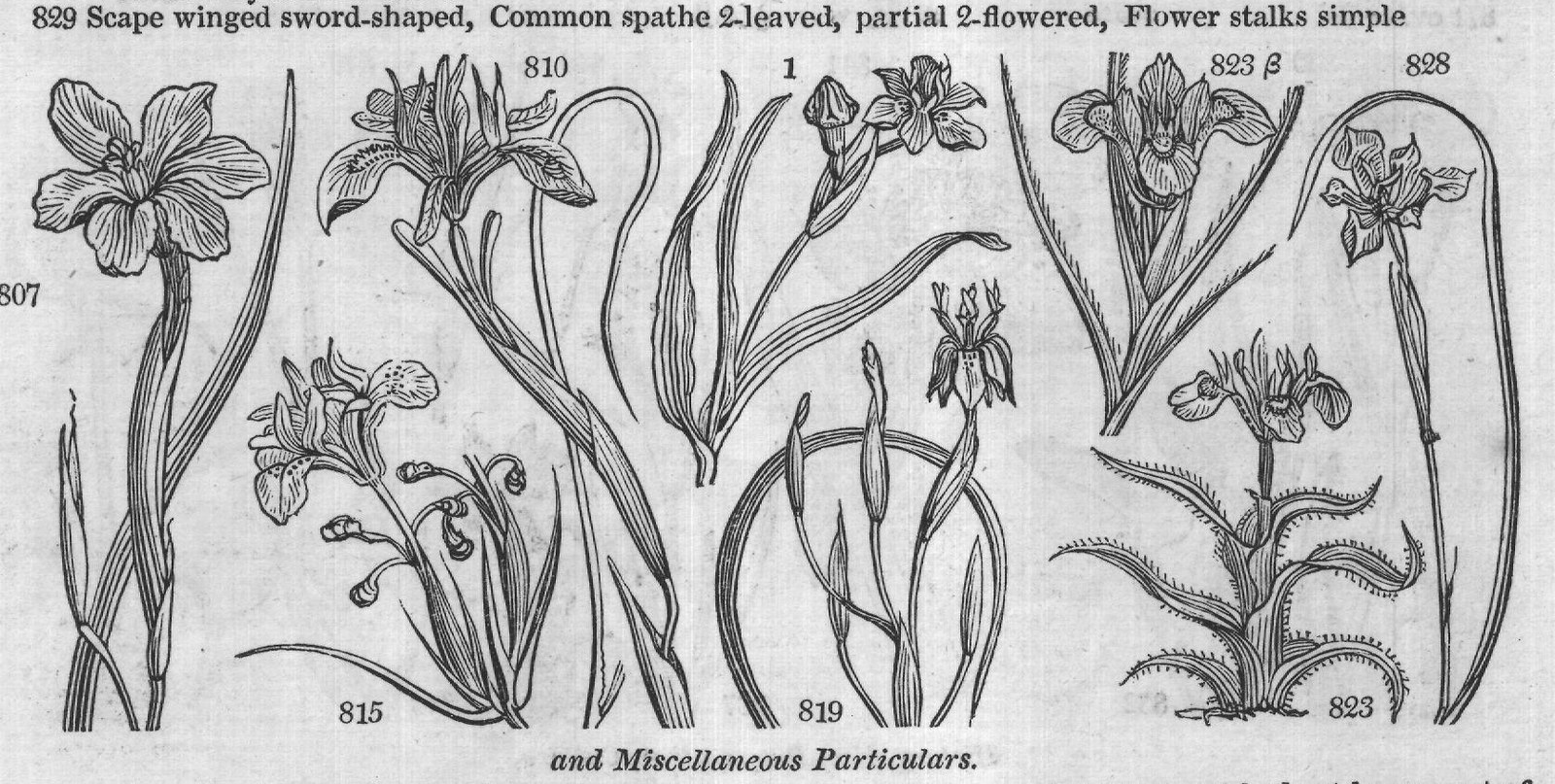
TRIANDRIA MONOGYNIA. 779 Stem round flexuose as long as leaves, Petals all emarginate obovate, the inner shortest, Capsules very large 780 Stem 2-edged many-flowered longer than the leaves 781 Leaves linear, Scape round, Germens 6-cornered, Stigmas acute, Petals rounded 782 Leaves linear, Scape about 3-flowered round, Germens hexagonal, Petals ovate longer than their claw 783 Leaves ensiform, Scape nearly round, Germens hexagonal, Petals erect oblong 784 Radical leaves very long, Stem higher than the leaves, Germens hexagonal 785 Stemless, leaves channelled, Three erect petals very small, Tube very long 786 Leaves channelled subulate, Stem 2-flowered, Petals nearly as narrow as stigmas, Germen round 787 Leaves channelled subulate, Stem 2-flowered, Petals much wider than stigmas, Germen acutely angular 788 Leaves channelled, Scape 2-flowered, Inner petals emarginate 789 Stemless, Leaves filiform very long, Scape very short 2-flowered, Tube of the corolla filiform 790 Leaves linear subul. channelled longer than the very short 1-flow. scape, Inner petals very short spreading 791 Leaves flat, Scape 1-flowered shorter than the leaves, Petals nearly equal 792 A little caulescent, Stem about 2-flowered shorter than the leaves, Spathes ventricose, Germens 3-angular 793 Stem about 3-flowered fistulous longer than the leaves, Germens 3-angular 794 Stem solid round as long as the leaves, Leaves very narrow long, Capsules long pointed at each end 795 Stem about 2-flowered 2-edged shorter than the leaves, Germens hexangular 796 Leaves linear-ensiform very much longer than the 2-flowered very short scape, Petals acuminate 797 Leaves linear longer than the 1-flowered scape, Alternate petals smaller 798 Leaves 4-cornered 799 Scape 1-flowered shorter than the 4-cornered leaves, Tube filiform, Root bulbous 800 Outer petals spatulate, Stem branched at the base shorter than the leaves 801 Leaves lanceolate falcate edged, Stem about 2-flowered 802 Leaves ensiform shorter than the 3-flowered 2-forked scape, Germen 3-angular 3-cornered 803 Leaves linear acute length of the 3-fl. scape, Spathes withered with a long point, Flowers close together 804 Leaves linear-lanceolate very long, Inner petals very short, Stigmas spirally revolute 805 Leaves ensiform doubled together striated incurved at end, Ovaries very long cylindrical, Stigmas keeled serrated at end 806 Segments of the flower nearly equal oblong spreading, Filaments united at base 807 Segments nearly equal obovate very spreading, Filaments united in a cylinder 808 Segments spotted and dotted at base, The three inner half as short as the others and much narrower erect 809 Inner segments linear, sometimes absent 810 Leaf filiform erect with 1-flowered scape smooth, Spathes obtuse 811 Outer segments very spreading bearded, Inner small 3-toothed at the end: the middle tooth the longest 812 Outer segm. deflexed bearded, Inner very small 3-toothed at end: the middle tooth longest and involute 813 Outer segments beardless; Inner very small 3-toothed at the end 814 Lower leaf longest of all, All the segments of the flower very spreading: the alternate ones small 815 Tube filiform very long: All the segments reflexed 816 Beardless, Flower uniform nearly equal, Stigmas petal shaped 817 Leaves very smooth, Stem branches and peduncles villous 818 Leaves about the length of the scape, All the segments of the flower spreading; the alternate ones smaller 819 Lower leaf spirally twisted, Stem smooth, Branches viscid 820 Leaves straightish, Stem and branches viscid 821 Stem panicled much branching, Segments nearly equal deflexed 822 Bearded, Leaves on the inside villous in lines, Štem pubescent, Invol. very smooth, Alternate segments of flower very small 3-toothed 823 Leaves ciliated, Inner segments erect 824 Tube filiform very long, Segments alternate erect 825 Leaves pubescent, all the segments spreading 826 Leaves slender dependent, Flowers terminal in close heads 827 Leaves perennial equitant, Segments of flower spreading: alternate ones much the largest 828 One-flowered a little bearded, Leaves about 3 linear, Stem simple, Outer segments of flowers rounded: inner very narrow entire 829 Scape winged sword-shaped, Common spathe 2-leaved, partial 2-flowered, Flower stalks simple 807 815 810 1 819 823 β 823 828 and Miscellaneous Particulars. sandy soil and eastern exposure; the bulbs are taken up every other year, but must not be kept longer out of ground than a month. I. persica is highly odoriferous; it is propagated by separating the bulbs, or from seeds; but by the latter mode no new varieties have hitherto been obtained. I. susiana and persica bear forcing well: supplies of them, and of I. xiphioides are annually imported from Holland. In a deep and loose soil the roots of the tuberous and bulbous species of this genus are apt to run down when they cease to flower, and getting gradually weaker and weaker, are at last lost. To prevent this, Miller advises to form a stratum of rubbish about a foot and a half under the surface. 116. Moræa. So named by Miller, in honor of Robert Moore, of Shrewsbury, a distinguished botanist, of whom there exists a memoir in the Philosophical Transactions. M. pavonia is one of the most elegant species of the genus. The bulbs of M. edulis are eaten at the Cape of Good Hope, both by men and monkeys; and those of M. sisyrinchium are eaten in Spain. Sweet recommends, as the best soil for these plants, "a mixture of sandy loam." 117. Marica. A name perhaps obtained from μaρaίvω, to become flaccid, in allusion to the nature of the TRIANDRIA MONOGYNIA. 830 martinicénsis H. K. Martinico 831 gladiáta B. Reg.
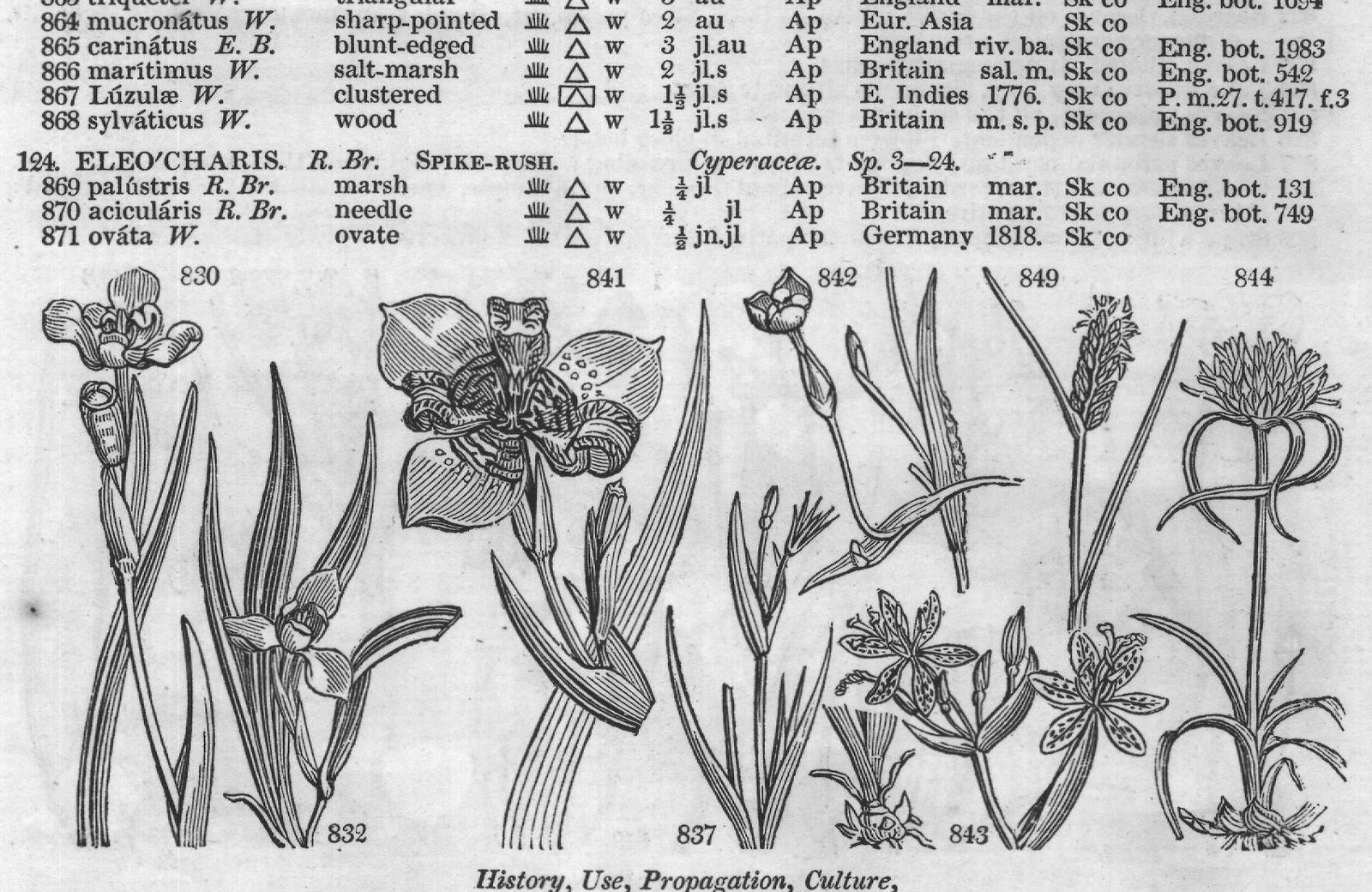
Cape 832 paludósa. H. K. marsh or 2 jn or 2 jn.jl Y or 1 jl.au W Y 833 califórnica B. M. yellow Aor 834 palmifólia W. palm-leaved or 2 f.mr 1 mys Y W Martinico 1782. D s.p C. G. H. 1816. D sp Guiana 1792. Sk s.p California 1796. Sk s.p Brazil CLASS III.
Bot. mag. 416 Bot. reg. 229 Bot. mag. 646 Bot. mag. 983 M. plicáta B. M. 835 striáta B. M. streaked Aor 2 ap.s Y 836 ánceps W. two-edged or 1 jn.jl B 837 micrántha Cav. small-flowered or 1 jn.jl Y 838 Bermudiána W.
Iris-leaved or 1 jn.jl B 839 convolúta W. convolute Aor my.jn Y 840 tenuifólia Red. slender-leaved or my.jn Y 841 cærúlea Ker. blue or my.jn B 842 semi-apérta Lodd. half-open or 1 my.jn Y 118. PARDAN'THUS. Ker. PARDANTHUS.
Irideæ. Sp. 1. 843 chinensis H. K. Chinese or 2 jn.jl 0 China 119. SCHŒ'NUS. Vahl. BOG-RUSH. 844 mucronátus W. clustered 845 nigricans W. black 846 rúfus E. B. brown 847 monoícus E. B. monœcious لالا Aw عاااد لالا A عاد W 848 ferrugíneus Schr. rusty 849 compréssus Sm. compressed 850 stellátus W. star-headed pr 120. RHYNCHOS PORA. Va. RHYNCHOSPORA. 851 álba H. K. white-headed 852 fúsca H. K. brown-headed 853 comáta Lk. leafy-headed 121. FIMBRISTYLIS. Vahl. FIMBRISTYLIS. 854 dichotoma V. dichotomous cu سلاد لاد 122. ISOLE/PIS. R. Br.
ISOLEPIS. 855 flúitans R. Br. floating 856 setácea R. Br. bristle-like عاد ẞ románus W.
Roman y australis L. southern A علا CLUB-RUSH. 830 Britain bogs. D co Eng. bot. 985 1 au Ap bogs. D co Eng. bot. 1575 Ap 1820. D co Cyperacea.
Sp. 1-65. 1 jn.jl Ap E. Indies 1819. D co Rottb.gr. 1.13.f.1 Cyperacea.
W fit. jl.au Ap Sp. 3-46.
Britain dit. D co Eng. bot. 216 jlau Ap Britain 857 Holoschœ'nus Sm. cluster-headed 123. SCIR PUS. R. Br. 858 multicaúlis E. B. 859 cæspitósus W. 860 pauciflórus E. B. 861 lacústris W. 862 glaúcus E. B. 863 tríqueter W. 864 mucronátus W. 865 carinátus E. B. 866 marítimus W. 867 Lúzulæ W. 868 sylváticus W. 124. ELEO'CHARIS. 869 palústris R. Br. 870 aciculáris R. Br. 871 ováta W. many-stalked scaly-stalked R. Br. SPIKE-RUSH. w 3 jl Ap 3 jl Ap bogs. S co England sea sh. Sk co Eng. bot. 1693 Austria Sk co Eng. bot. 1612