Home › L › Leguminosæ (Sp or ap jl Y N S W C s l p)
Leguminosæ (Sp or ap jl Y N S W C s l p)
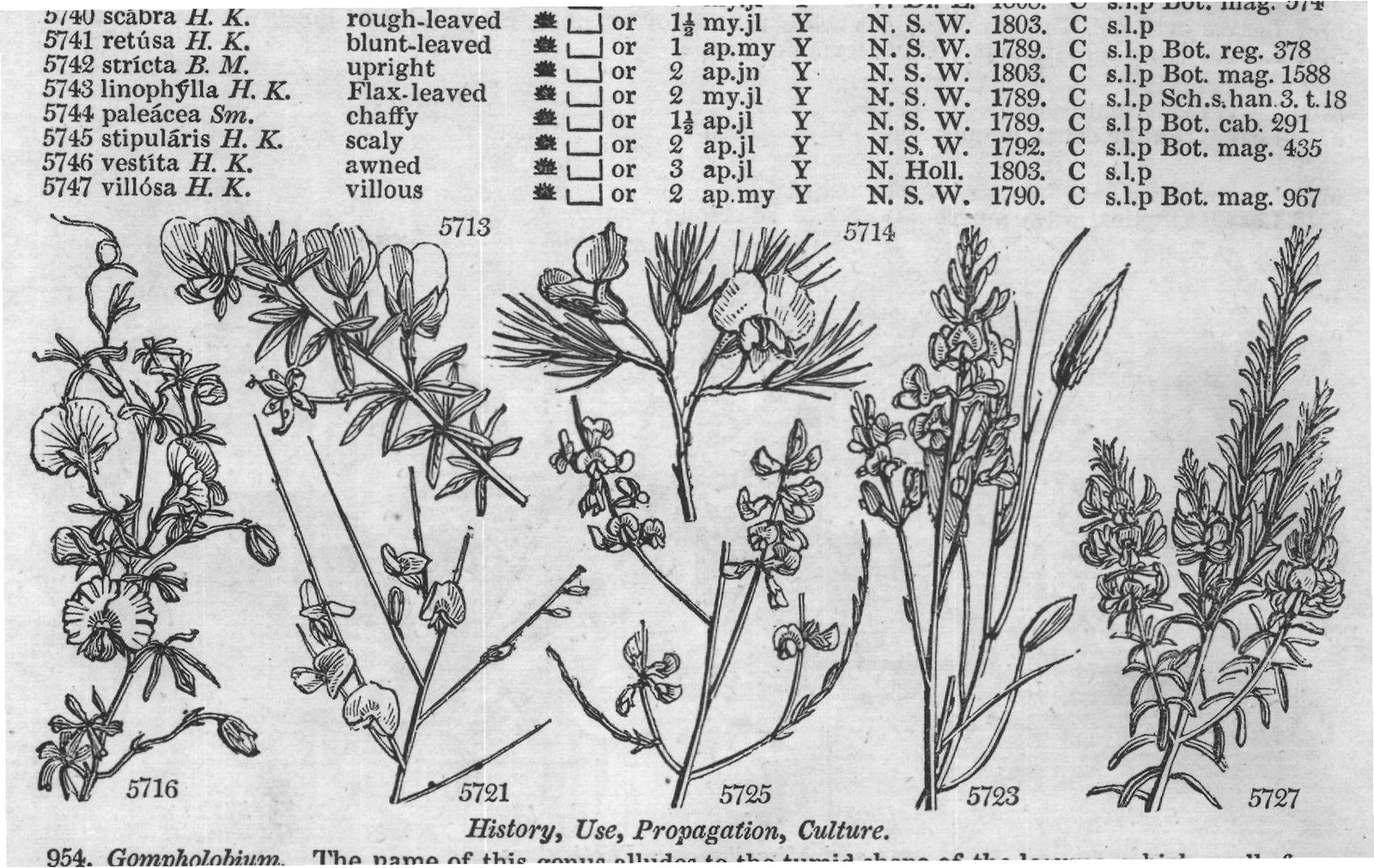
Sp. 13-19. or 1 ap.jl Y N. S. W. 1792. C s.l.p Bot. mag. 1394 V. Di. L. 1808. C s.l.p Bot. mag. 574 N. S. W. 1803. C s.l.p N. S. W. 1789. C s.l.p Bot. reg. 378 N. S. W. 1803. C s.l.p Bot. mag. 1588 N. S. W. 1789. C s.l.p Sch.s.han. 3. t. 18 N. S. W. 1789. C s.lp Bot. cab. 291 N. S. W. 1792. C s.l.p Bot. mag. 435 N. Holl. 1803. C s.l.p N. S. W. 1790. C s.l.p Bot. mag. 967 5714 5716 5721 5725 5723 5727 History, Use, Propagation, Culture. 954. Gompholobium. The name of this genus alludes to the tumid shape of the legume, which swells from a narrow base upwards according to the primary signification of гomфob, a word thence used to signify a narrow base upwards; according to the primary signification of γoμφoς, a word thence used to signify a club or wedge, or any thing formed upon a similar principle. Delicate plants, difficult to preserve, requiring a large proportion of sand in the peat, and moderate watering. Young cuttings root under a bell-glass in sand. 955. Burtonia. A genus defined in the Hortus Kewensis, without an explanation of the origin of the name. This plant, Sweet observes, requires more than ordinary treatment to keep it in good health ; an equal mixture plant, Sweet observes, requires more than ordinary treatment to keep it in good health; an equal mixture of very sandy loam and peat is the best soil for it, and the pots to be well drained with small potsherds, that the water may pass off freely, as nothing is more injurious to it than too much water. Young cuttings are not difficult to root, planted in sand under a bell-glass; it may also be raised from seeds, which are sometimes produced. (Bot. Cult. 156.) 956. Jacksonia. Named after Mr. Jackson, formerly librarian to Aylmer Bourke Lambert, and an excellent practical botanist, of whom too little is known. Young cuttings will root in sand under a bell-glass, or ripened ones under a hand-glass. botanist, of whom too little is known. Young cuttings will root in sand under a bell-glass, or ripened ones under a hand-glass. 957. Viminaria. From vimen, a twig. The appearance of the species which have no leaves is that of a bundle of naked twigs.
ORDER I.
DECANDRIA MONOGYNIA. 5713 Leaves term. Leafl. lin. or obl. lin. an inch and more long, Stem erect, Keel fringed, Cal. in fruit reflexed 5714 Leaves ternate linear mucronate straight, Branches angular smooth 5715 Leaves ternate, Leafl. obovate edged flat, Stipules as long as leafstalk, Cor. length of calyx 5716 Lvs. tern. and quinate, Leafl. linear recurved at edge, somewhat dilated at end, Stem procum. or twining 5717 Leaves ternate linear smooth mucronate, Branches round hairy, Keel hairy 5718 Leaves pinn. Leafl. subulate linear mucronate rough above, Cal. hairy shorter than pod, Keel silky ciliate 5719 Leaves pinn. of many pairs, Leafl. subulate veiny revolute at edge and calyxes smooth, Cor. purple 5720 Leaves ternate, Cal. smooth, Style beyond the middle beardless 5721 Arborescent unarmed, Branches angular, Racemes terminal 5722 Shrubby, Branches spiny 2-3-chotomous spreading angular, Bractes very short 5723 Segments of calyx straight ovate 5724 Flowers racemose, Segments of calyx lanceolate reflexed 5725 Tube of cal. a little shorter than lips, Style included bowed from the base, Cor. yellow 5726 Tube of cal. twice as short as the lips, Cor. red 5727 Cal. silky with appressed hairs, Pods stalked, Seeds dotted rugose, Leaves rough above 5728 Flowers axillary ternate, Leaves subulate mucronate 5729 Corymbs terminal sessile, Leaves subul. rough with dots divaricate twisted, Branches pubescent 5730 Corymbs terminal stalked, Leaves filiform erect smooth, Mucro weak recurved 5731 Leaves short spreading decussate, Fl. capitate, Pedunc. with two bractes, Stigma capitate 5732 Corymbs terminal sessile, Leaves filiform erect, with a weak short point, Branches silky 5733 Leaves acerose horizontal, Branches weak, Heads 3-9-flowered 5734 Leaves lanceolate or lanceolate-obovate, Peduncles axillary twin, Appendages of wings very short 5735 The only species 5736 Lvs. beneath somew. silky retuse, Lobes round. longer than little point, Stalk of pod as long as tube of cal. 5737 The only species 5738 Heads terminal, Leaves obovate oblong flat quite smooth 3 times as long as broad, Point pungent 5739 Heads term. Leaves cuneate obcord. retuse flat smooth scarcely twice as long as broad, Point pungent 5740 Heads term. few-fl. Leaves cuneate truncate bristly pointed recurved at edge rough above villous beneath 5741 Heads term. Leaves linear retuse blunt flat smooth, Bractes a little longer than cal. 5742 Heads term. Leaves obovate mucronate smooth, Stem upright, Calyx and pods hairy 5743 Bractes shorter than 6-8-fl. head, Lvs. lin. with a little point and recurv. edge, Stip. shorter than footstalk 5744 Leaves linear mucronate revolute recurved at end, Stipules solitary 2-nerved with membr. torn sheaths 5745 Heads many-fl. Bractes about as long as cal. Leaves flat linear acute, Stipules bifid flat imbricated 5746 Fl. axill. Leaves linear lanceolate mucronate smooth, Stip. imbric. ciliated, Cal. and bractes bearded 5747 Racemes leafy, Leaves linear oblong, above concave, beneath cal, and branchlets pilose 5734 5736 5737 5738 and Miscellaneous Particulars. 5747 5739 5741 958. Sphærolobium. From σφaiρa, a sphere; the pods being nearly spherical. See Jacksonia. 959. Aotus. From a, privative, and ωτa, ears, in allusion to the want of the appendages to the calyx in this genus. In Pultenæa, to which it is most nearly allied, they are very distinct. 960. Dillwynia. Named by Sir James Edward Smith, after Mr. Lewis Weston Dillwyn, whose labors upon Confervæ and other parts of British botany are well known. These plants being liable to suffer from wet, the pots must be well drained with sherds and refuse peat siftings. Young cuttings root freely in sand under a bell-glass. 961. Eutaxia. From εuτaξia, modesty, in allusion to the humble, modest appearance of the plant. Mr. Sweet directs to top the plants frequently when young, otherwise they are apt to run up naked and unsightly. 962. Sclerothamnus. From σκληρoς, hard, and θaμvoς, a shrub. The species are rigid plants with stiff hard leaves. 963. Gastrolobium. From yaσης, the belly; or, in botanical composition, something inflated. The pods of the genus are much swollen. 964. Euchilus. From εu, well, and χεiλoς, a lip; well lipped. The upper lip of the calyx is very large. 965. Pultenæa. Named after William Pulteney, M. D., author of a view of the writings of Linnæus, and DECANDRIA MONOGYNIA.
CLASS X. 5748 fléxilis H. K. shining-leaved or 1 ap.jn Y N. S. W. 1801. C s.l.p 5749 tenuifólia R. Br. thin-leaved or 1 ap.my Y N. S. W. 1817. C s.l.p Bot. mag. 2086 5750 bíloba, R. Br. two-lobed or 2 ap.my Y N. S. W. 1817. C s.l.p Bot. mag. 2091 966. DAVIESIA. L. T. DAVIESIA.