Madagas
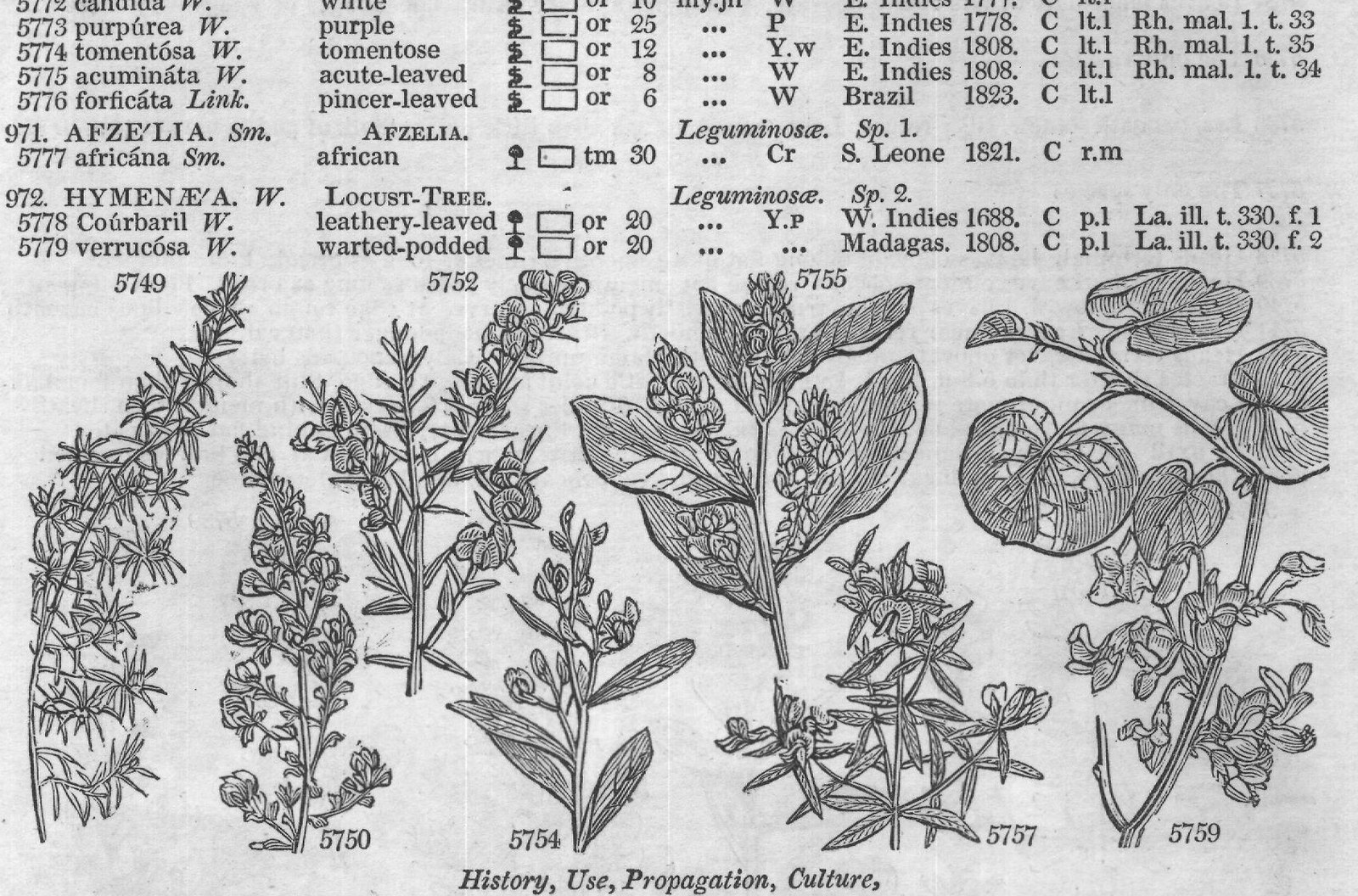
1808. C p.1 La. ill. t. 330. f. 2 5749 5752 5755 5750 of various other works of merit. quently brown on the outside. 5754 History, Use, Propagation, Culture, 5757 5759 These are small New Holland bushes, with numerous yellow flowers, fre- 966. Daviesia. Named after the Rev. Hugh Davies, a Welsh botanist. Plants like furze. The species root best when the cuttings are somewhat ripened ed and pl planted in pots of sand, and covered with a hand-glass without bottom heat. 967. Mirbelia. In honor of Mr. Mirbel, a distinguished French physiological botanist, whose elucidations of the reticulated structure of vegetables make it proper to consecrate to his merits plants remarkable for their reticulation. 968. Cercis. Kερκiς is a name of Theophrastus, supposed to have appertained to the tree now so called. Gainier or Arbre de Judée, Fr., Arbold Amor, Span. Handsome low trees, with singular leaves and fine shewy flowers. These having an agreeable poignancy, and being abundant on the branches, are frequently eaten in salads on the continent, and those of the C. canadensis are pickled by the French families in Canada. The wood of both species is finely veined with black and green, and takes a good polish and the young branches of the Canadian species are said to dye wool of a fine nankeen color. They may be propagated either by layers or seeds: the latter make the best plants. Gerarde, in compliance with the popular notions of his time, says, "this is the tree whereon Judas did hang himselfe; and not upon the elder tree, as it is said." 969. Schotia. So named by Jacquin, in memory of Richard van der Schott, a Dutchman, gardener at Schoenbrunn, and his companion in his travels. This beautiful genus has lately been increased by Burchell, the African traveller. "They require," Sweet observes, " rather more warmth than a common greenhouse, to keep them in good health through the winter. The coldest part of the stove will suit them better; but they should not be plunged in the tan, as they want no bottom heat. A mixture of loam and peat is the best soil for them; and cuttings planted in sand, and plunged in mould (not in tan), under a hand-glass, will strike root." (Bot. Cult. 105.) 970. Bauhinia. So named by Plumier, in honor of the two famous botanists, John and Caspar Bauhin. The species consist of trees or shrubs, most of them climbing. The leaves are simple, but two-lobed or two- ORDER I.
DECANDRIA MONOGYNIA. 5748 Very smooth, Fl. axill. Leaves oblong linear mucronate flat 5749 Heads terminal 2-flowered, Fruit lateral, Leaves subulate linear hairy above concave 5750 Heads terminal few-fl. Leaves wedge-shaped at the end dilated 2-lobed above rough beneath silky 5751 Leaves linear revolute pungent straight rough, Flowers axillary solitary 5752 Branches spiny smooth spreading, Leaves lanceolate or linear, Pedunc. axill. 1-fl. Bractes 8 imbricated 5753 Leaves linear oblong flat pointless, Pedunc. axill. twin corymbose many-fl. Calyx regular 5754 Branches unarmed, Lvs. long-lanc. with a very short weak point, Corymbs axill. Upper lip of calyx retuse 5755 Branches unarmed, Leaves ellipt. or oval veiny attenuated at base, Racemes axillary many-fl. 5756 Stem leafless winged, Umbels lateral, Calyx and bractes fringed 5757 Leaves lanceolate linear veiny, Ovaries 2-seeded 5758 Leaves wedge-shaped at the end dilated-trifid 5759 Leaves orbicular cordate 5760 Leaves cordate acuminate 5761 Leaves 7-10 pairs oval-lanceolate mucronate, Stipules subulate 5762 Leaves 8-10 pairs oval obtuse mucronate or not, at the base in front a little swollen 5763 Leaves 5 pairs oval acute mucronate, Stipules half-ovate falcate mucronate 5764 Stem tendril-bearing, Lobes of leaves attenuated 5765 Stem tendril-bearing, Fl. triandr, on outside with stam. at base hairy, Lvs. downy beneath, Lobes rounded 5766 Stem prickly 5767 Leaves smooth, Lobes divaricate acute 2-nerved, Petals lanceolate 5768 Leaves at the base nearly transverse, Lobes lanceolate porrect 3-nerved, Petals lanceolate 5769 Leaves cordate, Lobes porrect acute 3-nerved, Petals lanceolate 5770 Racemes axill. and term. nodding, Petals linear, Lobes of leaves rounded smooth 5771 Cal. 1-leaved bursting, Petals sessile ovate, Lobes of leaves ovate obtuse 5772 Leaves cordate downy beneath, Lobes ovate obtuse, Cal. narrowed upwards lengthened 5773 Flowers triandrous, Lobes of leaves oval obtuse 5774 Leaves cordate, Lobes half orbicular downy 5775 Leaves ovate, Lobes acuminate half-ovate spreading 5776 Stem prickly, Leaves cordate with porrect 4-nerved lobes 5777 Leaves alternate abruptly pinnated, Pod woody, Seeds black with a scarlet arillus 5778 Leaflets coriaceous veinless unequal at base, Flowers of panicle stalked 5779 Leaves veiny unequal at base, Panicle wavy spreading, Pedunc. many-fl. Pods warted 5761 5762 5769 5773 5765 5778 5777 5779 and Miscellaneous Particulars. parted, which circumstance gave occasion, it is said, to Plumier to name this genus from the two brothers. They merit a place in the stove, where they are easily cultivated in light loamy soil, and cuttings taken off when the plants are in a growing state, not over ripened, nor yet quite succulent, with their leaves on, will do well in sand under bell-glasses in moist heat. The species rarely flower in this country. In their native woods they are great ornaments of the trees, among which they climb in every direction. The stem of Bauhinia scandens, which had twined around a smaller plant, is said to have been the origin of Esculapius's snaken rod, which he brought from India. 971. Afzelia. Named by Sir J. E. Smith, after Dr. Adam Afzelius, an amiable and excellent Swedish botanist, resident for many years, in the service of the African Company, at the colony of Sierra Leone, and now living at Upsal. 972. Hymenæa. A poetical application of this plant, the leaves of which grow in pairs, to Hymen, the god of marriage. Courbaril is a vernacular American name. This tree is abundant in the West Indies, where it grows to a large size, with a spreading head. It has stiff sub-perfoliate leaves obliquely placed, and terminal spikes of flowers, which are succeeded by thick, fieshy, brown pods, shaped like those of the garden bean; they are six inches long, and two inches and a half broad, of a purplish brown color, and a ligneous consistence, with a large suture on both edges; they contain three or four roundish compressed seeds, divided by transverse partitions, and inclosed in a whitish substance of fine filaments, as sweet as honey. The Indians eat this substance with great avidity, though it is apt to purge when fresh gathered, but it loses this quality as it grows old.
Between the principal roots of the tree exudes a fine transparent resin, yellowish or red, which is collected in large lumps, is called gum Anime, and makes the finest varnish that is known, superior even to the Chinese lacca: for this latter use it is dissolved in the highest rectified spirits of wine. It burns readily, and with a clear flame, emitting a grateful and fragrant smell, for which reason it is sometimes ordered by way of fumigation in the chambers of persons laboring with asthmas or suffocative catarrhs. Its vapours not only strengthen the head, ad, but all parts of the body affected with cold. Some apply it outwardly, dissolved in oil or spirits of wine, to strengthen the nerves. An oil may be distilled from it, useful in palsies, in cramps, and DECANDRIA MONOGYNIA. 973. CYNOMETRA. W. CYNOMETRA.
CLASS X.
Leguminosæ. Sp. 1-2. 5780 cauliflóra W. stem-flowering or 30 Y.P E. Indies 1804. C s.l.p Lam. ill. t. 331 974. CASSIA. W.
CASSIA Leguminosæ. Sp. 56-149. 5781 diphýlla W. two-leaved pr 3 my.jl Y 5782 Ab'sus W. four-leaved un jn.jl Y W. Indies 1781. C lt.1 Ca. ic. 5.t. 600.f.1 India 1777. C lt.l Burm. zeyl. t. 97 5783 vimínea W. twiggy pr 3 Y ...
W. Indies 1786. S p.l 5784 bacilláris W. rod or 3 ...
Y E. Indies 1782. C co 5785 Tágera W. 5786 Tora W. 5787 bicapsuláris W. 5788 sennoídes W. long-podded oval-leaved W Y w 3 au Y 5789 acumináta W. 5790 mollíssima W. en. 5791 corymbósa W. 5792 emargináta W. 5793 obtusifólia H. K. 5794 péndula W. en. 5795 lævigáta W.en. 5796 serícea W. 5797 díspar W. en. 5798 occidentális W. 5799 pátula W. 5800 prostráta W. en. 5801 arboréscens W. 5802 itálica Lam. 5803 Sénna H. K. six-leaved Senna-leaved pointed soft-leaved corymbose notch-leaved blunt-leaved pendulous smooth silky-leaved unequal occidental shining or 4 my.jn Y or 3 jl.au Y or 8 Y ... or 6 ...
Y L or 3 jl Y w 2 jl.au Y or 3 jl.au Y pr 3 my.au Y w 1½ my.au Y or 3 Y ... pr 1 my.au Y pr 2 au.s Y prostrate or my.au Y tree un 3 jn.jl Y Italian Senna or 3 jn.jl Y false Senna m 3 jl.au Y 5804 orientális P. S. true Senna m 3 jl.au Y 5805 ruscifólia W.
Ruscus-leaved or 2 my.jl Y 5806 purpúrea Roxb. purple or 4 jn.au Y 5807 ægyptíaca W. en.
Egyptian or 3 my Y 5808 biflóra W. two-flowered or 6 ap.d Y 5809 chinénsis W.
Chinese L or 4 jn Y 5810 hirsúta H. K.. woolly w 4 jl Y 5811 coromandeliana W.en. Coromandel or 4 jn Y 5812 lanceoláta P. S. lanceolate pr 3 jl Y or 15 my.jn Y E. Indies 1803. C p.1 E. Indies 1808. S s.p Surinam 1820. S s.p S. Amer. 1816. S p.l B. Ayres 1796. C s.p Jamaica 1759. C p.l Jamaica 1732. C p.1 S. Amer. 1820. C p.1 C lt.1 ...
Jamaica 1731. C s.p S. Amer. 1824. C s.p Dill. elt. 63. f. 73 Plu. ic. t. 76. f. 1 Jac. ic. 1. t. 70 Bot. mag. 633 Sl.hi.2.t.180.f.1.4 Dil. el. t. 62. f. 72 W. Indies 1759. C p.l Bot. reg. 83 W. Indies 1778. C lt.l ... ...
S. Amer. 1819. C co E. Indies 1800. C p.1 S. Europe Sco Egypt 1640. S lt.1 Levant S lt.l Madeira 1816. C lt.l E. Indies 1821. C co Egypt 1822. C co W. Indies 1766. C p.l China 1807. S p.l America 1778. C s.p E. Indies 1822. C co W. Indies 1822. C co Rh. ma. 6. t. 9,10 Mo. h. 2. t. 24.f.2 Tabern. ic. 507 Jac. ic. 1. t. 71 Bot. reg. 856 Bot. mag. 810 Jac. ic. 1. t. 73 E. Indies 1693. Cr.m W. Indies 1739. C p.l 5813 bracteata W. bracteate or 6 ap.d Y W. Indies 1822. C co 5814 tomentósa W. tomentose or 15 jl.s Y W. Indies 1822. C co 5815 glandulósa W. glandular pr 4 au.o Y W. Indies 1822. C co 5816 grándis W. fine or 25 Y ... 5817 planisiliqua P. S. flat-podded pr 4 my.jl Y 5818 robinioídes W. en.
Robinia-like or 10 jl Y 5819 stipulácea W. large-stipuled or 3 Y ... 5820 cuspidáta W. en. cuspidate or 4 jn.au Y 5822 aláta W. 5823 ligustrína W. 5825 frondósa W. 5821 marilándica W. 5824 multiglandulósa W. glandular 5826 Sóphera W.
Maryland Apr 4 au.o Y broad-leaved or 12 Y ...
Privet-leaved or 6 jl Y pr 4 jn.au Y W. Indies 1822. C co W. Indies 1822. C co S. Amer. 1823. C co Chili 1786. C It.l S. Amer. 1820. C co N. Amer. 1723. C s.p W. Indies 1731. C p.l Baham. Is.1726. C p.1.
Teneriffe 1779. C s.p Plum. spec. t. 77 Feu. per. 3. t. 42 Brey. cent. t. 14 Di. el. t.260.f.339 Jac. ob.2. t.45.f.2 Bot. reg. 109 Jac. ic. 1. t. 72 smooth-shrub.
L or 3 mr.ap Y W. Indies 1769. C lt.l Jac. ic. 1. t. 74 round-podded or 4 jl.s Y E. Indies 1658. C lt.l Rh. ma. 2. t. 52 5827 reticuláta W. en.
Matapasto or 10 au.s Y S. Amer. 1821. C co 5828 auriculáta W. eared or 4 Y E. Indies 1777. C lt.l Pl. alm. t. 314.f.4 ... 5829 Chamæcrísta W. dwarf pr 1 jr.s Y 5830 hírta W. en. long-haired or 3 jl.s Y 5831 margináta W. en. 5832 mimosoídes W. 5833 microphýlla W. 5834 níctitans W. 5835 capénsis Th. 5836 procúmbens W. 5780 white-edged el 3 my.jl Y Mimosa-leaved pr 2 jn.s Y small-leaved pr 2 jn.s Y Virginian pr 2 jl Y Cape or 3 jn Y procumbent W 1½ jn.jl Y America 1699. Sr.m Bot. mag. 107 S. Amer. 1820. C co Surinam 1823. C co Ceylon 1806. S lt.1 Santa Cr. 1810. S lt.l N. Amer. 1800. S lt.l C. G. H. 1816. S lt.l Bot. cab. 511 N. Amer. 1806. S lt.l Pl. alm. t. 314.f.5 Com, pet. t. 11 5801 5786 5788 5791 5793 5798 History, Use, Propagation, Culture, 5805 contractions of the sinews. The solution in spirits has been thought not inferior to Guaiacum in venereal cases. A decoction of the leaves expels flatulency, and gives ease in colicky pains, by gently opening the bowels; and the inward bark is an excellent vermifuge in substance or decoction. The tree is excellent timber; but it must be very old before it is cut, otherwise the heart will be but small. It is in great request for wheel-work in the sugar-mills, particularly for cogs to the wheels, being extremely hard and tough: it is so heavy, that a foot cube weighs about a hundred pounds, and it will take a fine polish. It is much inhabited by wild honey bees. (Browne.) Besides this locust-tree, there is the American tree of that name, Robinia Pseud-acacia, and the locust-tree of scripture, Ceratonia siliqua.
ORDER I.
DECANDRIA MONOGYNIA. 5780 Flowers growing upon the trunk 5781 Leaves 1 pair and calyxes smooth, Stipules cordate-lanceolate 5782 Leaves 2 pairs obovate, Two subulate glands between the lower pair 5783 Leaves 2 pairs ovate oblong acuminate, An obl. gland between the lower pair, Spines obsolete 3-toothed 5784 Leaves 2 pairs ovate oblique, An obtuse gland between the lowest, Racemes axill, stalked 5785 Leaves 3 pairs: with a gland on the footstalk, Stipules ciliate cordate acuminate 5786 Leaves 3 pairs obovate: outer largest, A subulate gland between the lower pair 5787 Leaves 3 pairs obovate smooth: the inner roundest with a globose gland between 5788 Leaves 3 pairs, Leaflets obtuse elliptical, A gland between the lower leaves 5789 Leaves 3 pairs, Leaflets ovate acuminate, A sessile gland between the leaflets 5790 Leaves 3 pairs ovate acuminate with soft down on each side 5791 Leaves 3 pairs lanceolate subfalcate smooth, A gland between the lowest, Corymbs stalked, Pods cylind. 5792 Leaves about 4 pairs ovate, Flowers racemose irregular, Stem arborescent 5793 Leaves 3 pairs obovate obtuse beneath very villous outer largest, A gland between lowest, Pods recurved 5794 Leaves 3 or 4 pairs obovate the outer largest, A gland between the lower pairs, Pods pendulous rounded 5795 Leaves 4 pairs ovate hairy with a subulate gland between the leaflets, Peduncles 4-flowered 5796 Leaves 4 pairs obovate pubescent ciliated, A stalked gland between all, Pedunc. 4-fl. Pod jointed 5797 Leaves 4 or 5 pairs oblong obtuse: the outer the largest with a gland between every pair 5798 Leaves 5 pairs ovate lanceolate rough at edge: outer largest, A gland at foot of leafstalk 5799 Leaves 5 pairs oblong acute smooth, A gland at base of footstalk, Branches smooth 5800 Leaves 5 pairs elliptical smooth with an obl. gland between the lower, Stip. subul. falcate, Rac. axillary 5801 Leaves 5 pairs elliptical smooth, An oblong gland between the lower, Racemes axillary 5802 Leaves 5 pairs cordate obtuse, Stalks without glands 5803 Leaves 6 pairs obovate smooth, Stalks without glands, Spikes racemose, Pods leafy compressed falcate 5804 Leaves 5 pairs lanceolate equal, Gland above the base of the leafstalks 5805 Leaves 6 pairs ovate lanceolate smooth with a gland at the base of the stalk, Pod compressed edged 5806 Leaves 8-9 pairs ovate lanceol. hairy with a gland at base of stalk, Racemes many-fl. shorter than leaves 5807 Leaves 6 pairs lanceolate acute the outer largest, A gland on leafstalk, Peduncles 2 flowered 5808 Leaves 6 pairs obl. smooth: lower smaller with a subulate gland between the lowest, Stalks 2-flowered 5809 Leaves 6 pairs ovate acute smooth, with a gland at the base of the stalk, Pod cylindrical hooked 5810 Leaves 5-6 pairs ovate acuminate woolly: the outer largest 5811 Leaves 6 or 8 pairs lanceolate acute smooth, with a gland on_the leafstalk, Pod round smooth 5812 Leaves 2 pairs obovate veiny, Stipules lanceolate appressed, Leaflets nearly equal 5813 Leaves 10 pairs oblong obtuse without glands, Racemes long, Bractes ovate tumid imbricated 5814 Leaves 6-8 pairs linear obliquely rounded at base above hairy, Panic. axillary, Pod villous 5815 Leaves in many pairs with many glands, Stipules subulate 5816 Leaves 2 pairs velvety without glands 5817 Leaves 5 pairs ovate lanceolate smooth with a gland at the base of the leafstalk 5818 Leaves 6-9 pairs lanceolate acuminate smooth, A gland on the leafstalk 5819 Leaves 8 pairs ovate-lanceolate, A gland between the lower, Stipules ovate very large 5820 Leaves 10 pairs ovate-lanceolate obtuse mucronate smooth, Stalk without gland 5821 Leaves 8 pairs ovate-oblong equal, Gland at the base of the leafstalk 5822 Leaves 8 pairs oval-oblong: the outer smaller, Leafstalks without glands, Stipules spreading 5823 Leaves 7 pairs lanceolate: the outer smallest, A gland at base of leafstalk 5824 Leaves 6 pairs oval-obl. obt. hairy: the outer largest, A subulate gland between each pair, Pods linear 5825 Leaves 9 pairs oval-obl. smooth obt. A cylindrical gland between the lowest, Footst. with no gland at base with no gland at base 5826 Leaves 10 pairs lanceolate with an oblong gland at the base 5827 Leaves 10 pairs, Leaflets oblong rounded at each end beneath hoary, No gland on stalk, Pod compressed 5828 Leaves 12 pairs obtuse mucronate, Glands many subulate, Stipules reniform bearded 5829 Leaves many pairs, Gland of the footstalk stalked, Stipules ensiform 5830 Branches hairy, Stipules lanceolate linear with elevated lines, Leaflets cuspidate 5831 Leaves 15 pairs, Leaflets with a cartilaginous white edge and a subulate gland between every pair 5832 Leaves many pairs linear with an obsolete gland at the base of the leafstalk, Stipules setaceous 5833 Leaves many pairs linear mucronate with a gland between the lowest, Pedunc. solitary 1--fl. 5834 Leaves many pairs, Flowers pentandrous, Stem erect 5835 Leaves many pairs linear, Stem flexuose erect villous. The plant in Bot. Cab. is something else? 5836 Leaves many pairs without glands, Stem procumbent 5806 5808 5825 5834 5823 5829 5809 and Miscellaneous Pariiculars. 5821 973. Cynometra. A name contrived to indicate the peculiar form of the pods of this genus, which grow from the old stems and branches of the tree. Large cuttings root best planted in sand, and plunged in heat under a hand-glass. 974. Cassia. According to Olaus Celsus, this name is to be traced to the Hebrew, Ketzioth, rendered by Kaσiav in the Septuagint, and Latinized by Cassia. Cuttings of the species , which do not seed freely, root in pots of sand, in moist heat, and covered by a hand-glass. Of the trivial names of different species of Cassia, that of Absus is the name under which it is described by Professor Alpinus, and is supposed to have arisen from a river of Palestine of that name. Tagera is a Malabar name, Sophera, an Egyptian name, and Senna, the Arabic name of the plant- Soenna. plant - Sænna. 975. CATHARTOCARPUS. P. S. 5837 Fistula P. S. purging Y 5838 javánicus P. S.
Java 976. PARKINSONIA. W. PARKINSONIA. 5839 aculeáta W. prickly or 12 ... 977. POINCIANA. H.K. POINCIANA. 5840 pulchérrima H. K. Flower-fence 5841 eláta H. K. smooth or 15 ...
DECANDRIA MONOGYNIA.
CATHARTOCARPUS. Leguminosa. Sp. 2-5. m 3 jn.jl E. Indies 1731. C 1.p Pk E. Indies 1779. C 1.p Leguminosæ. Sp. 1.
Or W. Indies 1739. C l.p Leguminosæ. Sp. 2. or 10 jn.s R.Y.G E. Indies 1691. Sr.m Bot. mag. 995 Y E. Indies 1778. S r.m CLASS X.
Rh. mal. 1. t. 22 Co. hort. 1. t.111 Jac. amer. t. 80 978. CÆSALPINIA. H. K. BRASILETTO.
Leguminosæ. Sp. 9-18. 5842 bíjuga W. broad-leaved ec 15 Y ...
Jamaica 1770. S p.l Sl.h.2.t. 181.f.2,3 5843 brasiliénsis W. smooth ec 20 Or ...
Jamaica 1739. S p.l 5844 Sap'pan W. narrow-leaved ec 20 Y ...
E. Indies 1773. S p.1 Roxb.cor.1.t.16 5845 Crísta Sw. oval-leaved ec 15 ...
W.Y Jamaica Sp.l Plu. gen. t. 68 5846 mimosoídes W.
Mimosa-leaved pr 6 Y ... 5847 Núga H. K. acute-leaved ec 10 ...
Y 5848 cassioídes W. en.
Senna-like or 6 ... ... 5849 mucronáta W. en. mucronate or 6 ... ...
E. Indies 1806. S p.1 E. Indies 1801. S p.1 S. Amer. 1821. S p.1 Brazil Rh. mal. 6. t. 8 Rum. am. 5. t.50 1823. S p.l 5850 punctáta W. en. dotted or 6 ... ...
Brazil 1820. S p.1 979. GUILANDI'NA. H. K. NICKER-TREE. 5851 Bónduc H. K. oval-leaved or 12 Y Leguminosæ. Sp. 1-7.
India ... 1640. C s.p Lam. ill. t. 336 980. HYPERANTHE'RA. W. HORSE-RADISH-TREE.
Leguminosæ. Sp. 1-2. 5852 Morínga W. smooth or 10 ... ...
E. Indies 1759. C p.l Jac. ic. 3. t. 461 981. HOFFMANSEG GIA. Cav. HOFFMANSEGGIA. Leguminose. Sp. 1-2. 5853 falcária Cav. sickle-leaved cu 2 jl.au 982. ADENANTHERA. W. ADENANTHERA. 5854 Pavonína W. yellow-flowered or 5855 falcáta W. woolly-leaved or 5 983. CA'DIA. W.
CADIA. 5856 purpúrea W. purple cu 984. PRO'SOPIS. Rox.
PROSOPIS. 5857 spicígera L. eatable-podded ec 20 985. HEMATOXYLON. W. LOGWOOD. 5858 campechiánum W. common 오 dy 20 ...
Chili Leguminosæ. Sp. 2-5. 5 my.au Y E. Indies 1759. C s.l.p ...
Y E. Indies 1812. C s.l.p Ru. amb. 3. t.11 Leguminosæ. Sp. 1. 6 ja.jl W.pu Arabia Leguminosæ. Sp. 1. ...
W.G E. Indies Leguminosæ. Sp. 1.
Y 1806. C s.l.p Cav. ic. t. 392 1775. 1812.
C lt.l Pic. h.p. 9. c. ic.
Cr.m Roxb. cor.1. t. 63 ...
S. Amer. 1724. Cr.m Cat. car. 2. t. 66 986. COPAI FERA. W. BALSAM OF CAPEVI.
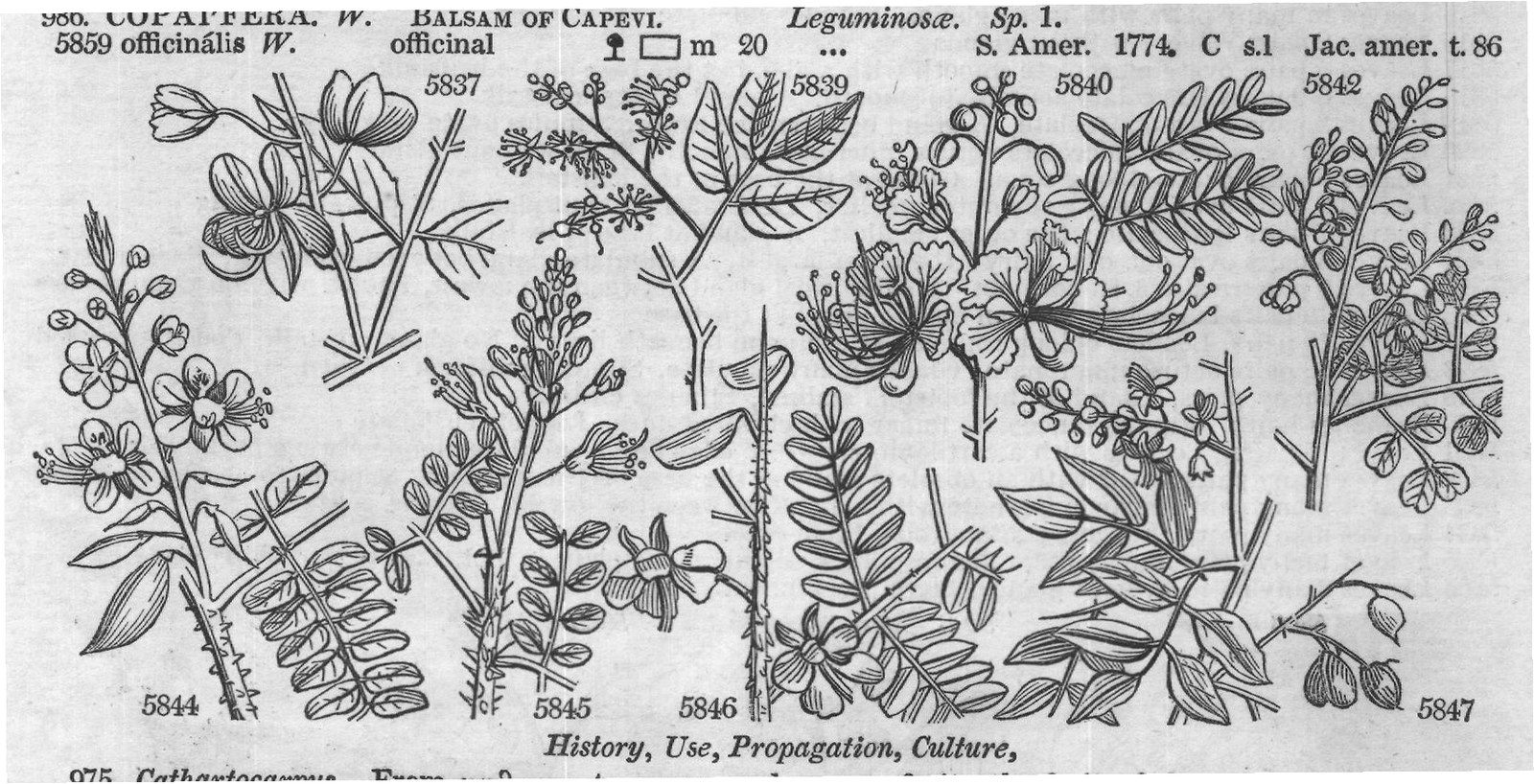
Leguminosæ. Sp. 1. 5859 officinális W. officinal 5837 오 m 20 ... 5839 S. Amer. 1774. C s.l Jac. amer. t. 86 5840 5842 5844 5845 5846 5847 History, Use, Propagation, Culture, 975. Cathartocarpus. From κaθaiρω, to purge, and κaρπoς, fruit; the fruit of the species being a strong cathartic. The species may be treated as Cassia. 976. Parkinsonia. So named by Plumier, in memory of John Parkinson, apothecary, of London, author of Paradisus Terestris, 1629, and Theatrum Botanicum, 1640. It is a handsome low tree, not unlike the Labur- Terestris, 1629 , and Theatrum Botanicum, 1640. It is a handsome low tree, not unlike the Laburnum, and planted in the West Indies near houses, as the latter is in this country. 977. Poinciana. So named by Tournefort, in memory of De Poinci, governor of the Antilles, placed by Linnæus among the promoters of botany.
P. pulcherrima is a low spiny tree, with an odor, when the leaves are bruised, like savin. It is a native of both Indies, and in Barbadoes is planted in hedges, whence the name of flower-fence, or Spanish carnations, Indies, and in Barbadoes is planted in hedges, whence the name of flower-fence, or Spanish carnations, which it is there called. In our stoves they require a strong heat to make them flower well. They are readily increased either by cuttings or seeds 978. Cæsalpinia. So named by Plumier, in honor of Andreas Cæsalpinus, chief physician to Pope Clement VIII., and the father of systematic arrangement in plants, in his now very scarce work, entitled, VIII., and the father of systematic arrangement in plants, in his now very scarce work, entitled, De Plantis, libri sedecim, Flor. 1583. He died at Rome in 1602. The wood of all the genus may be used in dying. In our stoves the plants are thorny, and, therefore, not being much liked, are seldom suffered to grow large enough to flower freely.
C. sappan is a prickly tree, with the heart of the wood red, heavy, and very hard: it dyes a beautiful red, which, however, is said not to stand. It is very durable in sea-water, and exported abundantly by the Chinese for trenails in ship-building, and as a dye. , however, is said not to stand. It is very durable in sea-water, and exported abundantly by the Chinese for trenails in ship-building, and as a dye.
C. crista and brasiliensis afford the Brazil wood used in dying, and extensively imported to England from the West Indies. The timber of the last species is elastic, tough, and durable, and takes a fine polish ; it is of West Indies. The timber of the last species is elastic, tough, and durable, and takes a fine polish; it is of a beautiful orange-color, full of resin, and yields a fine full tincture by infusion. The best Brazil wood is said to be produced by Cæsalpinia echinata.
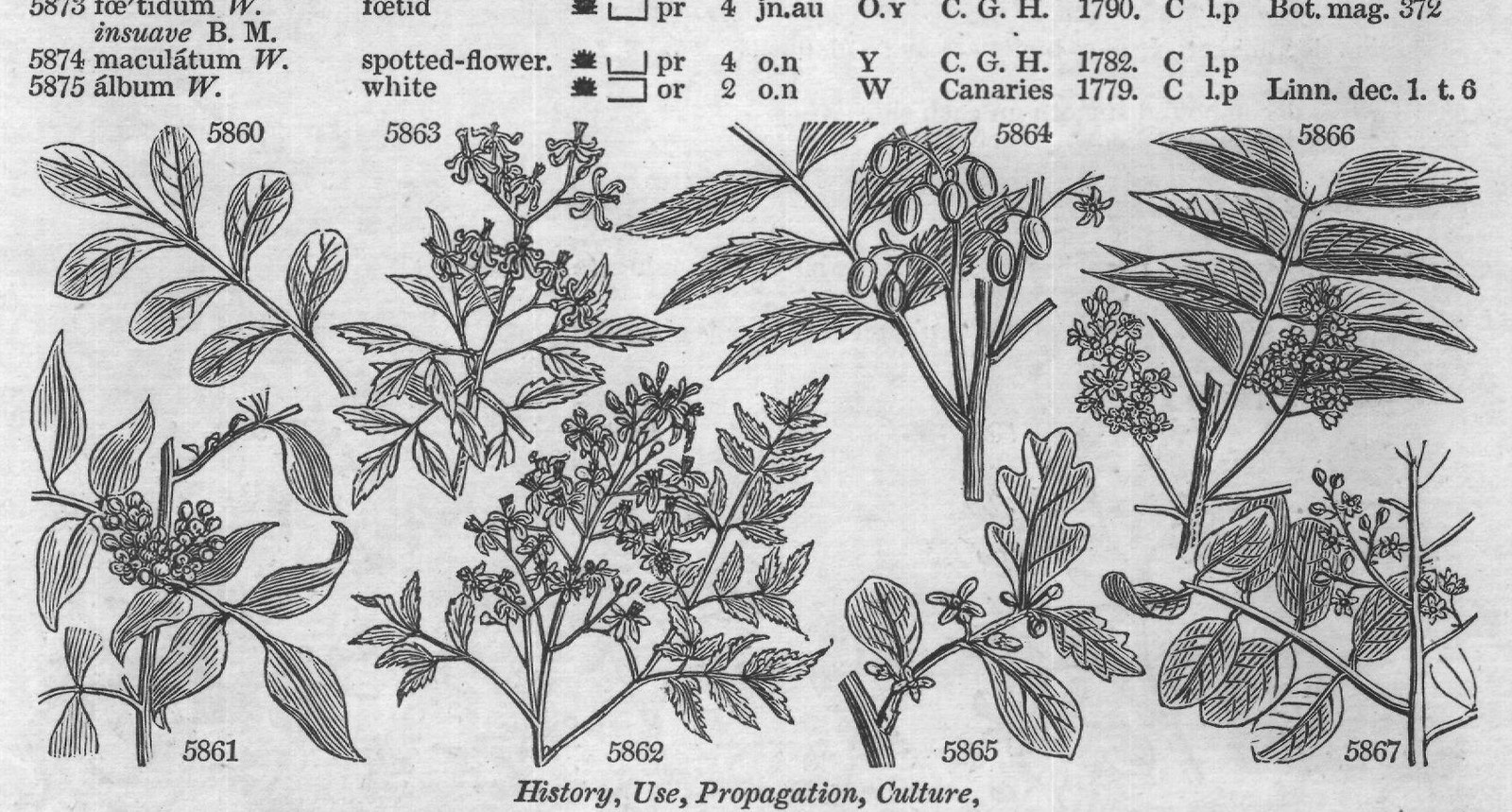
Cuttings, Sweet observes, will not root freely, but will sometimes succeed if taken off in a growing state, but not too young, and plunged in a pot of sand, under a hand-glass, in moist heat. (Bot. Cult. 32.) 979. Guilandina. Named after Melchior Guilandin, a Prussian traveller in Africa, and demonleaves. strator of Botany at Padua. He died in 1590. The species are all fine trees, with large compound of Botany at Padua. He died in 1590. The species are all fine trees, with large compound leaves. 980. Hyperanthera. From ὑπες, upon, and avθηρa, an anther. The five barren stamens of this ORDER I. 5837 Leaves 5 pairs 5838 Leaves 12 pairs 5839 The only species DECANDRIA MONOGYNIA. unequal smooth 5840 Prickly, Calyxes unequal 5841 Unarmed, Calyxes equal downy 5842 Prickly, Leaves doubly in 2 pairs, Leaflets obcordate and calyxes smooth, Stam. as long as corolla 5843 Unarmed, Leaflets ovate-oblong, Rachis pubescent, Cal. downy, Stamens shorter than corolla 5844 Prickly, Leafl. obl. oval uneq. sided obt. and cal. smooth, Stamens longer than cor. Upper petal very small 5845 Prickly, Leaflets oval, Racemes simple, Petals ovate shorter than the smooth calyx 5846 Prickly, Leaflets oblong obtuse, Stamens shorter than cor. Pods woolly 5847 First petiole prickly beneath, Leaflets acute and cal. smooth, Pods 1-2-seeded 5848 Stipules spiny, Leaflets oblong retuse, Leafstalks hairy 5849 Prickly, Leaflets oblong obtuse mucronate smooth 5850 Unarmed, Leaflets unevenly bipinnate, Leaflets elliptical obtuse mucronate dotted 5851 The only species 5852 Flowers half decandrous, Leaves about bipinnate, Lower leaflets ternate, Pods 3-cornered 5853 Stem decumbent, Leaves bipinnate ovate glaucous 5854 Leaves decompound smooth on each side 5855 Leaves decompound downy beneath 5856 The only species 5857 The only species. Branches spiny, Leaves alternate conjugate 5858 The only species. Leaves abruptly pinnated, Leaflets obcordate 5859 The only species 5851 5852 5853 5854 5856 5857 and Miscellaneous Particulars. 5858 5859 genus are surmounted by the five fertile ones. (Vahl.) Cuttings root best under a hand-glass in sand. 981. Hoffmanseggia. Named by Cavanilles, after John Charles Hoffmansegg, whom he calls a distinguished naturalist. It may be with some propriety be employed to commemorate the merits of the present distinguish.. ed Count Hoffmansegg. Cuttings, somewhat ripened, root under a hand-glass in sand. 982. Adenanthera. From aδηv, a gland, and avθηρa, an anther. The essential character of the genus is to have each anther tipped with a gland. Large cuttings, with the leaves not shortened, root best in a pot of sand plunged in heat under a hand-glass. (Bot. Cult. 13.) 983. Cadia. Contrived by Forskahl, from the Arabic name of the plant, - qadhy. 984. Prosopis. One of the names under which Dioscorides described the Arctium Lappa. The present plant has no sort of resemblance to that of the ancients. It is a leguminous plant, and the pods are eaten as a condiment in India. 985. Hematoxylon. From ἁiμa, blood, and ξuλov, wood, in allusion to the color of an infusion of its wood. The logwood of commerce. This is a crooked stemmed low tree, with pinnate leaves, originally from the Bay of Campeachy; the inner bark and wood red, the latter dark and very hard. It makes an excellent fence, the smaller shoots are cut for hoops, and the stems for exportation for dying. The gum is a gentle subastringent. In our stoves it grows well in loam and leaf-mould, kept rather moist, and cuttings root in sand under a handglass in heat. 986. Copaifera. This tree is so called from bearing the drug Copaiba, which is the name given to the tree itself by the people of Brazil. Beaume de Copahu, Fr., Kopaiva Balsam, Ger., Balsamo del Coppaiba, Ital. This is a lofty elegant tree, with a handsome branching head, the extreme branches flexuose at the axils, the bark ash-colored, and the leaves pinnate. It grows abundantly in the woods of Tolu, near Carthagena, and of Quito, in Brazil. The copaiba balsam of the shops is procured by wounding or boring these trees to the pith, near the base of the trunk, when it flows abundantly, in the form of a clear colorless liquid, which is thickened, and acquires a yellowish color by age. The operation is performed two or three times in the same year; and from the older trees the best balsam is obtained. Copaiba balsam is stimulant, diuretic, and gently purgative. It has been recommended in pulmonary complaints, and it certainly affords considerable relief in hæmorrhoidal affections. (Thompson's London Dispensatory, 265.) It may be increased by ripened cuttings in sand under cover. evergreen Ash-leaved 987. TRICHI'LIA. W. 5860 glábra W. 5861 odoráta B. R. 988. MELIA. W. 5862 Azedarách W. 5863 sempervirens W. 5864 Azadiráchta W.
DECANDRIA MONOGYNIA.
TRICHILIA. smooth sweet-scented BEAD-TREE. common