Home › O › Oleinæ (Sp ole ster Hoffm bastard)
Oleinæ (Sp ole ster Hoffm bastard)
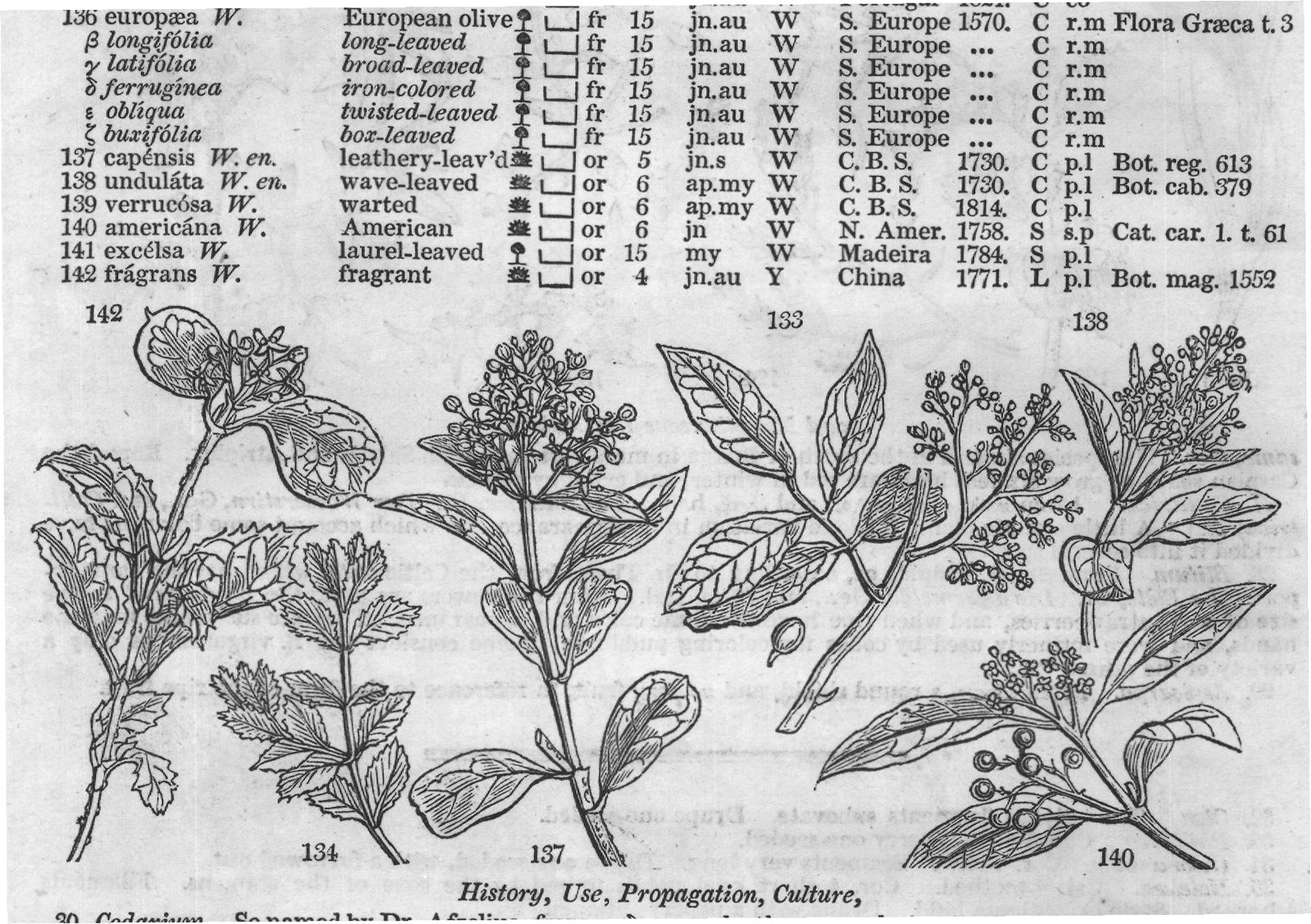
Sp. 8-12. 135 oleáster Hoffm. bastard or 5 jn.au W Portugal 1821. C co 136 europæa W.
ẞ longifólia latifólia ferruginea & oblíqua buxifólia 137 capénsis W. en. 138 unduláta W. en. 139 verrucósa W.
European olive ☐ fr 15 jn.au W S. Europe 1570.
Cr.m Flora Græca t. 3 long-leaved fr 15 jn.au W S. Europe ...
Cr.m broad-leaved fr 15 jn.au W S. Europe ...
Cr.m iron-colored fr 15 jn.au W S. Europe Cr.m ... twisted-leaved fr 15 jn.au W S. Europe Cr.m ... box-leaved fr 15 jn.au W S. Europe Cr.m ... leathery-leav'd or 5 jn.s W C. B. S. 1730. C p.l Bot. reg. 613 wave-leaved or 6 ap.my W C. B. S. 1730. C p.1 Bot. cab. 379 warted or 6 ap.my W C. B. S. 1814. C p.l 140 americána W. 141 excélsa W.
American or 6 jn W N. Amer. 1758. S s.p Cat. car. 1. t. 61 laurel-leaved 오 or 15 my W Madeira 1784. S p.l 142 frágrans W. fragrant or 4 jn.au Y China 1771. L p.l Bot. mag. 1552 142 133 138 134 137 History, Use, Propagation, Culture, 140 30. Codarium. So named by Dr. Afzelius, from κωδaρiov, a leathern pouch, in allusion to the pods of the tree. These are filled with an abundant pithy fæcula, which is eaten by the inhabitants of the coast of Guinea, where the fruit is called wild tamarinds. 31. Maytenus. The barbarous name of the shrub, and applied as a generic name by Molina. It has the habit of a Rhamnus, and will probably form an hardy inhabitant of our gardens. a Rhamnus, and will probably form an hardy inhabitant of our gardens. 32. Olea. From ελaia, the Greek name for the plant; a word derived in its turn, as De Théis conjectures, from the Celtic olew, oil. Olea is commonly put for the tree; oliva, for the fruit; and oleum, for the juice of the fruit. Celtic olew, oil. Olea is commonly put for the tree; oliva, for the fruit; and oleum, for the juice of the fruit. L'olivier, Fr. Oelbaum, Ger., and Ulivo, Ital. The cultivated olive came originally from Asia, and grows abundantly about Aleppo and Lebanon; it is naturalised in different parts of the south of France, Spain, and Italy, and found in hedges and woods; but the fruit of that kind is small and of no use. the variety chiefly cultivated in the south of France and in Italy. O. e. var. latifolia, is chiefly cultivated in O. e. var. longifolia, is Spain; its fruit is near twice the size of the common olive of Provence or Italy, but the oil is so rank of flavor as to be too strong for most English palates. The oil and fruit, in a pickled state, are sent chiefly from Languedoc, Leghorn, and Naples to England; the best oil is from Leghorn, and the best pickles from Genoa and Marseilles. The tree seldom exceeds thirty feet in height, is branchy, glaucous, evergreen; and of so great longevity, that some plantations in Italy, as at Terni, are supposed to have existed from the time of Pliny. The tree delights in schistous, calcareous steeps, and does not thrive in elevated situations, or at a distance from the sea. The best oil is produced from fruit grown in calcareous soils. Olive oil may be said to form the cream and butter of Spain and Italy; and the tree has been celebrated in all ages as the bounteous gift of heaven, and as the emblem of peace and plenty.
Olive oil is made by crushing the fruit to a paste, then pressing it through a woollen bag, adding hot water as long as any oil is produced. The oil is afterwards skimmed off the water, and put in tubs, barrels, and bottles as any oil is produced. The oil is afterwards skimmed off the water, and put in tubs, barrels, and bottles for use.
The best olive oil is of a bright pale-amber color without smell, and bland to the taste. Kept warm, it becomes rancid, and it freezes at 38º Fah. It is of the same nature with all mild expressed vegetable oils; of these the most fluid are preferred, and hence the oils of olives and almonds are those chiefly used in medicine. Oily substances do not unite with the contents of acid stomachs; but to healthy patients they afford much ORDER I.
DIANDRIA MONOGYNIA. 69. Ornus. Cal. 4-parted. Cor. of 4 petals. Fruit, a winged Samara of two cells. §10. Flowers complete, superior. 70. Morina. Cal. of the fruit toothed with bristles: of the flower bifid. 71. Circea. Cal. 2. leaved. Cor. with two obcordate petals. 72. Fedia. Caps. 3-locular, crowned with the upright (not involute) limb of the calyx. Corolla irregular. 11. Flowers incomplete, with no corolla. 73. Pimelea. Cal. funnel-shaped, with a 4-cleft limb. Stigma capitate. 74. Cladium. Cal. many-valved, 1-flowered: valves glumaceous, imbricated, the exterior smallest. Nut with a double coat.
Order 2. DIGYNIA. 2 Stamens. 2 Styles. 75. Gunnera. Cor. O. Cal. 2-toothed. Seed one, inclosed in a tough coat. 76. Anthoxanthum. Glume membranous, 3-flowered. Lateral florets neuter with one palea bearded; intermediate floret hermaphrodite, much shorter than the lateral ones. Paleæ obtuse, beardless. Seed free. Order 3. TRIGYNIA. & 2 Stamens. 3 Styles. 77. Piper. Cal. O. Cor. O. Berry 1-seeded. Spadix simple, slender, covered with little flower-bearing scales .
MONOGYNIA. 133 Leaves unequally pinnate, Leaflets oval acute the inner the smallest 134 Leaves sessile two inches long opposite or alternate oblong smooth serrated 135 Leaves oblong pointed entire: the young ones only hoary beneath, Branches spiny 136 Leaves lanceolate pointed entire hoary beneath, Branches angular not spiny 3 Leaves linear-lanceolate flat silky beneath Leaves oblong flat hoary beneath Leaves narrow acute at each end, rusty beneath • Leaves oblong bent obliquely pale beneath Leaves oblong ovate, Branches divaricate 137 Leaves oblong, Flowers racemose panicled terminal 138 Leaves elliptical wavy, Stalks of leaves green 139 Leaves lanceolate flat white beneath, Branches warted 140 Leaves elliptic-lanceolate, Bractes all persistent connate ovate, Racemes sub-compound narrow 141 Leaves elliptic acute, Bractes perfoliate: the lower cup-shaped persistent the upper large leafy deciduous 142 Leaves elliptic-lanceolate sub-serrate, Flowers single lateral in bunches 132 136 136 β 139 137 and Miscellaneous Particulars. nourishment, and medicinally are supposed to correct acrimony, to lubricate, and relax. Olive oil is applied externally to bites and stings of poisonous animals, and to burns alone, with chalk, or in liniments and poultices. The ancients rubbed their bodies with it in dropsies and for various purposes; but it is now little used excepting for coughs and in worm cases.
Pickled olives are prepared from unripe fruit by repeatedly steeping them in water, to which quicklime or any alkaline substance is sometimes added to shorten the operation. Afterwards they are soaked in pure water, and then taken out and bottled in salt and water, with or without an aromatic. They are eaten abroad as a whet before and during the principal meals, and in this country chiefly at the dessert. They are supposed to excite appetite and promote digestion. The finest kind of the prepared fruit is called by the merchants Picholine, after one Picholini, an Italian, who first discovered the art of pickling olives. The culture of the olive abroad may be said to resemble that of grass orchards in Britain. It is propagated by suckers, large cuttings, or truncheons planted in trenches four feet deep, into which it is still the custom to deposit stones for encouraging moisture about the roots, as described by Virgil. (Georg. ii. 346.) It is also propagated by chips of the stool, in the following manner: An old tree is cut down, and the ceppo, or stock, is cut into pieces of nearly the size and shape of a mushroom, and which, from that circumstance, are called novoli. Care is taken that each novolo shall have a small portion of bark. After being dipped in manure, the novoli are planted thick in a bed and covered with earth to the depth of three inches; they soon throw up shoots, and are transplanted at the end of one year, and in three more are fit to be finally removed to the olive plantation. The olive in Britain grows readily by cuttings, or may be grafted on the privet. With protection during frost, it may be maintained against a wall in the latitude of London. Some trees so treated, produced a crop in the be maintained against a wall in the latitude of London. Some trees so treated, produced a crop in the garden of Camden House, Kensington, in 1719; and in Devonshire, some trees have stood the winter for many years as standards, though without ripening their fruit. Large plants are frequently imported from Genoa, along with orange and pomegranate trees.
O. fragrans is highly odoriferous both in the leaves and blossoms; the plant is much esteemed on that account in China, and the leaves used at once to adulterate and flavor teas. 33. PHILLYRE'A.
PHILLYREA. 143 angustifólia W. en. narrow-leaved ẞ rosmarinifólia brachiata DIANDRIA MONOGYNIA.
CLASS II.