Passiflorea
Sp. 1.
CLASS XXII. or 12 au G S. Leone 1812. Cr.m Bot. reg. 433 2075. MODEC/CA. Lam. MODECCA. 13910 lobáta Jacq. lobe-leaved உ HEXANDRIA. 2076. XEROʻTES. R. Br. XEROTES.
Junceæ. Sp. 2-24. 13911 longifólia R. Br. long-leaved or 3 ...
G.w N. Holl. 1796. Dr.m 13912 rígida R. Br. rigid or 2 ...
G.w N. Holl. 1791. Dr.m Bot. cab. 798 2077. ELA IS. W.
OILY PALM.
Palma. Sp. 3. 13913 melanocócca Gærtn. black-seeded or 30 ...
G.w N. Grena. 1821. S co 13914 occidentális W.
West Indian or 30 ...
G.w Jamaica 1820, Sr.m 13915 guineénsis W.
Guinea or 30 ...
G.w Guinea 1730. S r.m Jac. amer. t. 172 2078. CHAMÆDO'REA. W. CHAMEDOREA. 13916 grácilis W. slender 초 or 10 ... 2079. BORAS SUS. W. BORASSUS.
Palmæ. Sp. 1.
Palmæ. Sp. 1.
W.G Caraccas 1803. Sk r.m Jac.sch.2.t.247,8 13917 flabellifórmis W. fan-leaved or 30 ...
W.G E. Indies 1771. Sr.m Rox.co.1.t.71,72 2080. MAURITIA. W. MAURITIA.
Palmæ. Sp. 1. 13918 flexuósa W. wavy-spiked or 40 ...
W.G Surinam 1816. S r.m 2081. SMI'LAX. W.
SMILAX.
Smilaceæ. Sp. 22-68. 13919 áspera W.
Rough Bindw. un 8 s W.G S. Europe 1648.
Sk s.p Sch.hand.3.t.328 ẞ auriculáta ear-leaved un 8 s W.G S. Europe 1648.
Sk s.p Pluk.al. t. 110.f.3 13920 excélsa W. tall உ un 12 au.s W.G Syria 1739.
Sk s.p Buxb.cen.1. t. 27 13921 zeylánica W.
Ceylon உ un 10 ...
W.G E. Indies 1778.
Sk p.l 13922 quadranguláris W. square-stalked Rum.am.5. t. 161 un 6 jn.jl W.G N. Amer. 1812.
Sk s.p Dend. brit. 109 13923 Sarsaparilla W. medicinal m 4 jl.au W.G N. Amer. 1664.
Sk s.p Dend. brit. 111 13924 Chína W.
Chinese m 6 W.G China ... 1759.
Sk s.p Kæm.amæ.t.782 13925 rotundifólia W. round-leaved 13926 laurifólia W.
Laurel-leaved un 6 jl.au un 5 jl W.G N. Amer. 1760. Sk s.p W.G N. Amer. 1739.
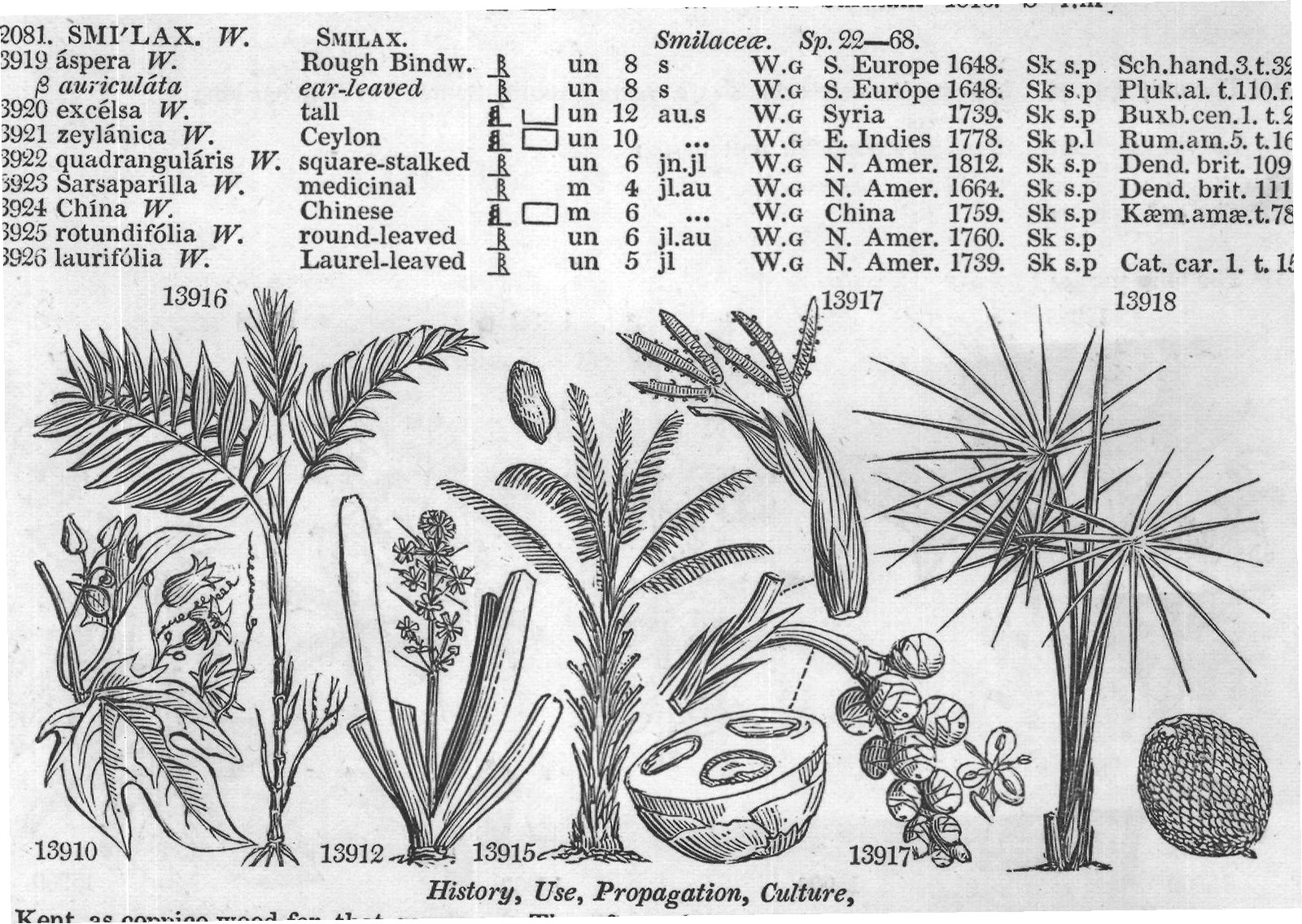
Sk s.p Cat. car. 1. t. 15 13916 13917 13918 13910 13912 13915 13917 History, Use, Propagation, Culture, in Kent as coppice wood for that purpose. The after-culture of the hop consists in stirring the soil, and keeping it free from weeds; in guiding the shoots to the poles, and sometimes tying them for that purpose with withered rushes; in eradicating any superfluous shoots which may arise from the root, and in raising a small heap of earth over the root to prevent any more shoots from arising.
Hops are known to be ready for gathering, when the chaffy capsules acquire a brown color, and a firm consistence. Each chaffy capsule or leafed calyx contains one seed. Before these are picked, the poles with the attached stalks are pulled up, and placed horizontally on frames of wood, two or three poles at a time. The hops are then picked off by women and children. After being carefully separated from the leaves and stalks, they are dropped into a large cloth hung all round withinside the frame on tenter-hooks. When the cloth is full, the hops are emptied into a large sack, which is carried home, and the hops laid on a kiln to be dried.
This is always done as soon as possible after they are picked, as they are apt to sustain considerable damage, both in color and flavor, if allowed to remain long in sacks in the green state in which they are pulled. In very warm weather, and when they are pulled in a moist state, they will often heat in five or six hours: for this reason the kilns are kept constantly at work, both night and day, from the commencement to the conclusion of the hop-picking season. The operation of drying hops is not materially different from that of drying malt, and the kilns are of the same construction. The hops are spread on a hair-cloth, from eight to twelve inches deep, according as the season is dry or wet, and the hops ripe or immature. When the ends of the hopstalks become quite shrivelled and dry, they are taken off the kiln and laid on a boarded floor till they become quite cool, when they are put into bags.
The bagging of hops is thus performed: in the floor of the room where hops are laid to cool, there is a round hole or trap, equal in size to the mouth of a hop-bag. After tying a handful of hops in each of the lower or trap, equal in size to the mouth of a hop-bag. After tying a handful of hops in each of the lower corners of a large bag, which serve afterwards for handles , the mouth of the bag is fixed securely to a strong hoop, which is made to rest on the edges of the hole or trap; and the bag itself being then dropped through the trap, the packer goes into it, when a person who attends for the purpose, puts in the hops in small quantities, in order to give the packer an opportunity of packing and trampling them as hard as possible. When the bag is filled, and the hops trampled in so hard as that it will hold no more, it is drawn up, unloosed from the hoop, and the end sewed up, other two handles having been previously formed in the corners in the manner mentioned above. The brightest and finest colored hops are put into pockets or fine bagging, and the brown into coarse or heavy bagging. The former are chiefly used for brewing fine ales, and the latter by the porter brewers. But when hops are intended to be kept two or three years , they are put into bags of strong cloth, and firmly pressed so as to exclude the air.
The stripping and stacking of the poles succeeds to the operation of picking. The shoots or bind being stripped off, such poles as are not decayed are set up together in a conical pile of three or four hundred, the centre of which is formed by three stout poles bound together a few feet from their tops, and their lower ends spread out.
The produce of no crop is so liable to variation as that of the hop; in a good season an acre will produce 20 cwt. ; in a bad season none, or only 2 or 3 cwt. From 10 to 12 cwt. in a season is considered a tolerable average .; in a bad season none, or only 2 or 3 cwt. From 10 to 12 cwt. in a season is considered a tolerable average ORDER V.
DIECIA PENTANDRIA. 13910 Leaves entire 3-7-lobed without glands cordate at base HEXANDRIA. 15911 Stemless, Lvs. long lin. coriaceous straight toothed at end rough at edge, Panicles lanceolate contracted 13912 Scapes and spikes short, Lvs. distichous cartilaginous convex beneath truncate at end, Stem very short 13913 Stem ascending, Stalks spiny serrated, Anthers and fruits ovate acute 13914 Fronds pinnated, Leaflets sheathed, Stems unarmed 13915 Fronds pinnated, Stems toothed spiny diverging: upper teeth recurved 13916 Fronds pinnated 2 feet long: pinnæ alternate oblong narrowed at base pointed at end 13917 Fronds palmate plaited cucullate, Stalks serrated 13918 Fronds flabelliform, Male spadix flexuose a foot long and more 13919 Stem prickly angular, Leaves hastate cordate lanceolate 7-9-nerved prickly toothed coriaceous 13920 Stem prickly angular, Leaves unarmed ovate slightly cordate about 7-nerved 13921 Stem prickly somewhat square, Leaves unarmed 3-5-nerved ovate-oblong cordate 13922 Stem prickly square, Leaves unarmed ovate acute 5-nerved 13923 Stem prickly nearly square, Leaves unarmed ovate-lanceolate cuspidate about 5-nerved glaucous beneath 13924 Stem prickly rounded, Leaves roundish-cordate acute at each end 5-nerved 13925 Stem prickly rounded, Leaves roundish-ovate acuminate slightly cordate 5-nerved 13926 Stem prickly rounded, Branches unarmed, Leaves ellipt. or elliptical-lanc. obtuse recurved acute 3-nerved 13920 13923 13926 13921 13922 and Miscellaneous Particulars. 13924 crop. The quality of hops is estimated by the abundance or scarcity of an unctuous clammy powder which adheres to them, and by their bright yellow color.
The expences of forming a hop plantation are very great; but once in bearing, it will continue so for ten or fifteen years before it requires to be renewed. The hop culture in England, like that of the culture of the vine in France, is only calculated for cultivators of considerable capital, who can retain the produce from years of abundance to years of scarcity. It is calculated on an average, that the hop crop fails almost entirely every fifth year, when the price will rise from two to thirty pounds per cwt. To those who can cultivate and preserve the hop with a view to such a rise, few crops will be equally profitable. The hop is peculiarly liable to diseases; when young it it devoured by fleas of different kinds; at a more advanced stage it is attacked by the green fly, red spider, and otter moth, the larvæ of which prey even upon its roots. The honey dew often materially injures the hop crop; and the mould, the fireblast, and other blights injure it at different times towards the latter periods of the growth of the plants. The use of hop in brewing is to prevent the beer from becoming sour, and this is the grand purpose for which it is cultivated. But the young shoots both of the wild and improved hops are eaten early in the spring as is cultivated. But the young shoots both of the wild and improved hops are eaten early in the spring as asparagus, and were formerly brought to market for that purpose. The stalk and leaves will dye wool yellow. From the stalks a strong cloth is made in Sweden, the mode of preparing which is described by Linnæus in his Flora Suecica. A decoction of the roots is said to be as good a sudorific as Sarsaparilla; and the smell of the flowers is soporific. During the illness of George the third, in 1787, a pillow filled with hops was used instead of opiates. 2075. Modecca, is an Indian word by which two or three species of this genus appear in the Hortus Mala.. baricus, and has been adopted as a generic name by Lamarck. A curious plant resembling a bryony, of easy culture and propagation. , and has been adopted as a generic name by Lamarck. A curious plant resembling a bryony, of easy culture and propagation. 2076. Xerotes. From ξηρoς, dry, on account of the aridity of the herbage and of the situations in which it grows. 2077. Elais. The natives of Guinea express oil from the fruit of this, as the Greeks from their olives, ελaia, whence its name. This palm bears a fruit about the size of a large plum. The inhabitants of the West India Islands draw an oil from it, by the same process used in extracting oil from olives. From the sap an inebriating liquor is fermented , and the negroes weave the leaves into mats, on which they repose. 2078. Chamædorea. Named, we presume, from χaμai, dwarf, and δωρεa, a gift : but we are ignorant of the sense in which the name has been applied. in which the name has been applied. 2079. Borassus. This is one of the names which were applied to the spatha of the date; and was applied by Linnæus to the designation of this family of palms. The fruit of this palm is of the size and shape of a child's head; a wine and a sugar are made from the sap of the trunk. 2080. Mauritia. Named in honor of Prince Maurice of Nassau, the patron of Piso, for whom he obtained the necessary aid towards publishing his Natural History of Brazil. A fine genus of palms. 2081. Smilax. From σμiλη, a grater; the stems are rough with stiff prickles. S. aspera has roots not unlike those of the Sarsaparilla. They have the same qualities, but in an inferior degree; and may be distinguished by of the Sarsaparilla. They have the same qualities, but in an inferior degree; and may be distinguished by 3 H 3 13927 tamnoídes W. 13928 austrális R. Br. 13929 cadúca 13930 Bona nóx W. 13931 latifólia B. P. 13932 herbácea W. 13933 lanceoláta W. 13935 púbera W. 13934 glycyphýlla B. P. 13936 Pseudo-chína W. 13937 pedunculáris W. 13938 glaúca B. M. 13939 rúbens Wats. 13940 longifólia W. 2082. TA'MUS. W. 13941 commúnis W. 13942 crética W.
DIŒCIA HEXANDRIA.
Я B ... un 10 my.jl G.w Cayenne 1820. C p.l Smilaceæ. Sp. 2-3.
Am 10 my.au G England hed. R s.p Aun 5 jl.au G Candia 1739. R p.l 2083. TESTUDINA'RIA. Burch. ELEPHANT'S FOOT, OR HOTTENTOT'S BREAD. Dioscoreæ. Sp. 1-2. CLASS XXII.
Tamus-leaved un 6 jn.jl W.G N. Amer. 1739.
Sk s.p Cat. car. 1. t. 52 oblong-leaved un 6 W.GN. S. W. 1815.
Sk s.p deciduous un 6 jn.jl W.G N. Amer. 1759.
Sk s.p ciliated un 6 jn.jl W.G N. Amer. 1739.
Sk s.p Pluk.al. t.111.f.1 broad-leaved un 8 G.w N. Holl. 1791.
Sk s.p herbaceous Aun 4 jl GN. Amer. 1699.
Sk s.p Bot. mag. 1920 spear-leaved un 5 my.jn G.w N. Amer. 1785.
Sk s.p Cat. car. 2. t. 84 Botany Bay Tea un 6 ...
G.w N. S. W. 1815.
Sk s.p downy un 5 G.w N. Amer. 1806.
Sk s.p Bastard Chinese ☐ ☐ un 6 my.jn G.w America 1739.
C p.l Slo. ja.1.t.143.f.1 long-peduncled Aun 6 my.jl glaucous-leav'd ☐ pink un 2 my.jl un 6 jl G.w N. Amer. 1812.
G.w N. Amer. 1811.
C p.l C p.1 G.w N. Amer. ...
C p.l Bot. mag. 1846 Dend. brit. 108 long-leaved BLACK BRYONY. common Cretan Eng. bot. 91 C. G. H. 1774. R p.l Sp. 1-14.
Bot. mag. 1347 W. Indies 1786. R p.1 Sp. 12-42. five-leaved * cul 10 ... prickly-stemm. cul 10 G G E. Indies 1768.
E. Indies 1803.
R r.m Rhee. mal.7. t.35 Rr.m Rhee.mal.7. t.37 ... wing-stalked cul 15 ...
G India 1739.
R r.m Rhee.mal.7. t.38 bulb-bearing ☑ ☑ esc 12 jl.au G E. Indies 1692.
Rr.m Par. lond. 17 common clt 20 au G W. Indies 1733.
Rr.m Rhee.mal.8. t.51 three-leaved un 8 ...
G Brazilian esc 8 ...
G leathery * un 8 ...
G tallest * un 20 G ... narrow-leaved un 10 ...
G pubescent un 3 au R opposite-leaved un 6 13930 ...
G Malabar 1820.
Brazil 1823. R r.m S. Amer. 1818. Rr.m Martiniq. 1821. R r.m Plum. ic. 117. f.1 Peru 1821, R r.m N. Amer. 1752. R s.p Jac. ic. 3. t. 626 E. Indies 1803. R. s.p Pet. gaz. t.31. f.6 13932 13933 Rr.m Rumph. 5. t. 128 13943 elephan tipes Burch. common 2084. RAJA'NIA. W. RAJANIA. 13944 cordáta W. cu 8 jl.au Y Dioscoreæ.
Tamus-leaved ☑ ☑ un 6 jl G 2085. DIOSCO'REA. W. YAM. 13945 pentaphýlla W. 13946 aculeata W. 13947 aláta W. 13948 bulbífera W. 13949 satíva W. 13950 triphýlla W. 13951 brasiliensis W. 13952 coriácea W. 13953 altíssima W. 13954 angustifólia W. 13955 villósa W. quaternata Ph. 13956 oppositifólia W. 3927 Dioscoreæ.
Plum.ic.t.155.f.1 13936 13938 History, Use, Propagation, Culture, 13939 being larger, more porous, and much less compressed. S. Sarsaparilla (zarza, furze, Spanish) has long slender roots covered with a wrinkled brown bark, white within, and having a small woody heart. It is inodorous, and has a mucilaginous very slightly bitter taste. Medicinally it is demulcent and diuretic. It was brought to Europe about the year 1530, and introduced as a medicine of great efficacy in the cure of lues venerea; but it fell into disrepute and was little used, till it was again brought into esteem by Dr. William Hunter and Sir William Fordyce, about the middle of the last century; not, however, as a remedy fitted to cure syphilis, but of much efficacy in rendering a mercurial course more certain, and after the use of mercury. Experience, however, has not verified the encomiums bestowed on it; and the extensive observations of Mr. Pearson have fixed the degree of benefit which is to be expected from this root in syphilitic complaints. The contagious matter and the mineral specific may, he observes, jointly produce, in certain habits of body, a new series of symptoms, which, strictly speaking, are not venereal, which cannot be cured by mercury, and which are sometimes more to be dreaded than the simple and natural effects of the venereal virus. Some of the most formidable of these appearances may be removed by sarsaparilla, the venereal virus still remaining in the system; and when the force of the poison has been completely subdued by mercury, the same vegetable is also capable of freeing the patient from what may be called the sequelæ of a mercurial course. Sarsaparilla is also recommended in scrophula, elephantiasis, or cutaneous affections resembling it, and in chronic rheumatism; but its efficacy is doubtful. (Thom. Lond. Disp. 505.) S. China has roots as long as a child's hand, twisted, full of knots, reddish on the outside, flesh-colored in the heart, and destitute of smell. It is employed both as food and medicine in China, and to feed hogs in the West Indies. None of the species are of much beauty or worth growing, but as objects of curiosity. 2082. Tamus. This name was employed by Columella and others, for a plant resembling a vine, and bearing fruit not unlike grapes; a description which does not apply badly to the modern plant. T. communis has very large tuberous black coated masses attached to its roots. These are so acrid, that the pulp has been formerly used as a stimulating plaster. The young shoots, however, are so mild as to be good eating when dressed like asparagus. The Moors eat them boiled with oil and salt. The flowers of the female plant are succeeded by ovate smooth berries. 2083. Testudinaria. So called from the resemblance which the great rugged cracked root of this plant bears to the shell of a tortoise (testudo). The rootstock is a large fleshy mass, covered with a thick bark cracked deeply in every direction. The Hottentots in time of scarcity make use of the fleshy inside of the root as a sort of yam. 2084. Rajania. Named in honor of our distinguished countryman John Ray, a distinguished naturalist, ORDER VI.
DIECIA HEXANDRIA. 13927 Stem prickly rounded, Leaves ovate oblong acute subpanduriform obsoletely cordate 5-nerved 13928 Stems prickly rounded, Leaves oblong acute unarmed 5-nerved smooth, Petioles with tendrils 13929 Stem prickly rounded, Leaves ovate mucronate 5-nerved 13930 Stem unarmed angular, Leaves cordate ovate acute ciliate prickly 7-nerved 13931 Stem unarmed angular, Leaves ovate 5-nerved smooth subcordate or obtuse at base, Petioles with tendrils 13932 Stem unarmed angular, Leaves ovate acuminate 7-nerved, Common pedunc. of umbel longer than leaf 13933 Stem unarmed rounded, Leaves unarmed lanceolate 13934 Stem unarmed rounded, Leaves obl. lanc. acute 3-nerved smooth glaucous beneath, Petioles with tendrils 13935 Stem unarmed rounded, Leaves oblong acute cordate about 5-nerved soft with down beneath 13936 Stem unarmed rounded, Leaves unarmed: cauline cordate; of the branches ovate-oblong 5-nerved 13937 Stem unarm, round. Lvs. roundish ov. cord. acum. 9-nerv. Peduncles of fr.-bear. umbel longer than leaves 13938 Stem prickly, Lvs. unarmed rounded ovate mucronulate about 7-nerv. glauc. beneath, Pedunc. about 2-fl. 13939 Stem angular prickly, Leaves ovate subcordate rather obtuse mucronate coriaceous 5-nerved denticulate 13940 Stem prickly square, Leaves unarmed hastate oblong obtuse mucronate about 7-nerved 13941 Leaves cordate undivided 13942 Leaves 3-lobed 13943 Leaves reniform entire 13944 Leaves ovate lanceolate cordate 7-nerved 13945 Leaves alternate digitate, Leaflets 5 oblong acuminate veiny, Stem aculeate bulbiferous 13946 Leaves alternate roundish cordate acuminate 7-nerved, Stem aculeate bulbiferous 13947 Leaves opposite ovate cordate-sagittate cuspidate 7-nerved, Stem winged bulbiferous [round 13948 Leaves alternate cordate roundish ovate acuminate about 9-nerved, Stem smooth bulbiferous 13949 Lvs. altern. cord. round. ov. cuspid. about 9-nerv.: lobes of base close together, Caps. obov. Stem smooth 13950 Leaves alternate ternate, Leaflets obl. acuminate nerved, Stem prickly 13951 Leaves alternate cordate 3-lobed: middle lobe acuminate, Stem compressed round naked 13952 Leaves alternate cordate oblong acuminate coriaceous 7-nerved, Stem round smooth 13953 Leaves opposite cordate roundish ovate acute 7-nerved, Stem round smooth 13954 Leaves alternate cordate lanc. narrow 3-nerved longer than petiole, Stem smooth 13955 Leaves opposite and whorled cordate acuminate 9-nerved downy beneath, Stem round 13956 Leaves opposite ovate acuminate 7-nerved, Stem round smooth 13945 13941 13943 13946 13947 and Miscellaneous Particulars. 13944 13955 born in 1628, died in 1705, and author of many works of the highest reputation. His zoological arrangement 1s still regarded with much respect. Twining plants resembling the Yam. 2085. Dioscorea. In memory of Pedacius Dioscorides, a Greek physician, born at Anazarba, in Cilicia. He is generally believed to have lived under Nero, but this is very uncertain. Abulfarrage makes him to have flourished under Ptolemæus Physcon ; but he is not generally credited. D. sativa, Iguame, Fr., and Inhame, Portug., has large thick tubers, a foot broad, and palmated like some Orchises. The stalks are slender, and with the leaves bear some resemblance to black bryony. The yam is largely cultivated for food in Africa and the East and West Indies, especially in the latter for the negroes. The roots grow to a great size, are mealy, and esteemed to be easy of digestion they are palatable, and not inferior to any roots now in use, either for delicacy of flavor or nutriment. They are eaten instead of bread, either roasted on the embers or boiled ; the flower is also made into bread and puddings. In Otaheite they make a dish, which they esteem very delicious, from the roots of the yam, with the kernel of the cocoa-nut scraped, and the pulp of the Musa or Banana. The juice of yam-roots fresh is acrid, and excites an itching on the skin. There are many varieties of these roots, some spreading out like the fingers (Rumph. t. 121.) others twisted like a serpent (Rumph. t. 122.) others again very small, scarcely weighing more than a pound, with a whitish ash-colored bark, whereas bark , whereas the bark is commonly black. The flesh of the yam is white or purplish, and viscid, but becomes farinaceous or mealy when dressed.
D. aculeata, by some considered only an improved variety of the sativa, is universally cultivated in the East and West Indies, in Africa, and in all the islands of the southern ocean within the torrid zone, and even as far as New Zealand. The tubers are frequently three feet long, and weigh thirty pounds. All the edible species and varieties are propagated in foreign countries like the common potatoe, but they arrive much sooner at maturity. The buds of the roots are not apparent, but still a small piece of skin is left to each set ; for from this piece of bark alone the shoots proceed. Holes are made in rows two feet apart, and at eighteen inches distant in the row into those holes two or three sets are put, first covered with earth, and then with a little haulm or rubbish to retain moisture. The only after culture consists in hoeing up the weeds. They are commonly planted in August, and are ripe about the November or December following. When dug up, the greatest care is taken not to wound them, as that occasions them to sprout much earlier than they otherwise would do. They should be rubbed over with ashes, and piled regularly on beds or hurdles raised above the floor, that the air may come easily between them or, if they be piled in heaps, some ashes should be strewed between the layers. None of the species are worth cultivating as ornamental plants; but some of the edible sorts have been raised in hotbeds in the Paris garden, and being transplanted early into a warm situation, have produced tubers of a considerable size. 3 H 4 D 2086. MA'BA. J. 13957 buxifólia P. S..
DICÆCIA HEXANDRIA.
CLASS XXII.
MABA.
Box-leaved pr 1 Y Ebenacea. Sp. 1-5.
E. Indies 1810. S s.p Rox, cor. 1. t. 45 2087. POPULUS. W. 13958 álba W. 13959 canéscens W. 13960 trépida W. 13961 trémula W. 13962 lævigáta W.
POPLAR.
Abele Tree gray Trembling Americ. 北 Aspen smooth 13963 græ'ca W.
Athenian 13964 nígra W. black tm 80 mr.ap Ap tm 40 mr.ap Ap tm 30 mr.ap Ap 13965 betulifólia Ph. black American tm 40 mr.ap Ap OCTANDRIA.
Amentaceæ.
Sp. 16. tm 40 mr.ap Ap tm 40 mr.ap Ap tm 30 Ap ... tm 50 mr.ap Ap Britain moi.w. Sk co England wat.pl. Sk co N. Amer. 1812. C co Britain moi.w. Sk co N. Amer. 1769. G co Archipel. 1779 C co Britain wat.pl. C co N. Amer. C co ...
Eng. bot. 1618 Eng. bot. 1619 Mic.arb.3. t.8.f.1 Eng. bot. 1909 Mich. arb.3. t.11 Duh. ar. 184. t.54 Eng. bot. 1910 Mi.arb.3. t. 10.f.1 hudsonica Mich. 13966 dilatáta W.
Lombardy tm 70 mr.ap Ap Italy 13967 monilífera W.
Canadian tm 70 my Ap Canada 1758. C co 1772. C co Dend. brit. 102 P. grandidentata Mich. 13968 aclades'ca Lindl. black Italian tm 70 my Ap N. Amer. ...
C co 13969 anguláta W.
Carolina tm 80 mr Ap Carolina 1738. C co Mi.a.3.p.302.t.12 13970 balsamífera W.
Tacamahac tm 70 ap Ap N. Amer. 1692. C co Mic.ar.3. t.13. f.1 13971 macrophýlla Lindl. Ontario tm 70 ...
Ap N. Amer. 1820. C co 13972 cándicans W. heart-leaved tm 50 mr Ap N. Amer. 1772. G co Cat. car. 1. t. 34 13973 heterophýlla W. various-leaved tm 70 ap.my Ap N Amer. 1765. G co Mich. arb. 3. t. 9 ENNEANDRIA. 2088. MERCURIAʼLIS. W. MERCURY.
Euphorbiaceæ. Sp.5-7. 13974 perénnis W. perennial 13975 ambígua W. doubtful 13976 ánnua W • annual 13957 业 W 1 ap.my G Britain woods. D s.1 00 W 1 jl.au G Spain 1806. S co Eng. bot. 1872 Lin.fil.dec. 1. t. 8 W 1 jl.s G Britain rub. Sco 13958 13959 Eng. bot. 559 13961 13960 13965 13964 History, Use, Propagation, Culture, 2085. Maba. The name given to the plant by the natives of Tonga-Tabu, according to Forster. (Gen. 61.) This shrub or small tree produces edible berries very well tasted. The wood is dark colored, remarkably hard and durable, and where its size will admit, is employed for such uses as require the most durable, compact, and heavy timber. 2086. Populus. In ancient times the public places of Rome were decorated with rows of this tree, whence it came to be called arbor populi, as being a tree peculiarly appropriated to the people. that the Poplar has obtained its name from the constant motion of the leaves, which are in a perpetual state of But Bullet asserts, agitation like the populace. All the species are rapid-growing soft-wooded timber trees, some of which attain a very great size. P. alba is one of the most valuable of the British species. The leaves of the common gray poplar are of a blackish-green above, but having a thick white cotton underneath; they are about three inches long, on petioles a foot in length. The leaves of the Abele are about double the size, and divided into three, four, or five lobes. The leaves of the gray poplar are also larger more deeply lobed, and the underside of the leaves and young shoots are covered with a hoary down. The Abele is said to have been introduced from Flanders, and the hoary poplar to have been originated in this country. The timber is of great value for all sorts of wooden vesseis, especially butchers' trays. It is of quick growth, soft, white, and stringy, and little subject to swell or shrink. It makes beautiful floors and turners' ware. Some of the finest Abeles in England are at Hartwell near Aylesbury.
P. tremula is commonly called the asp, from the German espe, which is the general name for all poplars, is a rapid-growing tree in almost any soil or situation but the numerous shoots of the roots spread so near the rapid-growing tree in almost any soil or situation: but the numerous shoots of the roots spread so near the surface that they will not permit any thing else to grow there. The wood is extremely light, white, smooth, soft, and durable in the air. It may be used for the same purposes as that of the Abele. The bark is the favorite On the leaves and leafstalks may sometimes be seen red glandular substances about the size of a pea, which are the nests of Tipula juniperina. P. nigra has a naked lofty trunk covered with an ash-colored a pea, which are the nests of Tipula juniperina. P. nigra has a naked lofty trunk covered with an ash-colored bark, and a regular handsome head. It is a tree of quick growth, and on the banks of rivers and in moist situations it grows up to a great height in a short time. The bark is light like cork, and is sometimes used by fishermen to float their nets. The timber is light and soft, fit for the turner and pattenmaker, and excellent for flooring -boards. These boards are much siower in taking fire than those of resinous trees; they smoke a long time before they burst into a flame: of course the wood is bad for fuel. Many species of insects are supported by this and the other poplars. The red substance like berries upon the leafstalks of this species are occasioned by the Aphis Bursonia. The leaves and young shoots are gathered in Sweden and other parts of Europe during the month of October and dried, to be given as fodder to the sheep in winter. The practice is as old as the time of the Romans; who, as well as the modern Italians, planted this tree for their vines to run on. In Kamchatka the inhabitants are sometimes reduced to the necessity of converting the inner bark into bread.
Scheffer made paper from the cotton down of the seeds. The buds both of this and the white poplar smell very pleasant early in the spring, and being pressed between the fingers yield a balsamic resinous substance, which, extracted by spirits of wine, smells like storax. A drachm of this tincture in broth is administered in internal ulcers and excoriations.
The black Italian poplar, so much recommended by Pontey, and said by him to have been intro- ORDER VI.
DIŒCIA HEXANDRIA. 13957 Leaves obovate entire, Flowers sessile, Calyxes hairy OCTANDRIA. 13958 Lvs. roundish cord. lobed toothed glab. above downy and very white beneath, Fert. catkins ov. Stigmas 4 13959 Leaves roundish angular-repand toothed hoary beneath, Catkins cylindrical lax 13960 Leaves roundish toothed with 2 glands at base acuminate smooth: younger silky 13961 Lvs. nearly orbicul. broadly tooth. glab. on both sides, Petioles compressed, Stigmas 4 auricled at base 13962 Lvs. roundish ov. acum, subcord. unequally serrat. smooth, Petioles compressed, Branches round smooth 13963 Lvs. round. ov. acute slightly cord. with equal close serratures smooth a little ciliat. Branches round smooth 13964 Leaves deltoid acute serrated glabrous on both sides, Fertile catkins cylindrical lax, Stigmas 4 13965 Leaves rhomboid acuminate toothed smooth, Younger branches hairy 13966 Leaves smooth on each side acuminate serrate deltoid, broader than long 13967 Lvs. subcord. smooth glandul. at base, Serrat. cartil. hooked hairy, Nerves spread. Branchl. slightly winged towards end compound 13968 Lvs. subcord. smooth glandul. at base, Serrat. cartil. hooked hairy, Nerves spread. Branchl. winged simple 13969 Leaves cordate deltoid acuminate bluntly hook-toothed, Branches winged angular 13970 Leaves ovate acuminate with close serratures white and netted beneath, Buds resinous 13971 Leaves cordate ovate large somewhat entire pale beneath 13972 Lvs. cordate ovate acumin. bluntly and unequally serrated white beneath 3-nerved netted, Buds resinous 13973 Leaves cordate roundish-ovate blunt hook-toothed: younger downy beneath ENNEANDRIA. 13974 Stem perfectly simple, Leaves rough, Root creeping perennial 13975 Stem herbaceous brachiate, Leaves ovate-oblong smooth ciliated, Fls. whorled: male and female mixed 13976 Stem branched, Branches opposite, Leaves glabrous, Root fibrous annual 13967 13970 13969 13972 13973 13976 13975 13974 and Miscellaneous Particulars. duced from America, seems intermediate between P. nigra and dilatata; indeed, all the three sorts are by some considered as but one species. P. dilatata differs from the common black poplar chiefly in its close conical manner of growth, which resembles the cypress. The leaves are greater in breadth than length; whereas in the black poplar the longitudinal diameter is the greatest. Though it generally attains a great height, the increase of the trunk is by no means so rapid as in most of the other poplars. It cannot, therefore, be highly recommended as a timber tree. In Italy it is considered peculiarly adapted for packing-boxes: nails do not split it; and if cases of this wood fall or are thrown carelessly on the ground, it gives way a little, and returns to its former position without splitting, which oak and other heavy woods will not do. In Lombardy all the vessels in which the grapes are carried home in carts from the vineyards, are of poplar plank, about two inches thick, and in them the grapes are squeezed. Such vessels last thirty or forty years; and by their lightness are manageable, however large and long. A four-wheeled cart is in general covered with one of them, and it contains about fifteen hundred weight of grapes, each hundred being a hundred pounds of thirty ounces. The conic form of the Lombardy poplar, as a deciduous tree, is peculiar. Among evergreens we find the same character in the cypress; and both trees, in many situations, have a good effect. The cypress often, among the ruins of ancient (and the buildings of modern) Rome, breaks the regularity of a wall or a pediment; and the poplar has the effect among deciduous trees of the round-headed kind. One beauty the Italian poplar possesses which is almost peculiar to it; and that is the waving line it forms when agitated by the wind. Most trees, in these circumstances, are partially agitated; one side is at rest while the other is in mo.. tion; but the Italian poplar waves in one single sweep from the top to the bottom, like an ostrich-feather on a lady's head. All the branches coincide in the motion, and the least blast makes an impression upon it when other trees are at rest.
P. balsamifera is a moderate sized conical tree, a native both of Siberia and America. The buds of this tree, from autumn to the leafing season, are covered with abundance of a glutinous yellow balsam, which often collects into drops, and is pressed from the tree for medical use. This balsam is brought to Europe from Canada in shells. It is smooth, of an even texture, a yellowish color, and a fragrant scent. In Siberia a medicated wine is prepared from the buds, which is diuretic, and esteemed by the inhabitants serviceable in the scurvy. The grouse and other birds of that family feeding on these buds during winter, acquire a flavor which is much esteemed by epicures. P. candicans bears a general resemblance to the preceding species; and, like it, the buds are covered with a resinous tenacious balsam. The other American species are rapid-growing bulky timber-trees, well calculated for immediate effect and utility; but all the species being short-lived when compared with oaks, elms, and other slower-growing hard-wooded trees, confer a temporary premature character on landscape; for nothing can be great and lasting but what advances by degrees. poplars as do not grow freely from cuttings of the shoots, are most rapidly increased by cuttings of the roots; but the largest plants are produced from layers.
Such 2087. Mercurialis. Mercury is said to have discovered the virtues of this plant. Böhmer, indeed, in his Lexicon, says, after Ambrosinus, that the name is a corruption of muliercularis, as being useful to women; but the Greeks call it ἐξμε πoa, which is the same as Mercurialis in its mythological sense. M. perennis is not eaten by any quadruped, and is poisonous to men and sheep. The plant on being dried turns blue, and steeped in water it DICECIA ENNEANDRIA.
CLASS XXII. 13977 ellíptica W. 13978 tomentósa W. oval-leaved woolly un 1 my.jl G un 1 jl.s G Portugal 1802. C co Spain 1640. C co Vent. cels. 12 2089. HYDRO CHARIS. W. FROG-BIT. 13979 Mórsus-ránæ W. common cu Hydrocharideæ. Sp. 1. jn.jl W 2090. TRIP LARIS. W. TRIPLARIS. 13980 americána W.
American 오 tm 40 ...
Britain dit. D co Eng. bot. 808 Sp. 1-7.
Pa.Y S. Amer. 1824. Cr.m Aublet, t. 347 DECANDRIA. 2091. CORIA'RIA. W. CORIARIA.
Coriarieæ.
Sp. 2-7. 13981 myrtifólia W.
Myrtle-leaved or 6 my.au G S. Europe 1629. L co Dend. brit. 103 13982 sarmentósa Forst. running cu 3 my.au G N. Zeal. 1823. L co Bot. mag. 2470 2092. KIGGELA'RIA. W. KIGGELARIA.
Euphorbiacea. Sp. 1-2. 13983 africana W.
African 2093. SCHI'NUS. W.
SCHINUS.
Terebintaceæ. Sp. 3-7. 13984 Mólle W.
Peruvian 13985 dentáta H. K. tooth-leaved or 6 my.jl G or 12 jl.au G Peru 1597.
Owhyhee 1795. 13986 depéndens H. K. entire-leaved un 8 my.jl G or 10 my.jn W.GC. G. H. 1683. C s.l Lam. ill. t. 821 Lr.m Mill. ic. 2. t. 246 Lr.m Bot. rep. 620 Chili 1790. C p.l Cav. ic. 3. t. 239 13987 canadénsis W. 13988 Papáya W. 13989 cauliflóra W.
Amýris polýgama W. 2094. GYMNOCLA'DUS. W. GYMNOCLADUS. 2095. CA'RICA. W.
Leguminosæ. Sp. 1.
Canadian Y or 20 W ...
Canada 1748. Rs.1 Mich.ame.2. t.51 PAPAW TREE.
Cucurbitaceæ? Sp. 4-6. common cul 20 jl stem-flowering or 20 ... 13990 spinósa W. 13991 microcárpa W.
ẞ monoica Desf. prickly small-fruited monœcious 호호호 or 20 ... or 20 ...
G India 1690.
G Caraccas 1806.
W.G Guiana 1821.
W.G Caraccas 1806.
Sr.m Bot. reg. 459 Sr.m Jac.schœ.3.t.311 Sr.m Aublet, t. 346 Sr.m Ja.sch.3.t.309,10 or 20 ...
W.G ...... 1818. S r.m DODECANDRIA. 2096. STRATIOʻTES. W. WATER SOLDIER. 13992 aloídes W.
Aloe-like △el 2 jn.jl W 2097. HYÆNANCHE. H. K. HYÆNA POISON. 13993 globósa H. K.
Cape or 8 ap.s 2098. EU'CLEA. W.
EUCLEA. ...... 13994 racemósa W. round-leaved or 5 n.d W 13995 unduláta W. wave-leaved or 5 W ...
Hydrocharideæ. Sp. 1.
England dit. D 1.p Eng. bot. 379 Sp. 1.
W.G C.G. H. 1783. C l.p Lam. cinc.52.t.10 Sp. 2-5.
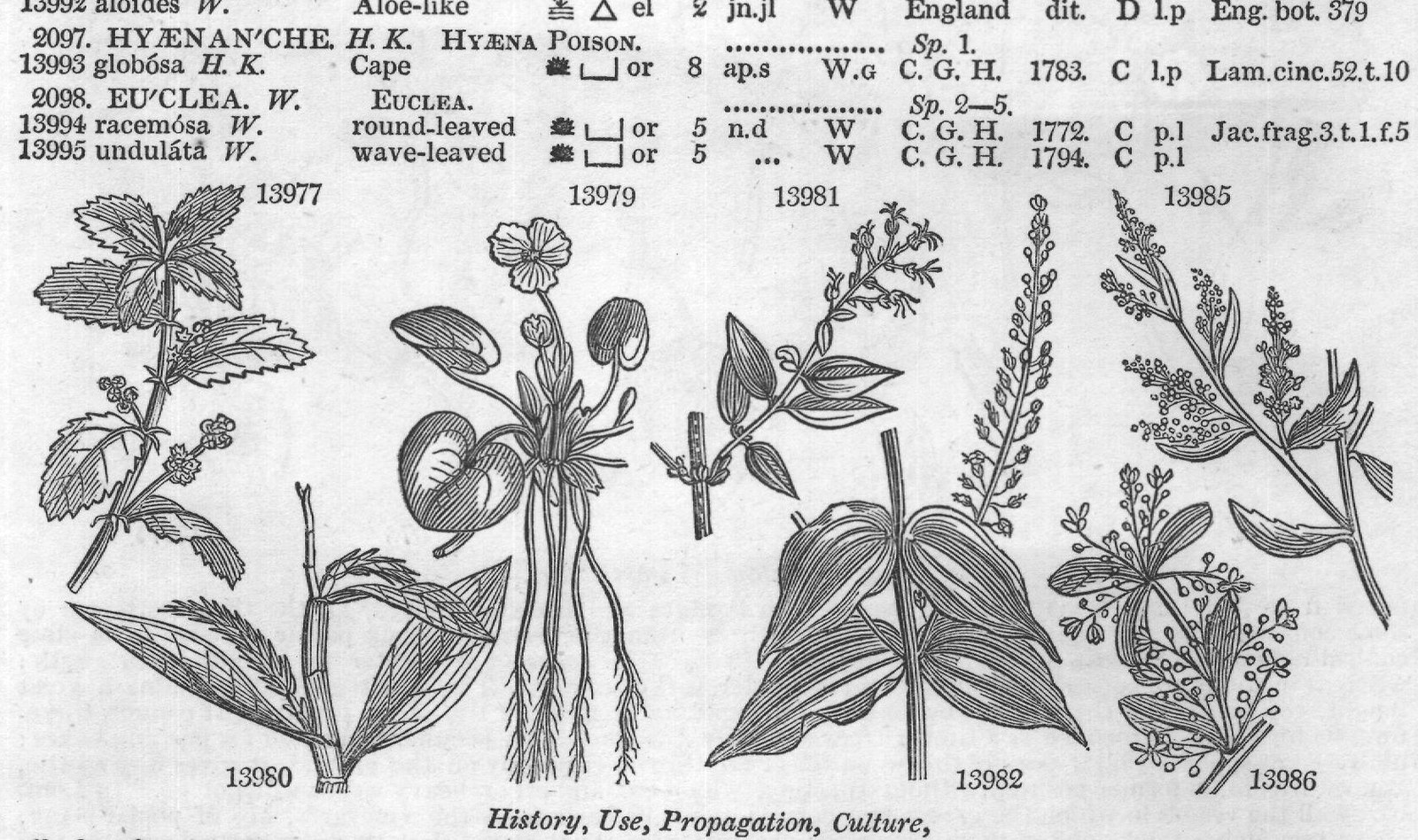
C. G. H. 1772. C p.l Jac.frag.3.t.1.f.5 C. G. H. 1794. C p.1 13977 13979 13981 13985 13980 13982 13986 History, Use, Propagation, Culture, affords a fine deep blue color, destructible, however, both by acids and alkalies. It has been observed that the male and female plants are seldom found intermixed, each sort usually growing in large patches; whence it is probable that this plant, which increases much by the root, rarely produces perfect seeds. M. annua was formerly accounted medicinal; its seeds taste like those of hemp. 2089. Hydrocharis. From ὕδωρ, water, and χaρiς, grace. This little plant is one of the prettiest ornaments of still waters. This plant increases by runners, which shoot out to a great length, and at the joints drop down long roots, which penetrate deep into the mud. The joints are furnished with pendulous buds, supported on long footstalks. The buds consist of two stipulaceous scales folded together, within which are curiously enveloped the embryo leaves of the future plant. 2090. Triplaris. All the parts of the fructification are in threes or triple. T. americana is a tree forty feet high, with a dense pyramidal head. The leaves are oblong, entire, smooth, a span long. The branches are often hollow, and are then filled with an innumerable quantity of little red ants, which are often showered down upon any incautious traveller who may stand under the shade of the tree, and whom they bite severely. (Bredemeyer.) 2091. Coriaria. A tanner's plant; from corium, a hide. Coriaria myrtifolia has handsome leaves, but very little beauty in the flowers. It is considerably astringent, and is used not only in tanning leather, but in dying beauty in the flowers. It is considerably astringent, and is used not only in tanning leather, but in dying black colors. It produces abundance of suckers. 2092. Kiggelaria. Named after Francis Kiggelar, an obscure botanist, who lived at the end of the seventeenth century. An uninteresting plant. Ripened cuttings strike in heat under a hand-glass. 2093. Schinus. This was the Greek name of the Pistacia Lentiscus. It is now applied to an American genus which resembles Pistacia in sensible properties. The word molle, applied to one species, does not allude to any softness in the plant which bears the name, but is a slight alteration of the Peruvian word mulli. Fragrant shrubs with beautiful foliage, easily cultivated in a cold conservatory or out of doors in a warm sheltered place 2094. Gymnocladus. From γuμvoς, naked, and κλaδoς, a shoot, on account of the naked appearance of its strange rigid shoots during the winter. This tree or shrub has pinnate leaves nearly a foot and a half long; both leaves and stalks are armed with thorns. The stalks at first grow erect, but afterwards twine about the neighbouring trees and shrubs. It is best propagated by cuttings of the roots. ORDER VIII.
DIŒCIA ENNEANDRIA. 13977 Stem suffruticose brachiate, Leaves elliptical acute at each end smooth glandular serrated 13978 Stem suffruticose, Leaves oblong downy with serratures on each side at the end 13979 The only species 13980 Racemes terminal and axillary brachiate DECANDRIA. 13981 Leaves ovate-lanceolate 3-nerved stalked 13982 Procumbent diffuse, Leaves cordate-ovate acuminate entire 5-nerved stalked, Racemes nodding 13983 Leaves oblong unequally serrated 13984 Leaves pinnated, Leaflets serrated: the odd one very long, Petioles equal 13985 Leaves simple toothed 13986 Leaves simple entire and trifid, Flowers generally octandrous 13987 Leaves bipinnate very large deciduous, Flowers equal diœcious 13988 Leaves palmate 7-lobed: middle lobe sinuated; segments oblong acute, Male flowers corymbose 13989 Leaves palmate 5-lobed: middle lobe sinuated; segments lanc. acum. Male fis. from excrescences of trunk 13990 Leaves digitate, Leaflets 7 oblong acuminate entire, Trunk spiny 13991 Leaves 3 or 5-lobed: middle lobe 3-lobed, Male flowers corymbose ẞ Lower leaves entire: cauline 3-lobed; upper 5-lobed, Flowers monœcious subracemose erect DODECANDRIA. 13992 Leaves linear anceolate keeled prickly toothed 13993 Branches diffuse cinereous scarred, Leaves opposite 3 or 4-nate oblong retuse coriaceous 13994 Leaves oblong or obovate flat 13995 Leaves obovate wavy 13987 13988 13994 13992 13983 13993 13991 and Miscellaneous Particulars. 2095. Carica. According to Linnæus, because a native of Caria; but as the plant has no relation to that country, it would be better to adopt, with Jussieu, the specific name Papaya for the genus. C. Papaya rises with a thick soft herbaceous stem to the height of eighteen or twenty feet, naked till within two feet of the top, and having marks of the fallen leaves great part of its length. The leaves have long footstalks, are very large, and divided into many lobes. The whole plant abounds with a milky acrid juice, which is esteemed good for the ringworm. The male flowers, which are in loose clusters on long peduncles, are of a pure white, and have an agreeable odor. Sometimes these are succeeded by a small fruit about the size of a pear, which has occasioned some to suppose the male plant a distinct species. The flowers of the female have short peduncles; they are large and bell-shaped, composed of six yellow petals. When these drop off, the germ swells to a large fleshy fruit the size of a small melon. When ripe it is eaten by the inhabitants of the Caribbee Islands, but its flavor is very indifferent. The most common use of them is when they are about half grown, to soak them in salt water, to get out the milky juice, and pickle them as mangoes , for which they are considered a good substitute.
The plant generally is said to have the property of intenerating animal fibre by suspension under its leaves in- or fibre by suspension under its leaves or branches; but this quality wants confirmation. In our stoves the plants grow freely in loamy soil, and are increased by large cuttings with their leaves on in a moist heat. 2096. Stratiotes. From στρaτoς, a camp; in English, water-soldier; both names alluding to the military appearance of the plant, with its long sword-like leaves, and flowers which may be liked to plumes of white feathers. An aquatic plant, remaining the greatest part of the year immersed in water, but rising to flower. It increases with such rapidity as to become a troublesome weed in artificial pieces of water in which it is planted. 2097. Hyænanche. From hyæna, and aγχη, pain; because the fruit is used at the Cape of Good Hope to poison hyænas. A small tree, six or seven feet high, also called Toxicodendron capense. The flowers used grow to Toxicodendron capense. The flowers grow in axillary branched yellowish panicles, and are succeeded by smooth nuts, which, being pounded, are used to poison the carcases of lambs, by which the hyænas are infallibly destroyed. 2098. Euclea. From εuκλεia, glory or beauty; in allusion to the permanent beauty of the neat evergreen foliage of the plants. Shrubs or small trees, natives of the Cape of Good Hope. Of one species the berries Cissus Cape of Good Hope. Of one species the berries are brought to the market of Cape Town for sale, and is the only kind of native fruit, except that of Cissus capensis, which is there eaten. Ripened cuttings root in sand under a glass. 2099. DATIS CA. W. DATISCA. 13996 cannabína W. Hemp-like or DIECIA DODECANDRIA.
Resedaceæ. Sp. 1-2. 4 jl.s Y Candia 1640. D co CLASS XXII.
Alp. exot. t. 298 2100. MENISPER MUM. D. MOON SEED.
Menispermeæ. Sp. 3-6. 13997 canadénse W.
Canadian or 10 jn.jl G.Y N. Amer. 1691.
R. s.p 13998 virgínicum W.
Virginian $ or 20 jn.jl G.Y N. Amer. 1732.
R s.p Bot. mag. 1910 Dil.el.t. 178.f.219 13999 smilacínum Dec Smilax-leaved or 10 ...
G.y Carolina 1776. R l.p Jac. ic. 3. t. 629 Cissampelos smilacina W. 2101. COC CULUS. Dec. COCCULUS.
Menispermeæ. Sp. 4-46. 14000 Plukenétii Dec. officinal or 10 G.Y E. Indies 1790.
R 1.p Pl.man. t.345.f.2 14001 carolínus W.
Carolina Σ or 4 jn.jl G.Y N. Amer. 1810.
R s.p Wendlandia populifolia 14002 orbiculátus Dec. round-leaved or 6 ...
G.Y E. Indies 1790.
R l.p Pluk.al. t.384.f.6 14003 villósus Dec. villous $ or 6 ...
G.Y E. Indies 1800. R l.p Plu.am. t.384.f.3 B hirsútus Dec. hairy PA or 6 ...
G.Y E. Indies 1800. R l.p Plu.am. t.384.f.7 2102. FLACOUR TIA. W. FLACOURTIA.
ICOSANDRIA.
Tiliacea. Sp. 4-7. 14004 Ramóntchi W. shining-leaved fr 12 jn.jl W Madagasc.1775. C p.l L'He.stir.59.t.30 14005 flavéscens W. yellow-flower'd fr 15 W ...
Guinea 1780. C p.1 14006 cataphrácta W. many-spined fr 4 W ... 14007 sápida W.
E. Indies 1804. C p.l esculent fr 10 ...
W E. Indies 1800. Cpl Roxb. cor. 1. t.69 2103. PEU'MUS. Pers.
PEUMUS.
Sp. 1. 14008 frágrans Pers. fragrant 오 ft 30 Chili ... 1824. C p.l Feuillée, 3. t. 6 2104. GELO'NIUM. Roxb. GELONIUM. 14009 bifárium Roxb. oval-leaved 2105. ROTTLE'RA. Roxb. ROTTLERA. 14010 tinctória Roxb. dyer's un 15 ...
Euphorbiaceæ. Sp. 1-2. un 6 jn.au Ap E. Indies 1793. C p.l Euphorbiaceæ. Sp. 1.
Ap E. Indies 1810. C p.l Roxb.cor.2.t.168 POLYANDRIA. 2106. CLIFFORTIA. W. CLIFFORTIA. 14011 cuneáta W. 14012 ilicifólia W. 14013 tridentáta W. 14014 ruscifólia W. 14015 cinérea W. 14016 pulchélla W. 14017 crenáta W. 14018 ericæfólia W. wedge-leaved Ilex-leaved three-toothed cinereous beautiful Rosaceæ. Sp. 11-24. or 3 ap G.w C. G. H. 1787.
C p.l or 3 my.s G C. G. H. 1714. C p.1 Dill. elt.t.31.f.35 or 3 my.s G.w C. G. H. ...
C p.l Ruscus-leaved or 3 jn.jl G.w C. G. H. 1752. C p.1 L'hort.cliff. t.31 * or 4 jn.jl G.w C. G. H. 1800. C p.l or 1 ap.my G.w C. G. H. 1795.
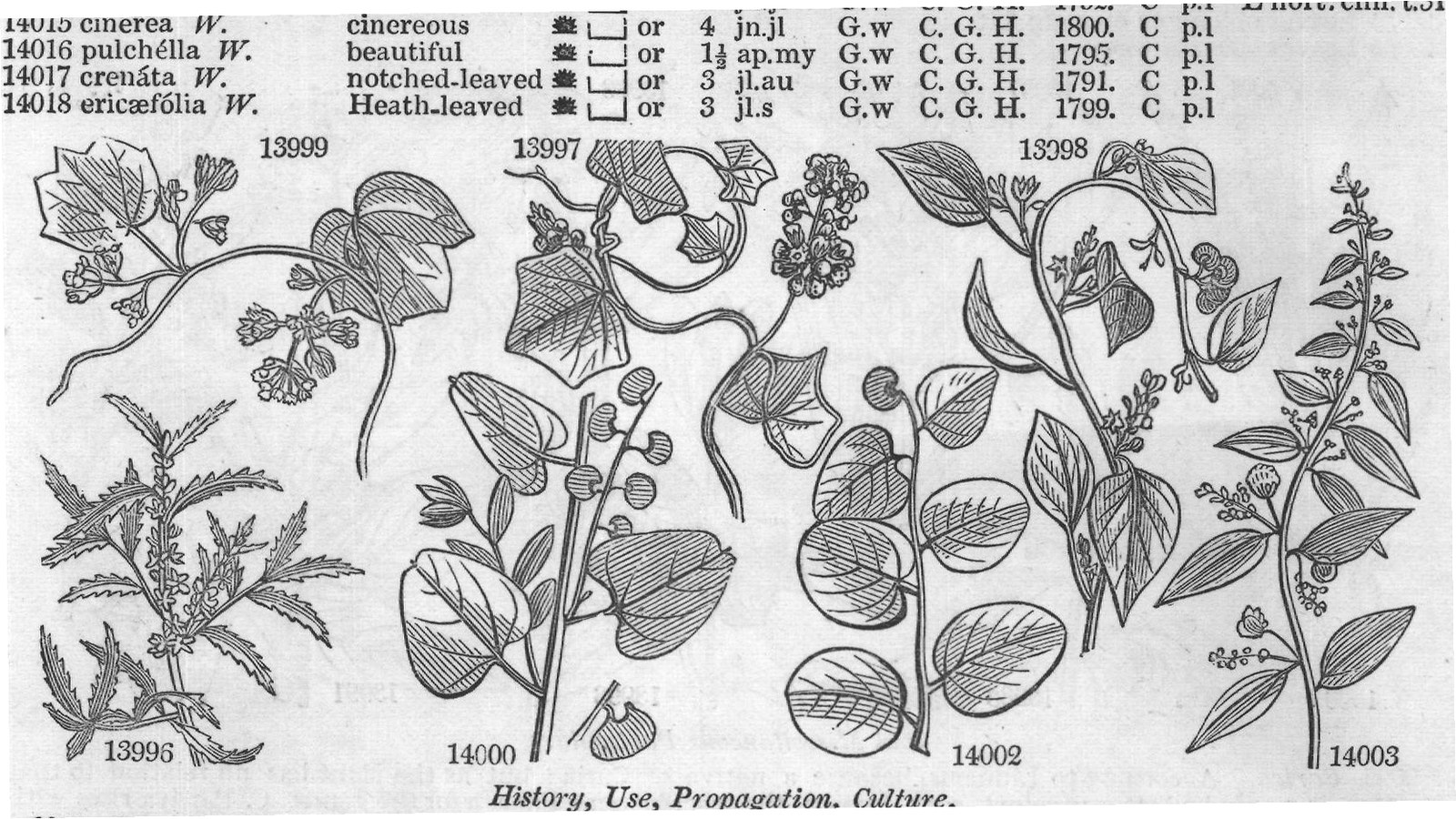
C p.l notched-leaved or 3 jl.au G.w C. G. H. 1791. C p.1 Heath-leaved or 3 jl.s G.w C. G. H. 1799. C p.l 13999 13997 13998 13996 14000 14002 History, Use, Propagation, Culture, 0 14003 2099. Datisca. A word the meaning of which is unknown. The plant is of no beauty, and of the easiest culture. 2100. Menispermum. From μηvη, the moon, and σπερμa, seed; on account of the crescent-like form of the fruit. All the species are of the easiest propagation and culture. fruit. All the species are of the easiest propagation and culture.
The M. palmatum produces the famous Colombo root, which is so remarkable for the intenseness of its bitter taste, and valuable on this account in dyspepsia, diarrhea, dysentery, and as a wash for putrid sores. 2101. Cocculus. This word is derived from coccus, the name of the well-known dyers' insect, and has been applied to this genus on account of the resemblance which has been found to exist between that insect and the scarlet berries of the plant. A genus with the habit of Menispermum.
Cocculus Plukenetii produces berries and bunches like grapes, but smaller; first white, then red, and finally blackish purple. In the East Indies they are made up into a paste, and used to intoxicate fish, birds, and different sorts of vermin. 2102. Flacourtia. Named in honor of Etienne de Flacourt, a director of the French East India Company, and the commander of an expedition to Madagascar in 1648; of which he afterwards wrote an account, containing considerable details upon the botany of the country. L'Heritier dedicated to him the first species of the genus, which was found by him in Madagascar, where it is called Ramontchi. It is a thorny shrub or tree, with leaves and fruit resembling those of the plum. The fruit is green when young, of a beautiful red when ripe, and finally of a dark violet color: the skin is very thin, and the flesh transparent red, of the same consistence with our common plums: in the middle are a dozen or fourteen small kernels, the size of those in the apple, and nearly of the same shape; they are bitterish like our apricot kernels, and covered with a tender shell. The natives eat the fruit; it is sweet, but leaves a slight sharpness in the mouth. An island on the coast of Madagascar is covered with these trees; and because they resemble the European plum-tree, the sailors have named the island Isle aux Prunes, or Plum-tree Island. All the species grow freely in a mixture of loam and peat, and cuttings root in sand, plunged and covered. 2103. Peumus. The Chilian name of this plant is Peumo. It is the Ruizia of the Flora Peruviana, and forms an evergreen tree among the woods upon the sandy shores of Chili; it is valuable for its wood, which is very fragrant.
ORDER X. 13996 Stem smooth DIECIA DODECANDRIA. 13997 Leaves peltate cordate roundish angular 13998 Leaves peltate cordate lobed 13999 Leaves peltate smoothish cordate-roundish bluntly angular glaucous beneath, Racemes simple 14000 Leaves ovate subcordate at base bluntly truncate at end with a little point, Fem. racemes axillary simple 14001 Leaves cordate villous beneath 14002 Leaves orbicular subcordate obtuse 5-7-nerved mucronulate ash-colored beneath, Peduncles very large 14003 Leaves ovate or lanceolate 3-5-nerved: younger villous; old ones downy, Branchlets vill. Pedicels few. fl. 14004 Leaves roundish ovate acute crenate ICOSANDRIA. 14005 Leaves oblong obtuse serrated narrowed at base 14006 Leaves ovate oblong acuminate serrated 14007 Leaves elliptical bluntish repand serrated obtuse at base 14008 Leaves ovate oblong with pellucid dots, Racemes short pellucid 14009 Leaves elliptical sharp-pointed 14010 Leaves alternate oblong elliptical acute at each end POLYANDRIA. 14011 Leaves alternate cuneiform truncate 5-toothed at end streaked with veins 14012 Leaves altern. roundish ellipt. amplexicaul. from the middle to end mucronate toothed streaked with veins 14013 Leaves alternate oblong cuneiform entire and 3-toothed nerved downy beneath 14014 Leaves alternate lanceolate smooth nerved terminated by a spine: floral 3-toothed, Branches downy 14015 Leaves connate ovate 3-cornered hoary 14016 Leaves opposite orbicular entire appressed many-nerved 14017 Leaves opposite or ternate orbicular appressed toothletted 7-nerved 14018 Leaves fascicled rounded furrowed smooth 14008 14004 14010 14007 14012 14009 14014 and Miscellaneous Particulars. 2104. Gelonium. So named by Roxburgh; but it is not known with what meaning. East Indian trees, with alternate leaves, the tubular stipular of a Ficus, and axillary flowers. 2105. Rottlera. Named by Roxburgh, in honor of the Rev. Dr. Rottler, an East Indian botanist of reputation, who resided many years at Tranquebar in the character of a Danish missionary. Rottlera tinctoria is a native of the inland mountainous parts of the Circars of Hindostan, flowering in the cold season. Dr. Roxburgh never found it any where else. This is a middle-sized, erect, branching tree. Leaves alternate, stalked, elliptic, oblong, acute, entire, from four to eight inches in length, three-ribbed, and veiny; nearly smooth above; downy beneath, furnished at their base with two brown glands. lands. Footstalks round, downy, wny, from one to three inches long. Flowers small, in clusters about the tops of the branches, axillary, and terminal; the latter branched. Capsules the size of a small cherry, clothed with abundance of deep red granular powder, easily rubbed off. This powder is a valuable article of commerce, being much esteemed, especially among the Moors, for dyeing silk of a deep, bright, very beautiful and durable, full orange or flower color. When the capsules are ripe, in February or March, they are gathered, and the powder carefully brushed off. It is preserved without any further process, and is sold to the merchants trading to Hydrabad and other inland parts. This substance is but little acted upon by water, except with the admixture of alkaline salts, when it gives out a very deep blood-red color. To spirits it communicates a rich, deep, reddish flame color; but in neither instance does it dissolve, the grains remaining entire, like sand. The inhabitants know this powder by the name of Wassunta-gunda, and use it in the following manner:- To four parts of Wassunta-gunda are added one of alum, and two of salt of soda, native barilla. These are rubbed well together, with a portion of expressed oil of Sesamum, so small as hardly to be perceived. When well mixed, the whole is put into boiling water, in quantity proportioned to the silk which is to be dyed, and kept boiling smartly, more or less time, according to the shade required. The silk is turned frequently, to render the color uniform. 2106. Cliffortia. Named in honor of George Cliffort, a Dutch gentleman; a great lover of plants, and one of the earliest of Linnæus's patrons. He had a superb garden at Hartcamp, of which Linnæus published the catalogue in one volume folio, in 1737. Shrubs of little beauty, except Č. pulchella, which is exceedingly pretty; they are easily cultivated in a good greenhouse. 14019 obcordáta W. 14020 trifoliáta W. 14021 sarmentósa W. 2107. CY CAS. W. 14022 circinális W. 14023 revolúta W. 2108. ZA'MIA. W. 14024 púngens W. 14025 cycadifólia W. 14026 angustifólia Jac. 14027 média Jac. 14028 débilis W. 14029 integrifólia W. 14030 pygmæ'a B. M. 14031 furfurácea W. 14032 spirális W. 14033 hórrida W. 14034 Cycádis W. heart-leaved three-leaved twiggy CYCAS. broad-leaved narrow-leaved ZAMIA. needle Cycas-leaved narrow-leaved DIŒCIA POLYANDRIA.
CLASS XXII. or 3 jn.au G.w C. G. H.
C p.l or 10 ap.jl G.w C. G. H.
C p.1 Pluk.al.t.319.f.4 or 4 jn.au W C. G. H.
C p.l Cycadeæ. Sp. 2-4.
SS cu 3 ...
Ap E. Indies 1700. cu 3 jl.au Ap China 1737.
Skr.m Rh.mal.3.t.13.21 Sk r.m Lin. trans.6. t.29 Cycadeæ.
Sp. 15. ココロ cu ...
Ap C. G. H. 1775.
Sk l.p Till. pis. 129. t.45 cu ...
Ap C. G. H. 1775.
Sk l.p Ja.frag. 1.t.25, 26 cu jl.au Ap Bahama I. ...
Sk p.l Jac. ic. 3. t. 636 intermediate cu jl.au Ap W. Indies ...
Sk p.l Bot. mag. 1838 long-leaved cu jl.au Ap W. Indies 1777.
Sk p.l Bot. cab. 155 dwarf cu jl.au Ap W. Indies 1768.
Sk p.l Bot. mag. 1851 least cu my Ap W. Indies ...
Sk p.l Bot. mag. 1741 broad-leaved cu 3 jl.au Ap W. Indies 1691.
Sk p.l Bot. mag. 1969 spiral cu 3 jl.au Ap N. S. W. 1796.
Sk p.l gray cu 3 ...
Ap C. G. H. 1800.
Sk p.l Jac.fr.27. t.27, 28 Cycas-like cu 3 ...
Ap C. G. H. 1775.
Sk p.l Th.act.ups.2. t.5 14035 púmila B. M. 14036 lanuginósa W. 14037 longifólia W. pygmy cu 1 ...
Ap C. G. H. 1812.
Sk p.l Bot. mag. 2006 woolly cu 3 ...
Ap C. G. H. 1812.
Sk p.l Jac. frag. t.27,28 long-leaved cu 7 ...
Ap C. G. H. 1818.
Sk p.1 Jac. fragm. t. 29 14038 tridentáta W. three-toothed cu 2 ...
Ap C. G. H. 1814.
Sk p.l MONADELPHIA. 2109. LATA'NIA. J.
BOURBON PALM.
Palmæ. Sp. 2. 14039 rúbra W. red or 15 ...
G.w Mauritius 1788. Sco Mauritius 1788.
Jac. frag. 13. t. 8 14040 borbónica W. common or 20 ...
G.w Bourbon 1816. S co Jac.frag. t.11.f.1 2110. LEPTOCARPUS. R. Br. LEPTOCARPUS.
Restiaceæ. Sp. 1-7. 14041 ténax R. Br. tough 2 un د ...
Ap N. Holl. 1823. D co Lab.no.hol.t.229 Schænódum ténax Lab. 2111. RUS CUS. W.
BUTCHER'S BROOM.
Asphodeleæ.
Sp. 5-7. 14042 aculeátus W. prickly 业 or 1 jn.d G England thick. Sk co Eng. bot. 560 B láxus L. T. loose or 1 ja.jn G Portugal ...
Sk co 14043 Hypophýllum W. 14044 Hypoglóssum W. broad-leaved or 1 my.jn G Italy 1640. Sk co Bot. mag. 2049 double-leaved业 or 1. ap.my G Italy 1596. Sk co 14045 andrógynus W. climbing or 3 ap.my G.w Canaries 1713.
Rp.l Sch. han.3. t. 340 Bot. mag. 1898 14048 excélsa H. K. 14035 14046 racemosus W. Alexandrian Laurel 2112. ARAUCARIA. J. ARAUCARIA.
Sir J. Banks's 14047 imbricáta W.
Norfolk Island or 4 jn G.Y Portugal 1713.
Sk co Dend. brit. 145 Coniferæ. Sp. 2-3. 오오 コ tm 150 ...
Chili Ap 1796. C p.1 Lam. ill. t. 328 tm 100 ...
Ap Norfolk I. 1793. C p.l Lam.pin.t.39, 40 14022 14031 14029 14027 History, Use, Propagation, Culture, 2107. Cycas. A name employed by the ancients to designate a little palm which grew in Ethiopia. The modern plant is analogous to it. This genus, which seems intermediate between palms and ferns, produces the plant is analogous to it.
This genus, which seems intermediate between palms and ferns, produces the nutritive granulated power called sago, from sagu, the name of a sort of bread made from the pith of the trunk in Tonquin. It is cultivated in China and Japan, and the fruit is eaten in the latter country. The tree, however, is chiefly valued for the pith of its trunk, which is full of white pith like that of the elder. The tree being cut down, this pith is beaten with a wooden pestle in a great mortar or trough; it is then strained, and the sediment, without farther preparation, constitutes sago. The native Indians live wholly upon it for three or four months in the year. That which is transported is dryed and granulated. In our stoves these plants require the culture common to all the palm tribe; a rich loamy soil, plenty of pot-room, and a strong moist heat. 2108. Zamia. From ζημia, loss or damage. Pliny applied the name to the pine-cones of the fir, which, when suffered to decay upon the tree, injured the succeeding crop. The modern genus bears heads of flowers very like pine cones. to decay upon the tree, injured the succeeding crop. The modern genus bears heads of flowers very like pine cones. 2109. Latania. The name of this plant in the Isle of Bourbon is Latanier. L. borbonica is a middle-sized palm with plaited fan-like fronds, which from the elongation of the axis and terminal lobe, seems as if pinnate. with plaited fan-like fronds, which from the elongation of the axis and terminal lobe, seems as if pinnate. When young their middle nerve is downy ; it afterwards becomes naked. The stalks of the leaves are spiny. The other species, L. rubra, is a much smaller plant, and is remarkable for its red livid leaves. 2110. Leptocarpus. From λεπτoς, smooth, and κaρπoς, fruit; with reference to the polished surface of the seeds. Rushy plants allied to Restio, and all natives of New Holland and the South Seas. . Rushy plants allied to Restio, and all natives of New Holland and the South Seas. 2111. Ruscus. Anciently bruscus, and derived, it is said, from beus, box, and kelem, holly, in Celtic; boxholly. The French at this day call one species buis-épineux and petit-houx. R. aculeatus has thick white . The French at this day call one species buis-épineux and petit-houx. R. aculeatus has thick white twining roots, which strike deep into the ground, and send out fibres like those of asparagus. The stem is suffruticose, tough, stiff, and dark green; having many stiff sharp prickly pointed leaves. From the middle of the leaf above, comes out a singl flower , on a very short pedicel: when it first appears it is the size and shape of a small pin's head; when expanded, composed of three outer calyxed leaves, and three inner ones con- ORDER XII.
DIECIA POLYANDRIA. 14019 Leaves ternate veinless smooth roundish elliptical: the middle one smaller obcordate 14020 Leaves ternate fascicled veiny hairy : lateral lanceolate entire; middle one obovate 3-toothed entire; middle one obovate 3-toothed 14021 Leaves ternate linear villous 14022 Fronds pinnated, Leaflets lanceloate linear acute 1-nerved flat 14023 Fronds pinnated, Leaflets linear mucronate 1-nerved revolute at edge [unarmed 14024 Fronds pinnat. Leafl. subul. spread. straight rigid mucron. : outer margin of base rounded, Stalk roundish 14025 Fronds pinnated, Leaflets linear mucronate distichous lower opposite, Stalk 1-round channelled downy opposite, Stalk-round channelled downy 14026 Fronds pinnated, Leaflets linear entire with a callous end twice emarginate obtuse, Stalk 1-round emarginate obtuse, Stalk-round 14027 Fronds pinnated, Leaflets linear lanc. blunt obsoletely serrulate at end and flat, Stalk 3-cornered smooth serrulate at end and flat, Stalk 3-cornered smooth 14028 Fronds pinnated, Leaflets lanc. acute pointless serrated at end, Stalk 3-cornered smooth 14029 Fronds pinnat. Leafl. lanc. rounded blunt narrow. at base serrul. on outside at end, Stalk smooth nearly sq. 14030 Very smooth, Leaflets of 16 pairs ovate oblique imbr. serr. at end, Stem round, Ament ovate nodding 14031 Fronds pinnated, Leafl. lanc. ac. pointless serrat. from middle to end chaffy ben. Stalk roundish spiny below to end chaffy ben. Stalk roundish spiny below 14032 Fronds pinnated, Leaflets in 30-40 pairs falciform outwards with 3 or 4 prickly teeth at the end [smooth 14033 Fronds pinnat. Leafl. frost. glauc. lanc. ac. point. with spiny teeth in midd. on outside, Stalk sq. and trunk 14034 Leaflets oblique linear-lanceolate subulate hairy curved with 1 or 3 spines at the end and none on [woolly stalk with 1 or 3 spines at the end and none on stalk [woolly 14035 Leaflets linear entire obtuse of 20 pairs, Stem round unarmed scurfy at base 14036 Leafl. oblique lanc. acute mucron. in midd. on outside with 2 spiny teeth smooth, Stalk squ. smooth, Trunk spiny teeth smooth, Stalk squ. smooth, Trunk 14037 Leaflets oblique lanceolate distichous acute pointless entire, Stalk smooth bluntly 4-cornered 14038 Leaflets oblique linear somewhat sulcate 3-toothed at end smooth, Stalk 1/20 round channelled , Stalk round channelled MONADELPHIA. 14039 Fronds plaited flabelliform, Leaflets spiny serrulate, Stalk unarmed 14040 Fronds plaited flabelliform elongated in the middle, Leaflets smooth at edge, Stalk spiny 14041 Spike divided, Catkins oblong somewhat squarrose, Scales cartilaginous acuminate, Culm simple 14042 Leaves mucronate pungent flower-bearing on their upper side and naked ẞ Leaves elliptical acute at each end, Branches weak 14043 Leaves bearing flowers on their underside naked 14044 Leaves bearing flowers on their upper side under a leaflet 14045 Leaves bearing flowers at their edge 14046 Raceme terminal hermaphrodite 14047 Leaves about 8 imbricated ovate-lanceolate mucronate perennial 14048 Old leaves closely imbricated inflexed pointless 14041 14042 14043 14039 14048 14045 14046 ♡ and Miscellaneous Particulars. sidered as petals. Mr. Woodward remarks, that the flower does not properly grow out of the leaf, but on a pedicel from the bosom of the leaf, which is immersed beneath the outer coat, whence it may with ease be dissected. The female flowers are succeeded by red berries, almost as large as some cherries; they are sweet for large as some cherries; they are sweet tasted, with two large orange-colored seeds in each. The green shoots were formerly used by butchers for sweeping their blocks, whence the common English name of the plant. It is still made into besoms in Italy. The tender growths, soon after they have sprung up from the root in spring, have been gathered and eaten by the poor like those of asparagus; and the branches, with the ripe fruit on them, were formerly stuck up in sand, with the stalks of Peony and Iris, displaying their capsules of ripe seeds; the three together made a sort of winter nosegay for rooms. In landscape gardening the plant is valuable as an evergreen, which will grow under the shade and drip of other trees. It harmonizes well with Daphne Laureola, and Ulex nana, and Vaccinium vitis idæa. R. hypophyllum has the flowers on the under side of the leaves, which are succeeded by small red berries about the size of those of Juniper. R. racemosus is an elegant evergreen shrub, by some is in an elegant evergreen shrub, by some supposed to be the plant with which the ancients crowned their victors; but the more general opinion is in favor of Laurus nobilis. All the species are readily increased by suckers from the root. 2112. Araucaria. The inhabitants of Chili call this noble ornament of their forests araucanos. A. excelsa, the Norfolk Island pine, is a most superb plant, growing to an enormous size, and never losing the bright imperishable foliage with which it is covered, as with a coat of mail. This genus, Sweet observes, may be termed the handsomest genus of plants with which we are acquainted. A. imbricata, in particular, is certainly one of the grandest plants known. It will thrive well in the open air, with the protection of a mat or two in very severe is protection of a mat or two in very severe weather, and when got pretty large, will, no doubt, be perfectly hardy. A. excelsa, or Norfolk Island pine, is also a beautiful tree, but will not do without the protection of a greenhouse . An equal mixture of sandy loam and peat will suit them very well; and cuttings may be rooted, though with difficulty, taken off at a joint in ripened wood, and planted in a pot of sand, which must be put under a hand-glass, in the propagating house, but not plunged in heat." (Bot. Cult. p. 136.) DIECIA MONADELPHIA. 2113. JUNIPERUS. W. JUNIPER.
Coniferæ. Sp. 14-17. or 10 my.jn ApS. Europe 1752. L s.l Ap 4 my.jn Ap 14049 thurífera W.
Spanish 14050 bermudiána W.
Bermudas Cedar tm 20 my.jn Ap 14051 chinénsis W.
Chinese or 10 my.jn Ap 14052 excélsa W. tall tm 20 14053 Sabína W.
Common Savin or Tamarisk-lvd. do. 4 my.jn Ap 14054 prostráta P. S. 14055 daúrica Pall. prostrate or 3 my.jn Ap Daurian 数 or 8 jn.au Ap 14056 virginiána W.
Red Cedar 오 tm 30 my.jn Ap 14057 commúnis W. common tm 15 my.jn Ap B suécica tamariscifólia 14058 nána W. 14059 Oxycédrus W. 14060 phœnícea W. 14061 lýcia W.
Swedish mountain brown-berried Phoenician Lycian Barbadoes Cedar 14062 barbadénsis W. 2114. TAX'US. W.
YEW-TREE. 14063 baccáta W. common ẞhibérnica Hooker Irish 2115. EPHEDRA. W.
EPHEDRA. 14064 distáchya W. great 14065 monostáchya W. small 14066 altíssima Desf. lofty 오오 or or 15 my.jn Ap or 2 my.jn Ap or 15 my.jn Ap or 15 my.jn Ap or 20 or 10 my.jn Ap Ap ...
CLASS XXII.
Bermudas 1683. S p.1 Herm. lug. t.347 China 1804. L p.l Siberia 1806. L $.1 S. Europe 1548. L s.l S. Europe 1562. L s.l N. Amer. ...
S s.l Dauria 1791. L s.l N. Amer. 1664. S s.p Britain heaths. S s.I N. Europe Ls.1 S l.p ... ...
Siberia Spain 1739. C s.l S. Europe 1683. C s.l S. Europe 1693. L s.l Florida 1811. L s.l Coniferæ. Sp. 1. ... or 20 f.ap Ap Britain or 12 Ap Ireland Coniferæ. Sp. 3-5. 2 jn.jl Ap France cu cu 2 s.n cu 24 ...
Siberia Ap Ap Bot. rep. 534 Mich. arb. 3. t. 5 Eng. bot. 1110 Pa.r.2.t.54.f.A.B Duh.arb.1.t.128 Pall. ross. 2. t. 57 Pall. ross. 2. t. 56 Pluk.al. t.197.f.4 m.wo. S co Eng. bot. 746 C p.l 1570. L co 1772. Lco L co Barbary 1825. 2116. CISSAM'PELOS. Dec. PAREIRA BRAVA ROOT. Menispermeæ. Sp. 3-28. 14067 Paréira Dec. genuine 14050 or Sch. han. 3. t.339 Dend. brit. 142 Desf. atl. t. 253 6 jl.au G S. Amer. 1733. C s.p Lam. ill. t. 830 14055 14059 14057 14058 C 14056 14060 History, Use, Propagation, Culture, 2113. Juniperus. From the Celtic jeneprus, which signifies rough, or rude. Sandarach, the name of a resin produced by the Juniper, is, according to Golius (p. 1225.), an alteration of the Arabic word sandarous. The species, with only one or two exceptions, are close conical-growing evergreen shrubs or trees. The timber of Indies under the name of Bermudas Cedar. J.
Virginiana grows in the West Indies, the North American continent, and in Japan. It is one of the highest timber trees in Jamaica, affording very large boards of a reddish brown color, close and firm contexture, shining, very odoriferous, and bitter to the taste. It is imported into this and various other countries for the purposes of the cabinet-maker, as it is offensive to most insects. J. communis is common in all the northern parts of Europe, in fertile or barren soils, on hills or in vallies , in open sandy plains, or in moist and close woods. On the sides of hills its trunk grows long, but on the tops of rocky mountains and on bogs it is a tufted shrub.
In England it is found chiefly on open downs in a chalky or sandy soil. In Scotland it is found in granite, trap and schistous hills and mountains; but not in the highest summits of the latter. In the south of Europe it is only found in elevated situations; it abounds in the Alps of Switzerland, but is not very common in the Appenines. In our shrubberies it forms a respectable looking conical bush, grouping and combining very well with cypresses, American cedars, and various species of the pine and fir tribe. It is easily transplanted, and bears cropping.
Grass will not grow beneath it, but the Avena Pratensis is said to destroy it. The wood is hard and durable; the bark may be made into ropes; and ardent spirits, impregnated with the essential oil of these berries, forms the true Juniper water or gin. Various insects feed on this shrub; and it is eaten by horses, sheep, and goats, when they can get nothing better. A gum oozes spontaneously from the trunk of old plants, which is Sanda. rach, and in its powdered form is known under the name of pounce . Juniper berries require to remain two years on the tree before they are fully ripe. The greater quantity of those which are used in Britain, are brought from Germany, Holland, and Italy. They have a peculiar aromatic odor, and a sweetish, pun- , they yield a volatile terebinthinate oil of a greenish color, on which their virtues depend. The flavor and diuretic properties of hollands depend on this oil; it is also supposed to be used for flavoring English gin, but for this purpose oil of turpentine is used.
Medicinally, Juniper berries are diuretic and cordial. They have been long known as a remedy in hydropic affections; but they cannot be depended on alone, although they form an excellent adjunct to foxglove and squill.
The tops yield the same essential oil as the berries, and may therefore be substituted for them. (Thom. Lond. Disp.) produces flowers or seeds in our gardens.
Professor Pallas says, that in the Chersonesus Taurica, where it is very common, the savin is often found a foot and a half diameter; that it grows upright there, like a cypress, whereas by the Tanais it is procumbent, the branches extending on the sand several fathoms; that the wood very much resembles that of J. lycia, but has a more cadaverous smell, and the leaves are more fetid. The leaves and tops of common savin have a strong, heavy, disagreeable flavor, and a bitter hot taste, with a considerable degree of acrimony. These qualities depend on an essential oil, which is obtained in considerable quantity by distillation with water. Both water and alcohol extract its active principles; and Lewis found that on inspissating the spirituous tincture, there remains an extract consisting of two distinct substances, of which one is yellow, unctuous or oily, bitterish, and very pungent; the other black, resinous, tenacious, less pungent, and subastringent. Medicinally, savin is a powerful stimulant, posssesing diaphoretic, emmenagogue, and anthelmintic properties. It has certainly, however, a considerable effect on the uterine system; but, on account of its stimulating properties, is suited to those cases only of amenorrhea which are unattended by fever, and in which the circulation is ORDER XIII.
DIECIA MONADELPHIA. 14049 Leaves imbricated in 4 rows acute 14050 Lower leaves ternate: upper binate decurrent subulate spreading acute 14051 Leaves decurrent imbricated spreading closely packed, of the stem in threes of the branches in fours 14052 Leaves opposite bluntish glandular in the middle imbricated in 4 ways, Stem arboreous 14053 Lvs. opp. blunt glandular in the middle imbricated in 4 ways: the younger acute and opp. Stem shrubby 14054 Leaves opp. acute imbricated in about 4 rows smooth glaucous, Branches horizontal prostrate 14055 Leaves opposite acute imbricated decurrent: occasionally spreading and subulate 14056 Leaves in 3s adnate at base: younger imbricated; old ones spreading 14057 Leaves ternate spreading mucronate longer than the berry 14058 Leaves ternate falcate somewhat imbricated the length of berries 14059 Leaves ternate spreading pointed shorter than berry 14060 Leaves ternate obliterated imbricated blunt 14061 Leaves ternate imbricated all ways ovate blunt 14062 Leaves all imbricated in 4 rows: younger ovate; old ones acute 14063 Leaves thickly set linear distichous flat, Male receptacles globose 14064 Sheaths of joints 2-toothed blunt, Catkins 2-3 opposite stalked, Peduncles shorter than catkins 14065 Sheaths of joints 2toothed blunt, Catkins solitary scattered or opposite, Peduncles longer than catkin 14066 Sheaths of joints bifid acum . Male catkins clustered sessile or stalked, Fem. solit. stalk. Branches spreading 14067 Leaves peltate subcordate ovate-orbicular silky beneath, Female racemes longer than leaves 14061 14062 14063 14064 14065 14066 14067 and Miscellaneous Particulars. languid. In plethoric habits, its use should be preceded by repeated bleedings; and at all times its internal exhibition requires caution. It has been given in gout and worm cases also, but is seldom used. As an exthe dried leaves in powder are applied to warts, flabby ulcers, and carious bones; and the expressed juice diluted, or an bones; and and the expressed juice diluted, or an infusion of the leaves, as a lotion to gangrenous sores, scabies. with lard and wax as an issue ointment. (Thom. Lond. Disp. p. 342.) J. Lycia, which greatly resembles the savin, is commonly thought to produce the gum resin called Olibanum; though Dr. Thomson and others consider the Boswellia Serrata of Roxburgh as the true plant. ; though Dr. Thomson and others consider the Boswellia Serrata of Roxburgh as the true plant. Olibanum is supposed to have been the incense used by the ancients in their religious ceremonies; it is much employed by the Roman Catholics in their churches, and generally as a perfume in sick rooms. was formerly great abundance in a wild state, 2114. Taxus. According to Vossius this word is derived from τoξoς, an arrow, because that weapon was formerly poisoned with the juice of the plant.
Yew seems to be an alteration of the Celtic iw, green. T. baccata inhabits mountainous woods in Europe, North America, and Japan. Cæsar mentions it as very common in Gaul and Germany. In Britain and Ireland there and planted in church-yards. Ray says that our ancestors planted the yew in church-yards because it was an evergreen tree, as a symbol of that immortality which they hoped and expected for the persons there deposited. Hence a custom, which still exists in a few places of Wales and Ireland, of carrying twigs of this and other evergreen trees in funerals , and throwing them into the grave with the corpse. According to some, the yew was planted in church-yards on account of its utility in making bows; but this is by no means likely, when the tree was so common in a wild state, and when a single one would have afforded so very scanty a supply. The bow was considered an engine of military warfare, at least up to the time of Henry VIII.; so great was the demand for yew in the days of archery, that our own stock could not supply the demand; it was obliged to be imported, and various laws were passed concerning it from the time of Edward IV. to Elizabeth. The wood of the yew is red and veined very hard and smooth, used by turners, cabinet-makers, millwrights, and for ponds made of it, are said to be of incredible duration. The twigs and leaves of yew, eaten in a very small quantity, are certain death to horses and cows; but deer, it is said, will crop these trees with impunity, and sheep and goats are said by Linnæus to eat them. Turkeys, peacocks, and other poultry and birds eat both the leaves and fruit. A few of the berries are not deleterious to the human species, but the leaves are fatal. The tree is very patient of the shears, and was much employed in the ancient style of gardening for verdant architecture and sculpture. Allowed to take its natural shape, and when advanced to a considerable age, it forms one of handsomest of British evergreens, harmonizing admirably with the holly, the box, and the juniper. The yew is generally propagated from seeds, which are either sown as soon as they are ripe, without clearing them from the pulp, or mixed with sand, and laid in a heap to be turned over two or three times during the winter, and in spring, the seeds from which the pulp will have rotted sown in beds of light loamy soil . By either mode, a part of the plants will come up the first season, and the remainder in that following.
The Irish yew is probably a distinct species. 2115. Ephedra. This was a name given by the Greeks to our Equisetum, which the plant now called Ephedra strongly resembles. E. Distachya abounds in the southern parts of Russia, and from thence southstrongly resembles. E. Distachya abounds in the southern parts of Russia, and from thence southwards to Persia and India. The berries ripen in July and August: they are sweetish, mucous, and leave a little heat in the throat. They are eaten by the Russian peasants, and by the wandering hordes of all Great Tartary. 2116. Cissampelos. From κiσσoς, the Greek name of the ivy, and aμπελoς, vine; a plant partaking of the 3 I DIECIA MONADELPHIA, CLASS XXII. 14068 Caapéba Dec. nervous-leaved & or 4 jl.au G S. Amer. 1733. C s.p Plum. ic. 67. f. 2 14069 capensis Dec.
Cape or G C. G. H. 1775. R p.l 2117. EXCECA'RIA. W. EXECARIA.
Euphorbiaceæ. Sp. 1-6. 14070 serráta H. K. saw-leaved or 6 f.n W Chili 1796. C p.l 2118. ADELIA. W.
ADELIA.
Euphorbiaceæ. Sp. 3-6. 14071 Bernárdia W. villous-leaved or 6 jl.au G Jamaica 1768. C p.l 14072 Ricinélla W. smooth-leaved or 6 jn.au G.W Jamaica 1768. C p.l 14073 Acidóton W.
Box-leaved or 3 jn.jl G.w Jamaica 1768. C p.l 2119. LOUREI'RA. W. LOUREIRA.
Euphorbiace. Sp. 1-2. 14074 glandulósa W. glandulous or 6 ... ...
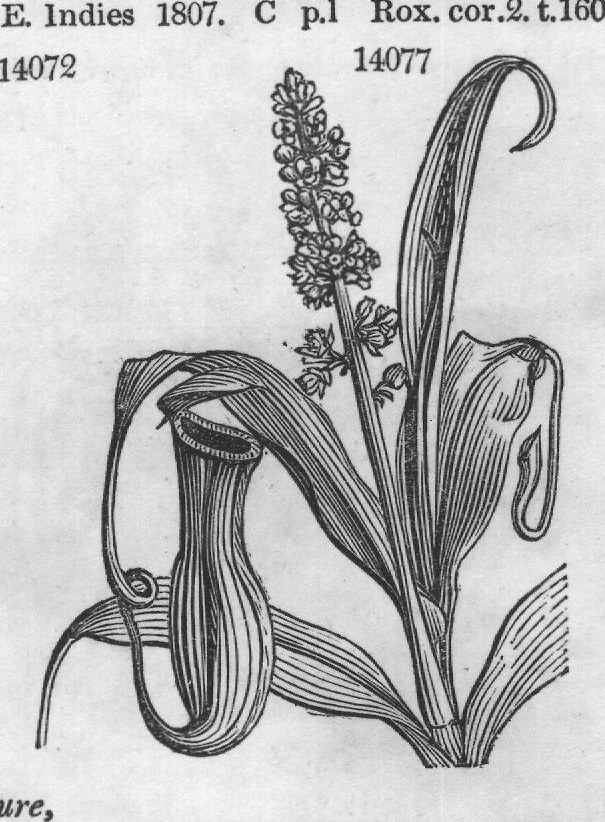
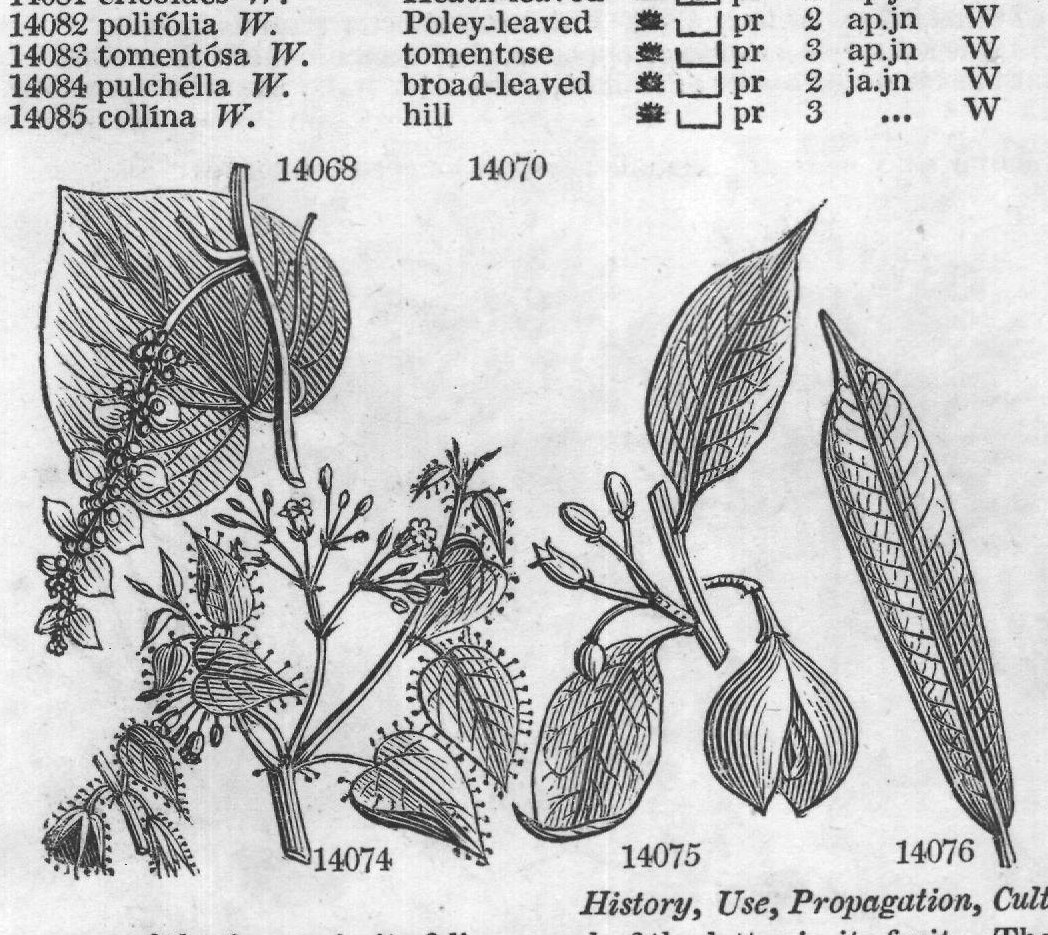
Mexico 1799. C p.1 Cav. ic. 5. t. 430 2120. MYRISTICA. W. NUTMEG. 14075 moscháta W. 14076 fátua W. 2121. NEPEN'THES, W. PITCHER PLANT. 14077 distillatória W. 2122. CLUY'TIA. W. 14078 alaternoídes W. 14079 polygonoídes W. 14080 daphnoídes W. 14081 ericoídes W. 14082 polifólia W. 14083 tomentósa W. 14084 pulchélla W. 14085 collína W.
Myristiceæ. Sp. 2-14. true tasteless 오오 clt 30 ...
G.w E. Indies 1795. C p.l Lam. ill. t. 832 or 30 ...
G.w Surinam 1812. C p.l Pluk.al. t.250.f.6 ..
Sp. 1-6.
Chinese cu 2 ap.my G China 1789. C p.1 Bur. zeyl.42. t.17 CLUYTIA.
Euphorbiaceæ. Sp. 8-11. narrow-leaved pr 2 mr.d W C.G.H. 1692. 1692. C p.1 Bot. mag. 1321 Polygonum-like pr 2 mr.d W C. G. H. 1790. C p.1 W. hort. ber. 51 Daphne-leaved pr 3 my.jn W C. G. H. 1731. C p.1 W. hort. ber. 52 Heath-leaved pr 2 ap.jn W C. G. H. 1790. C p.l Poley-leaved * pr 2 ap.jn W C. G. H. 1790. C p.l Jac. schœ.2. t. 50 tomentose pr 3 ap.jn W C. G. H. 1812. C p.l broad-leaved ☐ pr 2 ja.jn W C. G. H. 1739. C p.l Bot. mag. 1945 hill pr 3 W ...
E. Indies 1807. C p.l Rox. cor.2. t.160 14068 14070 14072 14077 14074 14075 14076 History, Use, Propagation, Culture, nature of the former in its foliage, and of the latter in its fruit. The roots of several species are said to have powerful medicinal qualities. That of the C. pareira, or Pareira brava, is bitter, diuretic, and aperient; of C. caapeba more mucilaginous. 2117. Excæcaria. From excæcare, to blind. The juice of this plant is so acrid as to cause loss of sight whenever it touches the eyes. Agallochum, the produce of one of the species, was the name given by the the Greeks to an aromatic wood they obtained from India. In Arabia it is called, according to Golius, âghâloùdjy. 2118. Adelia. From a, privative, and δηλoς, visible. The parts of fructification are so minute as to be hardly visible. A. Bernardia derives its name from having been considered a distinct genus, and dedicated to the celebrated Bernard de Jussieu. Bernardia is the name which ought to have been adopted for the genus. Ugly uninteresting shrubs. 2119. Loureira. Dedicated by Cavanilles to John de Loureiro, a Portuguese missionary, who travelled in China and Cochin-china, of which he published the Flora in 1790. 2120. Myristica. From μuρρa, myrrh, on account of the odor of the fruit. M. moschata produces spheroidal drupes, fleshy, smooth, and finally drying up into a coriaceous crust, and opening on one side. Each berry contains an ovate, globular, serrated nut. The arillus or cover, which is commonly called mace, is fleshy, coriaceous, and reddish-saffron colored. Under this are two shells, the outer thin and brittle, and reticulated by the impressions of the mace: the inner shell is membranaceous, and adheres very closely to the kernel. The fruit would be a drupe was it not for the arillus. The The nutmeg-tree yields three crops annually; the first in April, which is the best; the second in August, and the third in December; yet the fruit requires nine months to ripen it. When it is gathered, the outer coriaceous covering is first stripped off, and then the mace carefully separated and dried in the sun. nutmegs in the shell are next exposed to heat and smoke for three months, then broken, and the kernels thrown into a strong mixture of lime and water; after which they are cleaned and packed up. This process is necessary for their preservation, and with the same intention the mace is sprinkled with salt water. There are several varieties of the tree; but that denominated the queen nutmeg, which bears a small round nut, is the best. They are imported in chests, which contain each from 100 to 140lbs. weight; the mace comes in chests also of different sizes. The essential oil which is obtained in Banda by the distillation of the nut is brought ORDER XIII.
DIECIA MONADELPHIA. 14068 Leaves somewhat orbicular cordate at base 7-nerved or little downy, Fem. racemes the length of leaves 14069 Lvs. ovate bluntish smooth on short stalks, Racemes much branched, male? scarcely longer than petiole 14070 Monœcious diandrous, Leaves oblong serrated 14071 Leaves oblong downy serrated 14072 Leaves obovate entire 14073 Leaves oblong blunt entire fascicled, Spines axillary 14074 Leaves cordate glandular on the limb 14075 Leaves oblong acuminate smooth, Veins simple, Fruit solitary smooth 14076 Leaves oblong lanceolate with starry down beneath, Veins simple, Fruit racemose downy 14077 Leaves sessile, Pitchers cylindrical, Flowers panicled 14078 Leaves sessile linear lanceolate acute, Flowers axillary solitary 14079 Leaves sessile obovate acute, Peduncles about 3-fl. axillary 14080 Leaves subsessile lanceolate obovate, Flowers axillary solitary 14081 Leaves subsessile linear-lanceolate acute thickish, Flowers axillary twin 14082 Leaves stalked linear blunt mucronate revolute at edge, Flowers axillary subsolitary on long stalks 14083 Leaves elliptical blunt densely downy on each side, Flowers axillary solitary sessile 14084 Leaves stalked ovate acute smooth, Flowers in 5s axillary 14085 Leaves stalked elliptical blunt somewhat retuse smooth shining, Flowers axillary polygamous about 3 14078 14082 14079 14084 14080 14085 and Miscellaneous Particulars. in bottles, and the expressed oil in stone jars. Nutmegs are frequently punctured and boiled in order to obtain the essential oil, and the orifices afterwards closed with powdered sassafras. The fraud is detected by the lightness of the nutmeg. The nutmeg has a fragrant, agreeable, spicy odor, and a warm aromatic taste. As the medical properties of nutmeg and mace depend on the essential oil they contain, they agree in these circumstances and both are stimulant, carminative, and, in large doses, narcotic. Mace is more generally ; and both are stimulant, carminative, and, in large doses, narcotic. Mace is more generally used as a culinary spice; but the nutmeg and its volatile oil are in frequent use to cover the disagreeable taste of other medicines, and are sometimes ordered in cases of languor, vomiting, and diarrhea, and in flatulent colic. On account of the narcotic property of the oil, nutmeg should be cautiously employed in apoplectic and paralytic habits. In India its dangerous effects have been frequently felt; and in this country instances have occurred in which the nutmeg, taken in large quantity, produced drowsiness, great stupor, and insensibility, and on awakening delirium, which alternated with sleep for several hours. (Thom. Lond. Disp. p. 395.) M. fatua is a branching lofty tree; the branches long, tortuous and declining; the leafy and flowering branches downy and ferruginous; and the flowers in axillary and terminal clusters. The fruit varies in size and form on different trees; but is generally oblong, and about as long as a pigeon's egg. From the kernel is extracted a species of yellowish suet or fat, which serves for various medical and economical purposes, and is made into candles. From the wounded bark flows a red acrid juice. The plants are at present rare in British collections: they grow in light loam and peat, and may be increased by cuttings in sand under a bell-glass. 2121. Nepenthes. The name under which Homer speaks of a substance, which appears to have been opium. It is impossible to conceive in what sense the word has been applied to the plants now bearing the name. They is impossible to conceive in what sense the word has been applied to the plants now bearing the name. They are the famous pitcher-plants of China and the East Indies, which bear leaves, the extremities of which are hollowed out into cup-like appendages , which are generally filled with water, which seems as if confined within them by a little lid, by which the pitchers are surmounted. The cultivation of the plants is extremely difficult. It requires a very damp atmosphere, much heat , and perhaps, not much light. They are managed more successfully by Loddiges of Hackney, than by any cultivators in this country. 2122. Cluytia. Named by Boerhaave, after Outgers Cluyt, or Augier Clutius, a Dutchman, and professor of botany at Leyden. He published, in 1634, a little tract upon the Cocoa-nut of the Maldives, which he called nux-medica. The species are of little beauty or interest, and of the easiest propagation and culture. 3 I 2 POLYGAMIA.
CLASS XXIII.