Home › S › Solaneæ (Sp litt rea R Br yellow or my)
Solaneæ (Sp litt rea R Br yellow or my)
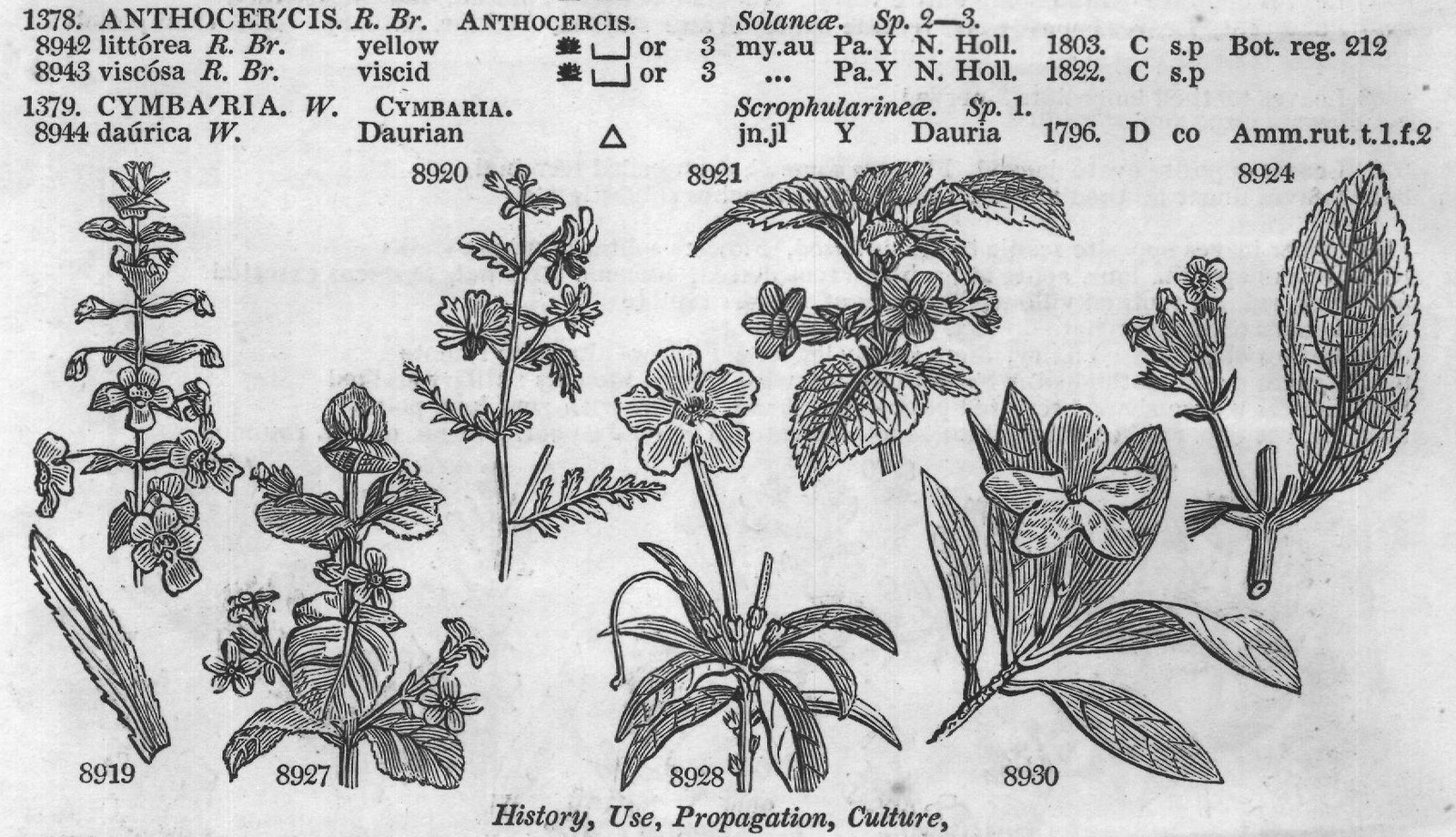
Sp. 2-3. 8942 littórea R. Br. yellow or 3 my.au Pa. Y N. Holl. 8943 viscósa R. Br. viscid or 3 ...
Pa. Y N. Holl. 1803. C s.p Bot. reg. 212 1822. C s.p 1379. CYMBA'RIA. W. CYMBARIA. 8944 daúrica W.
Daurian Scrophularineæ. Sp. 1. jn.jl Y Dauria 8920 8921 1796. D co Amm.rut. t. 1.f.2 8924 8919 8927 8928 8930 History, Use, Propagation, Culture, 1371. Angelonia. Angelon is the name of the plant among the Spanish colonists of Caraccas, where it grows. A very beautiful stove herbaceous plant, with large light-blue flowers. 1372. Schizanthus. From σχiζω, to cut, and avθoς, a flower, in allusion to the numerous divisions of the beautiful purple and yellow flowers. Tender annual plants, with finely cut pale green leaves, and termina panicles of elegant flowers. 1373. Besleria. After Basil Besler, an apothecary at Nuremberg, joint editor with Jungermann, of a sumptuous work entitled Hortus Eystettensis, 1613. The garden belonged to Bishop Conrad, of Eichstedt, and the plates were engraved at his expense. 1374. Teedia. So named by Persoon, but the meaning is unknown. Pretty herbaceous plants, with bright purple flowers and dark berries. 1375. Brunsfelsia. In memory of Otho Brunsfels, of Mentz, a Carthusian monk, and afterwards a physician, author of Figures of Plants in 1530. He died in 1534. The species are handsome tropical shrubs, with neat foliage and shewy white or purple flowers. Cuttings with a little ripened wood strike root freely in heat.
ORDER II. 8919 The only species 8920 The only species DIDYNAMIA ANGIOSPERMIA. 8921 Peduncles branched, Leaves ovate 8922 Peduncles simple clustered, Leaves ovate-lanceolate serrated 8923 Peduncles simple solitary, Calyxes serrated, Cor. smooth with a serrulated limb 8924 Leaves obl. ovate rugose crenate decurrent down the petiole, Cal. serrulate colored 8925 Peduncles simple solitary, Calyxes colored serrated, Cor. hairy with an entire limb, Leaves ovate 8926 Leaves opp. obl. finely serrulate smooth 8927 Leaves downy 8928 Leaves ovate-lanceolate narrowed at each end, Tube of cor. curved, Limb wavy 8929 Leaves obovate acuminate longer than petiole, Tube of cor. straight, Limb entire 8930 Leaves and leafstalks deeply stained with purple 8931 Cauline leaves bipinnate 8932 Rad. leaves lyrate: upper oblong, Pedicels longer than bractes, Sepals linear entire 8933 Radical leaves lyrate upper ovate, Bractes longer than pedicels, Sepals linear oblong entire , Bractes longer than pedicels, Sepals linear oblong entire 8934 Radical leaves lyrate: floral cordate half stem-clasping, Peduncles as long as flower 8935 Radical leaves lyrate: upper oblong, Flowers subsessile the length of bractes, Cal. ovate serrated 8936 Somewhat downy, Leaves lanceolate, Flowers axillary solitary 8637 All over wool, Leaves oval oblong blunt crenate, Stamens bearded with capitate hairs 8938 Leaves ovate lanceolate deeply serrated 8939 Leaves ovate acute cut serrated 8940 Leaves ternate remotely toothletted 8941 Leaves ovate acute serrated, Stem winged at angles 8942 Leaves obovate smooth, Segments of cor. length of tube 8943 Leaves obovate dotted with glands downy 8944 Flowers large yellow spotted 8932 8935 8937 8939 8940 8942 and Miscellaneous Particulars. 8944 1376. Celsia. In honor of Olaus Celsius, D. D., surnamed the northern Pliny, professor of the oriental languages in the university of Upsal. His Hierobotanicon, or History of the Plants of Scripture, appeared in 1745. There was also another Swedish botanist called Magnus Nicolaus Celsus, who died in 1679. Besides these moderns, the name is rendered familiar to classical scholars by the recollection of the famous Aurelius rendered familiar to classical scholars by the recollection of the famous Aurelius Cornelius Celsus, who wrote upon agriculture and medicine, and whose purity of style procured him the agriculture and medicine, and whose purity of style procured him the name of the Cicero of medicine. 1377. Alonsoa. Named by the authors of the Flora Peruviana, after Zanoni Alonso, at the time of the publication of that work, Spanish secretary for the kingdom of Santa Fé, and a great patron of objects connected with natural history. Sir James Smith considers the genus the same as Hemimeris. 1378. Anthocercis. From avθoς, a flower, and κερκiς, a ray, the narrow divisions of the corolla spreading in a radiant manner, like the spokes of a wheel. 1379. Cymbaria. From κuμβη, a boat, in allusion to the shape of the fruit. A small pubescent hoary plant, native of mountainous rocky places in Siberia.
Mm 4 TETRADYNAMIA.
CLASS XV.
CLASS XV. - TETRADYNAMIA. STAMENS 6, of which four are longer than the rest. THIS class consists, with the exception of Cleome, entirely of the natural order Cruciferæ, and has lately been the subject of the most acute and successful investigation of many botanists of celebrity. Our countryman, subject of the most acute and successful investigation of many botanists of celebrity. Our countryman, Mr. Brown, led the way to the improvements which have been made in the genera , in the second edition of the Hortus Kewensis, in which, discarding the uncertain and unnatural characters derived from variations in the floral envelopes, he took a new course, and by indicating with great precision the curious modifications of the seeds and seed-vessels, led the way to an entirely new arrangement of the class. The principles thus developed have been adopted by M. Decandolle, whose learned treatise upon Cruciferæ is here followed without variation.
The difference between the genera with a long pod (Siliquosa), and those with a short one (Siliculose), has given rise to two orders in the Linnean system. But these are not only ambiguous, but interfere so much with a distribution of the genera according to their natural affinities, that they have been rejected here, and the divisions of M. Decandolle, depending upon variation in the relative position of the various parts of the seed, have been substituted.
The plants of this class have always been celebrated for their antiscorbutic qualities. These seem to reside in an acrid, oily, volatile principle, not yet determined by chemists, and varying in the degree of abundance in an acrid, oily, volatile principle, not yet determined by chemists, and varying in the degree of abundance in which it is found in different species. It is particularly abundant in the seeds of mustard and garden rocket, in the roots of the horse radish, and in the foliage of the Lepidium latifolium , which, administered inwardly, act powerfully upon the gastric organs, or, applied externally, inflame the skin and operate nearly as severely as blisters.
A slighter degree of acrimony is found in the foliage of the scurvy grass, the roots of the garden radish, & c .; and these, therefore, operate more gently, and perhaps more safely, when eaten, scarcely at all when applied outwardly. Whatever the degree of acrimony may be in these plants, they all appear, when eaten, to produce some specific action upon the digestive organs, and thence upon scorbutic humours; for which reason, the horse radish, water-cress, radishes, and even cabbages are eminently antiscorbutic. They are also admitted by physicians as diuretic, sialagogue, and diaphoretic. It is only when the acrid principle is diffused over a considerable quantity of fleshy and watery substance, that cruciferous plants become eatable, as in the leaves and stems of cabbages and sea-kail, and in the roots of radishes and turnips. Even in these plants, the proportion of acrid principle is much diminished by exclusion from light. Plants of this class are also remarkable for containing a larger quantity of azote than most vegetables ; for which reason ammonia is generally evolved in their fermentation or putrefaction: to which circumstance it is possible that the two remarkable phænomena are to be attributed, viz.; that cruciferous plants contain a greater portion of nutritive matter than most herbaceous plants; and that they require either a very rich soil manured with animal substances, or at least a situation near the habitations of men. oil, and the seeds of Camelina sativa, Brassica campestris, some species of Rocket, &c. are cultivated in many The embryos of all these plants are filled with parts of Europe for the sake of their expressed oil, which is used either for culinary purposes or for lamps.
Cruciferous plants are chiefly natives of temperate climates, those which are found within the tropics being in all cases mountain plants, and are nearly all cultivable in the open air ; they are mostly found in open all cases mountain plants, and are nearly all cultivable in the open air; they are mostly found in open sandy plains; some on the tops of the highest mountains at the utmost limits of vegetation. Nine hundred species are now described, of which not more than twenty-two are to be found in the works of Hippocrates, Theophrastus, Dioscorides, or Pliny.
A. Cotyledons four, spirally twisted. Petals 4, cruciate. 1380. Schizopetalon. Petals pinnatifid.
B. Cotyledons two. Petals 4, cruciate. 1. Cotyledons flat, accumbent. Radicle lateral. Seeds compressed. (O=) PLEURORHIZEE, Dec. Silique opening ; with a linear dissepiment more or less wide than sceds. Seeds oval, compressed ; Silique opening; with a linear dissepiment more or less wide than sceds. Seeds oval, compressed; often margined. Cotyledons fiat, accumbent, parallel with the dissepiment ARABIDE, Dec. 1381. Mathiola. Silique roundish. Stigmas connivent, thickened or cornute at back. Calyx bisaccate at base . 1382. Cheiranthus. Silique round or compressed. Stigmas 2-lobed or capitate. Calyx bisaccate at base. 1383. Nasturtium. Silique roundish, shortened or declinate. Stigma nearly 2-lobed. Calyx equal at base, spreading .
Calyx spreading, equal.
Calyx equal at base. 1384. Leptocarpæa. Silique roundish, very slender. Stigmas sessile, 2-lobed. Calyx spreading, equal. the valves elongated at end into a horn or mucro. 1386. Barbarea. Silique 4-cornered, 2-edged, the valves not elongated at end. 1387. Braya. Silique oblong, subcylindrical, with flattish valves and a sessile stigma. Seeds few, ovate. Calyx equal at base. 1388. Parrya. Silique linear with veiny valves. Seeds in two rows, with a loose wrinkled skin. Stigmas approximating Filaments not toothed. 1389. Turritis. Silique linear with flat valves. Seeds in two rows in each cell. 1390. Arabis. Silique linear with flat valves, 1-nerved in the middle. Seeds in one row in each cell. 1391. Macropodium. Silique pedicellate, linear, with flat valves, 1-nerved in middle. 1392. Cardamine. Silique linear with flat nerveless valves, often opening with elasticity. Funicles of the hilum slender. 1393. Pteroneuron. Silique lanceolate with flat nerveless valves, often opening with elasticity: placentas with winged nerves. Funicles dilated. winged nerves. Funicles dilated. 1394.
Dentaria. Silique lanceolate with flat nerveless valves, often opening with elasticity: placentas not winged. Funicles dilated. ** Silicle opening lengthwise, with a broad oval membranous dissepiment, and flat or concave valves. Seeds compressed, frequently margined. Cotyledons flat, accumbent, parallel with the dissepiment. ALYSSINEE, Dec. 1395. Lunaria. Silicle pedicellate, elliptical or lanceolate with flat valves. Funicles long, adhering to the dissepiment. Calyx somewhat bisaccate. Petals nearly entire. Stamens not toothed. 1396 Ricotia. Silicle sessile, oblong, when ripe losing its dissepiment and becoming 1-celled: valves flat. Calyx with two prominences at base. Petals emarginate. Stamens not toothed. 1397. Farsetia. Silicle sessile, oval or orbicular, with flat valves. Seeds winged. Calyx bisaccate at base. Petals entire. 1398. Berteroa. Silicle sessile, elliptical or obovate, with flat or concave valves. Calyx equal at base. Petals 2-parted. The small stamens toothed. parted. The small stamens toothed. 1399.
Aubrietia. Silicle oblong with convex valves. Seeds not edged. Calyx bisaccate at base. Petals entire. Smaller stamens toothed. 1400. Vesicaria. Silicle globose inflated with hemispherical valves. Seeds more than 8. Petals entire. CLASS XV.
TETRADYNAMIA. 1401. Alyssum. Silicle orbicular or elliptical, with valves flat or convex in centre. Seeds 2-4 in each cell. Calyx equal at base. Petals entire. Some the stamens toothed. 1402. Clypeola. Silicle orbicular, 1-celled, 1-seeded, with flat valves. Calyx equal. Petals entire. Stamens toothed. 1403. Peltaria. Silicle orbicular, 1-celled, 1-4-seeded, with flat valves. Seeds two in each cell: funicles adhering to the dissepiment. 1404. Petrocallis. Silicle sessile, oval, with flattish valves. Seeds two in each cell: funicles adhering to the dissepiment. 1405. Draba. Silicle sessile, oval or oblong, with flat or convex valves. Seeds many, not edged. Calyx equal, Petals entire. All the stamens without teeth. 1406. Erophila. Silicle oval or oblong, with flat valves. Seeds many, not edged. Calyx equal. Petals 2-parted. Stamens without teeth. 1407. Cochlearia. Silicle sessile, ovate-globose or oblong, with ventricose valves. Seeds many, not edged. Petals entire. Stamens without teeth. *** Silicle opening, with a very narrow dissepiment, and keeled navicular valves. Seeds oval, sometimes margined. Cotyledons flat, accumbent, contrary to the dissepiment. THLASPIDEE, Dec. + Cells of silicle 2-many-seeded. 1408. Thlaspi. Silicle emarginate at end, with navicular valves, winged at back. Cells two, manyseeded. 1409. Capsella. Silicle triangular, cuneate at base, with navicular valves, not winged. Cells many-seeded. 1410. Hutchinsia. Silicle elliptical, with navicular valves, not winged. Cells 2-seeded, rarely manyseeded. 1411. Teesdalia. Silicle oval, emarginate at end, with navicular valves and 2-seeded cells. Stamens having a scale inside at their base. ++ Cells of silicle 1-seeded. 1412. Iberis. Two outer petals largest. Silicle compressed, truncate, emarginate. 1413. Biscutella. Silicle flat, biscutate, with the cells laterally united to the axis. Style long, persistent. Embryo inverted. **** Silicle not opening, with concave indistinct valves, and sometimes with scarcely any trace of a dissepiment. Seeds oval, very few. Cotyledons flat, accumbent, parallel with dissepiment. EUCLIDIEE, Dec. 1414. Euclidium. Silicle drupaceous, ovate, with manifest sutures. Style subulate. Cells 1-seeded. 1415. Ochthodium. Silicle cor coriaceous, subglobose. Stigma sessile. Dissepiment thick. Cells 1-seeded. ***** Silicle opening lengthwise, with concave valves, bearing internally transverse horizontal dissepiments separating the seeds. Seeds not margined. Cotyledons flat, accumbent, parallel with the dissepiment. ANASTATICEE, Dec. 1416. Anastatica. Silicle ventricose, with valves bearing an appendage outside at the end. ****** Silique or silicle separating across into 1-2-celled, 1-2-seeded joints. Seeds not edged. Cotyledons flat, accumbent, parallel with the dissepiment when there is any. CAKILINEÆ, Dec. 1417. Cakilc. Silicle 2-jointed, compressed: the upper joint ensiform. Seeds solitary in the cells: upper erect; lower pendulous. 1418. Rapistrum. Silicle 2-jointed: the upper joint ovate, rugose. Seeds solitary in the cells: upper erect, lower pendulous. 1419. Chorispora. Silique roundish, with many equal joints. Seeds all pendulous. 2. Cotyledons flat, incumbent. Radicle dorsal. Seeds ovate, not margined. (O||) NOTORHIZEE, Dec. * Silicle 2-celled, opening lengthwise, with concave or keeled valves. Seeds ovate or oblong, not margined. Cotyledons flat, incumbent, contrary to the dissepiment. SISYMBRIEÆ, Dec. 1420. Malcomia. Silique roundish. Stigma simple much pointed. 1421. Hesperis. Silique roundish, or about 4-cornered. Stigmas 2, erect, conniving. Calyx bisaccate at base. 1422. Sisymbrium. Silique roundish, sessile upon the torus. Stigmas 2, somewhat distinct or connate in a head. Calyx equal at base. 1423. Alliaria. Silique roundish, 4-cornered, with prominent nerves. Calyx lax. 1424. Erisymum. Silique 4-cornered. Calyx closed. ** Silicle with concave valves, and with a dissepiment elliptical in its greatest diameter. Seeds ovate. Cotyledons flat, incumbent, contrary to dissepiment. CAMELINEE, Dec. 1425. Camelina. Silicle obovate or subglobose, with ventricose valves and many-seeded cells. Style filiform. 1426. Neslia. Silicle subglobose, with concave valves, 1-celled, 1-seeded, indehiscent. *** Silicle with a very narrow dissepiment, and with keeled or very convex valves. Seeds solitary or few in the cells, ovate, not margined. Cotyledons flat, incumbent, parallel with the dissepiment. LEPIDINĖJE, Dec. 1427. Coronopus. Silicle twin. Valves ventricose or subcarinate, scarcely dehiscent, 1-seeded. 1428. Lepidium. Silicle ovate or subcordate, with carinate or rarely ventricose valves, opening with 1-seeded cells. 1429. Æthionema. Silicle oval, generally emarginate, with navicular valves, and 1-2-seeded cells. Larger stamens either united or toothed. **** Silicle with indistinct or indchiscent keeled valves, 1-celled, 1-seeded, with an obliterated dissepiment. Seeds ovate, oblong. Cotyledons flat, incumbent, apparently in the same direction as the dissepiment should be. ISATIDEE, Dec. 1430. Isatis. Silicle elliptical, flat, 1-celled, 1-seeded, with carinate navicular valves, which are scarcely dehiscent. 1431. Myagrum Silicle compressed, almost cuneate, with two empty hollows at end, and at base 1-celled, 1-seeded. 3. Cotyledons incumbent, folded together, or plaited lengthwise through their middle, and enwrapping the radicula. Style generally enlarged, with a cell and seed at its base. Seeds generally globose, never margined. (O>>) ORTHOPLOCEE, Dec. * Siliquc with valves opening lengthwise, and a linear dissepiment. Cotyledons folded together. BRASSICEE, Dec. 1432. Brassica. Silique roundish. Style small, short, obtuse. Seeds in one row. Calyx closed. 1433. Sinapis. Silique roundish, with nerved valves. Style small, short, acute. Seeds in one row. Calyx spreading. 1434. Moricandia. Silique 4-cornered, sowewhat 2-edged. Seeds in two rows. Calyx bisaccate at base. 1435. Diplotaxis. Silique compressed, linear. Seeds in two rows. Calyx equal at base. 1436. Eruca. Silique roundish. Style large, ensiform or conical. Seeds in one row. Calyx equal at base, TETRADYNAMIA.
CLASS XV. ** Silicle with concave valves, opening lengthwise, with an elliptical dissepiment. Cotyledons folded together. VELLEE, Dec. 1437. Vella. Larger stamens connate. 1438. Carrichtera. Stamens all free. Style ovate, flat, foliaceous. Style ovate, flat, at the end of a tongue-shaped silicle. 1439. Succowia. Stamens all free. Style slender, conical. Valves of the silicle echinate. *** Silicle indehiscent, ovate or globose, 1-celled, 1-seeded, with indistinct valves. Seeds globose. Cotyledons folded together. ZILLEE, Dec. 1440. Zilla. Silicle 2-celled. Cells 1-seeded. 1441. Calepina. Silicle 1-celled, 1-seed. Seed pendulous. Outer petals rather the largest. **** Silicle or silique dividing across into one or few-seeded joints or cells. Seeds globose. Cotyledons folded together. RAPHANEE, Dec. 1442. Crambe. Silicle with two joints, of which the lower is abortive, the upper globose 1-seeded. 1759. S l.p England sea sh. S 1.p Persia 1797. Cr.m Bot. mag. 1711 Crimea 1823. Cr.m 1380. SCHIZOPE/TALON. Sims. SCHIZOPETALON. 8945 Walkéri Sims.
Walker's 1381. MATHIOLA. R. Br. Stock. 8946 incána R. Br. multiplex ẞ coccinea y álba 8947 ánnua Sweet. 8948 glábra Dec. 8949 græ'ca Sweet. 8950 fenestrális R. Br. 8951 sinuáta R. Br. 8952 odoratíssima R. Br.
ẞfrágrans Fisch. 8953 vária Dec. 8954 trístis R. Br. ten weeks smooth Wall-fl.-leav'd window greater sea Persian short-podded variable dark-flowered 8955 tricuspidáta R. Br. three-forked 8956 parviflóra R. Br. small-flowered সসসস ○○[ [[OPOLO 1382. CHEIRAN'THUS. L. WALL-FLOWER. 8957 cheiri L.
B fruticulósus L. 8958 ochroleúcus Hall. 8959 tenuifólius Lher. 8960 mutábilis Lher. garden wild pale yellow fine-leaved changeable ẞ longifólius Vent. long-leaved 姓 8961 scopárius W. rock ẞ chamæleo Ker.
Chamæleon or or cu Cruciferæ. 2 my.jl W Sp. 1.
Chili 1822. S p.l Bot. reg. 752 Cruciferæ.
Sp. 11-26.
Pu. Gilly Flow. or 2 my.n Pu England cliffs. C 1.p Eng. bot. 1935 double Brompton white-branching or 2 my.n St or 2 my.n W ...... ... or 2 my.n W S. Europe ...
Cl.p S l.p S. Europe 1731. S l.p Dalec.lug.802.11 Mo.ox.s.3. t.8.f.2 or 1 jl.au Pu ...... or 1 my.au V Jac.vind.2. t. 179 Eng. bot. 462 or 2 jn.jl Ld or 2 jn.jl Ld or jn.jl Ld or 1 my.jl Ld pr 1 jl Pu pr jl.au Pu Cruciferæ.
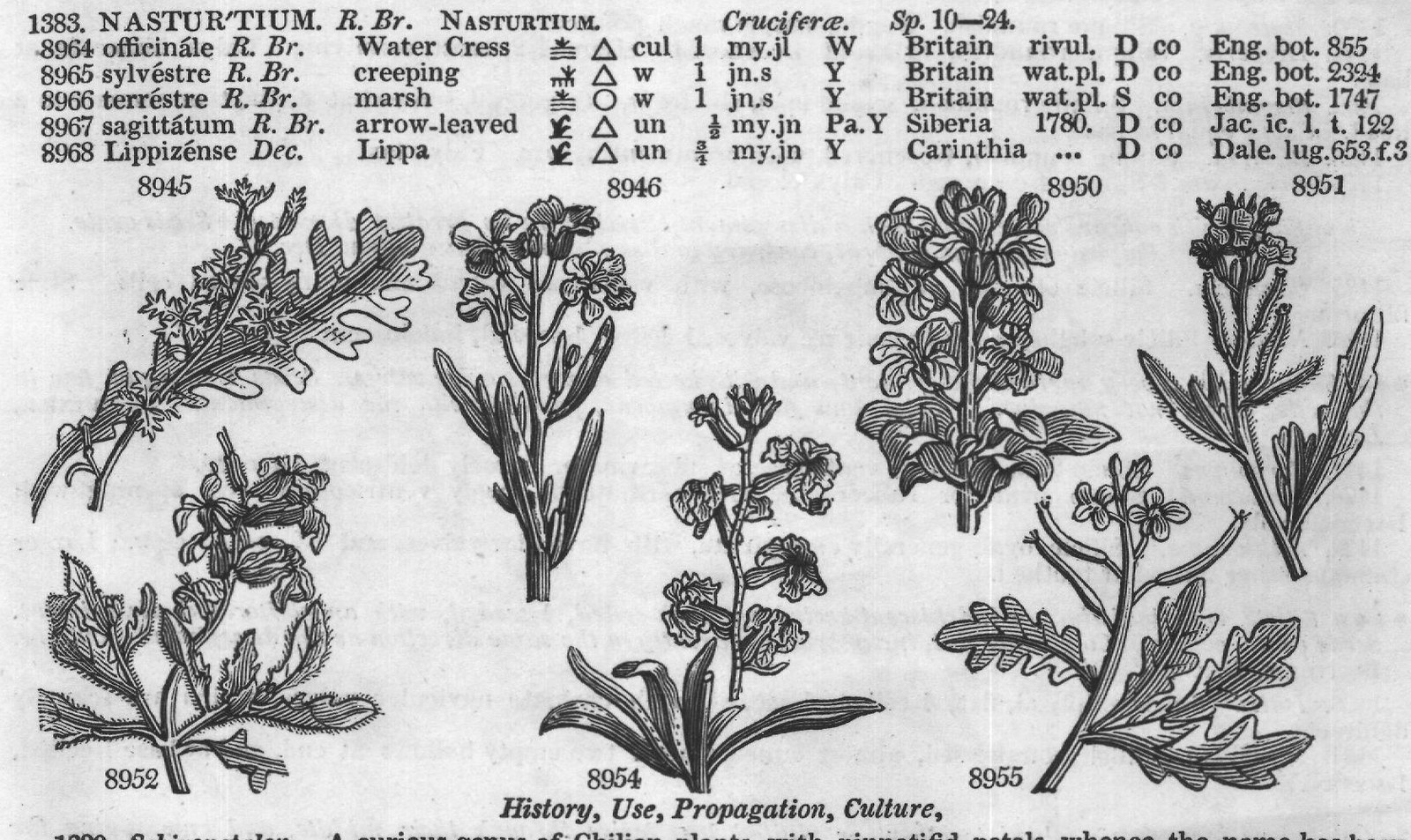
Sp. 7-17. or 2 ap.jl Or Y 8962 semperflórens Schon.ever-blowing ẞ frutescens Pers. entire-leaved 1383. NASTURTIUM. R. Br. NASTURTIUM. or ap.jl 3 ap.jl Levant 1820. Cr.m Fl. græc. t. 636 S. Europe 1768. S s.1 Barbary 1739. S s.1 Morocco 1799. S $.1 Š. Europe 1573. S r.m Britain old wa. S co Pa.Y Switzerl. 1820. D co 2 my.jn Y Madeira 1777. C 1.p or 3 mr.my Y.Pu Madeira 1777. C l.p or 3 s.d or 3 my.o or 3 my.o Bot. mag. 729 Lam.ill. t:564.f.2 Bull. herb. t. 349 Eng. bot. 1934 Hal.hel.449. t.14 Bot. mag. 195 W.pu Madeira 1815. C co Vent.malm. t.83 W.pu Teneriffe 1812. Cr.m Y.Pu Teneriffe 1812. Cr.m Bot. reg. t. 219 or 2 ja.d W or 2 mr.jl W or 2 mr.au Pu Crucifera. cul 1 my.jl W W 1 jn.s Y 8963 linifólius Pers.
Flax-leaved 8964 officinále R. Br.
Water Cress 8965 sylvéstre R. Br. creeping 8966 terréstre R. Br. marsh W 1 jn.s 8967 sagittátum R. Br. arrow-leaved un 8968 Lippizénse Dec.
Lippa un 8945 8946 Y Barbary 1815. C s.l Teneriffe 1815. C co Spain 1815. C s.l Sp. 10-24.
Britain rivul. D co Britain wat.pl. D co Britain wat.pl. S co my.jn Pa.Y Siberia 1780. D co my.jn Y Carinthia D co ... 8950 Eng. bot. 855 Eng. bot. 2324 Eng. bot. 1747 Jac. ic. 1. t. 122 Dale. lug.653.f.3 8951 8952 8954 History, Use, Propagation, Culture, 8955 1380. Schizopetalon. A curious genus of Chilian plants, with pinnatifid petals, whence the name has been formed, from σχίζω, to divide. A plant of difficult cultivation. It is raised from seeds, which it produces sparingly, and only in a well-aired cool greenhouse. 1381. Mathiola. Named after Peter Andrew Matthioli, an Italian physician, born in 1500, died in 1577. He was first physician to Ferdinand of Austria, and author of a laborious commentary upon Dioscorides. Herbs, or rarely shrubs, nearly all covered with a white stellate soft down. M. incana, annua, græca, and fenestralis are popular border flowers, especially the first; the leaves of all the species, and also of Cheiranthus, and many other plants of this class, may be used as potherbs or salads. 1382. Cheiranthus. So called from the Arabic kheyry, the name of a plant with red sweet-scented flowers. Herbs, or occasionally shrubs, with entire or toothed leaves, and flowers of various colors. C. Cheiri is a CLASS XV.
TETRADYNAMIA. 1443. Raphanus. Silique transversely many-celled or dividing into several joints. 4. Cotyledons incumbent, linear, spirally or rather circinately twisted. (O||||) SPIROLOBEE, Dec. 1444. Bunias. Silicle nucamentaceous, indehiscent, 2-4-celled. Cotyledons twisted spirally. 1445. Erucaria. Silique lomentaceous, 2-jointed; the lower joint having two cells, the upper being ensiform. having two cells, the upper being ensiform.
Cotyledons replicate, somewhat spiral. 5. Cotyledons incumbent, linear, with two legs, or a double plait, that is to say, plaited twice crosswise. Seeds depressed. (O||||||) DIPLECOLOBEE, Dec. 1446. Heliophila. Silique elongate or rarely oblong or oval. Dissepiment linear or oval. Valves flat, or in the long siliques somewhat convex. Calyx equal at base. 1447. Subularia. Silicle oval. Dissepiment elliptical. Valves convex.' Cells many-seeded. Stigma sessile. C. Cotyledons 2. Petals 4, not cruciate. Thalamus large, hemispherical or elongated. Stamens 4-6-00. 1448. Cleome. A honey gland at each division of the calyx, except the lowest. Calyx 4leaved. Petals ascending. 8945 Stem weak cœsious, Petals pinnatifid quickly perishable 8946 Stem shrubby at base erect branched, Leaves lanceolate entire hoary, Pods subcylind. without glands 8947 Stem herbaceous erect branched, Leaves lanceolate blunt hoary, Pods subcylindrical without glands 8948 Stem half shrubby erect branched, Leaves lanceolate smooth, Pods somewhat compressed without glands. lanceolate smooth, Pods somewhat compressed without glands. 8949 Stem herbaceous erect branched, Leaves lanceolate smooth, Pods somewhat compressed without glands 8950 Stem shrubby erect simple, Leaves close obovate downy, Pods downy without glands broadest at base 8951 Stem somewhat erect herbaceous branch. Lvs. obl. downy; lower sinuated, Pods comp. velvety and gland. . 8952 Stem erect branched, Leaves downy or pubescent toothed or pinnatifid, Pods compressed downy Pods twice as short as a 8953 Stem erect nearly simple naked, Leaves linear blunt hoary entire, Flowers subsessile, Pods compressed B Pods twice as short as a 8954 Stem shrubby at base branched erect, Leaves downy linear entire or toothed, Fl. subsess. Pods roundish 8955 Stem suberect branched, Leaves sinuate pinnatifid, Pods with three acute nearly equal points 8956 Stem suberect branched, Leaves downy lanceolate repand toothed, Fl. sessile, Middle point of pod longest lanceolate repand toothed, Fl. sessile, Middle point of pod longest 8957 Leaves lanc. entire, Hairs 2-parted appressed or none, Pods linear, Stigmas with recurved lobes 8958 Lvs. obl. lanc. somew. toothed, Hairs 2-parted or none, Stem decum. branch. Pet obov. Pods erect pointed 8959 Leaves linear entire somewhat silky, Stem half shrubby 8960 Leaves linear-lanceolate acuminate finely serrated downy with 2-parted hairs, Stem shrubby branched serrated downy with 2-parted hairs, Stem shrubby branched 8961 Leaves linear-lanceolate acuminate entire downy with appressed 2-parted hairs, Stem shrubby branched 8962 Leaves lin. lanc. entire roughish, Stem shrubby branched, Pods compressed, Pedic. half as short as calyx 8963 Leaves linear entire rough clustered, Stem shrubby branched, Pods roundish 3 times as long as calyx 8964 Leaves pinnatifid, Segments ovate subcordate repand 8965 Leaves pinnatifid, Segments lanceolate serrate or cut 8966 Leaves pinnated-lobed, lobes confluent toothed smooth, Root fusiform, Petals as long as calyx 8967 Downy, Rad. lvs. toothed backwards, cauline sagittate oblong blunt, Stems erect branched from the base oblong blunt, Stems erect branched from the base 8968 Radical leaves stalked obovate toothed or lyrate : upper pinnatifid, Lobes linear entire 8957 8964 8965 8960 8966 8961 8967 8958 and Miscellaneous Particulars. popular flower of long standing, admired for its various colors and agreeable odor. Being an acrid and hardy evergreen, it is sometimes sown in pastures, along with parsley, thyme, &c. as a preventative of the rot in sheep. 1383. Nasturtium, is said to have been so called from the effect its acrimony produces upon the muscles of the nose; nasus tortus signifying a convulsed nose. Pliny. N. officinale is a well known popular salad, gathered wild in most parts where it is found, and since 1808, cultivated to a considerable extent in the neighbourhood of London. A running stream of clear water is essential to its cultivation; in the bed of this stream the plants are inserted in rows in the direction of the current, and all that is necessary is to take up and replant occasionally, and to keep up the plants free of mud or any accumulation of extraneous matters, and to see that other plants, especially the Sium nodiflorum, a poisonous plant resembling the water-cress, do 8969 pyrenáicum R. Br. Pyrenean 8970 amphíbium R. Br. amphibious 8971 benghalénse Dec. Bengal TETRADYNAMIA.
CLASS XV. un my.jn Y w1 jn.au Y Pyrenees 1775. D co Britain riv.ba. D co Act. helv. 4. t.15 Eng. bot. 1840 8972 microspermum Dec. Chinese Oun 2 jn.au Y un jn.au W E. Indies China 8973 índicum Dec. doubtful 1384. LEPTOCARPÆA. Dec. LEPTOCARPÆA.
Oun jn.au Ap Cruciferæ.
China Sco 1820. S co Sco ...
Sp. 1. 8974 Loesélii Dec.
Loesel's W 1½ au Y Germany 1683. S co Jac. aust.4. t.324