Home › Contents › Double Trumpet Daffodil
Double Trumpet Daffodil
Narcissus pseudonarcissus.
THE trumpet daffodils constitute a distinct and important section of the great genus Narcissus; and they are, without doubt, the most useful of all our garden flowers, and eminently gay when, in the timid days of spring, they present their golden flowers. The double daffodils belong exclusively to the garden. Those that enrich the midland meadows in primrose time are invariably single, and of one distinct type, known as the English daffodil. It is of these more especially that Shakespeare speaks in the famous passage in the "Winter's Tale" where Perdita sighs for "some flowers o' the spring' wherewith to welcome the young people at the shearing feast-- "Daffodils, That come before the swallow dares, and take The winds of March with beauty; violets dim, But sweeter than the lids of Juno's eyes Or Cytherea's breath; pale primroses That die unmarried, ere they can behold Bright Phoebus in his strength."
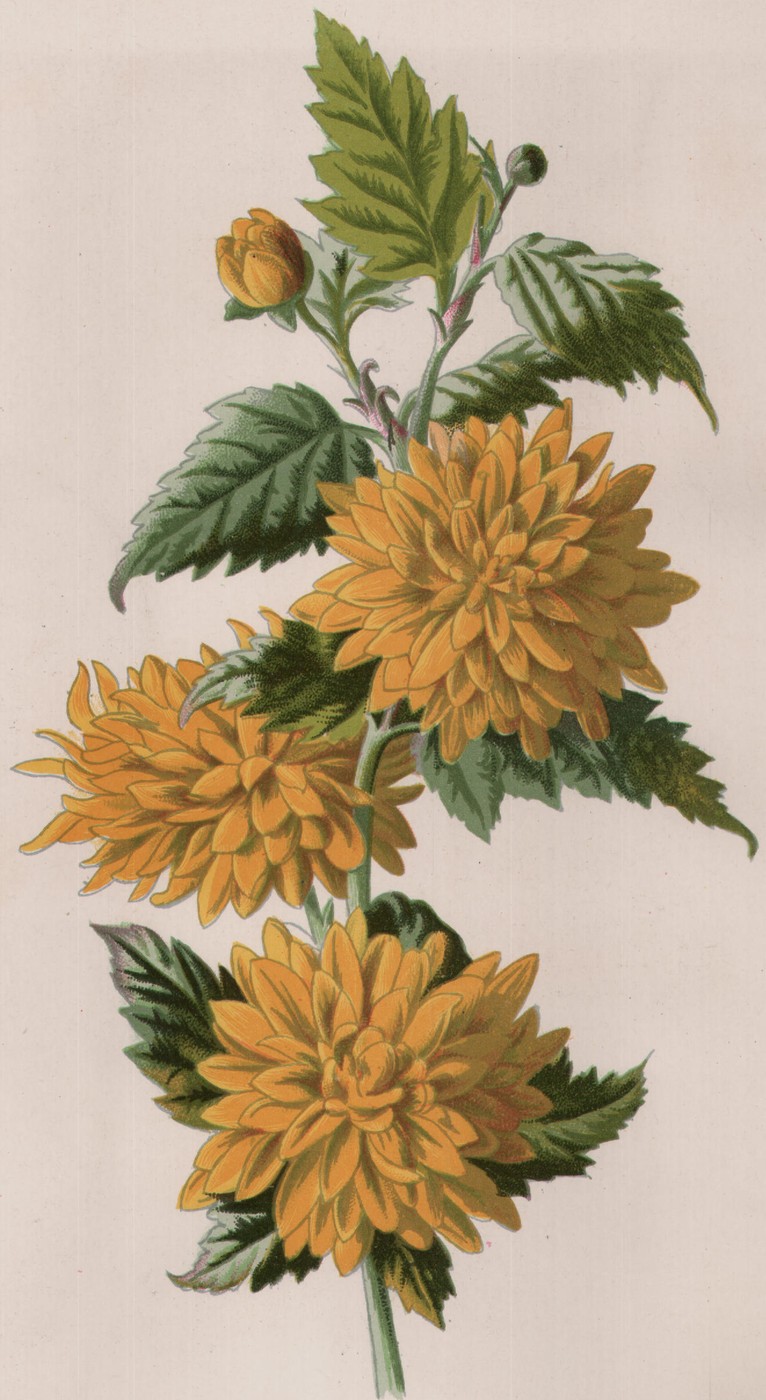
It is the early flowering of these trumpet daffodils that renders them so especially valuable in the English garden, and that has suggested to the greatest of poets the sweetest and simplest passage on spring flowers that has ever been written. From first to last, through all the fifty or more, as the case may be, these daffodils are amongst the hardiest of plants known to us; no frost hurts them; the "winds of March" cannot despoil them, and they are careless of conditions, provided they have soil of some sort to grow in, and are not at any time exposed to the full glare of the advancing sun. Although these comprise only one section of daffodils, there being at least four other sections equally distinct in character, they constitute a subject for an elaborate study, and the student of vegetable form may do well to secure as large a collection as possible, both for scientific observation and to add to the joy of the garden. One striking characteristic of the group is to be found in their delicate gradations of size and form with strict adherence to type, so that however they may differ in degree, we have no trouble at any time in determining that each is a veritable trumpet daffodil. In Minimus, Minor, and Nanus we have three miniature varieties that in their way bear the closest resemblance to Maximus, Princeps, Telamonius, Emperor, and Volutus, which are the largest of the section, the noblest in form and colour, and may truly be described as gigantic daffodils. Nor does the family likeness fade in the lovely Bicolor, Empress, and Moschatus, in which there are two distinct colours, white and yellow; or in Cernuus, which keeps its head down as if in trouble, and is wholly white, or but slightly touched with a delicate creamy shade.
In the process of doubling, a departure from the family likeness is made, and it must be owned there is a departure also from the prevailing beauty of the trumpet series. None of the double flowers can be properly said to equal the single ones in elegance, but they make more show, and they last longer; and if nature is pleased to give us double flowers we must accept them with thankfulness. For the student of daffodils, the double are as attractive as the single flowers, for the origin of their several parts, and the manner in which the process of doubling is accomplished, present subjects for inquiry not soon to be exhausted. Some flowers occur that are double within the trumpet only. In this case the organs of reproduction may be supposed to be converted into petals, or their equivalents. Other flowers occur that are double outside the trumpet, which remains intact in the midst of a crowd of golden banners; and others, again, are double throughout, like a double rose, and the trumpet is completely lost in a confused mass of petals--or, to be learned, we will say perianth segments.
When we inquire into the origin of these many petals, we find that we can in theory account for many of them. For example, the outer segments or petals are six in number; the trumpet consists hypothetically of six lobes united at their edges; there are six stamens and a stigma of three lobes. Thus in a common single trumpet daffodil there are twenty-one parts in all. How many separate parts there are in a very double flower we do not know, for we have never succeeded in counting them. We began with a flower called Grandiplenus, and having stripped from it sixty parts, found there were fully three times as many remaining, a considerable proportion of these being green scales, like miniature leaves.
As garden flowers, the finest of the double daffodils are Telamonius plenus, the largest yellow; Cernuus plenus, a lovely white rosette flower; and Cernuus bicinctus, a pretty and curious white flower, with a double trumpet and two rows of guard petals.
All the trumpet daffodils are suitable for planting on rockeries and in common borders; and although they will thrive almost anywhere, a deep moist loam is the kind of soil in which they are likely to attain to the finest proportions. A certain amount of shade is favourable to their well-doing; but they love light and air, and to be overmuch shaded is unfavourable to their flowering. The bulbs should be planted in autumn in clumps of six to twelve, about three or four inches deep, and should be left undisturbed for several years, to insure abundant flowering.