Home › Contents › Lily of the Field
Lily of the Field
Lilium chalcedonicum.
THE lily of the field is not of necessity a lily of any kind that will correspond to our definitions; it may be understood as a flower, and that is sufficient. To make a serious botanical study of the purport of the impressive lesson of the lily in the Sermon on the Mount would be to put our paltry views of nature on a level with the most homely and searching of Divine admonitions. It must suffice, therefore, to say that the frail flower painted by the creative hand surpasses in glory the greatest works of man, and teaches him the sources of his benefits and his dependence on the bounty of Heaven. But associations have their uses to the mind of man, and it is neither irreverent nor unreasonable to ask if any particular lily might be associated with the lesson that has sunk deeper perhaps than any into the human heart. There are probably only two species of lilium common to the Holy Land; at all events only two are mentioned in Dr. Tristram's "Survey of Western Palestine." These are Lilium candidum, seen wild on Lebanon, and L. chalcedonicum, marked as not seen, though known to be in the country.
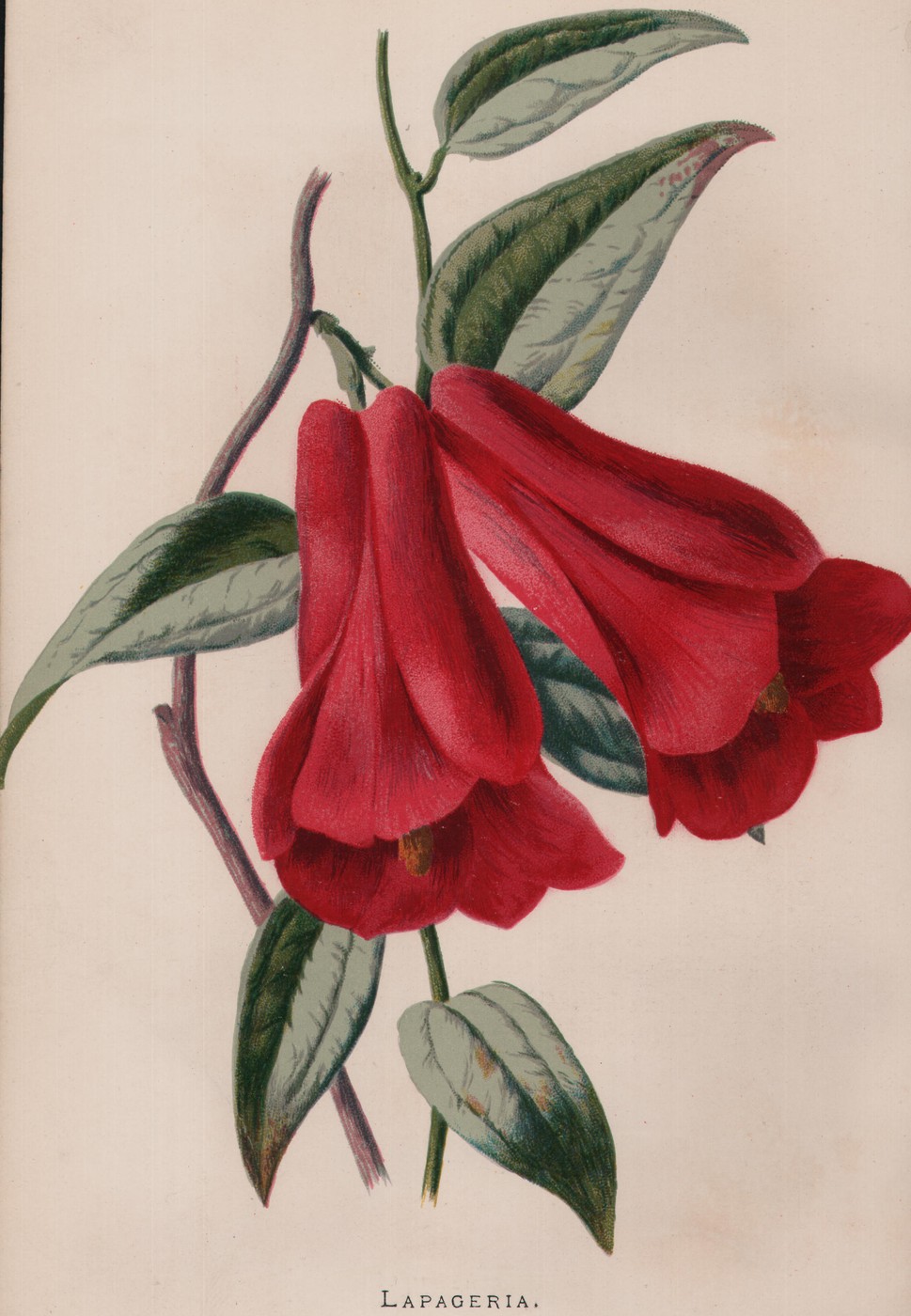
This lily is known in gardens as the scarlet martagon. It is, however, quite distinct from Lilium martagon, which is commonly called the Turk's cap. The last is one of the commonest lilies, but a good border flower for all that, and one that has many forms, as, for example, the pure white and the Dalmatic, the colour of which is blackish-purple. The common variety is of a dull purple colour, by no means attractive, nevertheless pleasing and useful. The scarlet martagon is not common, although easy to cultivate and resplendent in its beauty. In the later days of July it presents a liberal head of turban-shaped flowers of the most brilliant sealing-wax red colour. It is quite hardy, and thrives in any good soil, but is not happy in a calcareous soil nor in one that is of a poor dry nature.
How far east this lily extends we do not know. It is probably scattered through the temperate parts of Southern Asia, for we meet with one very much like it in Japan, the book name of which is L. callosum, less in growth than chalcedonicum, but serving fairly well as a small copy of it. Another nearly related kind is L. carniolicum, of which there are vermilion and yellow varieties.
For the full enjoyment of lilies a considerable extent of garden is necessary, for when many kinds are planted in proximity their several beauties seem to neutralise each other. In isolated clumps and groups, set off by masses of leafy vegetation, these distinct and striking flowers appear to singular advantage. Most delightful is it in a walk through a woodland scene to come upon great clumps of L. auratum, the golden-rayed lily of Japan; or the creamtinted, sometimes buff-coloured, L. testaceum, also known as L. excelsum; or, most noble of all, and least of all understood, L. giganteum, that loves a deep, damp bed of loam or peat, and needs shelter in the spring from the frosts that are then so destructive.
The cultivation of lilies in pots is much practised, and with many special advantages. In large gardens pot lilies are needed for the conservatory and entrance hall; in market gardens they are wanted to supply cut flowers in advance of the season for lilies in the open ground. The amateur who would succeed in growing lilies in pots must observe a few golden rules. In the first place the potting should be completed at the earliest time possible after the plants have flowered, for immediately the flowering is over they begin to make new roots. If the bulbs have to be purchased, therefore, orders should be given early, and the potting should be completed immediately the bulbs come to hand.
Another golden rule is to insure perfect drainage by packing the crooks with care before the compost is put in the pots, for unless surplus water can escape readily, the soil will become sour, and the plants will not prosper. As regards the soil, a mellow hazel loam containing abundance of vegetable fibre, such as loam from rotted turf, will suit any lilies, as will also turfy peat of the best quality. The lovely L. longiflorum is decidedly partial to peat, but will thrive in loam with the rest. A calcareous soil is not good for any of them. Finally, all lilies enjoy liberal watering and abundance of light and air.
The most useful lilies are the following:-L. Browni, with very large trumpet-shaped flowers, white, delicately striped outside with purple. L. auratum, a giant of its race, the flowers expanded, with yellow or red stripes on a white ground. L. candidum, the common white lily, thriving almost anywhere, and yet a little fastidious. L. chalcedonicum, always thriving best in a rich deep loam. L. croceum, good and cheap, very accommodating. L. elegans, usually orange red, but variable, and always useful. L. longiflorum, a lovely trumpet-shaped flower of the purest white; it requires a peaty soil, but is not very particular; in a cold locality a sheltered spot should be selected for it. L. tigrinum, the tiger lily, is very gay, and some varieties flower late; hence the Luareate puts it into the autumn garland: "Heavily hangs the broad sunflower Over its grave in the earth so chilly, Heavily hangs the hollyhock, Heavily hangs the tiger-lily."