Home › Contents › Major Convolvulus
Major Convolvulus
Convolvulus major.
THIS sweet old favourite is best known to botanists as Pharbitis hispida or Ipomoea purpurea; but the garden name of Morning Glory might be sufficient for present purposes, for it is universally understood. The plant was known to Parkinson, who, in 1656, described it as the "greater blew Bindweede, or Bell-flower with round leaves." Linnaeus named it Convolvulus purpureus, under which name it was figured and described in the Botanical Magazine, 1790, tab. 113. In Miller's "Gardeners' Dictionary" it is described as "an annual plant, which grows naturally in Asia and America, but has been long cultivated in English gardens by the title of Convolvulus major. Of this there are three or four lasting varieties; the most common hath a purple flower, but there is one with a white, another with a red, and one with a whitish-blue flower, which hath white seeds." Miller recommends sowing on the open border, "where the plants are designed to remain;" but it is better practice to sow the seeds in pans or pots, and nurse them under glass, so as to be strong and growing when put out in May for flowering. This secures to our subject a longer growing season than it can possibly have when sown in the open ground; and if planted out in rich light soil, it will soon run to ten or twelve feet, and present its lovely flowers in profusion. There is not a finer subject at our command for the study of delicate gradations of colour than this; its shades of red, blue, and purple are unique, and in its beauty of form it will ever surprise us, however familiar we may be with it. In the catalogues of the seed-houses, about a dozen varieties are offered, but they are all to be found in a packet of mixed seed.
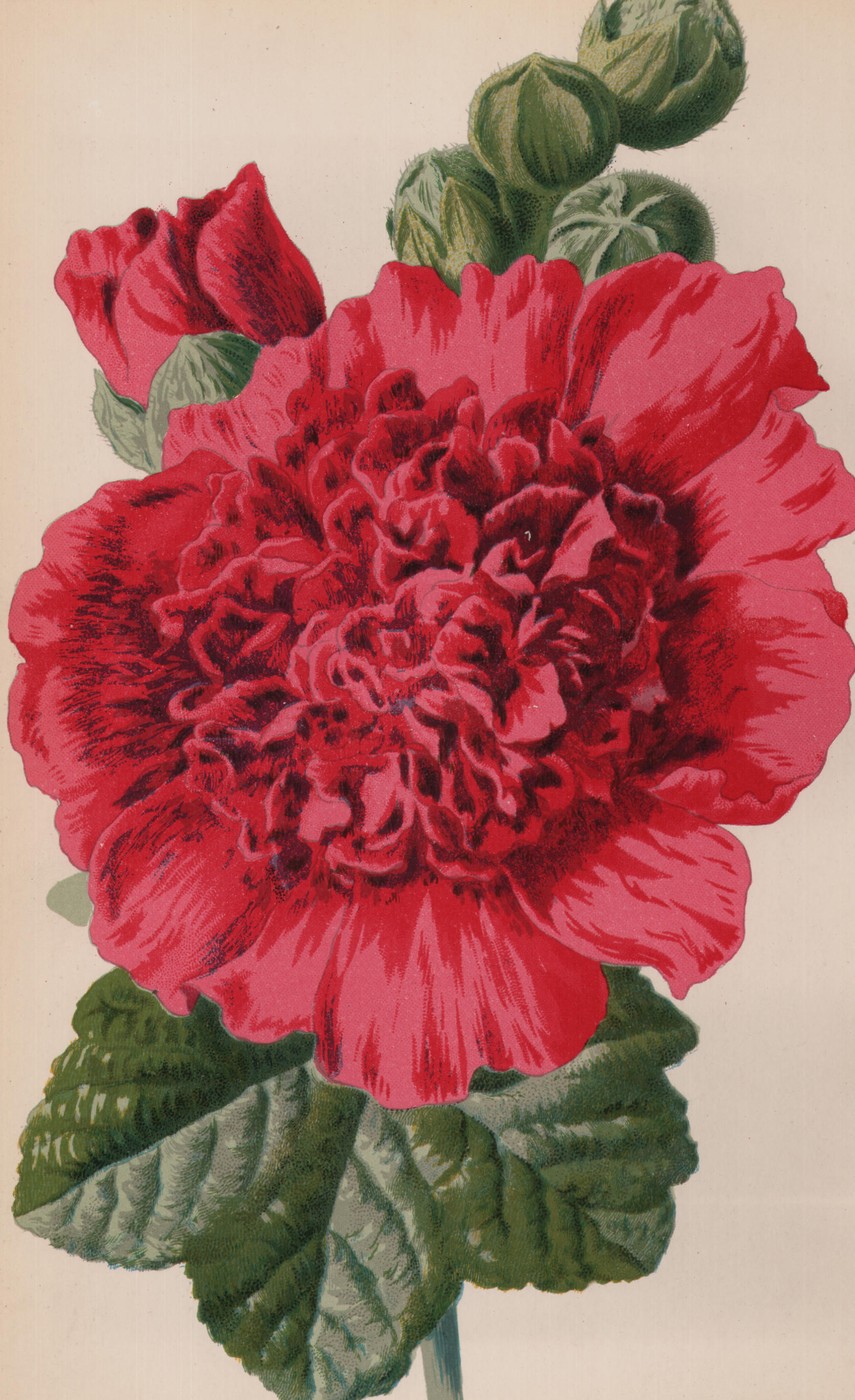
A hardier species of convolvulus is that known as Ipomoea hederacea, or the ivy-leaved pharbitis. The leaves are three to five lobed, the middle lobe ovate--a character peculiar to this species. The usual colour of the flower is deep glossy blue; the petals are rough, with yellowish hairs. This species may be sown on the open border with better prospect of success than the finer and more free-growing plant above described, and both are worth a place in any garden.
A grander plant than either of the foregoing is the red and blue convolvulus (Ipomoea rubro-coerulea), a native of Mexico, introduced about 1823, but not fully recognised until the year 1834, when it was figured in the Botanical Magazine, t. 3,297, from specimens flowered in the garden of John Allcard, Esq., of Stratford Green; Essex. The seeds from which Mr. Allcard's plants were grown were collected by Mr. Samuel Richardson, in the province of Guanaxuato, in Mexico, and were sent over to Mr. Powles, of Stamford Hill, who liberally distributed them.
This fine plant has purple-tinted branches, large cordate pale green leaves, and axillary clusters of flowers, which are most elegantly wreathed in spiral folds of red and white while in bud, but finally open to flowers that are five-lobed, and of a clear pale blue colour, sometimes striped with white. Being raised from seed, and sown in February or March, and carefully grown on in a warm house, the plants may be put out in June in a warm, sheltered situation, and soon after will begin to show their lovely flowers. The minor convolvulus is known as Convolvulus minor and Convolvulus tricolor, the three-coloured convolvulus. This is truly a hardy annual, that may be sown in autumn to stand the winter, or with other annuals in the spring. It forms a beautiful bed when in a sunny position on the north or west side of a house within view from the windows. The fresh flowers that open with the morning will all turn their faces to the south or east, and thus will be seen to peculiar advantage. The combinations of blue, yellow, and white in the flowers afford a rare lesson in colour. There are many varieties, and mixtures are generally preferred. But the finest form is undoubtedly the dark purple; it is truly sumptuous in colour.
A sweet rockery plant is the Mauritanian convolvulus (C, Mauritanicus), of dwarf habit, producing in summer lovely light blue flowers. It is not quite hardy, and must, therefore, be wintered with other tender bedding plants under glass, and planted out again in summer. It is admirably adapted for baskets to suspend in the greenhouse, but is very happy in a sheltered nook in front of the rockery.
There are a few hardy species worth a permanent place in the garden. Convolvulus dahuricus is a fine twining perennial with purple flowers. C. sepium is a grand plant with white flowers, but a dangerous intruder if allowed to run at its own sweet will. C. sylvaticus is a delightful plant to run over a rough bank, and C. scammonia makes a pretty pole plant, full of delicate suggestions for an artist.