Home › Contents › Miniature Mallow
Miniature Mallow
Malva Creeana.
GARDEN mallows afford us suggestion of the place that many mallow-worts occupy in the world of art. They are at once peculiar and beautiful, but they make no special appeal to us until we follow the good old plan of taking some knowledge to school with a view to add to its store, for such as go empty are but too likely to come empty away. We have but few garden mallows; and we may venture to add that the world has not very many. But a certain proportion of them are of great importance to the human race. The marsh-mallow (Althoea officinalis) is known to be emollient and demulcent, but it is not known as an article of food in this country, although in the East it is commonly eaten, and is much valued. The common hollyhock (Althoea rosea) is known for its beauty, but it is of importance as a plant yielding an abundance of fibre and a blue dye equal in quality to the best indigo. The hibiscus is a mallow, and in India is grown for its fibre, which is called "Ambaree hemp." The edible hibiscus (Hibiscus esculentus) is cultivated as an article of food in many of the warmer regions of the earth, and the seeds have been used as a substitute for coffee. The celebrated "pepper-pot" of West Indian cookery owes its peculiar attraction to the seed-pods of this species, which are largely used in preparing it. The sida and the abutilon-genera that may be said to be scarcely distinguishable-are, like so many other mallow-worts, productive of fibre of great strength and the most silky texture. The amateur when enjoying his greenhouse may therefore look to his beautiful abutilons, with their fresh green leaves and bell-shaped flowers, and calculate their money value for the loom or the rope-yard. The consideration need not destroy the poetry, for that can be re-established by studying the relations of the flowers to the true and undoubted mallows. Finally, and omitting many other uses of the mallows, the cotton-plant (Gossypium herbaceum) is a mallow of great beauty, and possessed of a history that has yet to be written. Should the future historian of the plant take notice of these humble pages, he will find here a reminder that may be of some value. It is a fact of peculiar interest, and one that carries a cream of humour in the story that embodies it, that cotton has been grown for the manufacturer in this country, and the fibre proved to be of the highest quality. The wealthy and public-spirited Mr. Sam Mendel, formerly of Manley Hall, Manchester, carried out the experiment, and possesses in the concrete the results of the manufacturing process. The details will be found at length in the Gardeners' Magazine of December 16, 1882.
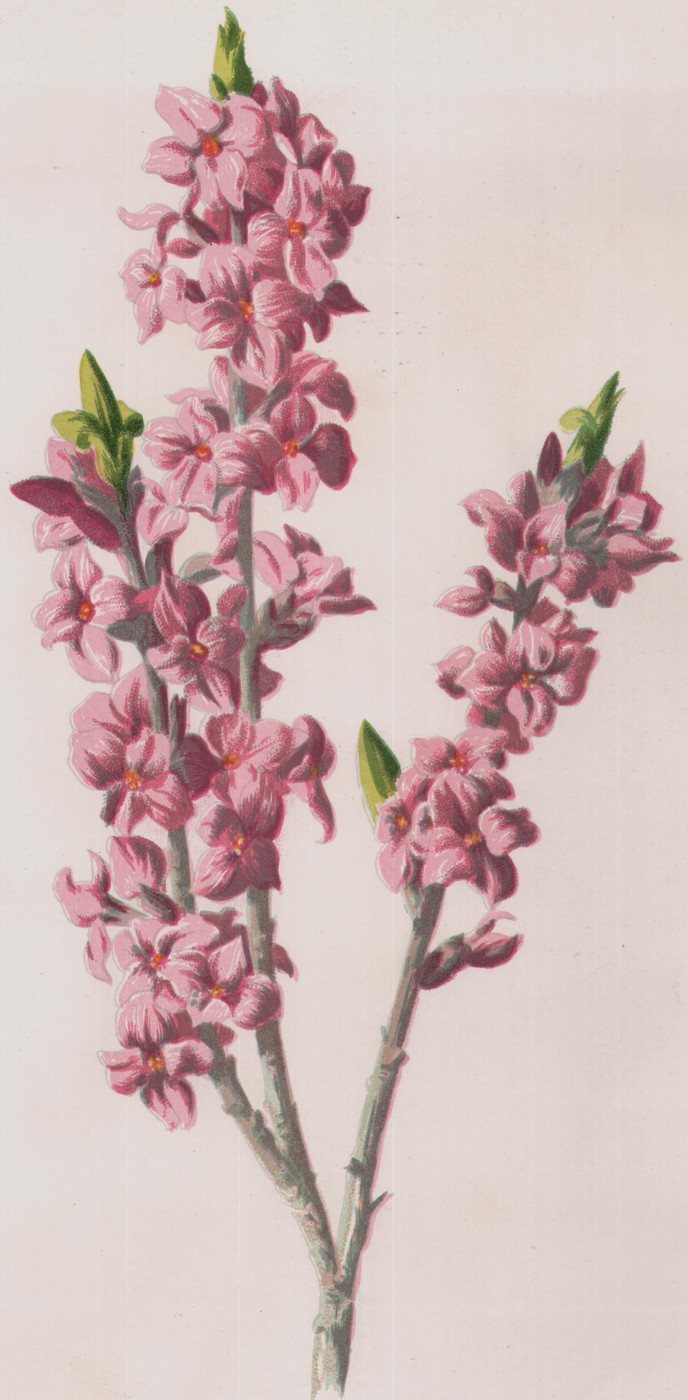
The grandest of the garden mallows are the well-known Lavatera arborea and L. trimestris. These are beautiful plants, the first-named being the bold tree-mallow which is so often seen near the sea-coast-a plant occasionally grown as fodder for cattle. There has been lately introduced to cultivation a fine variety with variegated leaves, which makes a stately figure in the flower-garden. Our pretty musk-mallow (Malva moschata) is perhaps the best of the native species, because of its neat habit; but the wild and daring woodland mallow (M. sylvestris) and the round-leaved sprawling mallow (M. rotundifolia) are, as wildings, glorious, and quite admissible to the sunny parts of a wild garden, to make bold blotches of colour amongst the rougher kinds of herbage. To recommend them for the flower garden proper would be as flagrant a violation of good taste as the introduction of a Bornean cannibal in his costume at an "at home" in a fashionable drawing-room. Plants of smaller growth and with various pleasing features are to be found in this family. Malva mauritanica, M. lateritia, and M. crispa constitute a group of useful border and rockery plants. M. divaricata, miniata, and Creeana are beautiful examples of typical mallows, of smallish growth, producing beautiful flowers, but of doubtful hardiness. The bell-flowered mallow (M. campanulata) and Moren's mallow (M. Morenii) are much to be desired for the rock garden, being hardy, showy, and of free growth. They need a well-drained soil and a sunny situation, and having these aids, will take care of themselves. To raise plants of any of the foregoing, the simplest method is by means of seeds. These should be sown in pans or boxes in the spring, and have the shelter of a frame until the plants are somewhat advanced, after which time the ordinary treatment of seedling herbaceous plants is all they require. But they may be raised with facility from cuttings, which should be made from the young shoots when these are nearly full grown. If planted firmly in sandy soil, and covered with a hand-light, the cuttings will soon make roots, and with a little care may be grown to a useful size for planting out. The plant figured was raised by Mr. George Penny, of Milford, who named it in honour of his friend Mr. Cree, of the Addlestone Nursery. It is nearly related to Malva miniata, and equally so, perhaps, to M. divaricata. It is a suitable plant for a sunny part of a rockery, and to insure keeping it a few surplus plants should be raised annually and wintered in a frame for planting out. Its place in the Botanical Magazine is t. 3698.