Home › Contents › Scarlet Geranium
Scarlet Geranium
Pelargonium zonale.
IT is to be hoped no savage botanist will behold this page, for it is a great sin against botanical propriety to label the flower before us "geranium," for a true geranium is something very different. All the showy plants of this class that are so highly prized in gardens are pelargoniums, or stork's-bills, the seed-vessels just before they begin to separate bearing some resemblance to the bill of a stork. The pelargoniums are, for the most part, natives of the Cape of Good Hope. They are shrubby in habit, but never attain to the dignity of trees, and they are distinguished by the irregularity of their flowers, the petals of which are never, or but rarely, of equal size throughout. The geraniums are mostly herbs of Europe, and a certain few of their number are conspicuous amongst the wild flowers of Britain, the merry little herb Robert of the mountains (Geranium Robertianum) and the sedate but lovely blue geranium of the valleys (Geranium pratense) being notable examples familiar to every wayside botanist. The generic name implies that the cluster of seeds when about to separate represents a crane's-bill, and a common name of the herb Robert is "Robert-leaved crane's-bill." There is another group classed under the generic term Erodium, the heron's bill, and the best-known plant of this genus is the hemlock-leaved heron's-bill (Erodium cicutarium), a sweet little thing bearing a near resemblance to the herb Robert. It must be understood, therefore, that our ordinary talk about geraniums refers to pelargoniums, and it will be waste of time to fight a battle in defence of the misuse of the term geranium, because the botanists have settled the matter, and there is no court of appeal against them. The pelargoniums of our gardens are seen by the most casual observer to be divisible into two great classes. One class may be considered to have for a centre the (perhaps) apocryphal Pelargonium speciosum. This group has green leaves that are much wrinkled and deeply notched, and large flowers that are sometimes spotted on all the five petals, but usually the two top petals alone are spotted, and these often are heavily and richly blotched with black, maroon, or crimson. The other class comprehends the plants familiarly called "zonals," the central species being Pelargonium zonale, a somewhat ugly thing, with coarse leaves that are distinctly zoned, and flowers that are distinguished by the narrowness of the petals, so that they are properly, though perhaps disrespectfully, spoken of as "windmills."
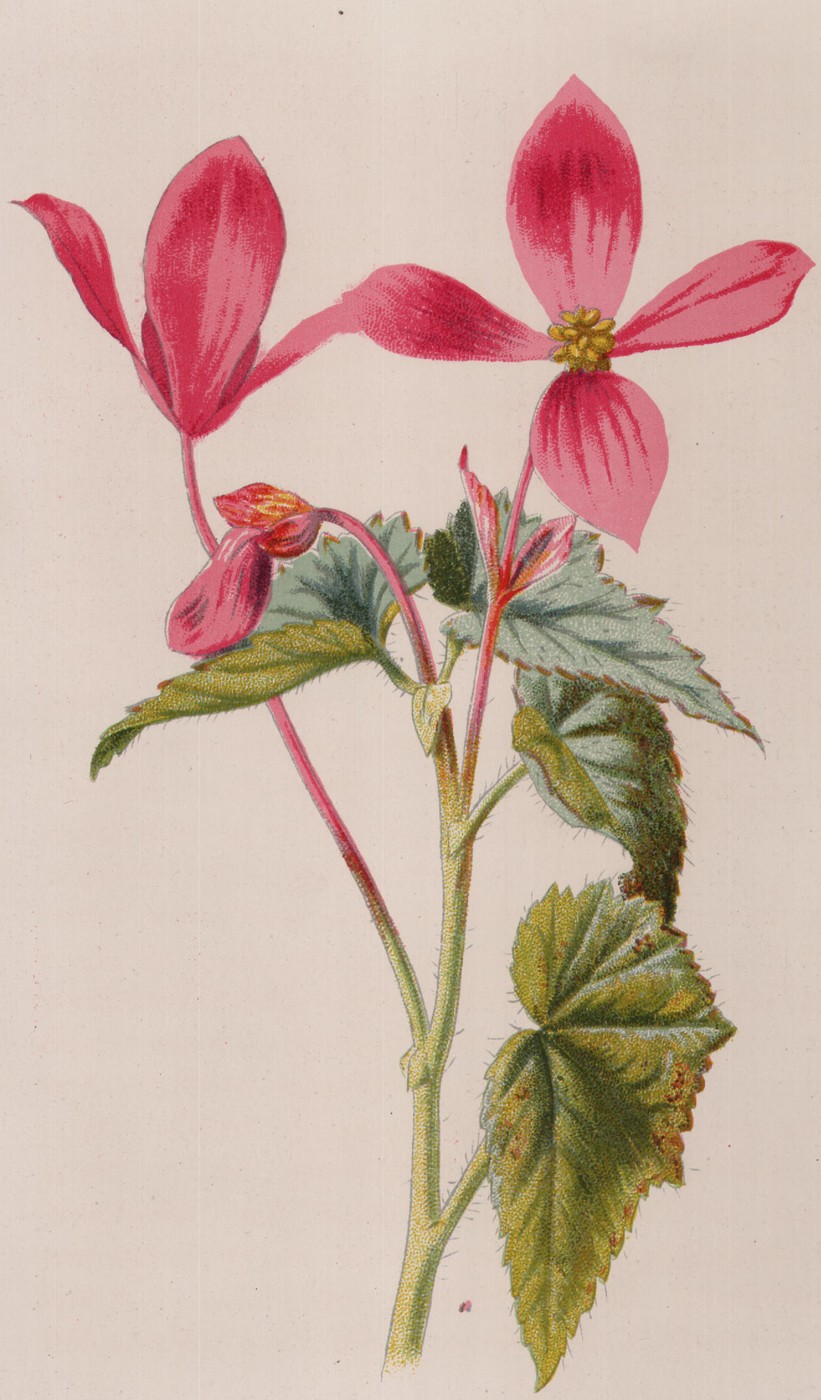
This possible parent of the zonale group was introduced from the Cape in the year 1710, but many years elapsed ere the florists took it in hand for the purpose of improving it for horticultural purposes. The results, however, of their more recent labours are really amongst the wonders of invention, and illustrate in the most striking manner the doctrines of evolution that are now generally accepted by men of science. A pelargonium is distinguished by one conspicuous sign, as well as by many that are inconspicuous. The petals are never of the same size, and usually the two topmost are much larger than the other three. But the florists have aimed at the obliteration of this distinguishing character, perfect symmetry being one of their main requirements in a flower of this kind; and they have succeeded in enlarging the lower petals so that they equal those above them in size, and they have also caused the flower to fill out, so that in place of the windmill we have a close disc, the petals being so broad as to overlap, and so smooth and equal that the flower rather appears to be formed of one piece than of five separate pieces, that were formerly separate and visibly independent. We will not discuss the propriety of the proceeding, but declare ourselves as altogether in favour of the florists' work, and being in no way ashamed to confess that we have played our part in the performance, and secured very many splendid varieties of zonals, with smooth, circular flowers, formed of stout over-lapping petals, so symmetrical and compact as to suggest to the casual eye a perfect disc of one piece only.
The cultivation of the zonals is pretty well understood, and the plants are so accommodating that they submit to the most diverse conditions, save that five degrees of frost is the utmost in the way of cold that they can endure. But they love sunshine, though they never need a rich soil, and any excess of moisture at any time of the year causes the leaves to become spotted, the growth rank, and the flowers few, while continued damp in winter is fully as fatal as frost to them. The high delight of the amateur who has taken in hand this class of plants for special treatment is to be found in the raising of seedlings. Oh, it is a rare pleasure to see a house full of seedlings just beginning to declare themselves in their first flowers as candidates for fame--or for the rubbish-heap! And to raise seedlings is an easy matter. The simplest mode of procedure is to take seed from the very best sorts that can be obtained, and sow it in a gentle heat in the month of March. The plants may be pricked off into thumb-pots, and afterwards, when large enough, be potted into 60 size, and again potted on into 48 size. The proper soil for them is a sweet, sandy loam, and all the better if from old meadow turf that has been laid up a year to break down the fibre; but any fairly good soil will answer with a liberal admixture of sand. If the management is good, some of them will show their flowers within a hundred days from the date of sowing the seed.