Home › Contents › The Hawkweed
The Hawkweed
Hieracium aurantiacum.
IN the first substantial book of botany in the English language--the "Herbal" of William Turner, 1568--the hawkweed is admitted to the high dignity of affording a problem in nomenclature. The older botanists were so ready at all times to believe anything, that it is quite amusing to find Turner saying, "I can not gesse why this herbe shoulde have the name of a hawke, seing other herbes have the same properties that this hath." But it suggests to us that Englishmen were beginning to think for themselves in the reign of Elizabeth, and the way was fast preparing for that true science whereof the great Lord Bacon was destined to speak as a prophet and to act as a master. However, to keep to Turner for a moment, and forget all that happened after him, he comforts us with a bit of philosophical etymology. He says the hawkweed probably takes its name "from the downe that groweth in the toppe after the flowers be gone," these feathery seeds being "good to be taken of the hawke, to make him cast his gorge wyth it." That it should be good against "the stingginge of a scorpion" does not aid us in the study of the etymology, because the old botanists regarded almost every weed that grew to be a "sovereign remedie" against scorpions and other "venomous beastes." The plant here figured is the best of the hawkweeds for the garden, as it is a perennial, quite hardy, and its orange-coloured blossoms appear at a time when flowers of that colour are scarce, for yellow tones belong rather to spring and autumn than to high summer, when this is at its best. It is a native of Southern Europe, but is occasionally met with in the woods of England and Scotland, as the sweet mignonette, the Eschscholtzia, and the umbellate candytuft are met with, as escapes from gardens. It is sufficiently common, indeed, to have obtained a familiar name, for in the rural garland it is called Grim the Collier, because of the black stains that appear at the base of the hairs on the stem and involucre. There was a comedy of the same name in high popularity in the time of Queen Elizabeth, from which it may be inferred that "Grim" was a kind of generic name for a black fellow, who perhaps in the present day would be called a "coaley."
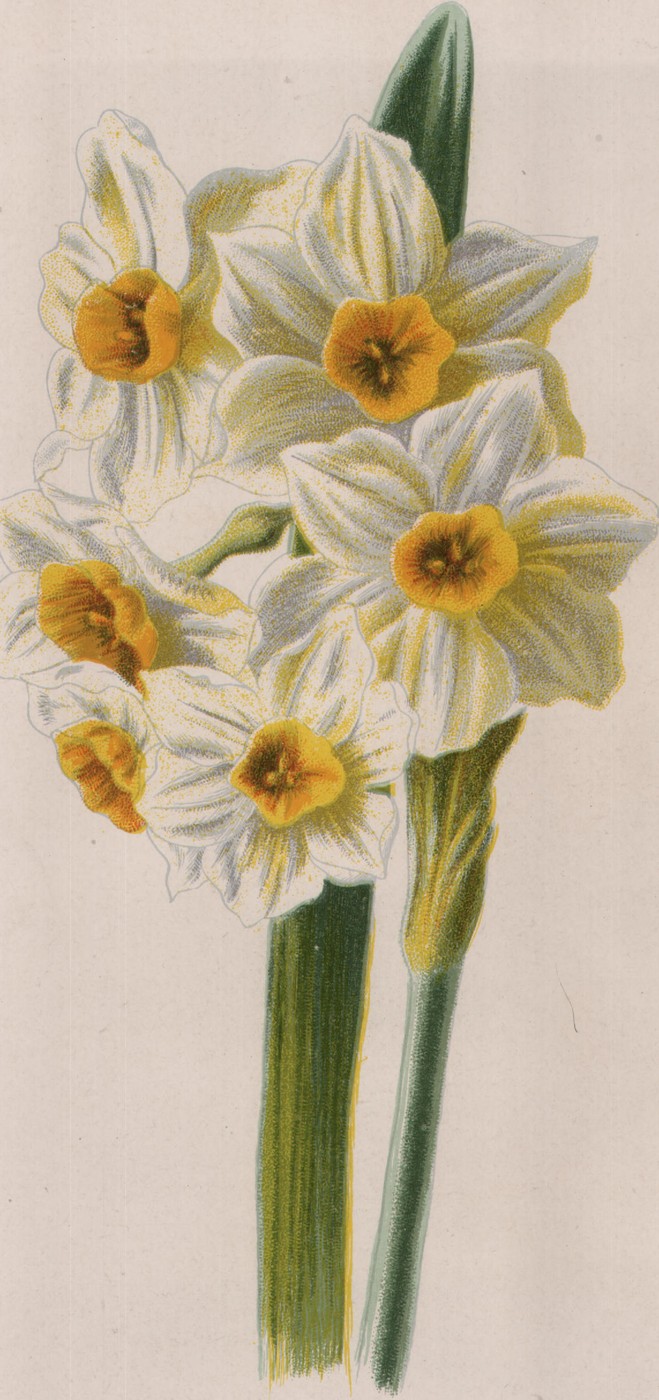
Amongst the annual hawkweeds, the best are the red hawkweed (Crepis rubra), the flowers of which are reddish-purple, and the yellow hawkweed (Tolpis barbata), with pale yellow flowers, which are purple in the centre. Of both these there are white varieties, making four sorts in all, the seeds of which should be sown where the plants are to remain, as they do not thrive when transplanted. As regards culture, any soil will suit them, and if sown on a sunny border in the month of March, they will take care of themselves entirely; but it will be prudent to thin out the clumps, for crowded plants never prosper.
The yellow hawkweed appears to throw a light on the origin of the name hawkweed, although its own botanical name of Tolpis has never been explained. The flower, with its yellow rays and dark disc, may be likened to an eye, and the eye of the hawk is proverbial for its keenness. We have but to suppose the hawk resorted to this flower to sharpen his vision, and the explanation is secured. To be sure, a supposition is but a supposition. But that is just the way the ancients made names for familiar things; they had little philosophy, but plenty of fancy, and when reason did not guide, analogy deluded them. About nine-tenths of the ancient names of animals and plants are founded on the flimsiest of fancies.
The larger kinds of wild hawkweeds are often mistaken for dandelions, but they differ in many respects, and they flower later, and are less gaudy in their colouring. The smaller kinds, such as the mouse-ear hawkweed, are neat and pretty, but they do not attract notice as do such kinds as the honey-wort hawkweed and the wall hawkweed. These are so abundant on dry banks and ruins and healthy spots in the later days of summer, as to make a fair semblance of flower-beds in many waste places. They congregate on gravelly soils, as the poppies do in the cornfields, and contribute greatly to the enjoyment of the wandering botanist. As compared with the dandelion (Leontodon taraxacum), the "sunflower of the spring," they lack its splendour, and are less conspicuous. Nevertheless, the lines of Lowell on the earlier and more familiar flower may be properly quoted here as a tail-piece to this miniature essay:-- "Dear common flower that grow'st beside the way, Fringing the dusty road with harmless gold-- First pledge of blithesome May, Which children pluck, and full of pride uphold, High-hearted buccaneers, o'erjoy'd that they An El Dorado in the grass have found, Which not the rich earth's ample round May match in wealth--thou art more dear to me Than all the prouder summer blooms may be. "Gold such as thine ne'er drew the Spanish prow Through the primeval hush of Indian seas, Nor wrinkled the lean brow Of age to rob the lover's heart of ease; 'Tis the spring's largess which she scatters now To rich and poor alike with lavish hand, Though most hearts never understand To take it at God's value, and pass by The open'd wealth with unrewarded eye."