Home › Contents › The Pelargonium
The Pelargonium
Pelargonium speciosum.
THE large-flowered pelargoniums, with lobed and wrinkled leaves, are usually described as hybrid forms of Pelargonium speciosum, but it would be a rash proceeding to insist on tracing all our "show," "fancy," "spotted," and "regal" pelargoniums to any one species. Indeed, it is a question now whether, of the so-called species described and figured by Sweet, Andrews, and other authors, as many as one-tenth of the whole can be considered entitled to specific distinctions. Pelargonium speciosum, as flowered about the year 1790, and figured in the "Monograph of Geraniums" by Andrews, has in it the making of a grand greenhouse flower. But in such pelargoniums as we now cultivate there are characters we could not hope to obtain from it; and in turning over portraits of pelargoniums, and, still better, in examining a collection of Cape species, we shall find a dozen or two that have as much "making" in them, and that have, beyond all reasonable doubt, contributed their characters to the collective flower we call a pelargonium. If we had to make a selection from the five hundred species and varieties figured by Sweet in his "Geraniaceae," we should lean to P. solubile and P. beaufortianum as likely to have contributed in an important degree to the fashioning of the florist's flower, because of the distinct lobing of the leaves, the breadth of their petals, and their tendency to variation of colour.
Those who are curious as to the history of the pelargonium may be advised to make a careful inspection of the extensive and beautiful collection of Cape species in the possession of the Royal Horticultural Society, in their experimental garden at Chiswick. The more distinctive and showy of these have hitherto been annually presented to public notice in connection with the exhibitions of the Pelargonium Society, and have been greatly admired. The difference between them and the magnificent flowers of the florists is so great that it seems impossible there should be any relation between them of any kind whatever. And yet the unpretending wildings, in many instances, are the real parents of the resplendent varieties that bear the names of heroes, horses, statesmen, ladies, actors, and eminent horticulturists, to distinguish them in the competitions that give life to flower-shows. Not often do we in a floral fete have presented to our view at one and the same time the wild flowers of the desert and their descendants of the garden; and this particular feature of the annual exhibition of the Pelargonium Society may be regarded as unique.
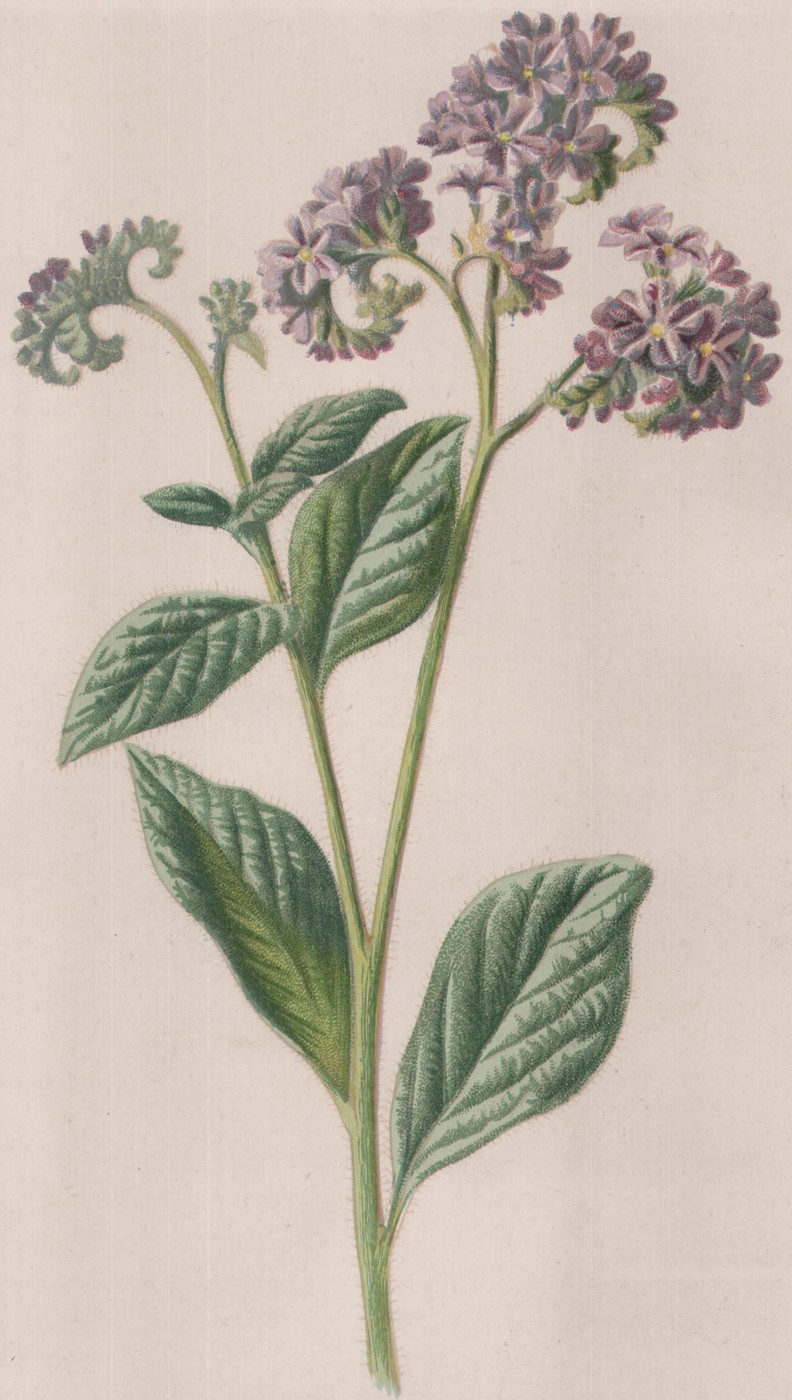
As classified for exhibition purposes, there are six kinds of pelargoniums, but for our present purpose we may consider there are but three--namely, the show varieties, supposedly descendants of P. speciosum; the zoned, descended from P. zonale; and the ivy-leaved, descended from P. lateripes. The flower figured belongs to the first of these three classes, but would not pass muster at an exhibition, being much more of an artist's than a florist's flower, or such as the florist might regard as a "market flower," because adapted for universal appreciation.
The cultivation of these pelargoniums is a less easy matter than that of the zonales, for they are more tender in constitution, and more liable to injury by the assaults of the insect pests that for ever and everywhere haunt the gardener. A somewhat light but substantial loamy soil is required, and the pots must be drained with extra care, for the slightest lodgment of excessive moisture will injure the health of the plants. None but an expert should employ what is understood as a "rich" soil, or should use any kind of liquid manure; for, unless these aids to development are very judiciously used, they produce a disease called "spot," which is likely to destroy the plants, and is certain to ruin the bloom for at least one season. The plant-house in which they are kept should be light and airy, and through-out the winter the temperature should be considerably above the freezing-point. Therefore a temperature of, say, 35 degree, which the zonales endure without harm, if somewhat dry, will be too low for these, the winter minimum for which should be about 40 degree until the turn of the year, and then, as the days lengthen, a rise to 50 degree is required. In the winter management the greatest care is required in respect of watering, for damp is as destructive as frost, and the two combined will soon make an end of the finest plants, no matter how robust they may have been up to the moment when these enemies entered the field. The summer management comprises plentiful watering in proportion to growth and temperature, free ventilation, exposure to the fullest daylight (yet with a little shade from the fiercest glare of the sun), and, after flowering, a moderate pruning, and, some three weeks afterwards, re-potting for the next year's growth. On the subject of training it is not necessary to speak, as that, to use the language of the day, is a "matter of taste." At the Pelargonium Exhibition of 1882 a place of high honour was given to a group of plants that had never been trained in any way whatever; and the judges, being men of true taste, though practitioners of conventional training, made note of the peculiar beauty of plants well grown in their "natural form!" It may be proper to advise the inexperienced amateur that frequent or even occasional wetting of the leaves of pelargoniums is to be deprecated as injurious. As a rule, rough and hairy leaves should never be wetted, but smooth leaves are often much benefited by the process.