Home › Contents › Yellow Heath
Yellow Heath
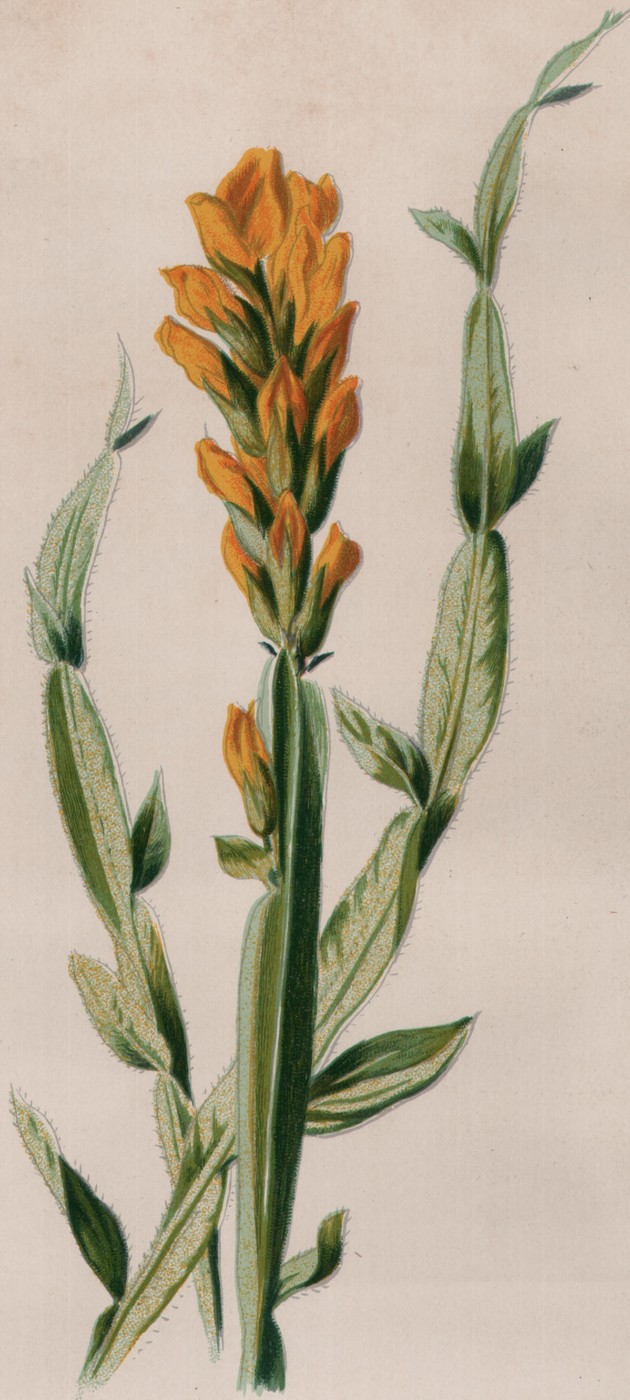
Erica Carendishiana.
ERICA Carendishiana derives its name from having been formerly known as the "Duke of Devonshire's golden heath." Its history is involved in some obscurity. It came into being anterior to the days of illustrated horticultural periodicals, and therefore obtained less attention than such a fine plant would have attracted at the present day on first appearing as a novelty. It was raised by the Messrs. Rollison and Sons, of the celebrated Tooting Nurseries, by fertilising the flowers of Erica depressa with the pollen of E. Patersoni. Both these have yellow flowers, and the Cavendish hybrid is a finer plant than either of them, and particularly well adapted for specimen cultivation. In the times that are spoken of as the "palmy days of Chiswick," the Cavendish heath was eminently fashionable, and Mr. Fairbairn, of Clapham, used to exhibit enormous specimens in a wondrous state of health and beauty. But even in these degenerate days we occasionally see it in perfect trim as a specimen plant, among the most successful cultivators of recent years being Mr. Thomas Baines, formerly of Bowdon, and Messrs. Cole, of Withington. At the present time among the ablest men in handling the plant are Mr. Cypher, of Cheltenham, and Mr. Tudgey, of Waltham. Between the growing of gigantic specimens, and the neat little plants that suit an amateur's greenhouse, there is considerable difference. A collection of heaths may be formed and kept at little expense, and to speak the truth about them, they are very easy to grow, and also very easy to kill; and the failures that occur usually represent a waste of delicate attentions. When housed with bedding plants and kept warm and close all the winter, and liberally and frequently watered, they die and do not come to life again. They belong to the more breezy and bracing climates of the Cape, and in cultivation require free ventilation, very moderate allowances of water, abundance of light, and to be guarded against all extremes of heat, cold, drought, and humidity. The men who succeed best with heaths group them in airy spacious houses with other plants of like character, such as hedaromas and epacrises, and other "hard-wooded plants." But a considerable proportion of the Cape heaths are so nearly hardy that, with ordinary care, a brick pit without any fire-heat will suffice for their safe wintering. The great point is to protect them from damp, towards effecting which perfect cleanliness and systematic ventilation will contribute in the most direct manner. It is likely that many have failed with these plants through over-solicitude in respect of the best soil for them. They will certainly not live in lumpy clay or any calcareous soil. But they are not so particular as is commonly supposed. They like rough sandy peat, pebbles, broken flower-pots, and are not particular as to gravel if it is a little loamy or peaty, and not pasty or loaded with salts of iron.
Heaths are propagated by cuttings, which should consist of short lengths of the young wood removed when nearly but not quite ripe. These are planted in pots or pans, carefully drained and filled with a mixture of about one part of peat to four parts of clean silver sand, with a surfacing of half an inch of sand only. When planted and watered the pans are covered with bell-glasses and shut up rather close in a frame or in some rather dark corner of the greenhouse, and are disturbed as little as possible until the cuttings show by their new growth that they are rooted. But the bell-glasses must be taken off occasionally and wiped dry on the inside and replaced. This process insures to the cuttings a little air periodically, and prevents death by damping. A beginner in propagating must not expect complete success, for it is a business demanding much skill, and the best directions are of only general value; the school of practice alone can teach effectually.
The following ericas are named as suitable to form an interesting collection for a beginner, as they are amongst the most useful and least troublesome of their beautiful family--Hyemalis, Willmoreana, Persoluta, Rubens, and Sindryana, for winter flowers; Florida, Cavendishiana, Exquisita, and Aristata, for flowering in the spring; Irbyana, Jacksoni, and Retorla major, for the summer; Depressa, Austiniana, and Tortiliflora, for the autumn. They do not flower at the same time from year to year; they observe what may be called general rather than particular seasons, and hence where there is anything like a collection spring-flowering kinds will be found to flower in autumn, and some few will be nearly always in bloom. The splendour of the Cape heaths does not diminish our regard for those beauties of the moorland that our native ericas so bravely represent. As the poet writes:-- "The erica here, That o'er the Caledonian hills sublime Spreads its dark mantle, where the bees delight To seek their purest honey, flourishes, Sometimes with bells like amethysts, and then Paler, and shaded like the maiden's cheek With gradual blushes."