Important: Safety Warning
This page recommends pest-control substances such as arsenic compounds, strychnine, or cyanide — in some cases applied to food crops. These substances are lethal to humans and animals, and their use is now banned or strictly controlled.
This information has been left in for historical purposes but should not be acted upon.
Home › Introduction › Introduction: Queen of Flowers
Introduction: Queen of Flowers
Since history was first written the rose has been associated with the most important events in the life of man. For centuries it has been fully recognized as the Queen of Flowers, honored alike by poet and king. Yet such varieties as Columbia, Duchess of Wellington, and Frau Karl Druschki, the ancients never knew! Why, then, should not you and yours share in the pleasures of the twentieth-century roses, to your own enjoyment and to the advantage of those around you? Just a little garden of these modern wellbred roses; just a little daily, loving care; just a little cost; and the result to you and your neighbors will be the glory of the Queen of Flowers. & The Glory of the Queen of Flowers * AND HOW TO ARRANGE THEM Establishing Ideals First consider what kind of rose-garden you will plan. Roses seem to enjoy being arranged in countless ways. Will the first show of bloom to burst into view, as one approaches your home, be on your pergola, or arbor, or rose-covered summer-house? If none of these furnishes appropriate setting, probably your banks or fences will be clothed or beautified. A variety of types, shown on the following pages, is available, and choosing from these will become a delight. Perhaps your fancy may picture prosperous beds, abounding in a wealth of bloom, to be seen across a sweep of level lawn, or from your favorite room in the house, or even hidden beyond the curve in your garden-walk.
The formal rose-garden, too, is important, especially on the larger place. There are excellent reasons why the rose-garden should have a domain all its own. These fastidious creatures that so well repay your thoughtful care may well be grouped and with greater resulting effectiveness. In no other case, perhaps, does careful planning pay so well as in the formal garden.
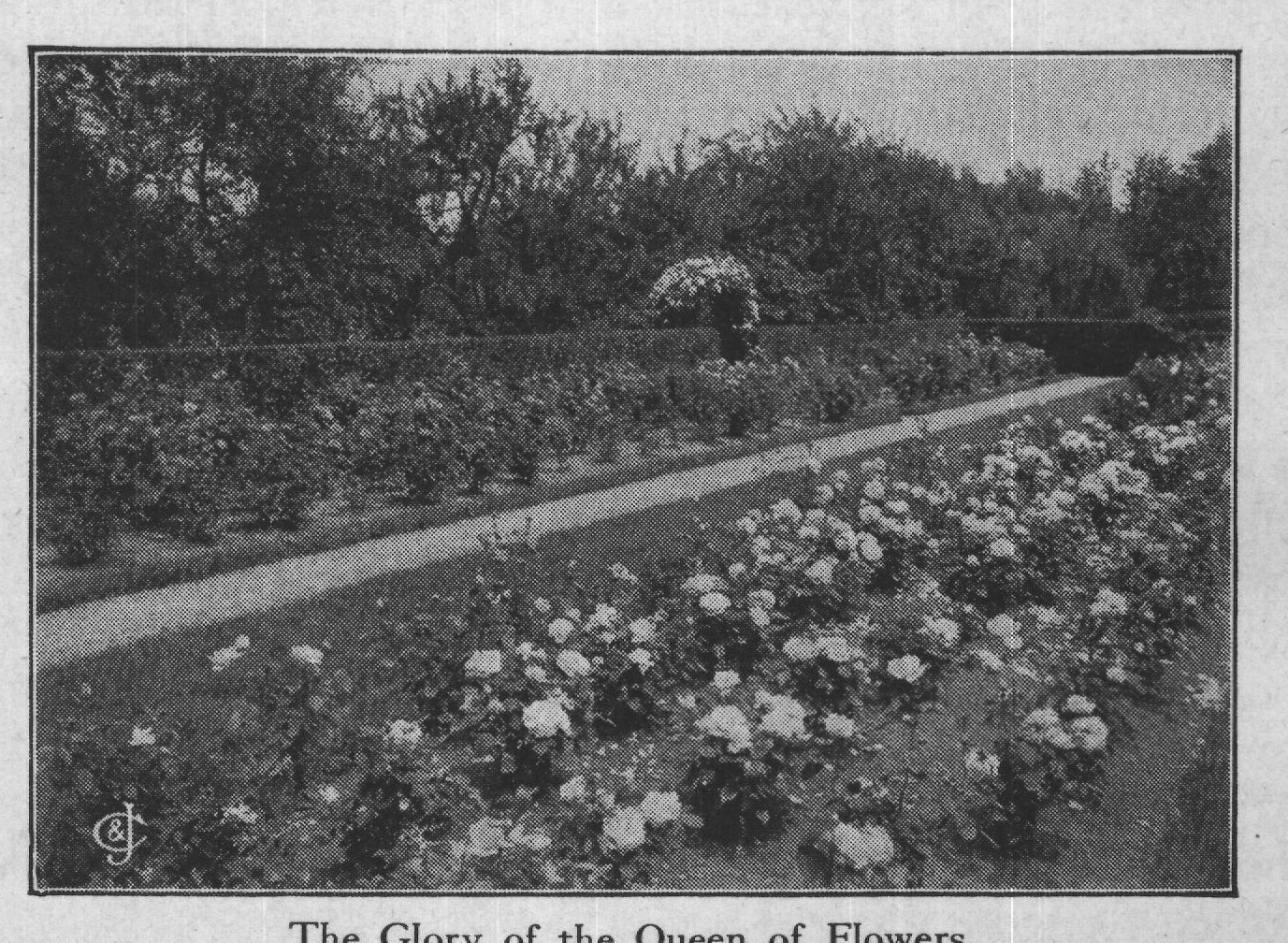
In these brief suggestions of rose-garden possibilities let us recall vividly the value of the rose in the landscape. Here again a knowledge of varieties is important. Landscape architects are recognizing more and more the noteworthy species which are valuable in mass-plantings for showy effects, for retaining embankments, for bordering driveways, or even for certain types of hedges.
Or you may wish most for a garden of roses from which to cut bouquets, so that “the Glory of the Garden" may be reflected in your home. "Good taste" will suggest the right roses-one for this vase, a bunch for that bowl, a spray for the guest-room, still others for the hallway or the diningroom table, then surely some for boutonnieres, and at times for "state occasions." Surely anyone who has experienced the exquisite thrill welling up in the soul from the presence of choice roses well arranged will be eager to develop the skill needed to make the best use of Nature's garden-gifts. The Rose-Lover's Calendar of Operations These dates will be found relatively correct for the average season in the latitude of Philadelphia. If you live north or south, make the usual allowance of about four days for every 100 miles of latitude. Comparative altitude must also be taken into consideration. The seasons vary; for example, the ground may be in good condition and ready for digging as much as three weeks earlier one year than it will be the following spring.
March 15. Such hardy roses as are already planted should ncw be pruned.
March 25 to 30.-As soon as the ground can be well worked, plant new hardy roses which are to be had dormant. Prune these even more closely than older established bushes.
April 10.-Less hardy roses, including the Everblooming class, should be pruned. Begin to remove the winter protection as the increasing heat of the sun permits. April 15.-Roses are not immune from mildew and other fungoid contagious diseases; therefore it pays at this time to spray with bordeaux mixture all your rose plants as well as nearby fruit trees and grape-vines. April 25 to 30.-Finish uncovering and pruning your roses. Plant new ones (now or until the middle of May). A slight shading of these from the sun will prove an advantage.
May 1 to 10. As soon as plants are well set with foliage, a spraying with a solution of nicotine or sulpho-tobacco soap will act as a preventive against aphides (green fly). May 20. As soon as buds begin to swell, weak manure-water may be applied to the plants. Spray again to kill off the aphides, otherwise they will multiply with amazing speed.