Home › Contents › B. Trees for Street and Specimen Planting
B. Trees for Street and Specimen Planting
a.
Northern list: This group of trees covers material which can be used throughout northern Florida, southern Georgia, Alabama, and over the area which is known as the Coastal Plain. In general, this list does not extend into Florida farther than one hundred miles south of Jacksonville. Trees in this group which are marked thus (+) are also adapted for street tree and specimen planting in the southern portion of Florida as shown on the accompanying list: Acer rubrum Red Maple Albizzia julibrissin Mimosa Broussonetia papyrifera Paper Mulberry Cedrus deodara Deodar Cedrus libani Cedar of Lebanon Celtis occidentalis Nettle Tree +Cercis canadensis Red-bud +Cornus florida Flowering Dogwood Cunninghamia sinensis Chinese Pine Gordonia lasianthus Loblolly Bay Ilex opaca American Holly Liquidambar styraciflua Sweet Gum +Magnolia grandiflora Magnolia Melia azedarach umbraculiformis Umbrella Tree +Quercus laurifolia Laurel Oak Quercus nigra Water Oak Quercus phellos Willow Oak Quercus virginiana Live Oak Ulmus americana American Elm b. Southern list: This group of trees, together with those which are marked thus (+) in the previous list, are adapted especially for street planting throughout the southern and middle section of Florida. Those marked (*) are the more commonly used and perhaps the better types for street tree planting.
Adenanthera pavonina Circassian Bean Albizzia lebbek (T) Woman's Tongue Tree Aleurites triloba Candle-nut Araucaria excelsa (T) Norfolk Island Pine Bauhinia (in variety) (T) Mountain Ebony Bombax ceiba Silk Cotton Tree Callitris robusta Cypress Pine Calophyllum calaba Calaba Tree Canangium odoratum Ylang-Ylang Cassia fistula Yellow Cassia *Casuarina equisetifolia Australian Pine Cedrela odorata West Indian Cedar Cinnamomum camphora Camphor Tree *Cocos plumosa Cocoanut Palm Cryptomeria japonica Japanese Cedar Delonix regia (T) Royal Poinciana Ficus nitida Indian Laurel Ficus species (T) Rubber and Fig Trees Gordonia lasianthus Loblolly Bay *Grevillea robusta (T) Silk Oak Ilex specimens, especially Ilex opaca American Holly Libocedrus decurrens Incense Cedar Mangifera indica Mango Sabal palmetto Cabbage Palmetto *Washingtonia robusta California Fan Palm C. VINES. The first part of this group consists of those vines which are commonly known as scrambling vines and which must be provided with a definite support on which they can twine or to which tendrils can attach themselves in order to maintain their upright habit of growth. Most of the vines which are interesting in the north are of great value in Florida planting. There is also an extensive list of vines which will not grow in the northern climates, but which are valuable in Florida. Those which are marked thus (+) are very interesting for Florida planting on account of their habit of producing flowers during the winter months. The second part of this group is composed of vines which can be used for covering bare wall surfaces and which will naturally attach themselves to walls of brick, stone, or concrete. These vines are of the evergreen type of foliage and are of value only for their foliage effect./ a.
Lattices and wire fences:
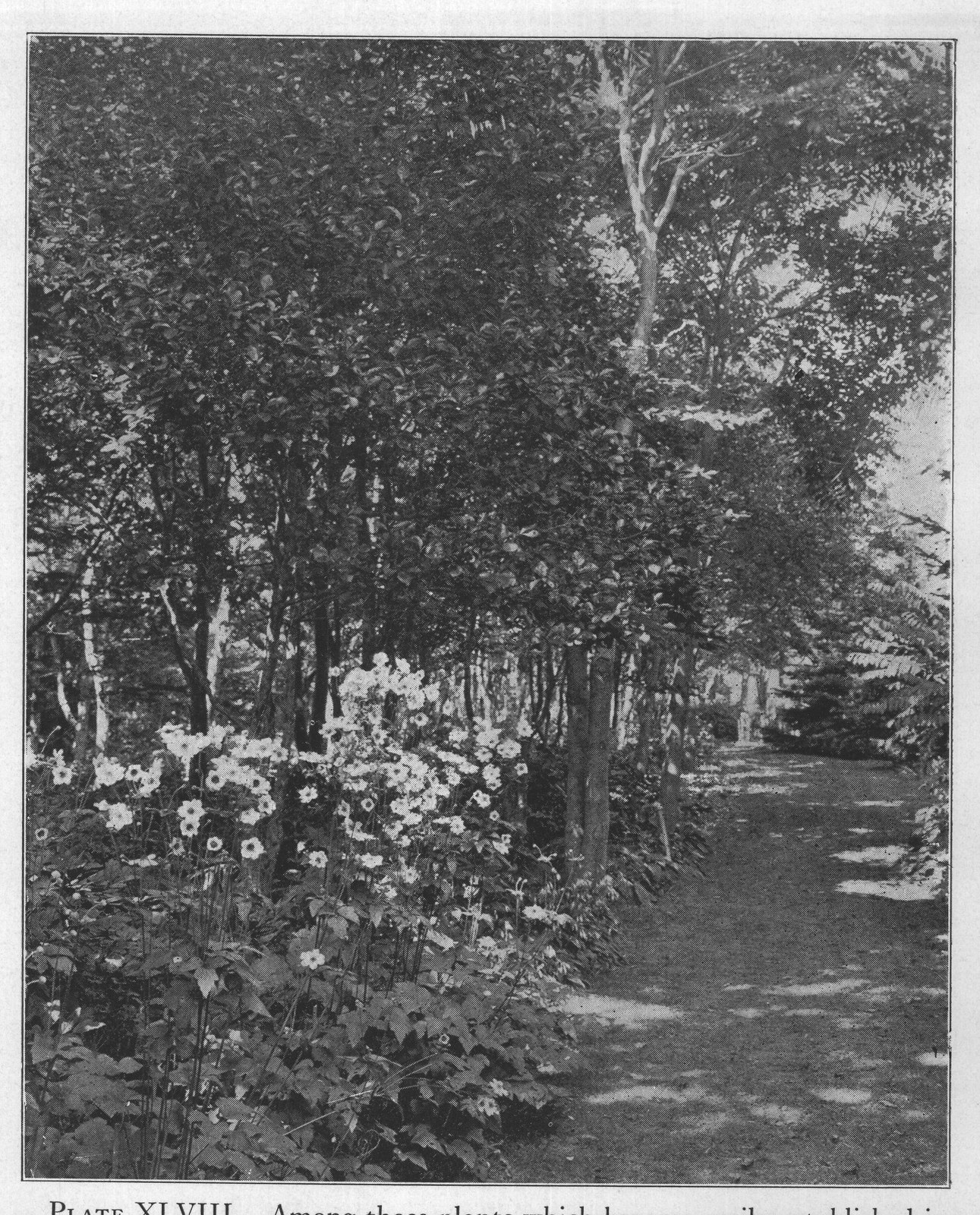
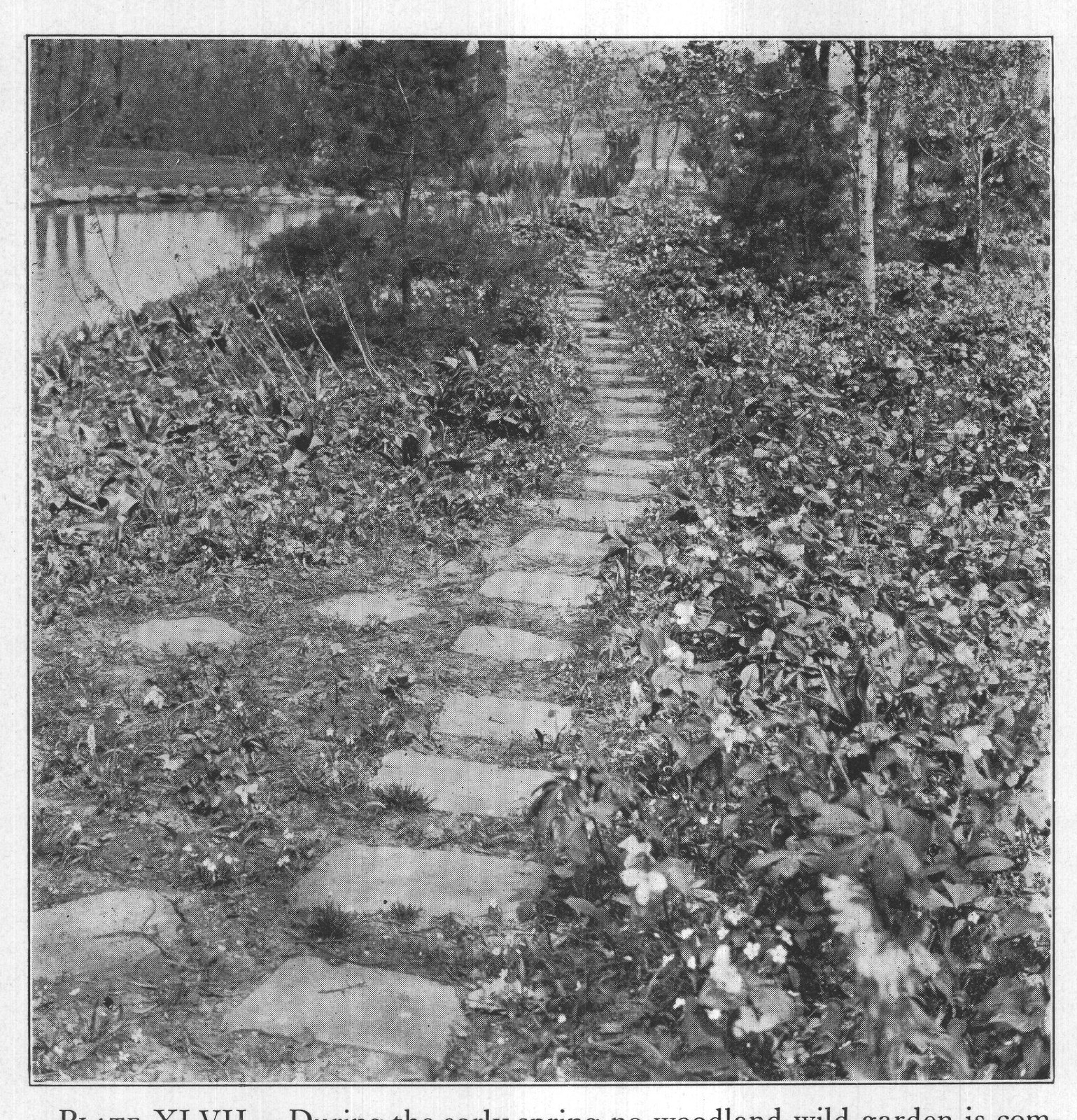
Abrus precatorius Crab's Eye Vine +Allamanda hendersoni (T) Henderson's Allamanda +Allamanda williamsi (T) Williams' Allamanda Antigonon leptopus Mountain Rose Ampelopsis quinquefolia Virginia Creeper Aristolochia elegans Dwarf Dutchman's Pipe PLATE XLVII. During the early spring no woodland wild garden is complete without its quota of trilliums, grape hyacinth, and hepatica which grow luxuriantly if happily surrounded by correct conditions of soil and shade. (See page 227, group XXXI-C) PLATE XLVIII. Among those plants which become easily established in the wild garden, there is none the flower effect of which excels the Japanese windflower during the late summer. (See page 227, group XXXI-C)