Important: Safety Warning
This page recommends pest-control substances such as arsenic compounds, strychnine, or cyanide — in some cases applied to food crops. These substances are lethal to humans and animals, and their use is now banned or strictly controlled.
This information has been left in for historical purposes but should not be acted upon.
Home › CHAPTER VII › CHAPTER VII: Summer
CHAPTER VII: Summer
The various forms of sprays may be classified in four different ways: according to the season of spraying, the kind of chemicals used, the form in which the chemical is applied, and the kind of plants sprayed. SEASONS FOR SPRAYING. The seasons for outdoor spraying are two: the summer or growing season, and the winter or dormant season. Summer sprays are invariably not applied so strong as winter sprays, because the bark on the new shoots as well as the leaves would be injured by a spray of a strength which would not only be entirely safe, but advisable to use when a plant was dormant. Dormant sprays are mostly confined to those applied for protection against vegetable parasites and those intended to destroy scale insects. Some useful winter work is often done in the destroying of egg masses and cocoons by torches and the application of creosote or other strong paints by hand in small quantities; but this is not, strictly speaking, spraying. Summer spraying includes nearly all the methods used in the dormant season, with the spray made more or less dilute, dependent upon the exact season, as well as all the other forms of sprays. It should be noted that dormant spraying may be done at almost any time after the plants become dormant in the autumn and until they start growth in the spring; but it is not advisable to attempt to spray during freezing weather, nor too early in the winter, because in the latter event much of the benefits of the spray will be lost through the subsequent winter storms. If dormant spraying is delayed until nearly spring some beneficial results may be expected to extend into the summer, which would otherwise have been lost. Summer spraying, on the contrary, must usually be done at some precise time in order to secure the desired results, though this is not always strictly necessary. SPRAY CHEMICALS USED. The spray chemicals used are those which are best adapted to destroy the various forms of plant and animal parasites which it is desired to attack. Sometimes it is possible to combine two forms of chemicals in one spray and thus make one MAINTENANCE operation serve two purposes. Those sprays intended for leaf-eating insects are classified as poisons and act like all poisons on being absorbed into the digestive tract of the insect. It is generally necessary only to secure an even distribution of such a spray, which usually contains some form of arsenic, over the leaves of the plant. Those sprays intended for insects, such as the scale insects, which do not eat leaves or green parts of plants, are classified as contact insecticides. They kill by suffocating the insect or by their direct physical action upon the body of the insect. Thus they may also be useful against leaf-eating insects as well. These sprays may be merely some powder in a form so minute that it can enter the breathing apparatus of the insect or, in the case of the sucking insects, some oil which can be held in suspension in water long enough to allow it to be sprayed over the plant. Other well-known contact insecticides are tobacco extract (nicotine sulphate) and various soaps, such as "whale oil" soap, made from fish oil. Sometimes poisonous gases are used for this purpose but that is, properly speaking, fumigation and not spraying. The third classification of sprays according to chemicals is that intended for fungous diseases, caused by low forms of vegetable parasites. Anthracnose, rust, mildew, canker, blight, and numerous other descriptive names are given to these diseases but they are nearly all treated alike by the application of a fungicide which is generally some spray containing sulphur, either lime-sulphur mixture or Bordeaux mixture, which is a lime and copper sulphate mixture. The lime-sulphur mixture also acts as a contact insecticide in some cases. Fungicides should be applied very evenly over the whole of the plant from top to bottom and may be used much stronger during the dormant season than would be safe during the growing season.
FORMS OF SPRAYS. The types of spray classified according to the form in which they are used are two. The most generally used form is the liquid, which generally means a chemical in suspension in water. Most sprays used in liquid form are chosen because of their ability to stay in suspension in water for a considerable length of time without either going into solution or gathering in lumps. This property of staying in suspension is a very valuable one, because it insures an even distribution of the spray material without an excessive amount of agitation to keep the mixture even. There is an increasing tendency to use the dust form of spray in which the chemicals are blown upon the plants in the form of a very fine powder which is largely dependent upon atmospheric moisture to make it stick to the plant. Dust sprays are used more often in a commercial way than by the average amateur when protecting ornamental plants, and this form of spray is not adapted to all the chemicals used, as, for instance, the oil and tobacco extract sprays. Sometimes poisons are mixed with bait and spread upon the ground near the plants to be protected, but this again is not spraying in the generally accepted sense of the word. OUTFITS FOR SPRAYING. There are various spraying outfits adapted to the various requirements dependent on the amount of work to be done and the physical difficulties to be overcome. Probably the best small outfit for the amateur is the knapsack sprayer which can be easily transported and even carried up into the tops of trees if necessary. This consists of an airtight receptacle for the spray mixture, which may be strapped to the back in such a way as to easily allow the pressure to be kept up with one hand while the nozzle attached to a short length of hose is manipulated in the other hand. The best knapsack sprayers have a copper tank holding about four gallons of liquid, a brass pump, and an air pressure chamber which insures a steady stream. They weigh fifty pounds when full of liquid. A cheaper pump of about the same type but small capacity is the bucket pump which can be used with any bucket or pail. This is harder to transport about and not so satisfactory in other ways as a knapsack sprayer. There are various types of hand-operated barrel outfits. Sometimes the barrel is mounted on large wheels so that it can be easily moved about with a pump installed in the head of the barrel, or sometimes a larger hand-operated pump is mounted on a cart beside a barrel or tank. Such an outfit will take care of all but the tallest trees and is about the largest suitable for amateur spraying. It has enough capacity to take care of considerable spraying and enough pressure to insure a fine spray reaching all parts of even large plants. For occasionally spraying small shrubs and such plants as perennials and annual flowering herbs a small hand force pump is a very convenient one to have. These small pumps hold a quart of liquid in a glass or copper retainer.
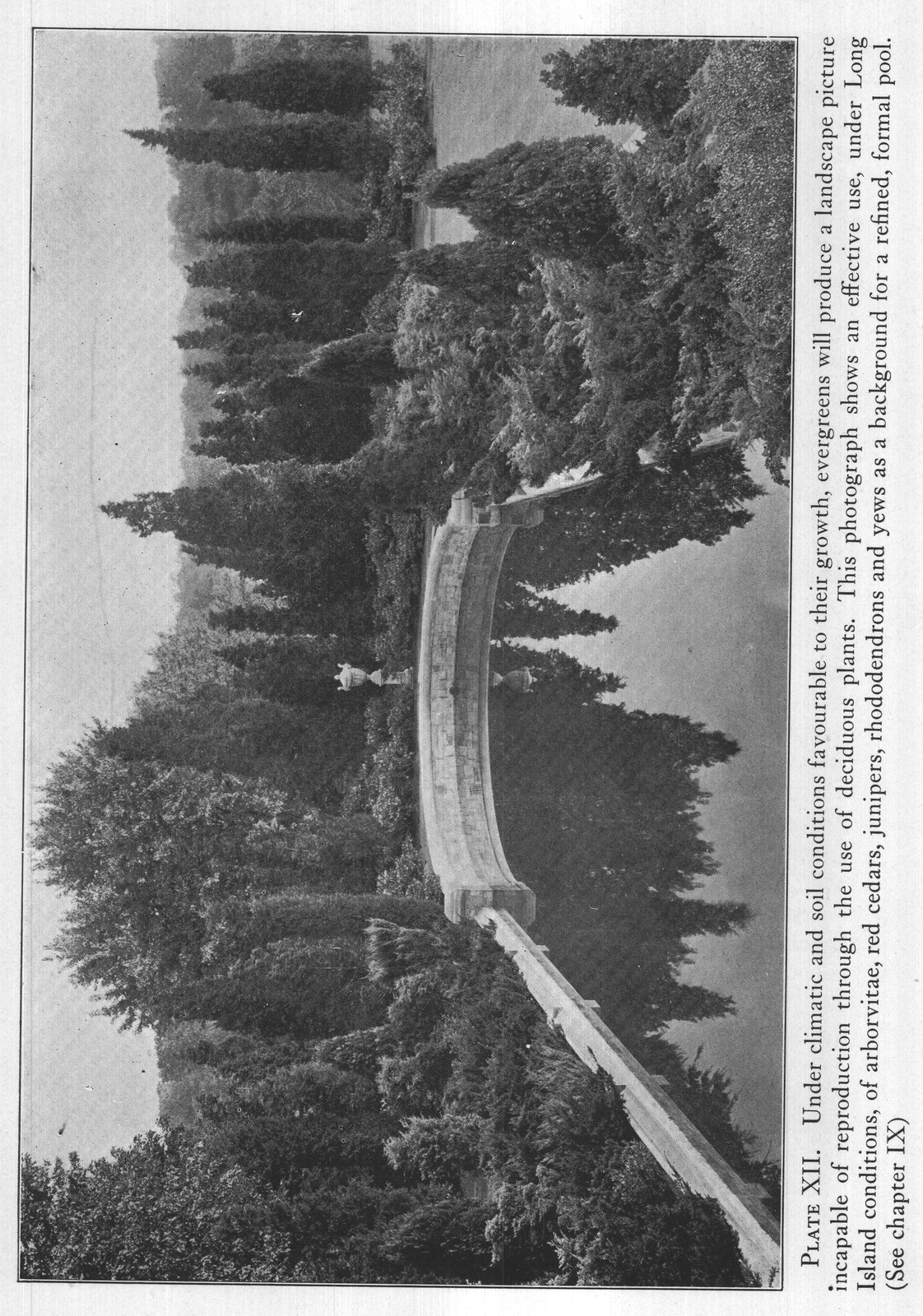
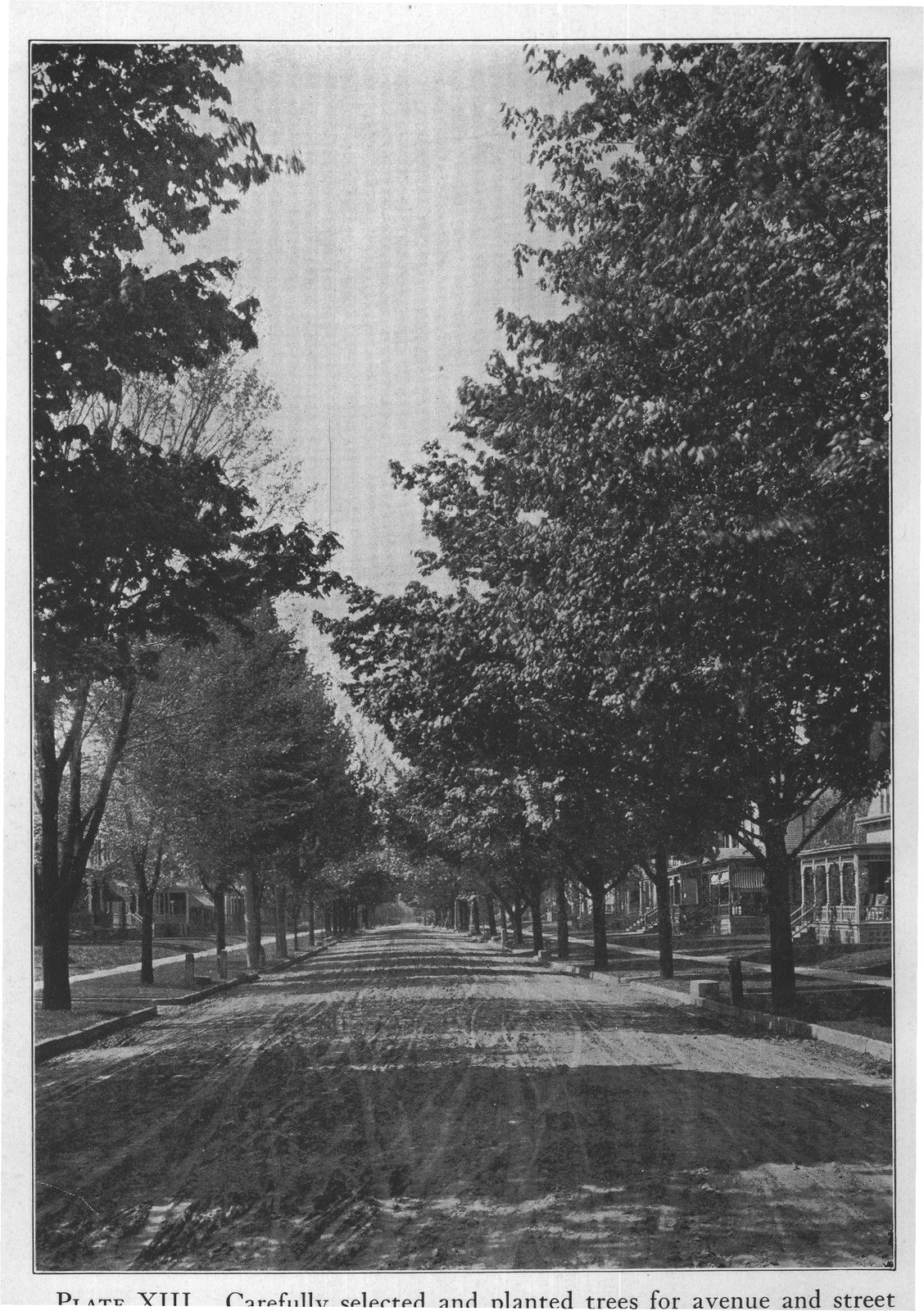
The power sprayers are operated either by a gearing or sprocket and chain connecting the wheels of the outfit to the pump or by a gasoline engine mounted on a platform together with a pump and PLATE XII. Under climatic and soil conditions favourable to their growth, evergreens will produce a landscape picture incapable of reproduction through the use of deciduous plants. This photograph shows an effective use, under Long Island conditions, of arborvitae, red cedars, junipers, rhododendrons and yews as a background for a refined, formal pool. (See chapter IX) incapable of reproduction through the use of deciduous plants. This photograph shows an effective use, under Long Island conditions, of arborvitae, red cedars, junipers, rhododendrons and yews as a background for a refined, formal pool. (See chapter IX) PLATE XIII. Carefully selected and planted trees for avenue and street planting provide a uniform and a symmetrical effect together with the inviting shade, all of which are so essential to the standards of modern residential districts. (See page 116, group X-A) MAINTENANCE tank. When many trees are to be sprayed a power sprayer should be used in order to secure a pressure which will enable the forcing of a fine spray to all parts of the tallest trees. For spraying tall trees an apparatus which works up a pressure of two hundred pounds is required so that the spray mixture may leave the nozzle in a solid stream and break into a mist as it nears the top of the tree. This is not required for spraying smaller trees or bushes or flowers where the requirement becomes that of producing a fine spray a few feet from the nozzle. Spray chemicals which are to be used in dust form are applied by means of so-called "powder guns" when large amounts are used on large trees. These are seldom useful on ornamental plants because of the usual proximity of houses or public streets and the consequent annoyance caused by clouds of obnoxious dust flying in the air. Many times, however, sulphur dust or hellebore can be applied by means of small hand force pumps adapted to using the dry dust, or this dust can be applied by sifting over the plants through holes punched in the container in which it is purchased. FORMULAS FOR SPRAYS. The formulas for some of the simpler insecticides and fungicides will be given here; but it is generally more advisable for the amateur to purchase his chemicals already mixed and in packages of a size adapted for his immediate requirements. POISONS:
Paris green-aceto arsenite of copper.
Arsenite of lime.
Arsenate of lead; use 2 lbs. to 50 gal. water.
Hellebore; use I ounce to I gallon of water.