F. Lilies
a.
List of lilies:
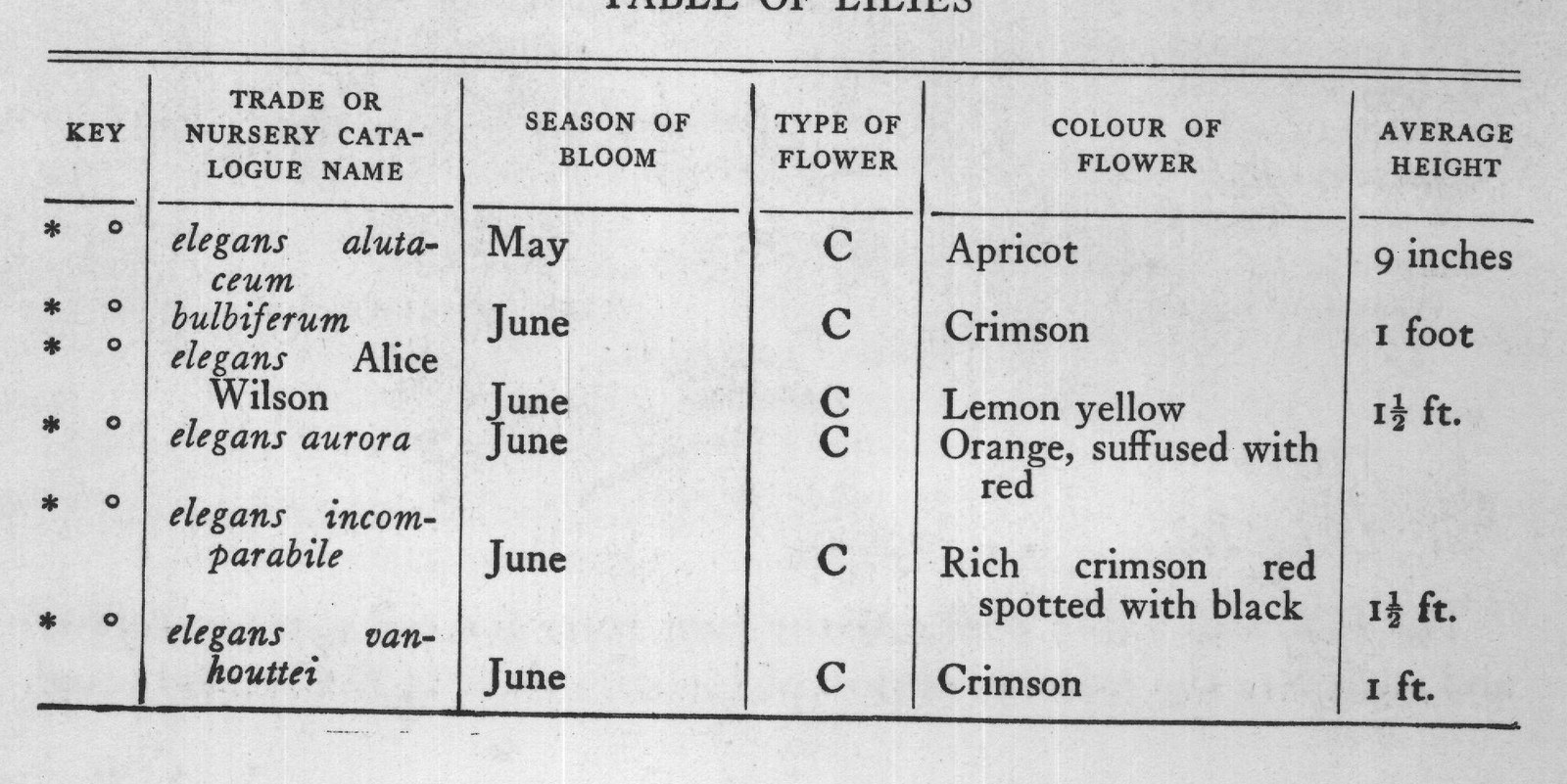
The following table contains the best sorts for the average grower and indicates the culture, season of bloom, colour of flower, and usual height. There are four clearly defined types of lilies as indicated in the table by the letters A, B, C, and D. First the funnel form like the Easter lily (A); then the pendant, spreading, or bell form (B). The same flower erect is the cup-like type (C), which flowers earliest of all; and the Turk's cap group with petals completely reversed (D). (0) All the lilies marked thus should thrive in any ordinary fertile garden soil. If the available soil is naturally compact or adhesive it can be lightened and made more porous by digging some coarse sand or leaf mold into it. If the soil is light and sandy, procure and incorporate with it some clay loam; but in a broad sense all these lilies can be depended upon to live and increase under average garden conditions. (+) These lilies require a good soil and if the soil is heavy it should be lightened by the addition of some leaf mold or peat; these lilies do not quite so well withstand heat and drought either. Partial shade is beneficial, especially at their roots, which can be provided by interplanting them among other plants that will shade, yet not too densely cover the ground. (=) This group embraces all native species and they are shade and moisture loving. Although they lift up their tall flower spikes to the bright sun, they like a cool root run at all times. In a cool north corner, or by lake or stream or in any moist hollow, about or near the garden, these lilies are a host in themselves wherewith to make a summer picture. (*) Lilies marked in this manner are stem-rooting. Therefore they can be transplanted in the spring.