Home › Introduction › Introduction: Table
Introduction: Table
THE USE OF THE INDEX. This book is indexed very completely and in detail and has a reference both to pages and to groups. The reader will note that the book has been paged in the usual manner, and also that on each page the groups have been alphabetically arranged for the purpose of making it more easy to consult information as referred to by the Table of Contents and by the Group Index. As a matter of fact, this Index is almost equally as valuable as the complete list of plants under each of the various groups. By means of this Index the student who is familiar with some plant and wishes to find a proper use for it can readily ascertain the use or uses to which the plant is adapted.
THE PURPOSE OF THE ILLUSTRATIONS. A number of photographs and drawings have been introduced throughout this volume. These photographs are illustrative of various group ideas covering uses of plants. Words, however carefully selected, often cannot be a literal interpretation of an idea, whereas a photograph immediately conveys the definite idea which cannot be reproduced in words. These illustrations have been selected, so far as possible, to illustrate the main features which justify the making of an individual group for reference purposes. It is hoped that they may for that reason prove to be of great value.
METHOD OF USING THE BOOK. Theoretically, a treatise on any subject should be so simplified that to the average reader the method of using it is self-evident. However, a few suggestions covering the methods of consulting the information in this volume may not be amiss. The Table of Contents, which is a complete compilation of all the general information in this volume, is arranged with INTRODUCTION many larger and more important headings to include the many minor headings. It is here that the reader can easily find reference to lists of plants which are valuable for specific uses by exactly the inverse process that he can find from the Index a reference to the different purposes for which an individual plant may be used. To the reader who is seeking to find a list of plants which can be used for a specific purpose, first, the Table of Contents and the List of Illustrations are of direct and primary value. To the reader who is seeking to find for what specific uses any plant may be adapted, secondly, the Index to pages and groups of plants is of greatest importance. To the reader who wishes to go farther into the subject of plant study, as covered by various phases of landscape work, thirdly, the Bibliography is the one reference which will be of value. The complete glossary containing a complete list of definitions covering terms frequently used by landscape architects is of real value in defining such terms.
The criticism may be raised by some who consult a volume of this kind that in reality no definite line can be drawn between the uses of some plants for one purpose or for another purpose. This is admittedly a fact. It will be quite evident from a short study of the Index that many plants frequently have a distinct and definite value as adapted to different purposes.
RANGE OF MATERIAL COVERED. While the range of material covered by the lists is sufficient to meet the requirements of the average property holder, the lists may be supplemented by additional and unusual varieties which, if selected, should be given unusual care. The information in this book has been compiled to cover the range of material which is adapted for use generally throughout the following portions of the United States: The North Atlantic States, the Great Lakes Region, the Central States as far west as the Missouri River and as far south as Arkansas. No lists have been compiled for the Great Plains and the Rocky Mountain States, but special lists have been compiled for the Atlantic Coastal Plain from Virginia to Mississippi; also for the Peninsula of Florida and for the region within a radius of one hundred and fifty miles from the Twin Cities. For the Pacific Coast, lists have been prepared for the Oregon-Washington Coastal Plain. It should be borne in mind that plants which develop one type of growth in a northern climate will develop another type of growth, because of the longer growing season, in a southern climate. THE RANGE OF PLANT ADAPTATION IN GENERAL. After studying a compilation of this kind the great range of plant adaptations becomes evident. There is a large group of materials which are hardy under almost all conditions. There are many other types of material, however, too numerous to mention in detail, which are adapted only to specific sections of the country.
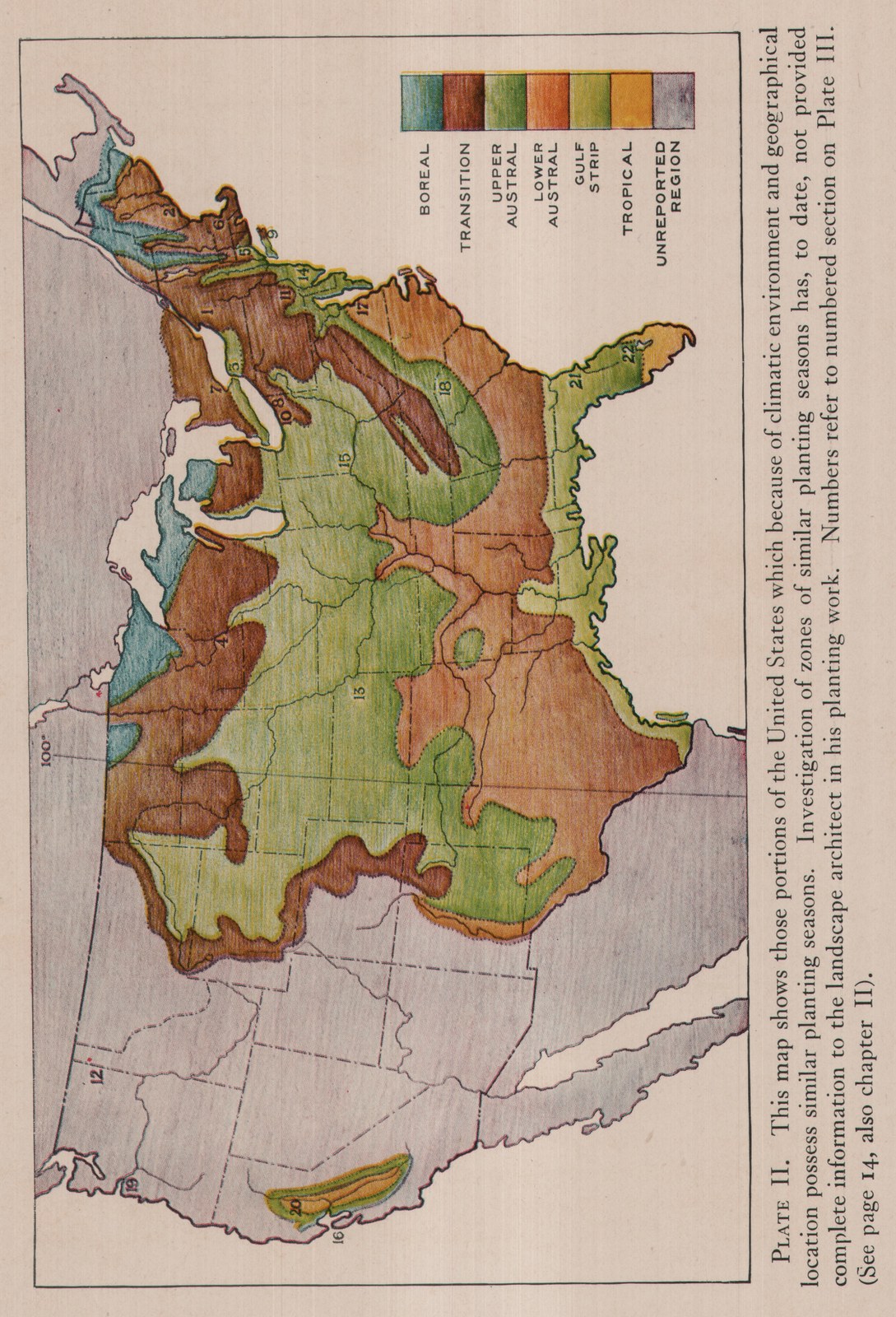
THE ADAPTATION OF EVERGREENS IN PARTICULAR. The question of the adaptation of evergreens is perhaps the one which may cause the most serious discussion. Evergreens are a group of plants which possess widely varying characteristics, especially of hardiness under different climatic conditions. The evergreens which will flourish in the humid and less severe atmosphere of Long Island will not grow through the windy regions of the Middle West, nor in the extreme exposure of the water-front conditions of the North Atlantic and the Great Lakes Region. Neither will evergreens which flourish in the sandy soils of Michigan grow upon the clay soils of the Middle Western States. Therefore, the question of evergreens has been carefully considered, and an attempt has been made to differentiate the groups and the requirements of each. This subdividing of evergreens for various locations is based entirely upon the normal protection. Many evergreens, as with other plants, will thrive under abnormal conditions if they are nursed and protected during the severe winter months. On the other hand, many evergreens which will withstand the exposures of winter conditions will not continue to thrive when placed in the clayey soils of some of our Middle Western States, where they are subjected to the severe baking and drying out of these soils during the summer months. METHOD OF GROUPING PLANTS. The question of whether plants for landscape use should be grouped according to height or according to other characteristics, such as season of bloom, character of growth, soil adaptations, etc., is one that has been discussed to a considerable extent. The writer feels that in the selection of plants as a part of any landscape design, the question of height is of secondary consideration as compared with the natural characteristics and adaptations of the stock under consideration. The selection of plants for specific purposes such as background planting, undergrowth planting, windbreaks, ground cover, etc., implies that, in addition to other important characteristics of hardiness, compactness, and qualities of fruiting and 16 20 12/ 100% 08 15 13 17 18 21 22 14 BOREAL TRANSITION UPPER AUSTRAL LOWER AUSTRAL GULF STRIP TROPICAL (See page 14, also chapter II).
REGION PLATE II. This map shows those portions of the United States which because of climatic environment and geographical location possess similar planting seasons. Investigation of zones of similar planting seasons has, to date, not provided complete information to the landscape architect in his planting work. Numbers refer to numbered section on Plate III. (See page 14, also chapter II).
INTRODUCTION flowering, such plants fulfill the requirements of height automatically imposed by some few groups. Height of plants means little to the landscape designer as compared with the many other important requirements of foliage effects, character of fruits and flowers, soil adaptations, hardiness and habits of growth and their response to pruning operations.
In the selection of garden perennials questions of height are entirely secondary to the ability of the plants to produce flowers and foliage of varying qualities, so essential to the success of the garden picture during different months of the growing season.