Home › Perennials for Different Purposes › Perennials for Different Purposes
Perennials for Different Purposes
WHETHER to use annuals or perennials, what perennials to use for different flowering effects, and how to take care of the perennial garden are important questions, the correct answers to which make for the success or failure of a flower garden. A flower garden in itself is the intimate companion either of those who own it and enjoy working in it, or of those who are only sufficiently interested to be thoroughly satisfied when an interesting flower effect is produced. There is no part of the field of landscape design, from the standpoint of the professional designer, from which so much criticism can arise as through the failure to produce an interesting flower garden. It is useless to discuss the question of taste, concerning the individual preferences for various colours of garden flowers; yet to everyone the successful garden implies a garden filled with flowers. The proper relationship between the unusual types and unusual effects becomes a secondary and yet an important consideration.
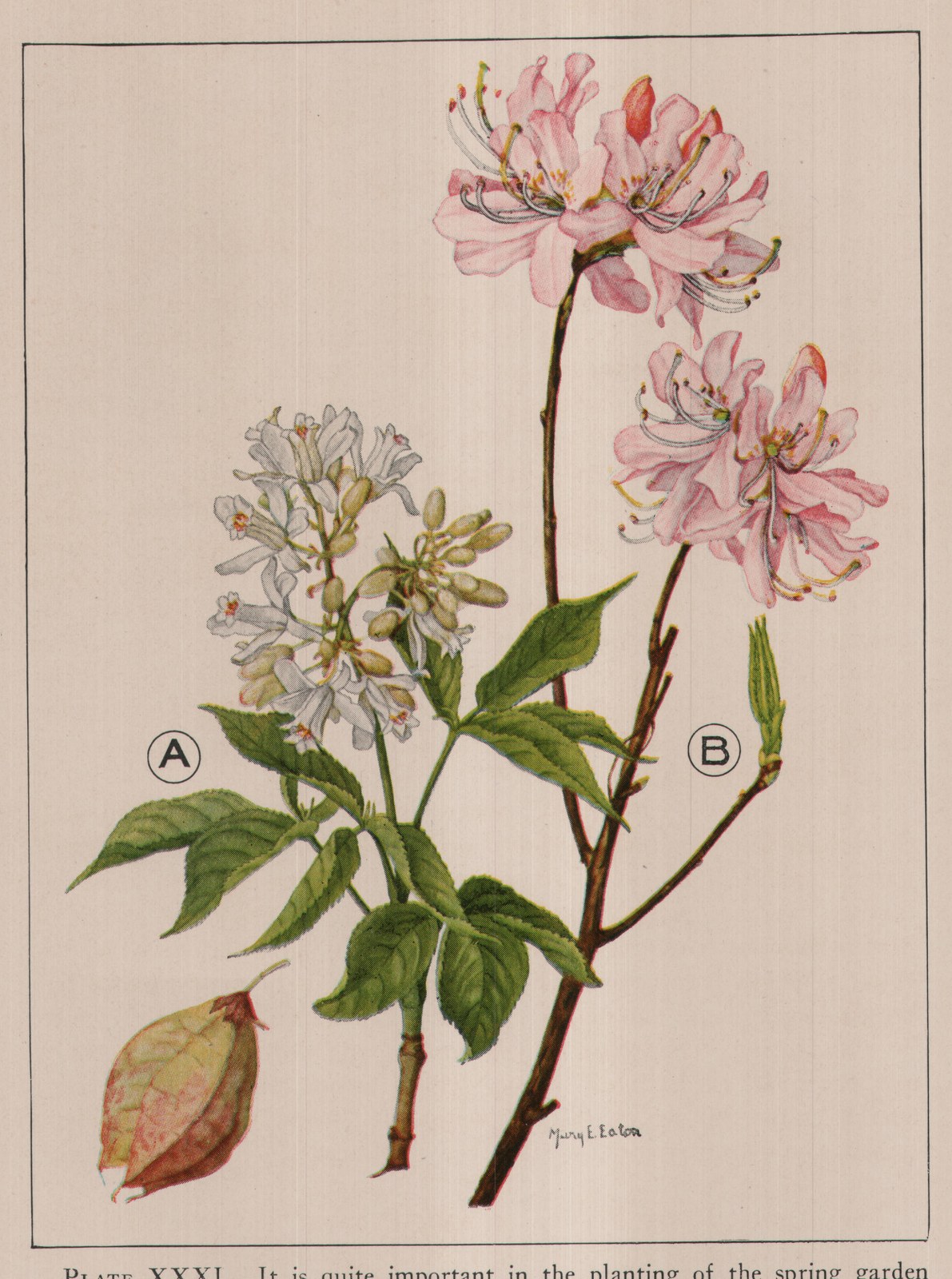
The success of a perennial planting does not rest entirely with the proper selection and proper planting of perennials. A perennial garden cannot stand still. It cannot be made to-day and exist tomorrow without some care. Many gardens in which the types of plants have been selected with extra care have completely failed because whoever was responsible for their subsequent maintenance has not understood the nature and requirements of the plants with which he was dealing. The general rule can be laid down for the success of any perennial garden that the one who assumes responsibility for its success must be as intimately acquainted with the plants, their habits and requirements, as with the members of one's own family. TREES, AND THEIR EFFECT ON THE FLOWER GARDEN. The old saying is true, either the flower effect of the garden or the quantity of flowers cut for house use must be greatly reduced if the same garden is to serve two purposes. It is also true that trees and desirable sorts of A B Mary E. Eaton PLATE XXXI. It is quite important in the planting of the spring garden that the designer should know those shrubs which produce flowers before the leaves appear, similar to the Carolina azalea (B), and those early-flowering shrubs which produce flowers and leaves at the same time, similar to the bladdernut (A). (See page 154, group XIX-A) garden flowers seldom grow in nature together. Most of the garden flowering plants demand ample sunlight for their best development. For those who develop homes, and attempt the making of a flower garden on areas covered with dense shade of large trees, it is impossible to provide the ideal flower garden which one may have wished so often to possess. Trees must be sacrificed, or soil conditions will be too wet or too dry. Spreading roots from such trees will steal plant food from the garden, and sunlight so essential for the development of fine flowers will be shut out. The true garden lover who realizes that plants, like human beings, thrive only in congenial and healthful surroundings will either love and preserve his trees or will have the courage of his convictions to remove unnecessary trees and give to his flower garden ideal conditions of air and sunlight. Morning sunlight is generally considered more effective in producing plant growth than afternoon sunlight.
Trees on the north side of a garden are seldom objectionable; but most trees within the garden or on the south and west side are very undesirable.
Persons who are planting a perennial garden for the first time, and who are not familiar with the flowering types of perennials, should adhere, in the selection of plants, to a few hardy types of perennials, such as the iris, the phlox, the larkspur, the chrysanthemum, and the columbine, together with others shown in this list (XXXI-A). All of these, with average care, are certain to produce flowers. The more unusual types can be selected and introduced into the garden as one's knowledge of them increases.
For a person who is a lover of garden flowers, and who attempts to procure definite colour combinations during different periods of the growing season, it is well to outline groups of perennials, from each of which material may be selected to produce the desired effect. We should associate perennials in groups for season and colour in order to use them most successfully. This knowledge comes only with a certain experience. There also may be plants found outside of these groups which can be used to advantage. The object in compiling these groups has been to establish a definite reference list from which the more important types can readily be found and associated in one's mind with the definite purpose for which they can be best used. Frequently, as a matter of taste, one person may desire a garden with yellows and blues predominating. Another may desire a garden with pinks and whites. It is essential that one should be able to readily and definitely select plants for these different purposes. The woodland wild garden becomes an important problem because the selection of material adapted to partially shaded conditions existing in such garden areas does not present the same problems as the selection of a type of material adapted to a sunny, open exposure. The term "wild garden" applies to the use of plants which can be naturalized; plants which, when once planted and given normal care during the first year, will become thoroughly acclimated and continue to grow vigorously and multiply as the years go by. In the selection of material there are two types of plants which can be selected: the tall-growing types and the low-growing types. The low-growing types are adapted for use in the more intimate, small garden areas, where the taller types should be used with great care. It must be remembered that many types of wild garden perennials, such as the day lilies, the bergamot, and the Japanese loosestrife, will multiply so rapidly that they will crowd out many of the less vigorous plants such as hepatica and spring beauty which are not able to survive such competition. Consequently it is not safe to say that material selected for wild garden areas does not require a certain amount of care after the first planting of the garden. It should also be borne very definitely in mind that plants such as the cardinal flower, some irises, the blazing star, the lily-of-the-valley, the cowslip, and the violet require partial shade and a moist condition of the soil, while such types as the beebalm, sweet william, asters, and moss pink thrive in a much more exposed and lighter soil. The success of a wild garden, either large or small, depends very largely upon the proper selection of materials to produce the required effects. The development of wild garden planting requires a series of years in which to complete it and bring it to perfection. It is a process, beyond a certain point, of the survival of the fittest, and the elimination finally of those plants which prove through the first few years their inability to meet the soil and exposure requirements of the local situation. A successful wild garden area never shows the amount of work that has been expended in its development, because every detail looks finally as though nature had provided it without the assistance of man. Perennials for wild garden planting are not in use as much as they should be even in extensive estate development, because of the lack of knowledge concerning the ability of many of the wild flowers to adapt themselves to these new environments. Yet this group of plants provides to those who are really interested in the development of our wild flowers an excellent source of satisfaction. In this day of large country estates with the varying types of garden conditions there is no reason why the wild garden consisting of plants which have become naturalized should not be as important as any other type of garden, especially to those who are real garden lovers. It is true that many of these plants, such as the varieties of the native ferns, require special conditions of the soil from a standpoint of soil texture, special conditions of the soil from the standpoint of moisture, and also special conditions of exposure concerning the question of open sunlight and the question of shade. It is unfair to expect that any plants which we attempt to naturalize in the wild garden development will continue to grow under conditions which are exactly opposite from the conditions of nature in which these plants have been living a "happy" existence in their surroundings of soil and sunlight. The wild garden requires, more than anything else, a soil which contains plenty of humus and is commonly termed leaf mold soil. If such soil is not available then only well-rotted manure or compost should be used. No fertilizer such as sheep manure, dried blood, or other fertilizers commonly used for the forcing of plants should be applied to wild garden material.
In the use of perennials another problem is often met: that of selecting proper types for planting at the water's edge. These plants must be of the kind that will thrive with their "feet in water." The group from which selection can be made is comparatively limited, especially with reference to genera. Many of these plants, such as the lemon lily, the loosestrife, and the iris will soon spread beyond control if not carefully thinned out and kept within bounds during the succeeding years. Most of this material is adapted to growth in the open sun and will not withstand extreme shade conditions.
In the selection of perennials to be used in the development of the large flower garden areas the entire field of perennials is open from which to choose. The development of a small, refined flower garden, the intimate details of which add to its charm, requires a more careful knowledge of perennials, especially of those which usage has proven cannot be safely introduced into such limited areas. These types of perennials should be avoided in the development of a small flower garden. They can be used by one who will give them consistent attention to keep them within bounds by staking and cutting back. Otherwise they will produce a loose, ragged effect not in keeping with the neat lines desired in a small garden, and will often crowd out interesting types of smaller perennials which mean more to the success of the garden.
Most varieties of the hardy aster or Michaelmas daisy, the sneezeweed, the loosestrife, and the plume poppy are too rampant and vigorous in their habit of growth to be successful in a small garden. The most important requirement in the development of any flower garden is to provide perpetual bloom throughout the growing season. There are a variety of combinations of perennials which can be used to accomplish this purpose. As illustrative of a possible range of plants it is well to list some of the thoroughly tested varieties that will grow in any good garden soil and which will provide flowers from early spring until late fall. For a person who understands plants to some extent the lists of perennials, grouped according to colour and season, will make an excellent source of reference from which to select types for continuous blooming effects.
There are some perennials, among the most important of which are the peony, of which the blooming period is very short and the foliage effect during a great part of the summer may be consequently monotonous and uninteresting. In such plants it is highly desirable to have touches of colour throughout the later parts of the season. To accomplish this there can be introduced, among the peony plants, such types as the monkshood, the blazing star, lilies and gladioli, to provide flowers and add interest to the otherwise monotonous mass of green leaves.
A considerable part of the success of any perennial flower garden is the presence of groups of perennials which present good blooming combinations. Often a garden is seen where some particular colour note attracts special attention. On close examination it is found that this effect is produced by a combination of colour brought about by the successful grouping of two or more perennials. The average garden lover cannot become familiar, from his limited study of plants, with all of the interesting types of perennials which produce colour effects that harmonize with each other. A list of these groupings has been included in this chapter, and through further study many others may be found which will be equally effective. Annuals are most often planted because of their ability to produce flowers for cutting. Many perennials are planted for this same purpose. There are a few perennials, such as the blanket flower, ball of snow, larkspur, and marguerite, which are benefited by constant cutting, and the flowering season of which is lengthened through this process. There are other perennials, such as the foxglove, peony, and iris, with which the process of cutting flowers does not encourage growth of others during the same season. If such perennials are to be used for cut-flower purposes it is best to plant them in a distinct cut-flower garden. The same discussion concerning a cut-flower garden, and a flower garden as an interesting design, applies to the planting of perennials in the same manner that it applies to the planting of annuals (See Chapter XXXII, Page 238).
The majority of perennials will continue to increase from year to year and will require "dividing" and transplanting every two or three years. There are other perennials which should be treated as biennials and accordingly replaced completely by new plants at the end of every second year. These plants, such as the foxglove, white pink, English daisy, and bellflower will "run out" after a period of two or three years. They will still continue to grow, but their vigour will be so much less that their presence will be but an apology for strong, healthy specimens. All of these plants are known as perennials; but in reality they develop only as biennials. Other perennials, such as the aster, phlox, and iris, which grow into large clumps, should be divided at least every three years. If they are not so treated they will become crowded and the plants will not have space to develop properly and the result will be spindly, unhealthy plants which will not produce normal flower effects. But the peony, in good soil, with space of a diameter of approximately three feet in which to grow, is best left to grow undisturbed for a score of years or more (Page 88). Taken on the whole, no more picturesque or graceful effects can be produced anywhere than by appropriate planting along the banks of ponds and streams. The more bold and picturesque a planting mass is, the better it looks when reflected in a still pool; while the flowing lines of a stream are supplemented by the graceful, arching branches of shrubs and vines. Among the most successful and beautiful plants for watersides are the herbaceous perennials.
Perennials for planting in deep water are largely confined to the lotus and water lilies. These plants should not be permanently planted in ponds which freeze solid during the winter, nor where there is not plenty of rich soil on the bottom, and an abundance of clear water and uninterrupted sunlight. The best locations are on the margins of sluggish streams and of bays and in sheltered nooks. Water which flows too swiftly or is too cold or contains mud is not good for aquatic plants, nor should they be planted in newly constructed cement tanks which have not been thoroughly washed and rinsed so as to remove all the caustic property of the new cement. The best fertilizer for aquatic plants is cow manure, which may be mixed with twice its bulk of strong loam and used for planting beds.
In the water near the margin of a pond many more sorts of aquatic and bog plants may be used, such as the native irises or flags, water plantains, bulrushes, arrowheads, and marsh marigolds. These plants are more hardy and less exacting in their requirements. Indeed, they are likely, when congenial conditions occur, to grow so luxuriantly as to prove annoying if planted in very large quantities. A rich alluvial mud provides the proper soil for most sorts, and once established where there is not too much lime in the water, or too swift a current, they will take care of themselves.
For planting on the land at the water's side, a still larger list of plants is available. These include many of our common herbaceous garden perennials, such as sneeze-weed, Japanese iris, and lemon lily, as well as native herbs, such as gentians, cow parsnips, and some of our native orchids. With these perennials should be combined, if possible, some of the moisture-loving native shrubs. For this purpose nothing is better than the swamp honeysuckle, button bush, red chokeberry, rhodora, leather leaf, and wild rosemary, not to mention the more commonly known dogwoods or cornels.
If no special place is assigned to perennials, room may always be found for some in the shrub border. Here there should be reluctance to place any sorts that require considerable culture or the full development of which might be desired, particularly if they be sorts that are prized. One would be loath to subject a valuable variety of the peony, for example, to a life-long competition with vigorous shrubs which, in addition to sending out more rapid-growing roots, would have the advantage of overtopping it. But there are certain types of perennials that can, in every way, be appropriately used to fill bare spaces among shrubs that do not yet cover all the space, or at the front edge of the border. Here at the edge, if the shrubs do not droop too low or are not too vigorous in their habit of growth, may be found a place for a fine thing like the evergreen candytuft. In the edge of the shrubbery bed can always be found room for some bulbs; they really seem to prefer the slight protection of the overhanging branches and the soil around the roots of the other plants. An additional consideration is that the flowering season of bulbs is not encroached upon by the foliage of the shrubs, as would occur to the detriment of perennials that flower later in the year. Formal regularity in planting should be avoided because most perennials and bulbs appear best in small masses or clumps.
In designing a border planting of perennials or annuals located at the edge of masses of shrubs an ample width of four or five feet should be allowed, especially if this is the only place for the development of a flower border. Unless this provision is made and frequent pruning of the shrubs resorted to, the branches of the shrubs even then are apt to encroach upon the smaller plants at the front. This does not, however, apply to bulbs. Where it is necessary to develop a flower border in combination with a border of shrubs which shall serve as its background, little success will follow the attempt to develop such a border, especially in relation to tall-growing shrubs, if the flower border is placed upon the north side. If the shrub border or hedge is to consist of tall and vigorous-growing shrubs or columnar trees to provide a screen against objectionable views, the designer must always remember that competition of perennials with the greedy root systems of such plants will starve the perennials.
A. TYPES OF HARDY PERENNIALS FOR GENERAL USE. For the average person who is developing a small garden a knowledge of some of the standard types of hardy perennials, which are well adapted for general use, will often meet the requirements. This group contains standard types of perennials which are adapted for general use, and which with ordinary cultivation will produce interesting flower effects. Anemone japonica Chrysanthemum Chrysanthemum Japanese Windflower Anthemis tinctoria kelwayi Hardy Marguerite Aquilegia Columbine Aster Aster Delphinium Larkspur Dianthus Pink Doronicum plantagineum Leopard's Bane Iris Iris Paeonia Peony Lilium Lily Phlox Phlox Viola Violet B. PERENNIALS ACCORDING TO COLOUR AND SEASON. This, with its sub-groups, is an interesting group. The division of seasons in these groups is merely relative and is made for the purpose of obtaining some relationship in the succession of bloom throughout the growing season. Many perennials in these groups lap over from one group into the other, but for convenience of reference they are listed only in the season during which they are at their height of bloom. The subdivisions into colours of flowers, as a matter of easy reference, will prove valuable as a check on one's memory and a saving of time in being able to readily select flowers for varying colour effects at different seasons. a.