Home › Planting and Transplanting › Planting and Transplanting: Soil
Planting and Transplanting: Soil
SEASON OF YEAR FOR TRANSPLANTING. Planting seasons in different localities are influenced by many factors. Soil conditions and climatic conditions are the most important, as seen in Chapter II. Heavy soils are more friable during the fall, while during the spring they remain heavy, cold, and wet until quite late. In such soils if but little planting is to be done it is better to plant during the spring months for the reason that clay soils tend, through frost action during the winter months, to heave out material which is planted in the fall. It is undoubtedly true that fall planting, especially in heavy soils, requires more thorough winter protection than spring planting in the same soil. On the other hand, if a quantity of planting is to be done it is much safer to plant during the fall in a heavy soil, especially as a rainy season is frequently experienced during the early spring months, thus delaying planting work until growth is too far advanced. There is little actual difference between the desirability of spring planting and fall planting. There are arguments on both sides of the question and, with the exception of those plants which are adapted for transplanting only at a specific season, the writer suggests that planting should be done whenever the soil is ready to receive the plants, whether it be spring or fall. This is especially true in the loamy soils. Transplanting should not be done too late in the spring, for the reason that growth will be too far advanced for the plants to be moved with safety, and the season will become hot and dry before the plants are well established. It is for this reason that plants taken from a colder climate to a much warmer climate should preferably be transplanted in the fall.
PLANTING BEDS. GENERAL PREPARATIONS OF. Soil for planting should be prepared carefully. Beds for shrubbery should be dug at least twelve inches deep and ample width and depth provided for trees, varying according to their size. The soil should be made loose and friable so that it will cover the roots thoroughly. Well-rotted manure should be incorporated in planting beds, but never directly in contact with the roots, especially of evergreens. Heavy soils should be lightened, if possible, by the addition of sandy loam or straw manure and light soils should be improved by the addition of vegetable matter. Oftentimes owners of property are so anxious to do their planting in an economical way that they lose sight of the fact that thorough preparation of all planting areas, although more expensive, is good economy, and the least expensive way in the long run of obtaining good results. Poor preparation of planting beds as well as foundations for lawn areas means an increased expense in the cost of maintenance during the succeeding years after the completion of the original work. origina Thorough preparation of planting beds can be accomplished only through the use of good friable topsoil and an adequate supply of wellrotted manure. It is an easy matter in all planting work, especially that done in clay soils, to do so-called pocket planting and to feel that the initial expense has been very greatly reduced. In all planting areas bordering refined lawns this method of planting is not desirable. It causes a "soil-bound" and a stunted growth of the root system and does not provide the adequate food supply which plants growing freely in a loose and friable soil can obtain.
HEELING-IN STOCK TO BE TRANSPLANTED. When shipments of stock are received it is frequently impossible to plant the material as rapidly as it is unpacked, and it is often impossible to plant the stock because the beds are not prepared. The placing of stock in temporary nursery rows immediately after it has been unpacked is called "heeling in." In this manner stock may be preserved in its normal condition until such time as it can be transplanted to its permanent location. There are a few important points in connection with the operation of "heeling-in" stock which should be clearly understood. Trees and shrubs, when "heeled-in" over winter, should be leaned to the north so that the low winter sun may not shine directly into the tops nor so readily melt the frozen ground about the stems. Thus they are protected better from freezing and thawing of the ground and from premature starting of the buds in the spring. Nursery stock may be placed in temporary nursery rows, either by keeping the plants tied in original bundles as taken from the packing boxes, or by taking the individual plants from each bundle and heeling them in separately. The latter method is the safer and is the one to be adopted if plants are to remain in these temporary nursery rows for a period longer than ten days or two weeks. When stock is "heeled-in" in bundles, a special effort should be made to get the fine topsoil worked into the air spaces among the roots of the plants in each bundle. Permitting the air to reach the roots in the middle of the bundle because this precaution is not taken, is one of the most frequent sources of injury. The best method to adopt to be certain that fine soil is worked in among the roots is to thoroughly water the plants when they are "heeled-in" and to make sure that the water leaves no roots suspended in air. When individual plants are placed in temporary nursery rows, where they are to remain for a period longer than three or four weeks, they should be spaced not closer than twelve inches, or even farther apart for the larger shrubs, to eliminate injury from crowding as soon as the new growth begins (See Plate VI).
ROOT PROTECTION AND PUDDLING. The important object in transplanting is to transfer the plant to its new position in such a condition that growth will immediately continue as nearly normal as possible when growing conditions become favourable. Growth is first excited and maintained by very fine, fibrous roots, almost thread-like in character, which attach themselves to the soil. It is this fine root growth which is so sensitive to injury from drying-out processes, and which must be protected against the sun's rays, and also from the effect of wind. A dry wind will work greater injury to plants which are left uncovered during any unnecessary length of time than will a bright sun on a moist day.
It is often necessary to transplant material under exceedingly unfavourable conditions, due to wind, or sun, or when plants have advanced in leaf growth. Under such circumstances it is advisable to "puddle" the roots at the time when the plants are removed from the temporary nursery rows, and before they are planted permanently. "Puddling" consists in dipping the roots of the plants in a basin hollowed out of the soil and filled with a molasses-like mixture of loam and water. This "puddling" process leaves a coating of mud over the fine roots and prevents excessive drying out until the material is planted. DRAINAGE FOR TRANSPLANTED STOCK. The soil in which plants are placed should be considered carefully. Sandy soils which have ample drainage, and clayey soils, which naturally retain water, require distinctly different treatment. It is invariably necessary in clayey soils, especially with larger trees, to provide artificial drainage. In sandy soils, on the other hand, an extra supply of water must be added, especially when stock is transplanted during the latter part of the spring season or in the warmer climates. A plant should not be placed in a "pocket," excavated in shale or clay, which will afford little or no drainage; and it is of course better not to plant on a small mound which will lose moisture rapidly during the dry season. The common practice of "hilling" earth around the stem of the plant, which sheds water away from the roots, is to be discouraged. A shallow, basin-shaped depression should be left around the stem. This will hold the water until it soaks down to the roots. But suitable allowance must be made for later settling of the loosened earth.
BALLED-AND-BURLAPPED ROOT SYSTEMS. Planting material is often lifted with a ball of earth left intact around the roots. The ball of earth after being lifted is then carefully wrapped with burlap. This process is used with large material, evergreens, and any plants that are difficult to move. The great danger of transplanting such material after it has been wrapped for three or four days lies in the fact that during this period the outer thin layer of earth on the ball becomes hard and dry. The general practice with many planters has been to plant the stock without further care after removing the burlap. In the course of a few months the plant dies. Loss is due to insufficient moisture reaching the outer coating of the ball to loosen it, and thus necessary water cannot reach the roots, which have become sealed inside the hard coating. The best practice with all plants which have been "balled and burlapped" is to immerse the ball in water for a short time in order to thoroughly loosen the dirt in this outer coating before transplanting. It is never advisable simply to slit the burlap with a knife without removing the covering entirely and soaking the ball with water before transplanting. Place the plant in the hole where it is to be planted, then cut the binding and remove the burlap very slowly and carefully, exercising caution to avoid disturbing the ball; then partially fill the hole with water.
DEPTH FOR TRANSPLANTING. The question is often asked as to how deep stock should be set when it is transplanted. This is a query which must be applied to various types of material according to the special requirements of each. For example, some of the more tender perennials like the shasta daisy, the foxglove, and the cardinal flower should not be set as deep as some of the hardier types like the phlox, the larkspur, and the hardy sunflower. The suggestions here, however, are general. A plant in its new location should stand at about the same level as it stood before. There is more danger of setting a plant too deep in a clayey soil than in that which is sandy, for it is vital that the air should reach the roots. More stock is injured by deep planting than by shallow, and it often will be found well to set the plant with the crown or top of the roots an inch or more nearer the surface than it was before. This is especially true in the case of trees which, as is frequently observed, are easily killed by filling in earth around them. In the case of shrubs it is not a serious matter, except with rhododendrons and azaleas. These two plants are strongly characterized by having roots that remain near the surface. Roses of all kinds, however, are better set deep, for they readily throw out new roots above the old. Deep planting thus incidentally helps to conserve the supply of moisture so essential to success with the rose. In the case of budded roses it is necessary to have the union at least two and a half or three inches below the surface of the ground, in order that suckers may not spring up from the stock and choke the engrafted plant. Vines, particularly grape vines, also it is well to plant deep. In fact, grape vines are often led under the ground for a rod or more to spring up at a distant point where it is desired to have them grow. But with perennials in general, extreme care must be exercised. Those like the iris, with leaves that spring from a point near the ground, are made to decay by earth heaped about them. Those with thick, fleshy roots particularly should be planted only according to a careful observance of their habit of growth. The peony does not make good bloom if the eyes are sunk much more than two and a half inches below the surface. In the transplanting of the roots of the larkspur it should be borne in mind that the crown at the base of the plant should be covered with good topsoil to a depth of approximately two or three inches. In all transplanting calculation should be made of the possibility of the earth settling around the plant (See Plate VI), FERTILIZING TRANSPLANTED STOCK. In using fertilizers it is not advisable to apply them in any quantity so that they will come in direct contact with the roots of newly transplanted stock. It is always essential for plants to become established before they can make use of a fertilizer; otherwise injury may result. Until a tree makes a new terminal bud on the second growth its root system has not become established nor has it developed fibrous feeding rootlets sufficient to support the tree. A safe recommendation is that fertilizers should be so distributed in the soil surrounding the roots of transplanted stock that the food can become available as soon as the roots have started growth. In transplanting nursery trees and large trees a slow-acting fertilizer, such as bone meal, can be used in the soil around the roots, because the fertilizer will become available at the time when the tree has developed some of its new root growth.
TAMPING AND WATERING. Soil should be made compact in among the roots of newly transplanted stock by watering or tamping. Tamping may be accomplished by pressing down the soil with the heel or a stick. In tamping, care should be exercised not to press too heavily immediately around the stem of the plant, as in so doing injury may be caused by the breaking of roots. Soil that can be readily packed should be used around the roots. This is necessary, as any air spaces remaining will cause drying out of roots and consequent injury to the plants.
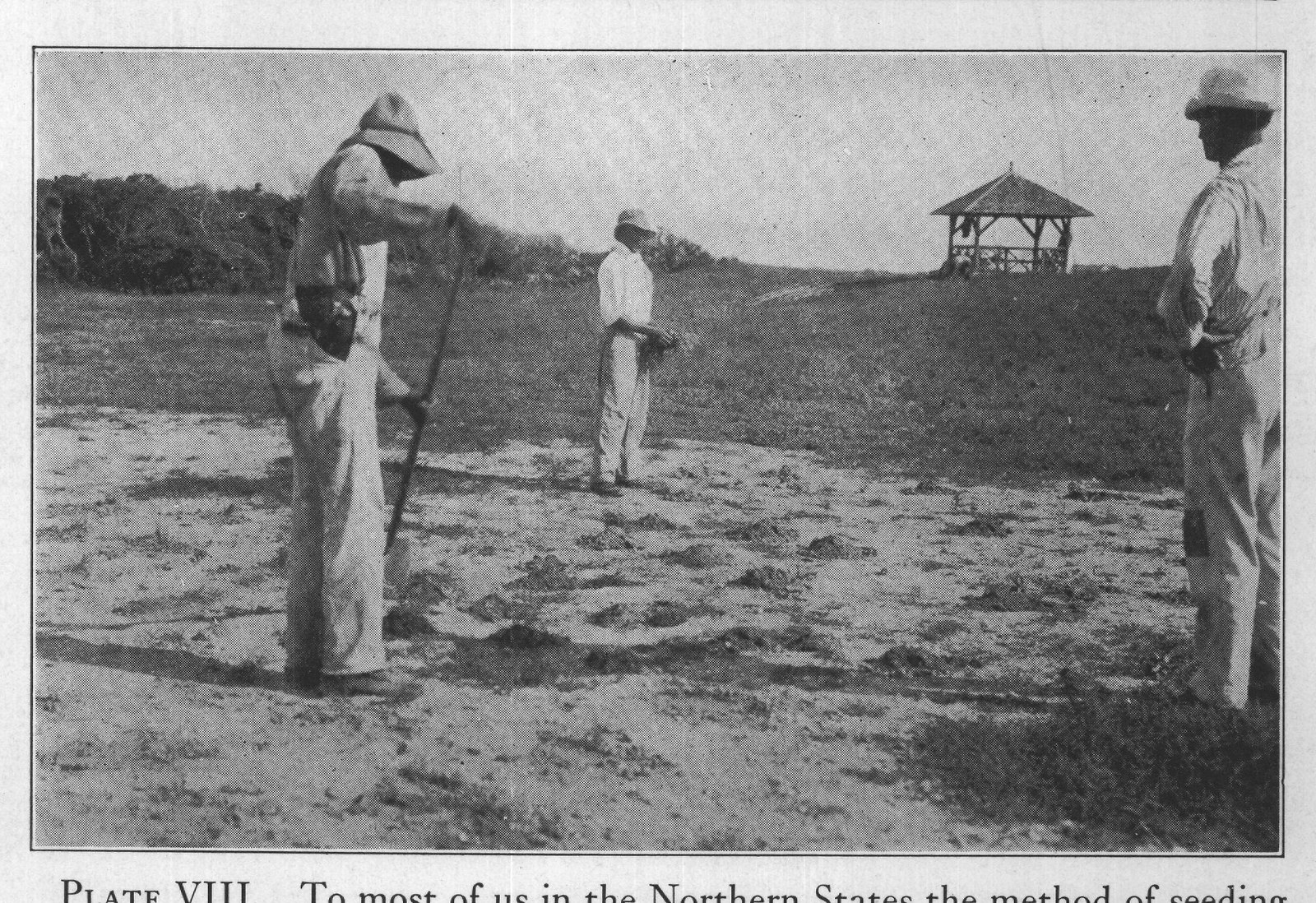
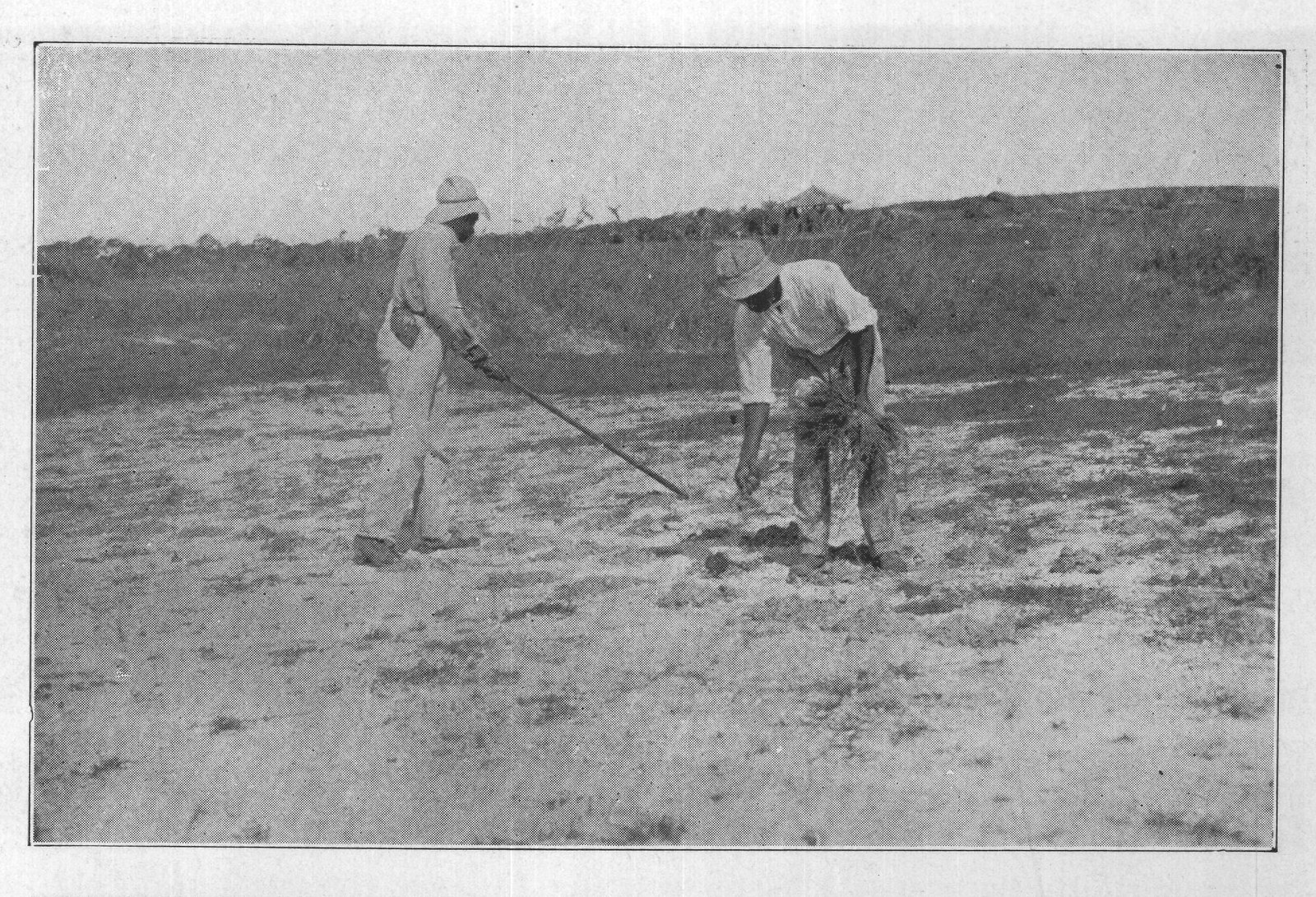
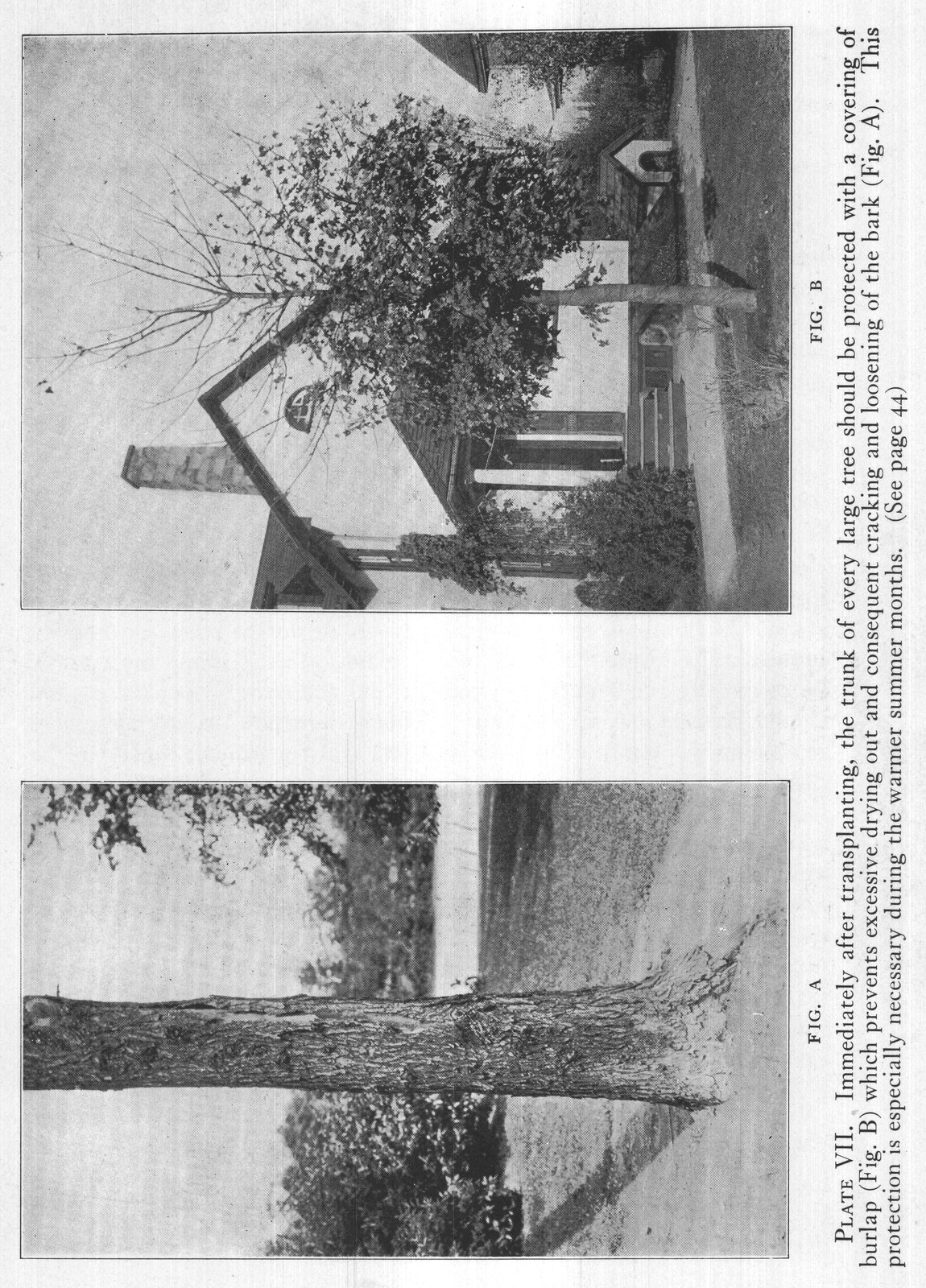
If water is available, it is advisable to run some slowly into the holes where material is planted, either at the time of planting or immediately after planting. The best plan is to put it in when the hole is partly filled with earth around the roots. This is done further to compact the soil and to provide necessary moisture. Unless soil is particularly moist, newly transplanted stock should be watered shortly after transplanting. It is not advisable, however, to apply very much water in soils or sites extremely retentive of moisture for it is quite as easy to injure plants from over-watering as it is to preserve them by giving them just sufficient water to meet their requirements. TRANSPLANTING SMALL SEEDLINGS. For transplanting small seedlings of trees and shrubs a well-protected spot should be selected, and the ground should be prepared to a depth of twelve or fifteen inches by deep spading and careful raking. Prepare the area in the same way P FIG. A FIG. B PLATE VII. Immediately after transplanting, the trunk of every large tree should be protected with a covering of burlap (Fig. B) which prevents excessive drying out and consequent cracking and loosening of the bark (Fig. A). This protection is especially necessary during the warmer summer months. (See page 44) PLATE VIII. To most of us in the Northern States the method of seeding a lawn is familiar, but the method of making lawns in the Southern States by planting Bermuda grass, is little known. In these photographs small clumps of Bermuda grass are being planted in "hills" staggered at intervals ranging from 18 inches to 30 inches. The thicker the planting the more quickly a mat of turf can be developed. (See page 62) as for a vegetable garden. The little plants, which should not have been exposed at all to the warm air or drying winds, are then best puddled before they are lined out. But in this actual planting there is danger of permitting the mud in which they were puddled to become hardened about their roots. Further to safeguard them, particularly if they are evergreens, it is necessary to shade them until they are well established in the new home. Some evergreens, particularly the small shrubby kinds, need such shading even beyond the first year.