Amaranthacea
Sp.8-22.
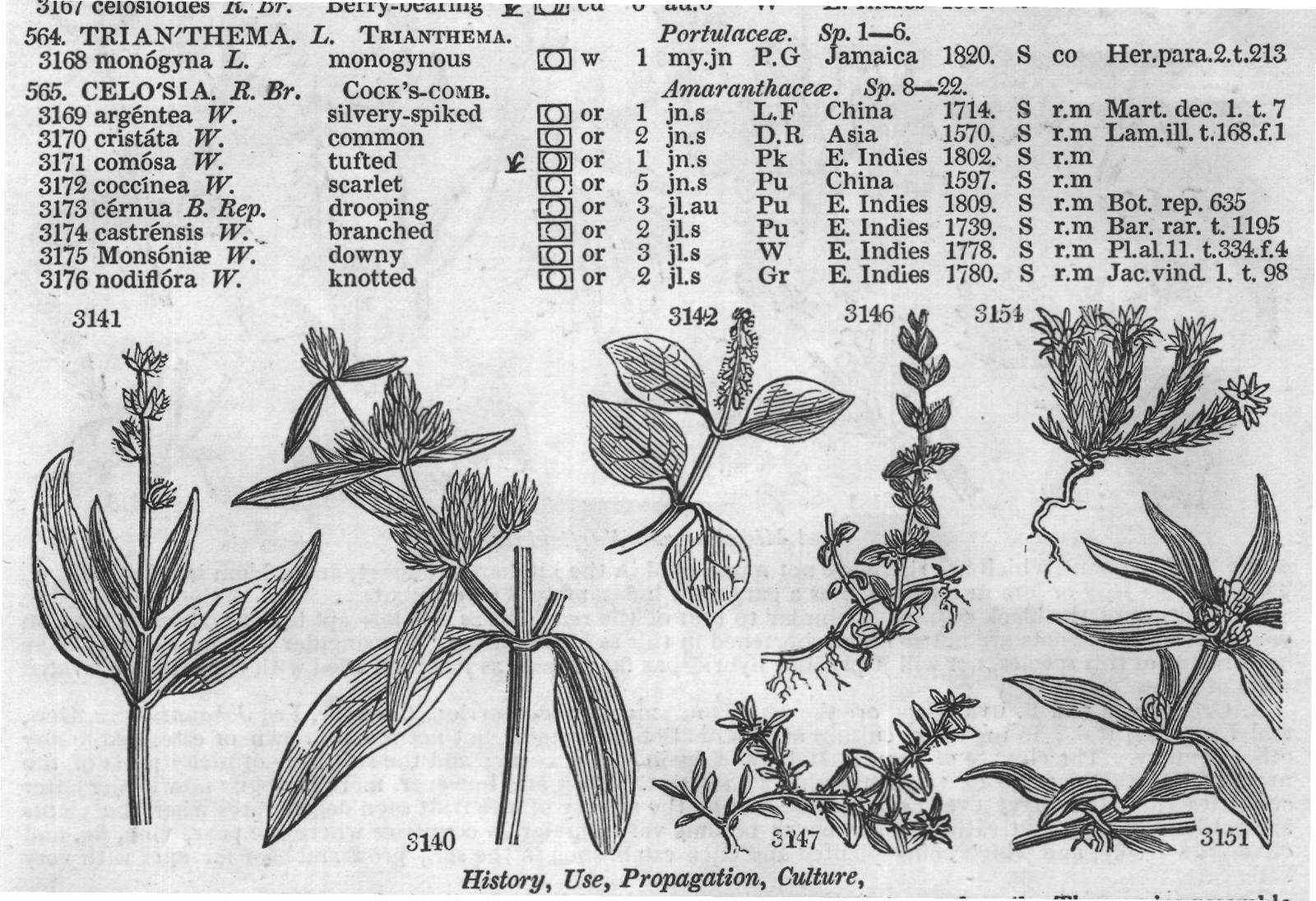
N. Holl. 1823. C co N. Holl. 1823. C co 3169 argentea W. silvery-spiked or 1 jn.s L.F China 1714. Sr.m Mart. dec. 1. t. 7 3170 cristáta W. common or 2 jn.s D.R Asia 1570. Sr.m Lam.ill. t.168.f.1 3171 comósa W. tufted or 1 jn.s Pk E. Indies 1802. S r.m 3172 coccínea W. scarlet or 5 jn.s Pu China 1597. S r.m 3173 cérnua B. Rep. drooping or 3 jl.au Pu E. Indies 1809.
Sr.m Bot. rep. 635 3174 castrénsis W. branched or 2 jl.s Pu E. Indies 1739.
Sr.m Bar. rar. t. 1195 3175 Monsóniæ W. downy or 3 jl.s W E. Indies 1778.
Sr.m Pl.al.11. t.334.f.4 3176 nodiflóra W. knotted or 2 jl.s Gr E. Indies 1780.
Sr.m Jac.vind. 1. t. 98 3141 3142 3146 3154 3140 3147 3151 History, Use, Propagation, Culture, 553. Philoxerus. From φiλoς, a lover, and ξηρoς, arid; a plant delighting in sandy soil. The species resemble Gomphrena or Achyranthes. 554. Desmochata. From δεσμoς, a bond, and χaiτa, a sheath, in allusion to the coherence of the flowers in their heads. It was called Pupalia by Jussieu, from its Malabar appellation. Plants nearly related to Achyranthes, in which they were included by Linnæus. 555. Illecebrum. A name of Pliny, designating a kind of wild purslane. It is now applied to singular little weed-like plants, with white scarious stipules to their leaves. 556. Alternanthera; that is to say, alternate anthers, those organs being by turns fertile and barren. 557. Paronychia. Something which cures whitlows, or maladies of the finger nails, called by the Greeks the finger nails, called by the Greeks These are dwarf plants which grow in light soil, and are well adapted for pots or rock-work. 558. Chenolea. From χηv, a goose, and olea, an olive. The leaves are silvery, like those of the olive; the plant humble like the Goosefoot. This plant is noticed for its silvery leaves: it is propagated by young cuttings planted under a hand-glass. 559. Anychia. A word with the same meaning as Paronychia (in No. 557.), and a genus with similar habits. ORDER I.
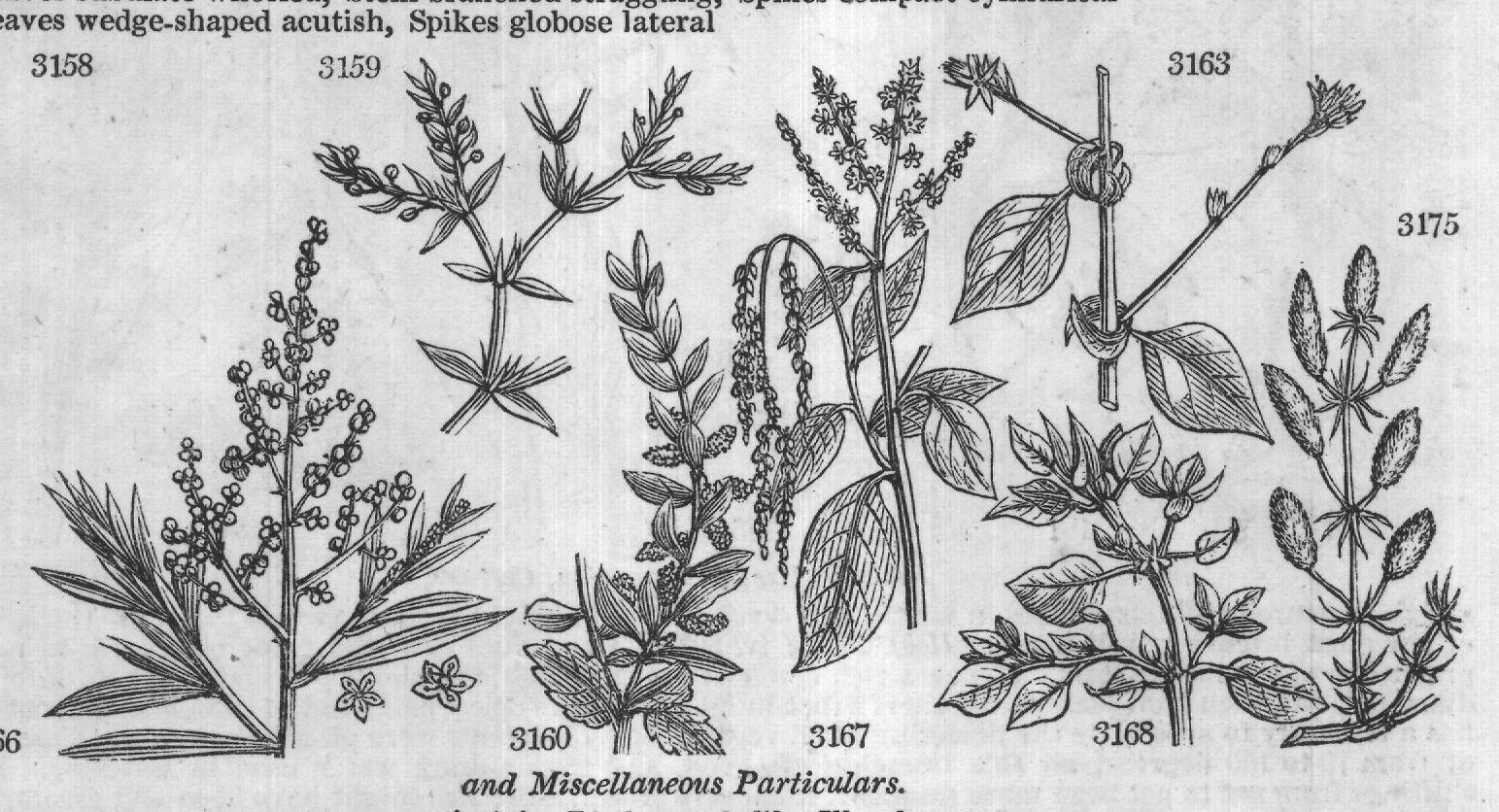
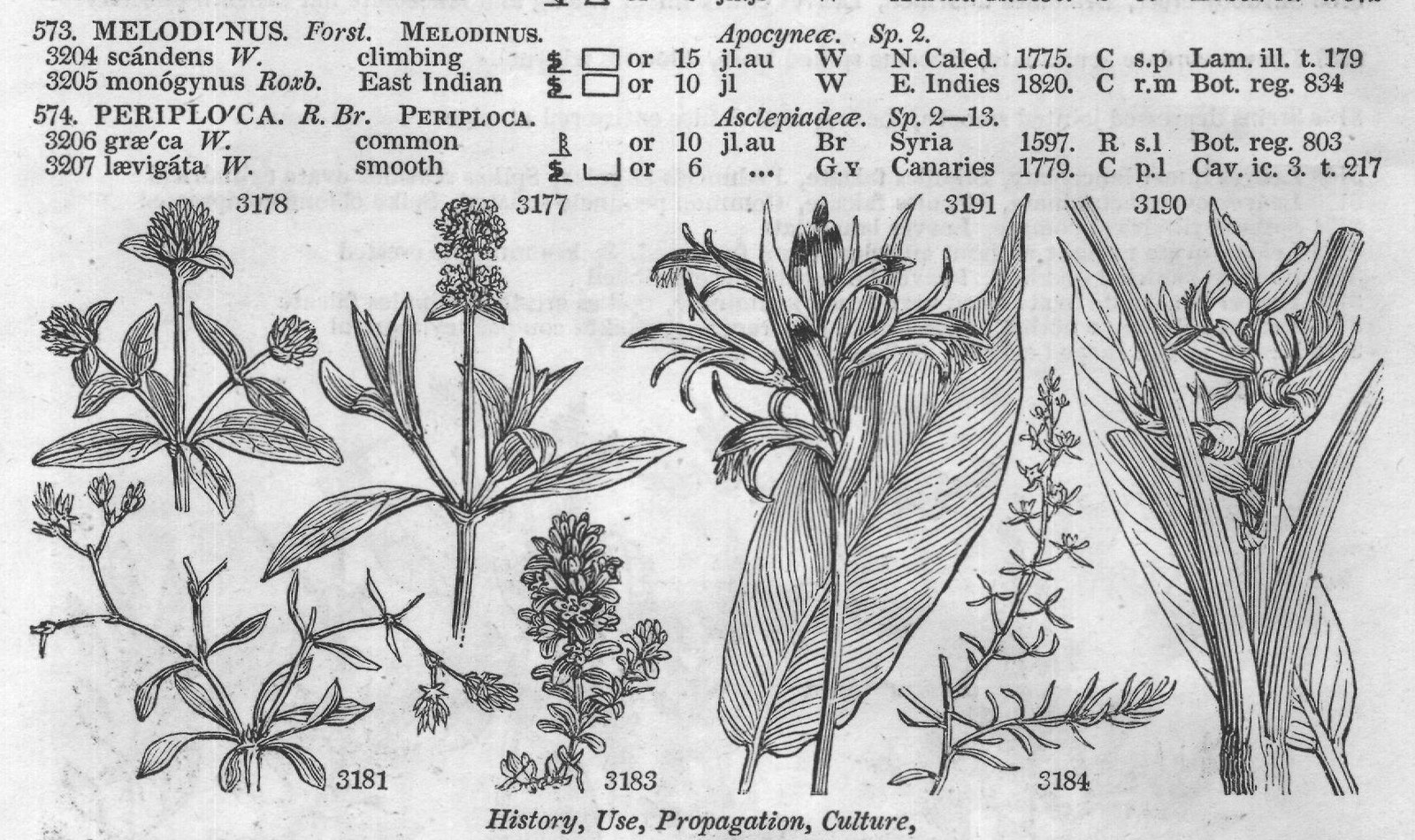
PENTANDRIA MONOGYNIA. 3139 Stems creeping, Leaves rounded fleshy, Heads solitary terminal oblong 3140 Stem erect shrubby, Leaves ovate oblong acuminate, Heads round stalked leafless 3141 Stem -shrubby spreading smooth, Leaves opp. ovate acum, roughish, Flowers with long purple bristles 3142 Stems shrubby prostrate, Leaves opposite ovate, Fascicles of flowers remote spreading at length reflexed 3143 Stem shrubby spreading, Leaves alternate ovate naked, Fasc. of flowers remote ovate, Bristles callous 3144 Stem erect, Leaves alternate ovate smooth, Racemes many, Fascicles ovate remote, Bristles callous 3145 Stem shrubby spreading pubescent, Flowers in round prickly spikes 3146 Stems filiform smooth, Leaves roundish, Calyxes 5-cornered bearded 3147 Stem branched erect, Leaves rounded smooth bearded, Flowers cymose, Bractes very short 3148 Stem branched prostrate, Flowers clustered axillary naked, Calyxes ventricose beneath hairy 3149 Heads sessile, Flowers smooth three times as long as utricle, Leaves ovate mucronate unequal 3150 Stems creeping hairy, Leaves broad lanceolate stalked, Heads round naked 3151 Heads subsessile, Calyx ovate acuminate nearly as short again as utricle, Leaves ovate lanceolate 3152 Stems creeping smooth, Leaves broad lanceolate stalked, Heads round pubescent 3153 Leaves ovate lanceolate deflexed, Flowers axillary clustered, Cal. spiny, Stem tomentose dichotomous 3154 Stems rising, Leaves carinate oblong ciliated at base, Flowers terminal mixed among the bractes 3155 Stems sub-erect much branched, Leaves spreading villous, Brastes very large concealing the flowers 3156 Stems diffuse, Leaves ovate, Flowers heaped, Bractes shining ocumbent, Leaves smooth 3157 Flowers surrounded by shining bracteæ, Stems procumbent, Leaves smooth 3158 The only species 3159 Stem dichotomous, Leaves lanceolate: of the stem opposite, of the branches altern. Flowers sol. axillary 3160 Stem herbaceous erect, Flowers lateral woolly, Leaves alternate ovate 3161 Leaves lanceolate downy, Spikes cylindrical numerous terminal 3162 Leaves ovate oblong, Stem rising panicled, Spikes alternate terminal remote 3163 Leaves ovate acuminate flat, Raceme loose, Bractes scarious, Pistil trifid 3164 Shrubby smooth, Cauline leaves spatulate, Stem leaves lanceolate, Flowers heaped spiked 3165 Half shrubby erect, Branches diffuse, Leaves nearly opp. hastate entire smooth 3166 Shrubby erect, Branches unarmed, Leaves entire linear oblong and lanceolate flat beneath powdery 3167 Leaves cordate acuminate, Raceme spiked loose, Flowers trigynous 3168 Stems depressed jointed smooth, Leaves oval obtuse entire red at edge 3169 Leaves linear lanceolate, Stipules falcate, Peduncles angular, Spikes scarious ovate cylindrical 3170 Leaves ovate acuminate, Stipules falcate, Common peduncle striated, Spike oblong compressed 3171 Spikes cylindrical comose, Leaves lanceolate 3172 Leaves ovate upright without auricles, Stem furrowed, Spikes multiple crested 3173 Flowers panicled nodding, Leaves lanceolate, Stem ribbed 3174 Leaves lanceolate ovate lined very much acuminate, Spikes crested, Stipules falcate 3175 Leaves subulate whorled, Stem branched straggling, Spikes compact cylindrical 3176 Leaves wedge-shaped acutish, Spikes globose lateral 3158 3159 3163 3166 28 3160 3167 3168 3175 and Miscellaneous Particulars. 560. Ærua. From its Arabic name êroùa. Little weeds like Illecebrum. 561. Lestibudesia. Named by M. du Petit Thouars, after Fr. Jos. Lestiboudois, a Flemish botanist, author of a work called Botanographie Belgique, published in 1781. The species are readily increased either by seeds or cuttings. 562. Rhagodia. From ῥaγωδης, bearing berries. The fruit is a small berry, by which character the genus is chiefly distinguished from Chenopodium. 563. Deeringia. Named by Mr. Brown, in memory of Dr. Charles Deering, author of a Flora of Nottingham, and a skilful botanist of his day. Weak shrubs, with terminal spikes of flowers, and a berried inflated pericarp. 564. Trianthema. From τρεiς, three, and avθoς, flowers. The flowers are frequently placed in threes in the axillæ of the leaves. Little tropical weeds. 565. Celosia. From κηλεoς, burnt, because the flowers of some species appear as it were singed. C. cristata is a well known tender annual, of which there are many varieties, as in the balsam, and which, like that plant, will attain a large size and singular beauty by repeated shiftings. Thunberg states that the flowers or crests are frequently a foot in length and breadth in Japan. T. A. Knight sent a flower to the Horticultural Society 3177 globósa W. annual 3178 perénnis W. perennial 3179 arboréscens W. tree 3180 interrúpta W. trailing PENTANDRIA DIGYNIA. 566. GOMPHRE'NA. R. Br. GLOBE AMARANTH.