Important: Safety Warning
This page states that certain wild plants are safe to eat. Its identifications and edibility claims are more than a century old and in some cases simply wrong, and deadly look-alikes exist for many edible species. Never eat a wild plant on the strength of this text.
This page prescribes plants as medicine according to pre-modern medical theory. Several of the plants named are toxic, correct identification is difficult, and the doses given have no scientific basis. Do not ingest or apply any preparation described here.
This information has been left in for historical purposes but should not be acted upon.
Home › E › Eng (Bot History Use Propagation) (V)
Eng (Bot History Use Propagation) (V)
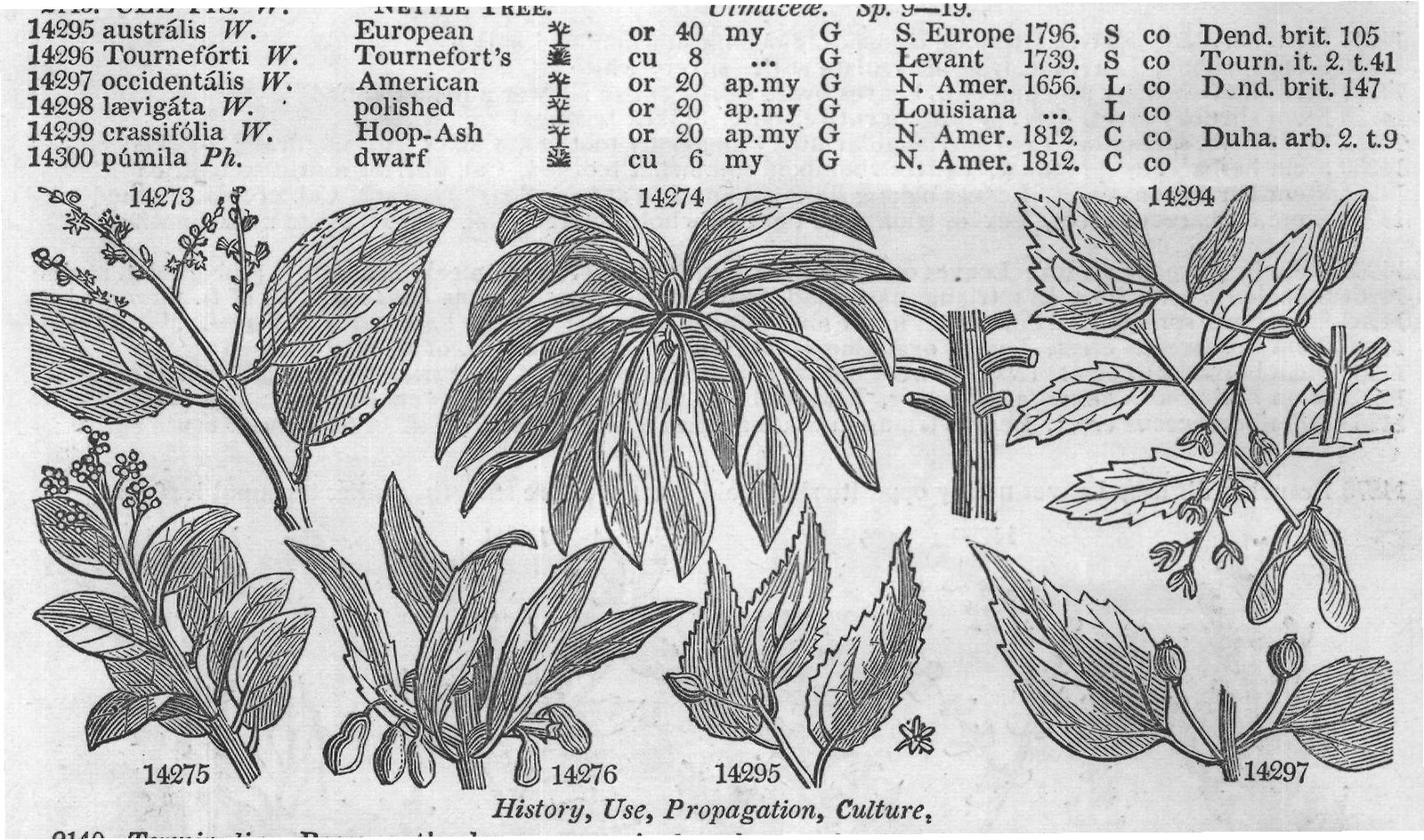
bot. 304 14275 14276 14295 14297 History, Use, Propagation, Culture, 2140. Terminalia. Because the leaves grow in bunches at the termination of the branches. The species grow in loam and peat, and ripened cuttings, with their leaves on, will root in sand closely covered. 2141. Fusanus. The ancient name of the Euonymus. This plant resembles it in foliage. A little Cape shrub, formerly included in Thesium. , formerly included in Thesium. 2142. Brabejum: From βρaβείov, a sceptre. The elegant racemes of splendid flowers may well be compared to a sceptre. 2143. Acer. A Latin word signifying vigorous or sharp. The wood was formerly manufactured into the heads of pikes and other weapons. The species consist of trees, most of them yielding a saccharine juice from of pikes and other weapons. The species consist of trees, most of them yielding a saccharine juice from the trunk, branches, and leaves. A. Pseudo-Platanus, Plane tree, Scot., grows wild in Switzerland, Germany, Austria, and Italy. It is remarkably hardy, and will grow with an erect stem, exposed to the highest winds, or to the seabreeze. It is in leaf by the middle of April; and on their first appearance the leaves are of a pleasant green, but they exude a clammy juice so abundantly, that they attract a variety of insects, which soon perforate and disfigure them. The flowers of none of the species are of any beauty. The shade of the tree is said to do less damage to pasture than most trees. The timber was formerly much used by the turner, and is still in repute by the saddle-tree maker and the millwright. In spring and autumn, if the trunk be pierced, it yields abundance of juice, from which a good wine may be made, or sugar to a certain extent procured by evaporation. A. rubrum grows in swamps in Pennsylvania, where the natives use it for almost all sorts of wood-work; with the bark they dye a dark blue, and make a good black ink. The Canadians tap the tree for the juice, of which they make sugar and treacle. The scarlet flowers of this species come out in spring before the leaves; they are without petals, and have not more than six stamens. A. saccharinum bears a considerable resemblance to A. platanoides, especially when young. From this tree, and probably also from other species, the inhabitants of North America make a very good sort of sugar. The trees are tapped in February, March, and April, during warm days and frosty nights. The incision is made with an axe or auger, or about two inches deep. A spout of sumach or elder is introduced, through which the sap flows, from four to six weeks, into a trough, whence it is carried daily to a larger receiver; from which it is conveyed after being strained to the boiler. The boiling and refining process is or should be carried on in the same manner with that for the cane sugar in the West Indies. A tree of an ordinary size yields in a good season from twenty to thirty gallons of sap, from which are made from five to six pounds of granulated sugar.
A. platanoides grows on the mountains of the northern counties of Europe, déscending in some places of ORDER 1.
POLYGAMIA MONECIA. 14271 Leaves ooovate without glands at base blunt obsoletely toothletted: beneath soft with down 14272 Leaves obovate without glands at base blunt entire smooth on each side 14273 Leaves obovate oblong blunt entire smooth on each side, Petioles with 2 glands above 14274 Leaves linear-lanceolate repand downy beneath 14275 The only species 14276 The only species 14277 Leaves evergreen entire and 3-lobed obsoletely toothletted smooth on very short stalks 14278 Leaves cordate somewhat cut unequally toothed, Corymbs erect, Fruit smooth 14279 Lvs. cord. 5-lobed glauc. and smooth beneath: lobes unequally tooth. Racemes pendulous, Fruit smooth 14280 Lvs. on long stalks subcordate 5-fid smooth glauc. beneath: segm. acuminate cut-toothed, Umbels erect 14281 Lvs. cordate 5-fid whitish and smooth beneath: segm. acuminate cut-toothed, Fl. in capitate umbels 14282 Lvs. shortly 3-lobed serrated smooth on each side: male peduncles branched; female simple 14283 Lvs. subcord, acutely 5-lobed downy beneath: lobes nearly entire, Corymbs before the lvs. loose nodding 14284 Lvs. cordate 5-lobed downy beneath, Corymbs sessile nodding, Fruit smooth 14285 Lvs. cordate 5-fid smooth: segm. acuminate cuspidate somewhat toothed, Corymbs nearly erect 14286 Lvs. cordate 3-fid acuminate serrated smooth, Racemes simple long pendulous, Branches striated 14287 Lvs. about 5-lobed acute serrated downy beneath, Racemes compound erect 14288 Lvs. cord. bluntly 5-lobed shining smth. beneath: lobes nearly ent. Corymbs erect, Wings of fruit divaricat. 14289 Lvs. on long stalks round. coriac. bluntly 5-lob. pale ben.: lobes bluntly tooth. Corymbs erect, Fruit smth. 14290 Lvs. cord. 5-lobed glauc. beneath netted: lobes blunt crenate-tooth. Umb. pendul. Pedun. and fruit smooth 14291 Lvs. annual cordate 3-lobed: lobes nearly entire equal, Corymbs few-flowered erect, Fruit smooth 14292 Lvs. cordate slightly and very bluntly 5-lobed downy beneath: lobes repand, Umbels pendulous 14293 Lvs. evergreen tapered at base 3-fid: segments toothletted; lateral shortest, Corymbs few-flowered erect 14294 Leaves ternate and pinnate cut serrate, Male flowers corymbose: female racemose 14295 Leaves oblong-lanceolate acumin. finely serrated scabrous above beneath soft with down unequal at base 14296 Leaves ovate acute serrated unequal at base roughish above: younger somewhat cordate 14297 Leaves ovate acuminate serrated unequal at base rough above hairy beneath 14298 Leaves unequally cordate acuminate nearly entire smooth on each side 14299 Leaves ovate acuminate serrated unequally cordate at base subcoriaceous rough on both sides 14300 Leaves unequal at base ovate acuminate serrated smoothish on each side 14279 14273 14287 14280 14283 14288 and Miscellaneous Particulars.
Norway to the sea-shore. It abounds in the north of Poland and Lithuania, and is common through Germany, Switzerland, and Savoy. On a tolerable soil it attains a large size, and the leaves being smooth and of a shining green, as large or larger than those of the sycamore, and being seldom eaten or defaced, because the tree abounds in a sharp milky juice disliked by insects, they have a much better appearance than those of the sycamore; and in the spring, when the flowers are out, which are of a fine yellow color, this tree has great beauty. Hanbury observes, that in the autumn the leaves die to a golden yellow color, which produces a good effect at that season, when the different tints of the decaying vegetable world are displayed. He says further, that it is a quick growing tree, arrives at a great bulk, and is one of the best trees for sheltering habitations. Linnæus recommends it for sheltering walks and plantations; as yielding a juice from which sugar may be made, if it be wounded in the winter; and as cutting out into a white smooth wood, fit for the stocks of guns, the joiner and the turner. Dr. Hunter observes, that it is a quick grower, arrives at a great bulk, and answers all the purposes of the sycamore; the raising it for use, as well as ornament and variety, should not be neglected. (Mill. Gard. Dict.) A. striatum has a slender stem, with a smooth bark beautifully varied with green and white stripes, the boughs of a shining red in winter. The thickness of the shade, the beauty of the bark, and the tree not being liable to insects, render it very desirable for ornamental plantations; the only objections to it are, that it is subject to be injured by storms, and that the abundance of its foliage and seeds occasions a great litter in autumn.
A. campestre forms a very picturesque little tree, and the timber is said to be far superior to that of the beech or the sycamore for the purposes of the turner. It is also frequently substituted for that of the holly and box by the mathematical instrument maker.
A. Opalus is a noble tree, with large and beautiful foliage, throwing an extensive shade; it is much prized in Italy for planting by avenues and public walks. All the species are easily raised from seed, though the ashleaved and some other species are occasionally propagated by layers and cuttings; the cuttings should be cut off at a joint, and, as in the case of most hardy trees and shrubs, they succeed best when planted in the autumn in a sheltered situation in the open ground. 2144. Negundium. A genus obviously distinguished from Acer by its pinnated leaves. A fine ornamental tree, called in North America black ash. There is another species in China. 2145. Celtis. One of the names anciently given to the Lotus. Tournefort first applied the name to the modern genus, which may be said to resemble both in fruit and foliage the shrubby Lotus of the ancients. 3 K 14301 sinensis Pers. 14302 micrántha W.
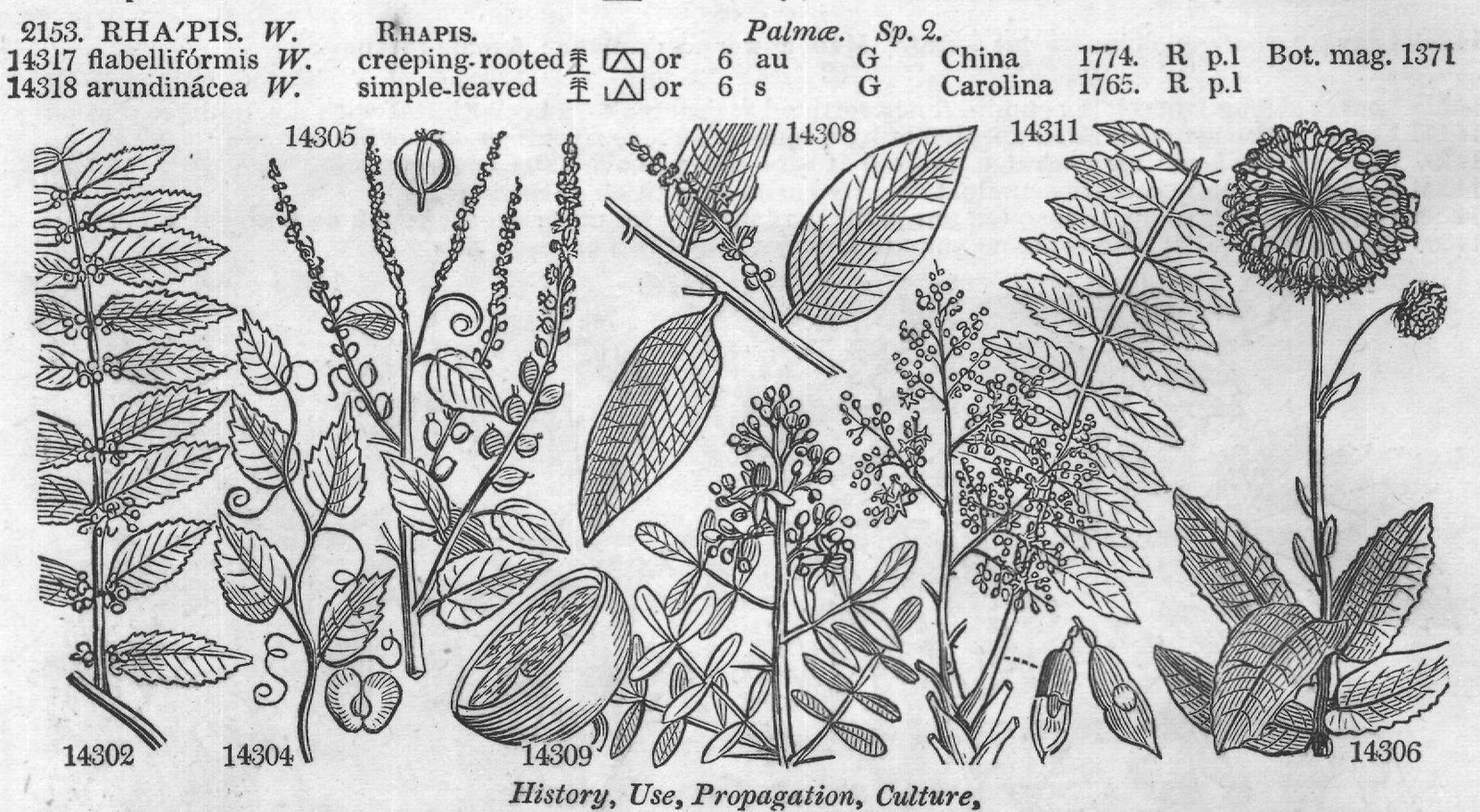
Chinese smooth 14303 aculeáta W. prickly or 12 G or 10 au.s G or 10 G POLYGAMIA MONECIA.
CLASS XXIII.
Asia 1820. L p.l Jamaica 1739. C p.l Plum.ic.t.206.f.1 Jamaica 1791. C p.1 2146. GOUA'NIA. W. 14304 domingénsis W.
GOUANIA.
Chaw-stick 14305 tiliæfólia W.
Lime-tree-lvd. or 10 or 10 ...
Rhamneæ.
G G Sp. 2-20.
W. Indies 1739. C p.l Pluk.al. t.201.f.4 ...
E, Indies 1810. C p.l Rox. cor. 1. t. 98 2147. HER'MAS. W.
HERMAS.
Umbelliferæ. Sp. 2-5. 14306 depauperáta W. hairy Acu 2 jn.jl G 14307 gigantéa W. gigantic cu 4 jn.jl G C. G. H. 1795. D l.p C. G. H. 1794. D l.p Bur. afr. t.71. f.2 T.in.ac.p.14.t.11 2148. BRIDE'LIA. W. BRIDELIA.