Home › E › Eng (Bot Mill ic t Jac vind t Dun)
Eng (Bot Mill ic t Jac vind t Dun)
bot. 565 Mill. ic. 2. t. 294 Jac. vind. 1. t.12 Dun. sol. t. 11 Sabb. rom. t. 59 P 4 jn.s G Guinea ...
Ss.l Jacq. ic. 2. t. 326 Di.elt. t. 274.f.354 p 2 jn.s W Virginia ...
Ss.I Di.elt.t 275.f.356 Barbary 1804. C l.p P 3 jn.s W W 4 jn.jl W W 1 jn.jl W W 5 jn.s W Barbadoes ... 2543 pátulum W. spreading or 4 jn.s V India ...
Britain rub. S s.l Eng. bot. 566 S. Europe 1823. S co S. Europe 1823. S co S s.1 Di.elt.t.274.f.353 Ss.l Di.elt.t.275.f.355 2544 críspum Fl. per. 2545 bombénse-Jacq.
Natre or 18 jn.jl W Chili 1824. C co Fl. per. 2. t. 158 Bomba or 12 jn.jl W Mexico 1822. C co 2546 Cervantésii Lag. 2547 verbascifólium W. 2548 auriculátum W.
Cervantes's or 4 my.jn W Mullein-leaved or 7 jn.jl W ear-leaved or 4 V ... 2549 diphýllum W. 2550 havanénse W. two-leaved or 3 jn.jl W Havannah 2551 lycioídes W. 2552 uniflórum Lag. spiny one-flowered or 3 my.jn B 2556 ígneum W. 2557 subarmátum W. 2558 bahaménse W. 2553 stellátum Jacq. 2554 elæagnifólium Cav. Oleaster-leaved 2555 racemósum W. wave-leaved red-spined half-armed Bahama stellate or 6 jn.jl B ...... or 5 jlau B or 4 my.jn Pa.B C s.l Mexico 1818. C co W. Indies 1749. S p.1 Madagasc.1773. S p.1 W. Indies 1699.
W. Indies 1793.
Peru 1791. Cs.p N. Spain 1820. D co 1822. C co Jac. vind. 1. t.13 Scop. insub.3. t.8 Jac. ic. 2. t. 322 Jac.amer.49.t.35 Jac. ic. 1. t. 46 Jac. ic. 2. t. 325 or 6 jn.jl B or 4 jl.au W Chili 1823. C co W. Indies 1781. C co Cav. ic. 3. t. 243 Jac.amer.50.t.36 or 3 mr.n W S. Amer. 1714. C s.p Jac. vind. 1. t. 14 or 6 my.jn W 1820. C co ...... or 6 jn.jl V Bahama 1732. S p.l Di.elt.t.271.f.350 2559 tomentósum W. woolly or 2 jn.jl B C. G. H. 1662. C p.1 Bocc. sic. 8. t. 5 2560 lanceæfólium Jacq. lance-leaved or 10 jl.au W W. Indies ...
C co Jacq. ic. 2. t. 329 2561 bonariénse W.
Buenos Ayres or 10 jn.s W B. Ayres 1727.
C s.l D.e.364.t272f351 2562 subinérme W. spear-leaved or 7 jl.au B W. Indies 1752.
C 1.p Jac.amer.t.40.f.3 2563 lanceolátum Cav. lanceolate or 7 jn.jl Pa.B Mexico C s.l Bot. mag. 2173 2564 gigantéum W. tall or 15 jn.jl V C. G. H. 1792.
C s.p Bot. mag. 1921 2533 2539 2542 2530 2535 History, Use, Propagation, Culture, 2547 2549 in his Herbal, published in 1597, gives a figure of the potatoe, under the name of Potatoe of Virginia, whence he says he received the roots; and this appellation it appears to have retained, in order to distinguish it from the battatas or sweet potatoe (Convolvulus battatas) till the year 1640, if not longer. "The sweet potatoe," Sir Joseph Banks observes, "was used in England as a delicacy long before the introduction of our potatoes; it was imported in considerable quantities from Spain and the Canaries, and was supposed to possess the power imported in considerable quantities from Spain and the Canaries, and was supposed to possess the power of restoring decayed vigor. The kissing comfits of Falstaff, and other confections of similar imaginary qualities, with which our ancestors were duped, were principally made of these and of eringo roots." Gough says the potatoe was first planted by Sir Walter Raleigh on his estate of Youghall near Cork, and that they were soon after carried into Lancashire. Gerrarde and Parkinson, however, mention them as delicacies for the confectioner, and not as common food. Even so late as Bradley's time they are spoken of as inferior to skirrets and radishes The use of potatoes, however, became more and more known after the middle of the 18th century, and has greatly increased in all parts of Britain within the last thirty years. It is also very general in Holland, and many parts of France and Germany, and is increasing rapidly in Russia. In Spain, and the East and West Indies they are not much cultivated, owing to the heat of the climate; but in all the temperate parts of North America, Australasia, and South America they are grown by the colonists. In China they are cultivated, but not extensively, owing to the slow progress which every thing new makes in that country. Indeed, no root hitherto discovered is so well adapted for universal use as the tubers of the potatoe; for, having no peculiarity of taste, and consisting chiefly of starch, their farina is nearly the same as that of grain. Hence, with the flower of potatoes, puddings, and such preparations as do not call the gluten of wheat-flower into action, may be made equal to those of millet or rice, and excellent bread with a moderate proportion of good wheat-flour. made equal to those of millet or rice, and excellent bread with a moderate proportion of good wheat-flour. Potatoe starch , independently of its use in the laundry, and as a hair powder, is considered an equally delicate food as sago or arrow-root. As starch and sugar are so nearly the same, that the former is easily converted into the latter, the potatoe yields a spirit equal to that of malt by distillation, and a wine or beer by the fermentative process The varieties of the potatoe are very numerous, differing in earliness, lateness, form, size, color, and quality. The names for these are quite arbitrary or local. In general, every district has its peculiar or favorite varienames for these are quite arbitrary or local. In general, every district has its peculiar or favorite varieties. Some of these degenerate, and others improve when removed from one district to another. New varieties ORDER I.
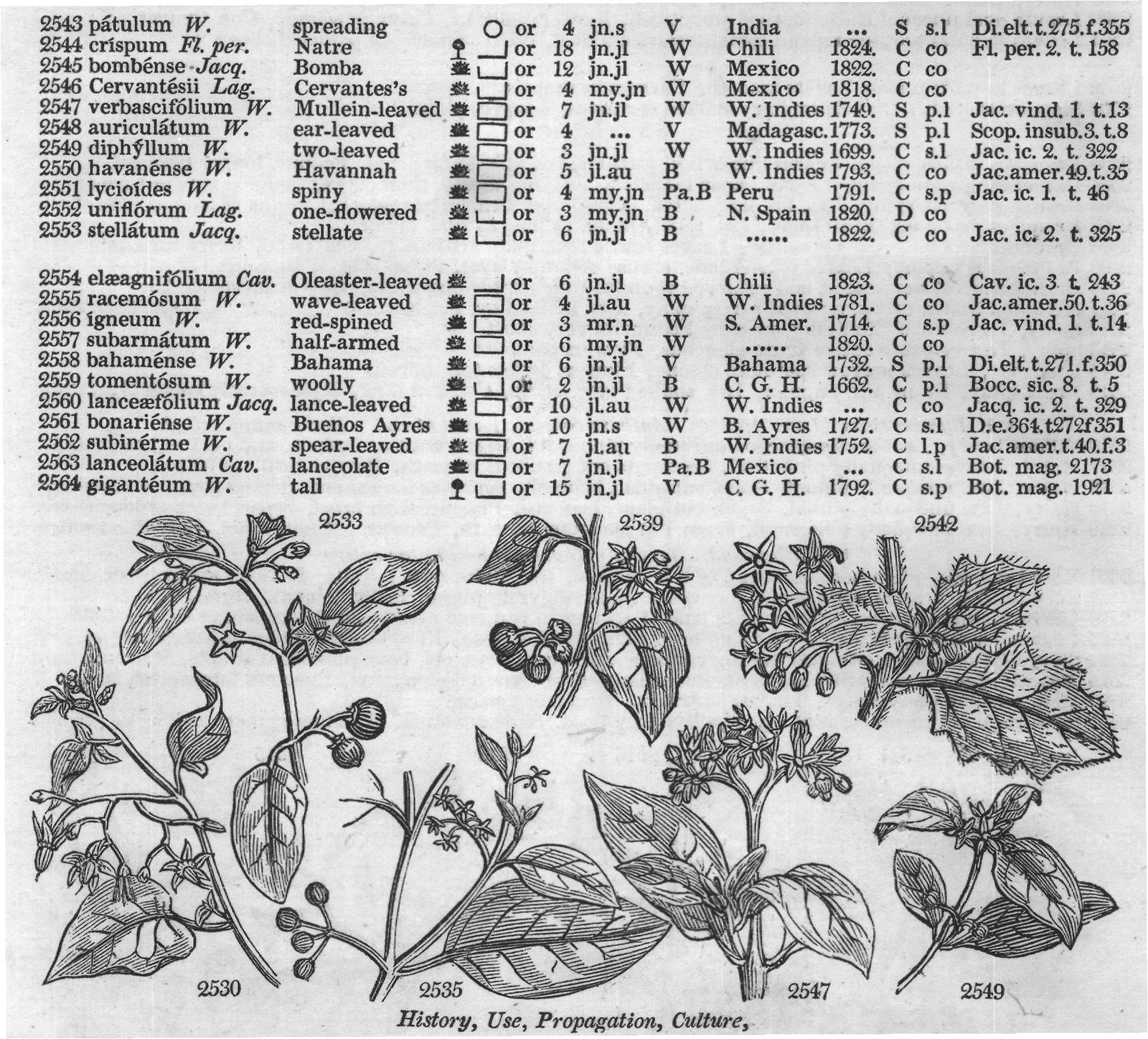
PENTANDRIA MONOGYNIA. 3. Unarmed. Leaves lobed, sinuate, angular, toothed, or entire. 2528 Leaves ovate lanceolate entire or lobed, Racemes cymose opp. to the leaves, Cor. 5-parted 2529 Leaves lanceolate sinuate tomentose bright-green, Pedunc. few-flowered, Sepals ovate acute 2530 Stem wavy, Leaves ovate cordate upper lanceolate, Corymbs opposite the leaves 2531 Stem smooth, Leaves cuneate at the base sinuate smooth, Peduncles few-flowered short 2532 Leaves ovate repand angular smooth, Peduncles 1-flowered cernuous, Berries torulose 2533 Leaves ovate angular repand smooth unequal at base, Pedunc. 1-flowered cernuous, Berries round 2534 Leaves oblong lanceolate subrepand, Peduncles 1-flowered outside the leaves 2535 Branches rounded, and leaves smooth ovate entire, Flowers umbelled 2536 Branches smooth angular toothed, Leaves ovate smooth entire, Flowers numerous umbelled 2537 Stem and branches angular toothed, Leaves subovate sinuate angular, Flowers umbelled 2538 Leaves ovate toothed angular ciliated, Umbels extrafoliaceous stalked 2539 Stem angular, Leaves ovate toothed naked, Flowers in umbels 2540 Branches strigose pubescent angular winged, Wings toothed, Leaves ov. rep. smooth, Flowers in umbels 2541 Branches angular toothed pubescent, Leaves ovate repand upper entire, Flowers in umbels 2542 Stem rounded villous, Leaves ovate angular toothed villous hoary, Flowers in umbels 4. Unarmed. Leaves quite entire. 2543 Stem shrubby, Branches powdery, Leaves oblong lanceolate powdery on both sides, Racemes spreading 2544 Leaves ovate and subcordate waved curled acuminate, Flowers corymbose 2545 Leaves oval pointed at each end smooth, Racemes cymose 2546 Stem erect, Leaves ovate lanceolate attenuated at each end pubescent, Racemes 2 and 3-chotomous 2547 Leaves ov. obl. acuminate entire downy, Surface discol. Axils leafless, Corymbs terminal dichotomous 2548 Leaves ovate oblong acuminate woolly axillary, Leaflets semicircular, Corymbs di-trichotomous 2549 Lvs. in pairs one obl. narrow. towards each end obt. other smaller obov. ellipt. Cymes stalk. opp. the lvs. 2550 Leaves ovate lanceolate acute shining smooth, Peduncles 1-flowered, Berries oval 2551 Branches spiny, Leaves elliptical, Peduncles filiform 1-flowered 2552 Stalks axillary 1-flowered, Cal. 10-cleft, Leaves mostly in pairs subsessile elliptical 2553 Stem climbing flexuose, Lvs. ovate lanc. smooth acuminate, Pedunc. in pairs, Cal. unequally toothed §5. Prickly. Leaves entire or sinuate-angular. 2554 Leaves discolored the lower sinuate prickly upper entire unarmed, Pedunc. few-flowered 2555 Stem unarmed, Leaves lanceolate repand undulated acute 2556 Leaves lanceolate acuminate revolute on both sides at the base 2557 Stem prickly, Leaves lanceolate pubescent beneath entire edge revolute at base 2558 Leaves lanceolate repand obtuse reflexed at edge 2559 Stem prickly, Prickles acerose, Leaves cordate unarmed repand wavy, the young ones purple. 2560 Leaves lanceolate oblong attenuate at each end roughish beneath prickly, Raceme short unarmed 2561 Stem nearly unarmed, Leaves ovate oblong sinuate repand rough, Corymb extrafoliaceous stalked 2562 Stem nearly unarmed, Leaves lanceolate ellipt. entire above smooth beneath tomentose, Cymes mealy 2563 Stem downy, Leaves lanceolate long entire hoary beneath, Racemes terminal, Sepals subulate 2564 Stem with downy prickles, Leaves lanceolate acute unarmed above smooth beneath hoary 2554 2551 2553 2556 2553 2563 2560 2564 and Miscellaneous Particulars. are readily procured by sowing the seeds, which, with care, will produce tubers the third year, and a full crop the fourth. As few of the early sorts produce blossoms, to procure seeds from them deprive the plant of its tubers as they appear, and keep the runners from which they proceed above ground, by not earthing up the plant, and blossoms and seeds will soon be produced. This Mr. Knight completely proved, and the rationale is developed in the Philosophical Transactions for 1806. It appears that the same sap gives existence both to the tuber and blossom, and that whenever a plant of the potatoe affords either seeds or blossoms, a diminution of the crop of tubers, or an increased expenditure of the richness of the soil, must necessarily take place. This led Mr. Knight to attempt the practice adopted by the Dutch florists with their bulbous flowers, viz. to pinch off the flowers to strengthen the bulbs. This, in the potatoe, Mr. Knight thinks may add an ounce in weight to the tubers of each plant, or considerably above a ton per acre. The practice is now general among scientific cultivators even in field culture.
The curl is a well known disease of potatoes, which frequently disappoints the cultivator of a crop, or renders that produced of little value. A great variety of opinions exist as to this disease: without enumerating these, we may state, as the general result of experiments by different persons, that the curl arises in most, or at least in many cases, from using over ripe tubers as seed stock, or from the employment of seed stock which has been injured or improperly kept during the winter; that is, kept exposed to the light and air instead of being covered with earth, or sand, or straw, so as to preserve their juices. The experiments of various farmers and gardeners, as recorded in the Farmer's Magazine and Caledonian Hort. Mem., lead to the above conclusions. The culture of the potatoe, both in the field and garden, is universally known. It may be forced in pots or on dung or tan beds; and, for this purpose, using sets from tubers that have been retarded a year in an icehouse or cold place, is found a great advantage. Thus, in planting in December 1823, use tubers of crop 1822. These, from the long period of repose which they have had, will be found highly exciteable by heat, and of much more rapid growth than sets of the preceding crop. As matter of curiosity, boxes containing alternate layers of light earth and potatoes of the last season but one may be placed in any dry covered place, free from frost, in November, and they will produce a brood of young tubers in contact with the old ones on the December following, without either leaves, roots, or runners. (Hort. Trans. i. 225.) Potatoes are best preserved by burying in pits in dry ground, so deep as to be under the influence of surface temperature, or so enveloped with thatch as to produce the same effect. At a certain depth, they will keep 2565 Melongéna W. 2566 insánum P. S.
Egg-plant Mad-apple cul 2 jn.jl B or 2 au.s B 2567 ovígerum Dun. oval-egg-plant or 2 jn.jl B 2568 sodómeum W. black-spined or 3 jn.jl 2569 índicum W.
Indian or 6 jl Pu 2570 coágulans W. scollop-leaved or 3 jl W 2571 marginátum W. white-edged or 4 jn.s Pu 2572 campechiénse W. purple-spined w 2 jl V 2573 aculeatissimum Jac. most-prickly or 3 ap.jl 2574 mammósum W. nipple or 4 jlau 2575 stramónifólium W. broad-leaved or 6 jn.s Pu 2576 férox W.
Malabar w 2 au.s Pu 2577 Milléri W.
Miller's or 3 jl.au W 2578 trilobátum W. three-lobed or 12 au V 2579 carolinénse W.
W 2 jl.s 2580 Pyracantha Sm. orange-thorned or 4 au.s Pu 2581 virginiánum W.
Virginian W 1½ my.au V 2582 Jacquíni W.
Jacquin's w 2 s.n Pu PENTANDRIA MONOGYNIA.
Carolina CLASS V.
Africa, &c.1597. C 1.p Pluk.phy.226.f.2 E. Indies 1815. S 1.p Plu.alm.t.226.f.3 Arabia 1597. S co Africa 1688. Cr.m Her. lugd. t. 575 India 1732. S p.1 Di.elt.t.270.f.349 Arabia Fe.1802. C s.p Jac. schö.4. t.469 Africa 1775. Cs.p Bot. mag. 1928 America 1732. C s.p Di.elt.t.268.f.347 Pa.B S. Amer. 1816. C co Pa.B W. Indies 1699. S s.p W. Indies 1778. C s.p E. Indies 1795. C l.p C. G. H. 1762. C s.l India 1759. C s.p Pa.B Carolina 1732. S p.1 Madagasc.1789. Cr.m Virginia 1662. S s.p E. Indies 1804. S s.p Jacq. ic. 1. t. 41 Plu.alm.t.226.f.1 Jac. ic. 1. t. 44 Jac. ic. 2. t. 330 Bu. in.57.t.22.f.2 Jac. ic. 2. t. 331 Ex. bot. 2. t. 64 Di.elt.t.267.f.346 Jac. ic. 2. t. 332 2583 Balbísii Dun. decurrent or 4 ap.s W 2584 téctum P. S. covered or 3 ap.s Y S. Amer. 1816. C co Mexico 1824. C co Bot. reg. 140 Cav. ic. 4. t. 309 2586 amazonium 452. NYCTE'RIUM. Vent. NYCTERIUM. 2585 cordifólium Vent. 2587 lobátum Nutt. 2588 fontanesiánum Dun. Desfontaines' 453. CAPSICUM. W. CAPSICUM. heart-leaved or 2 ap.my Pu purple or 3 jn.au Pu yellow or 2 jl.au Y or 2 jl.s Y Solaneæ. Sp. 4-7.
Can. Isl. 1779. C co Mexico 1800. C co Louisiana 1813. S co Brazil 1813. S co Solanea. Sp. 18-24.
Vent. malm. 85 Bot. reg. 71 Pursh. am.2. t.7 Bot. reg. 177 2589 ánnuum W. common 2590 sphæricum W. en. cul 1 jn.jl W India globular-fruited cul 2 ap.jl W ...... 1548. S r.m Knor. th. 2. t.c.6 1807. Cr.m 2591 baccátum W.
Bird-pepper 杯 2592 sinénse W. 2593 gróssum W. 2594 frutéscens W. 2595 bícolor Jacq. 2596 cerasifórme W. 2597 péndulum W. en. 2598 lóngum Dec. large shrubby dark-fruited cul 3 jn.s W ...... 1731. Cr.m Sl. ja. 1. t. 146.f.2 oval-fruited cul 2 jn.s W China 1807.
Cr.m Jac. vind. 3. t. 67 cul W India 1759. 业 cul 1 jn.s Pa.Y India 1656.
Sr.m B. ey. a. 1.t.11.f.1 Cr.m Ru. amb. 5. t. 88 cul 4 jn.s Pu W. Indies 1804.
Cr.m Bot. mag. 1835 2599 cordifórme Mill.
Cherry-pepper pendulous long-fruited heart-fruited O cul 1 jn.s Pa.Y W. Indies 1739.
Sr.m cul 2 ap.jl W 1804.
Cr.m O cul 1 jn.jl W India 1548. Sr.m 2600 tetragónum Mill. cul 1 jn.jl W India ...
Sr.m quince-fruited 2601 angulósum Mill. cul 1 jn.jl W India Sr.m ... angular-fruited cul 1 jn.jl W India ...
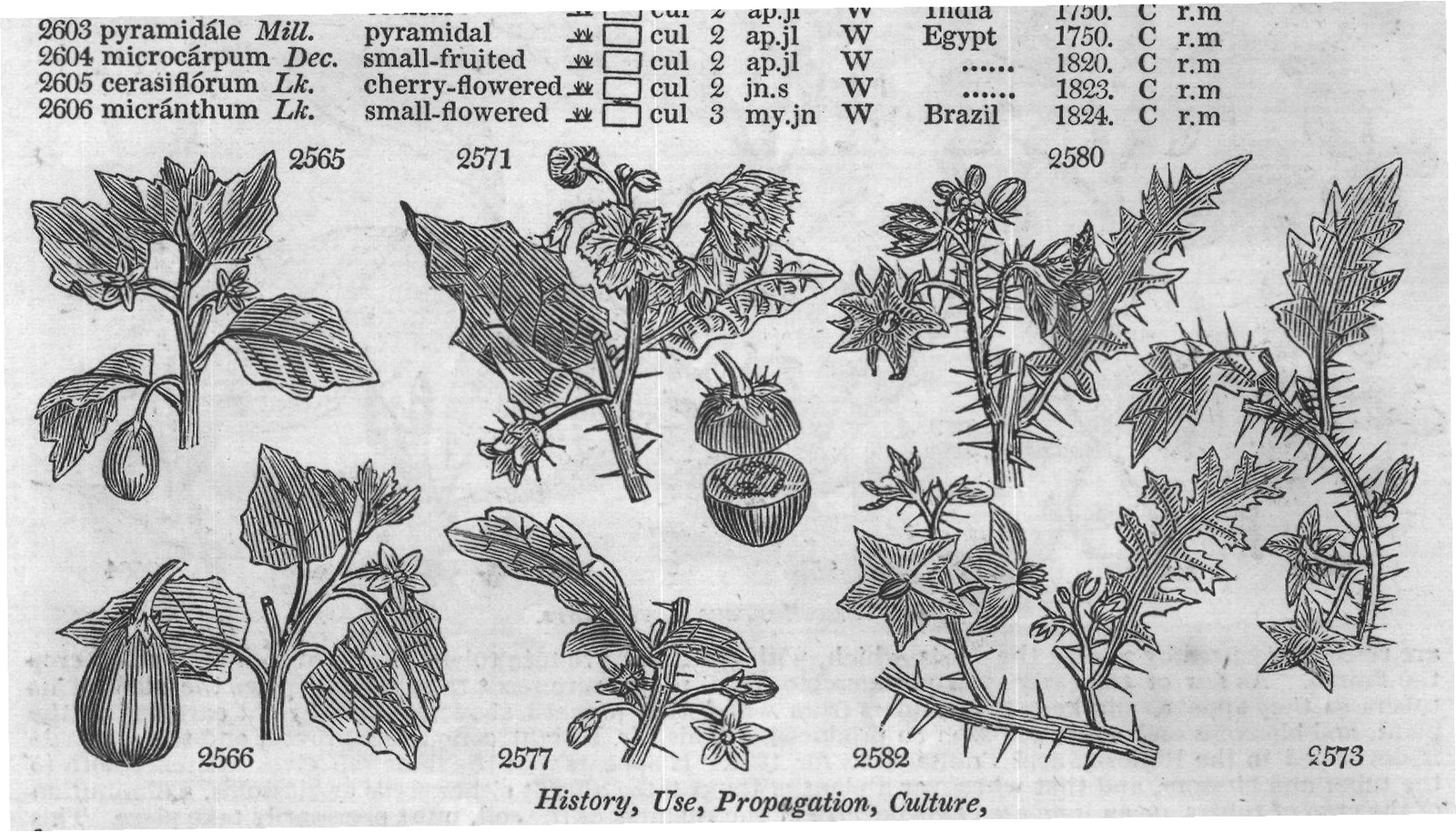
Sr.m 2602 conoídes Mill. conical 2603 pyramidále Mill. pyramidal 杯 2604 microcárpum Dec. small-fruited 2605 cerasiflórum Lk. cherry-flowered 2606 micránthum Lk. small-flowered 00000 cul 2 ap.jl W India 1750. Cr.m cul 2 ap.jl W Egypt 1750. Cr.m cul 2 ap.jl W 1820. Cr.m cul 2 jn.s W 1823. Cr.m cul 3 my.jn W Brazil 1824. Cr.m 2565 2571 2580 2566 2577 2582 2573 History, Use, Propagation, Culture, for years without vegetation. Where there is an ice-house, they may, when taken out of the pits, be kept in small quantities in it till wanted for use.
S. lycopersicum. (From λuκoς, a wolf, and persica, a peach, in poetical allusion to the beautiful appearance and and Rome deceitful value of the fruit.) Tomate, Fr., and Pomo d'oro, Ital., is cultivated extensively about appearance Naples deceitful value of the fruit.) Tomate, Fr., and Pomo d'oro, Ital., is cultivated extensively about Naples and Rome for the use of the berry in sauces, stewing, and soups. It is one of the most common articles used in Italian cookery, and makes an excellent sauce for fish, meat , and general purposes. Its use for sauce in this country is greatly on the increase, and it is cultivated to considerable extent near London, against walls and artificial banks, being raised on a hot-bed, and transplanted like other tender annuals.
S. nigrum, a very common plant on dunghills, is narcotic and poisonous like S. dulcamara and Atropa belladonna. A Spanish cure for the consumption is burying up to the chin in garden earth, and afterwards rubbing the body over with an ointment made from the leaves of this plant.
S. æthiopicum is cultivated in China for the fruit, which is served at the tables of mandarins like our cherries.
S. melongena, (M. from bydendjân, its Arabic name, according to Forskahl) is cultivated both in Europe and The East and West Indies for its fruit, which is used boiled, stewed in sauces, &c. like that of the love-apthe East and West Indies for its fruit, which is used boiled, stewed in sauces, &c. like that of the love-apple. The plant is more tender, and in this country requires to be matured under glass, like the balsam and other tender annuals. S. muricatum resembles it in habit, and may be cultivated for the same purpose. 452. Nycterium. From vvξ vuκτoς, night. A small tribe of plants cut off from their ancient genus Solanum. N. amazonium is quite a beautiful shrub, growing well in pots in a moderate stove. amazonium is quite a beautiful shrub, growing well in pots in a moderate stove. 453. Capsicum. From κάπλω, mordeo, to bite, on account of the biting heat of the seed and pericarp. Poivre d'Inde ou de Guinée, Fr. The fruit of C. baccatum, commonly called bird pepper, is gathered when ORDER I.
PENTANDRIA MONOGYNIA. § 6. Prickly. Leaves sinuate, angular and lobed. 2565 Stem prickly, Leaves ovate subsinuate downy prickly, Flowers many-parted, Seeds naked 2566 Stem prickly, Leaves ovate tomentose, Pedunc. pendulous thick, Cal. prickly 2567 Stem nearly unarmed, Leaves cvate subrepand tomentose unarmed, Berries ovate oblong, Seeds pulpy 2568 Stem diffuse, Prickles straight dilated at base, Lvs. obl. sinuate pinnatifid, Pedunc. 2-fid, Berries globose 2569 Stem prickly, Leaves oblong tomentose sinuate angular, Segm. sinuate toothed, Sepals reflexed 2570 Leaves ovate oblong sinuate repand downy white beneath, middle nerve beneath with smooth prickles 2571 Leaves subcordate sinuate lobed beneath hoary above white at edges, Berries 3-celled globose 2572 Stem very prickly hairy , Lvs. cord. obl. lob. Lobes tooth. Fertile cal. very prickly, Berries cher.-shaped 2573 Stem very prickly, Lvs. cordate lob. Lobes acute toothed villous and prickly on both sides, Berries round 2574 Stem vil. with scat. prickl. Lvs. subcord. lob. prickly on both sides very vil. Ber. like the teat of an animal 2575 Stem prickly, Lvs. cordate sinuate acutely lob. vil. and prickly on both sides, Pedunc. and cal. unarmed 2576 Stem prickly, Lvs. cord. angular toment. with the racemes and calyxes prickly, Ber. hairy cov. by calyx 2577 Stem prickly, Leaves smoothish lobed obtuse prickly, Peduncles in pairs 2578 Stem prickly, Leaves 3-lobed obtuse smooth, Flowers racemose violet 2579 Stem prickly, Leaves ovate oblong tomentose sinuate angular acuminate, Racemes simple.ax 2780 Stem prickly, Leaves oblong acute sinuate pinnatifid downy, Prickles straight scarlet 2581 Stem erect prickly, Lvs. pinnat. sinuated prickly on both sides, Segm. sinuated obtuse, Racemes prickly 2582 Stem decumbent diffuse prickly, Leaves sinuate pinnatifid prickly on both sides smooth, Calyxes prickly $7. Prickly. Leaves pinnatifid or bipinnatifid, Berries covered by the enlarged and prickly calyx. 2583 Stem villous prickly, Lvs. pinnatifid, Segm. acute sinuate toothed, Racemes cymose lateral and terminal Stem villous prickly, Lvs. pinnatifid, Segm. acute sinuate toothed , Racemes cymose lateral and terminal 2584 Stem shrubby rounded prickly, Leaves bipinnatifid prickly on both sides villous 2585 Leaves cordate entire, Racemes divided, Cal. unarmed 2586 Leaves elliptical sinuate tomentose, Flowers several large terminal 2587 Stem and leaves prickly, Leaves ovate pinnatifid hairy on both sides 2588 Stem woody prickly hairy, Leaves deeply pinnatifid, Anthers small 2589 Fruit oblong pendulous and erect their stalks smooth, Stem herbaceous 2590 Fruit globose pendulous, Stalks smooth, Stem shrubby 2591 Fruit globose ovate erect in pairs, Stalks smooth, Stem shrubby 2592 Fruit ovate pendulous in pairs, Stalks pubescent, Stem shrubby 2593 Fruit oblong ovate subcompressed erect, Stalks smooth, Stem herbaceous 2594 Fruit oblong obtuse, Stalks smooth, Stem erect 2595 Fruit oblong mucronate, Stalks smooth, Stem shrubby 2596 Fruit globose, Stalks smooth, Stem shrubby 2597 Fruit oblong, Stalks pubescent, Stem shrubby 2598 Fruit oblong acuminate incurved, Stalks smooth, Stem herbaceous 2590 Fruit heart-shaped, Stem herbaceous 2600 Fruit very large angular obtuse, Stem herbaceous 2601 Fruit heart-shaped angular, Stem herbaceous 2602 Fruit ovate conical erect, Stem half shrubby 2605 Young stalks ciliated, Berries erect globose 2603 Leaves linear lanceolate, Fruit pyramidal erect yellow, Stem shrubby 2604 Fruit ovate erect, Footstalks and leaves pubescent, Teeth of the calyx 5 subulate spreading 2606 Leaves ovate acuminate, Stalks ciliated, Cal. obtuse 2586 2595 2592 2583 2588 2582 2594 and Miscellaneous Particulars. ripe, dried in the sun, pounded and mixed with salt: it is then kept stopt in bottles, and is commonly known by the name of Cayenne-pepper. A mixture of sliced cucumbers, shallots or onions cut very small, a little lime juice and Madeira wine, with a few pods of bird pepper, well mashed and mixed with the liquor, seldom fails to provoke the most languid appetite in the West Indies. It is there called Man-dram Gathered fresh from the pla plant, the pods of all the species are liberally used both in the East and West Indies, to assist digestion and correct flatulencies.
C. frutescens and minimum, the latter by many considered only a variety of the former, low shrubs with an oval red berry more sharp and biting than any of the others, furnish the Cayenne pepper of the shops. The ripe pods are dried in the sun, and then in an oven after bread is baked, in an earthen or stone pot, with flour between the strata of pods. When quite dry they are cleaned from the flour, and beaten or ground to fine powder. To every ounce of this, a pound of wheat flour is added, and it is made into small cakes with leaven; these are baked, cut into small pieces, baked again that they may be as dry and hard as biscuit, and then are beaten into powder and sifted. It is then fit for use as a pepper, or for being packed up, in a compressed state, and so as to exclude air, for exportation. C. annuum, Piment, Fr., Spanischer Pfeffer, Ger., Peberone, Ital., is cultivated for its fruit, which is used in a green state for pickling, and ripe for mixing with other ingredients, as Tomatos, &c. to form sauces. They are also dried and ground, and used like Cayenne pepper. The seed is sown in the end of March or beginning of April on a moderate hot-bed, and covered a quarter of an inch. When the plants are two or three inches in growth, some are transplanted into a new slight hot-bed to forward them for final planting; or in default or such a hot-bed, they are placed in a bed of light rich earth, from twelve to eighteen inches apart, where they are finally to remain in the end of May, and protected during night by mats. They will flower in July, and PENTANDRIA MONOGYNIA.
Meliaceæ. Sp. 4-6.
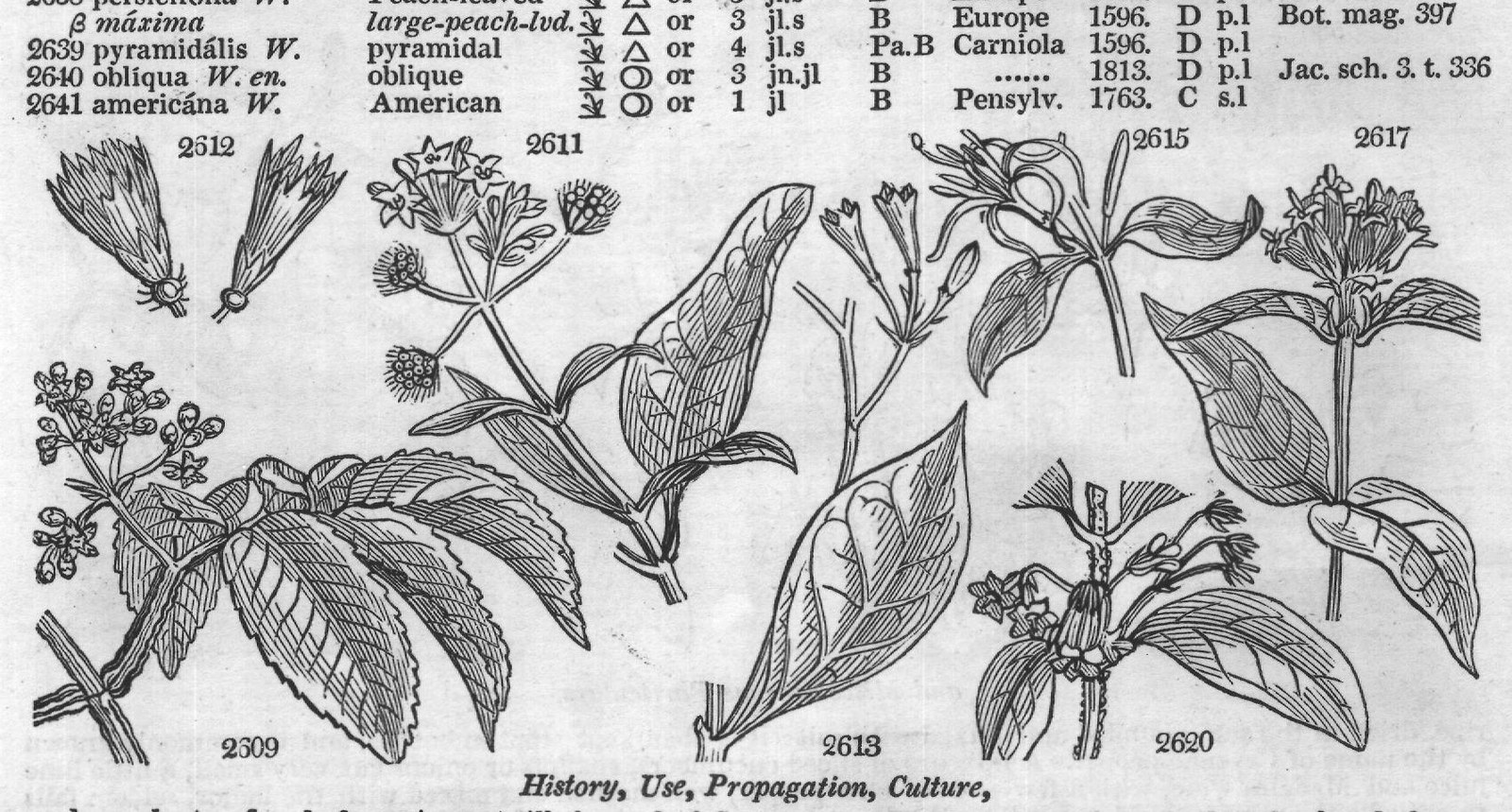
CLASS V. 454. LEEA. W. 2607 sambucína W. 2608 æquáta W. 2609 críspa L.
LEEA.
Elder-leaved shrubby curled cu 10 W E. Indies 1790. C l.p Cav. dis. 7. t. 218 cu 10 G E. Indies 1777. C 1.p cu 30 W C. G. H. 1767. C 1.p Bot. rep. 355 2610 macrophýlla Roxb. long-leaved cu G E. Indies 1806. C 1.p 455. SPERMADICTION. Roxb. SPERMADICTYON.
Rubiacea. Sp. 1-2. 2611 suavéolens Roxb. sweet-scented or 40 W E. Indies 1818. Cl.p Bot. reg. 348 456. DENTEL/LA. W.
DENTELLA.
Rubiaceæ. Sp. 1. 2612 répens W. creeping or از W N. Holl. 1802. S co Lam. ill. t. 118 457. MACROCNE MUM. W. MACROCNEMUM.
Rubiaceæ. Sp. 2-6. 2613 jamaicénse W.
Jamaica or 14 W ...
Jamaica 1806. C p.l Sw. obs.68.t.3.f.1 2614 strictum Roxb. upright or 10 W ...
E. Indies 1804 C p.1 458. EXOSTEM'MA. Rich. ExoSTEMMA.
Rubiacea. Sp. 2-12. 2615 caribæ'um W. caribæan or 20 jn.s W W. Indies 1 W. Indies 1780. C l.p Bot. rep. 481 2616 floribúndum W. many-flowered tm 40 W ...
W. Indies 1794. C l.p Lamb. cin. 27.t.7 459. BURCHEL/LIA. R. Br. BURCHELLIA.
Rubiaceæ.
Sp. 1. 2617 bubalína R. Br.
Cape or 3 my.jn S 460. RONDELE TIA. W. RONDELETIA.
Rubiacea. 2618 americána W.
American 2619 lævigáta H. K. smooth-leaved 2620 hírta H. K. hairy 461. COUTARE'A. Aub.
COUTAREA. 2621 speciósa Aub. laurel-leaved or 12 Pu ...
Portlandia hexandra W. 462. PORTLAN DIA. W.
PORTLANDIA.
Rubiacea.
Sp. 2. 2622 grandiflóra W. great-flowered 2623 coccinea P. S. scarlet or 3 or 12 jn.au W S ... or 10 au W or 12 jl.au W or 10 jn.au Pk Rubiace. Sp. 1.
C. G. H. 1818. Cr.m Bot. mag. 2339 Sp. 3-18.
W. Indies 1752. C s.p Plu. ic. t. 242. f.1 W. Indies 1790. C s.p Jamaica 1776. C s.p Bot. cab. 350 Sp. 1.
Guiana 1803. C s.p Aub. gui. t. 122 Jamaica 1775. C s.p Bot. mag. 286 Jamaica 1812. C s.p 463. CAMPANULA. W. BELL-FLOWER.
Campanulacea. Sp. 75-240. 2624 cenísia W. ciliated or jn.jl B Switzerl. 1775. R co All. ped.1. t.6.f.2 2625 microphýlla Kit. small-leaved or jn.jl B Hungary 1820. R co 2626 Bellárdi All.
Bellardi's or jn.jl B Italy 1813. R co All.ped.1.t.85.f.5 2627 púlla W. russet or jn.jl B Austria 1779. R co Bot. cab. 554 2628 Zoysii W. blunt-leaved or jn.au D.B Carniola 1813. D co Jac..ic. 2. t. 334 2629 carpática W.
Carpathian or jn.au B 2630 rotundifólia E. B. round-leaved or jn.au B 2631 pusílla Hänke. diminutive or jn.jl Pa.B Carp. Alps 1774. D p.l Britain hea. D p.1 Switzerl. 1821. R co 2632 púmila B. M. dwarf or jn.au B Switzerl. 2633 pubéscens W. pubescent or 1 jn.au B 2634 grácilis R. Br. slender or 1 ap.au B 2635 Scheuchzéri Vill.
Scheuchzer's or jn.au B 2636 pátula W. spreading or 1 jl.au V 2637 Rapúnculus W.
Rampion cul 3 jl.au Pu 2638 persicifólia W.
ẞ máxima 26-10 oblíqua W. en.
Peach-leaved or 3 jl.s large-peach-lvd.or 3 jl.s B B 2639 pyramidális W. pyramidal or 4 jl.s oblique or 3 jn.jl B 2641 americána W.
American or 1 jl B ...
D p.1 Bohemia 1813. D co N. S. W. 1794. R co Europe 1813. D co Britain past. Sp.l Britain hed. b. S r.m Europe 1596. D p.1 Europe 1596. D p.1 Pa.B Carniola 1596. D p.l 1813. D p.1 Pensylv. 1763. C s.l ......