Eur
Asia Eng. bot. 1694 Sk co 3 jl.au Ap England riv. ba. Sk co Eng. bot. 1983 2 jl.s Ap Britain sal. m. Sk co Eng. bot. 542 clustered w 1 jl.s Ap wood W 1½ jl.s Ap E. Indies 1776. Sk co Britain P. m.27. t.417. f.3 m. s. p. Sk co Eng. bot. 919 Cyperacea. Sp. 3-24. marsh needle ovate A علا A لا 14 14 jl Ap Britain mar. Sk co jl Ap Britain mar. Sk co Eng. bot. 131 Eng. bot. 131 Eng. bot. 749 jn.jl Ap Germany 1818. Sk co 841 842 849 844 Cyperacea. 1 ap.my Ap 1 jl Ap Ap 1 jlau Ap ap.my Ap 1 ap.my Ap s.d Ap Cyperaceæ. 1 au Ap 1779. Sk s.p Mexico 1788. Sk s.p N. Amer. 1693. D co S. Amer. 1815. D co Bermudas 1732. D co S. Amer. 1816. D co S. Amer. 1816. D co Brazils 1818. D co Brazils 1820. D co Sp. 7-79.
Bot. mag. 464 Cv. diss. t. 191. f.2 Bot. mag. 94 Red. lil. t. 47 Bot. mag. 2313 Bot. reg. 713 Bot. cab. 685 1759. R p.l Bot. mag. 171 S. Europe 1781. D co Britain sp. bo. D co Scotland sc. bog. D co England bogs. D co Europe 1781. D co Britain bogs. D co W. Indies 1822. D co Sp. 3-26.
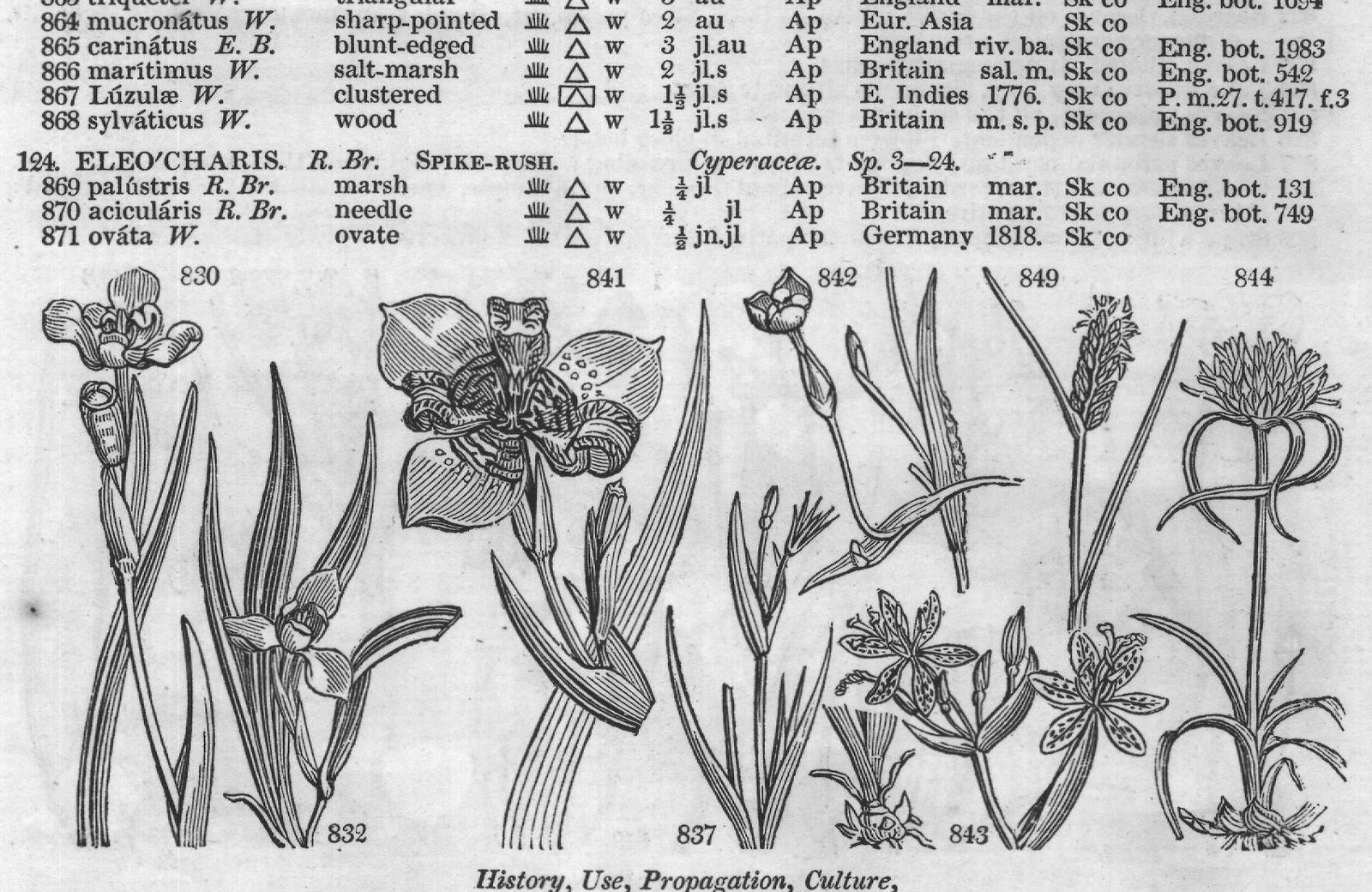
Britain Brazil Fl. græc. 1. t. 43 Eng. bot. 1121 Eng. bot. 1010 Eng. bot. 1410 Sch. gm.1. t. 1.f.4 Eng. bot. 791 Bot. mag. 655 Bot. mag. 701 ... 832 837 History, Use, Propagation, Culture, 843 flowers. M. northiana has beautiful and transient flowers, like the rest of the species, all of which grow freely in a rich light soil, and are readily increased by parting the roots or from seeds. 118. Pardanthus. Named by Mr.J. B. Ker, from πaρδoς, a leopard, and avθoς, a flower, on account of the spotted flower. 119. Schænus. From χoivoς oi σχoivoς, a cord, in Greek. From plants of this kind the first cordage is supposed to have been made. All the plants from this genus to Mariscus, No. 130., are sedgy plants of similar habit, of value in an economical point of view, but not cultivated for ornamental purposes. 120. Rhynchospora, (ῥuγχoς, a snout or rostrum, and σπoρa, a seed.) The seeds are beaked. 121. Fimbristylis. So named by Vahl. The word is constructed from the Latin fimbria, a fringe, and stylus, the style. 122. Isolepis. From iσoς, equal, and λεπiς, a scale, on account of the relative form of the scales which constitute the inflorescence. ORDER I.
TRIANDRIA MONOGYNIA. 830 Beardless, leaves linear, Petals with glandular spots, Ovaries 3-cornered 831 Flower-stalks lateral nearly equal to the one-leaved involucrum 832 Leaves linear-lanceolate, Scape round shorter than the plaited leaves 833 Leaves linear-ensate flat, Scape simple leaf-like winged, Flowers opened out, Fil. united at base 834 Scape 2-edged, Flowers in spikes, Leaves sword-shaped nerved-plaited 835 Scape 2-edged leafy, Flowers in spikes, Petals roundish ovate acute, Leaves linear sword-shaped 836 Scape 2-edged simple nearly leafless, Spathe about 4-flowered unequal longer than the flowers, Pet. muc. 837 Scape 2-edged branchy leafy, Spathe about 3-flow. unequal, Pet. linear acuminate, Leaves grassy channelled 838 Scape 2-edged branched leafy, Spathe about 4-flow. shorter than the flowers, Pet. muc. Leaves sword-shaped 839 Scape 2-edged branched leafy, Spathe 3-flowered shorter that the flower, er, Leaves sword-shaped 840 Scape 2-edged ascending leafy, Spathe 3-flowered, Caps. hairy, Leaves capillary 841 Stigmas united petal shaped, Scape many-flowered erect, Spathe not viviparous 842 Leaves linear-lanc. nerved a little wavy at back, Fl.-stalks nearly as long as spathe, Flowers campanul. 843 Flowers spotted with orange 844 Culm round naked, Spikelets bundled in a roundish head, Involucr. 3, 6-leaved very long reflexed 845 Culm naked round, Spikelets Spi in headed bundles, Invol. 2-leaved longer than the valves, Setæ none 846 Culm round leafy, Leaves channelled, Spike compound 2-ranked longer than the bractea 847 Culm round naked, Spike compound, Flower monœcious, Leaves channelled rough 848 Culm round, Spikelets 2-3, Outer valve of involucrum as long as spikelets, Setæ several 849 Spike distichous, Spikelet Spikelets many-flowered, Involucre 1-leaved, Culm roundish 850 Involucres very long white. (Dichromena, Vahl.) 851 Culm leafy 3-angular, Leaves linear keeled, Root creeping 852 Culm 3-angular, Leaves bristly channelled, Root creeping 853 Leaves flat glaucous with hairy sheaths, Invol. longer than the contracted panicle, Spikelets oblong, Scales oblong carinate mucronate 854 Spikes ovate oblong, Involucre about 3-leaved decompound longer than the umbel 855 Culms branched leafy flaccid, Spikelets few-flowered, Floating 856 Culm bristle-shaped, Spikelets lateral sessile 857 Culm round naked, Heads terminal globose clustered, Leaves channelled 858 Stem round sheathing at the base, Spike ovate terminal, Glumes obtuse equal, Root fibrous 859 Stigmas 3, Spike enclosed in a 2-leaved involucrum, Lower glumes very large as hig as the spike, Culm round, Sheaths bearded 860 Glumes unequal obt. ovate, one larger but shorter than the 2-valved spike, Culm round, Sheaths not bearded 861 Culm round, Inner sheaths ending in a short leaf, Cyme terminal decompound with 2-4-leaved involucrum Spikelets ovate smooth 862 Top of the 3-angular stem straight, Upper sheaths leafy, Panic. lateral under the end, Spikel. sess. & stalked 863 Culm straight naked pointed, Lateral spikes sessile or stalked, Stigma bifid 864 Top of the 3-cornered culm bent down at end, Sheaths leafless, Spikel. lateral sess. clustered naked, Stigmas 3 865 Culm naked, upwards 3-cornered, Panicle cymose terminal, Bract. pungent, Stigma bifid 866 Panicle globose terminal, Glumes mucronate torn bifid 867 Spikes roundish headed, Heads umbelled globose proliferous, Invol. many-leaved, Culm 3-angular 868 Culm 3-cornered leafy, Cyme term. supra-decompound surrounded with a many-leaved invol. Gl. mucronate 869 Spike oval naked, Scales lanceol. acute, Culms roundish, Sheaths leafless beardless lanceol. acute, Stigmas 2 870 Spike ovate naked, Two lower scales scarcely larger than the rest, Culms 4-cornered setaceous 871 Spike ovate naked, Scales oblong obtuse, Stigmas 2, Culms sub-compressed, Sheaths leafless, Root fibrous 855 851 852 854 856 857 858 861 863 869 870 and Miscellaneous Particulars. 123. Scirpus. From cirs, a Celtic word for rushes, which is, in the singular, cors, whence the Latin chorda. S. cæspitosus is the principal food of cattle and sheep in the Highlands of Scotland in March and till the end of May. S. lacustris, the bull-rush, is used to bottom chairs: cut at one year old, it makes the finer bottoms; at two years, the coarser sort; still older, and mixed with the leaves of Iris pseud-acorus, it makes the coarsest bottoms. Cottages are sometimes thatched, and pack-saddles stuffed with it, and in severe seasons cattle will eat it. Of S. maritimus there are several varieties, natives of the salt marshes of Europe, Barbary, and Siberia, greedily eaten by cattle; and the roots, which are large, Withering says, have been ground and used instead of flour in times of scarcity. The Pi-tsi or water-chestnut of the Chinese, is a species of this genus (Scirpus tuberosus). It has not yet been introduced to our gardens. In China it is cultivated in tanks, the bottoms of which are manured and exposed for a time to dry in the sun. The tubers are eaten either boiled or raw, and are esteemed both as food and medicine. 124. Eleocharis. A name not explained by Mr. Brown, its author, the meaning of which is not obvious. E TRIANDRIA MONOGYNIA. 125, ERIO PHORUM. P. S. COTTON-GRASS.
CLASS III.
Cyperacea. Sp. 6-7. 872 vaginátum W.
Hare's-tail A pr لا mr.ap Ap 873 polystáchion W. 874 angustifolium W. broad-leaved Apr 1 jn.jl Ap narrow-leaved pr ap Ap 875 virgínicum W.
Virginian pr 1 my.au Ap 876 grácile P. S. slender pr 1 jl.au Ap 877 capitátum E. B. round-headed pr au.s Ap Britain moors. D co Britain bogs. D co Britain bogs. D co N. Amer. 1802. D co Scotland sc. mo. D co Scotland sc. mo. D co Eng. bot. 873 Eng. bot. 563 Eng. bot. 564 Pk. alm. t.299.f.4 Eng. bot. 2402 Eng. bot. 2387 126. TRICHO PHORUM. P.S.
TRICHOPHORUM.
Cyperacea.
Sp. 2. 878 cyperínum P. S. cyperine 879 alpínum P. S.
Alpine cu 6 my.s Ap cu Ap N. Amer. 1802. D co Scotland bogs. D co Plk.mt. t. 419. f.3 Eng. bot. 311 127. CYPERUS. W.
CYPERUS. 880 dúbius W. bulbous-rooted cu 881 tenéllus Vahl. slender cu Cyperaceæ. jl Ap my.jn Ap 882 conglomerátus Rotb. many-flowered 883 pannónicus W. dwarf 884 Lúzulæ W. compact-flower. 885 dístans Vahl. distant cu 2 my.s cu 2 jl.au Ap Ap cu my.s cu 1 jl.au Ap Hungary 1781.
W. Indies Sp. 22-250.
E. Indies 1802.
C. G. H. 1819.
Arabia 1820. D co S co Sco Rot. gr.20. t.4. f.5 Pk.al. t.300. f.4. 5 Sk co ...
Sk co Ap W. Indies 1820.
D co 886 viscósus W. clammy cu 2 my.au Ap 887 fastigiátus W. lofty cu 1 my.au Ap 888 erubescens Lk. pink cu 1 my.jn Ap 889 paniculátus Vahl. panicled cu 1 my.jl Ap 890 glomerátus W. en. round-headed cu 2 my.au Ap 891 élegans W. elegant cu 1½ my.s Ap 892 flavéscens W. yellow cu 1 jn.s Ap 893 fúscus W. brown cu jl.s Ap 894 strigósus W. bristle-spiked jl.s Ap 895 vegétus W. smooth cu 1½ my.s Ap 896 esculéntus W.
Rush-nut cul 1 jl Ap 897 lóngus W. sweet cu 3 jl Ap 898 I'ria W. tall cu 1½ jl Ap Sk co 899 alopecuroídes P.S. fox-tail A cu للاد 2 my.au Ap C. G. H.
Jamaica 1781. Sk co E. Indies 1800. Sk co ...... 1820. D co E. Indies 1804. D co Italy 1804. S co Jamaica 1801. S co Germany 1776. S co Europe 1777. S co W. Indies 1786. Sk co America 1790. Sk co S. Europe 1597.
England mar.
E. Indies 1802.
Sk co Sk co 1804. Sk co Host. gr. 3. t. 20 Rott. gr. t. 13. f. 3 Jacq. ic. t. 299 Jac. ic. 2. t. 295 Rt. gm.32. t.7.f.2 Slo. ja. 1. t. 75. f.1 Host. gra. 3. t.72 Host. gra. 3. t. 73 Rt. g. 40. t.11. f.3 Jac. vind. 3. t. 12 Host. grm.3. t.75 Eng. bot. 1309 Rheede. 12. t. 56 Rott. g.38. t.8. f.2 900 bádius P. S. brown cu 2 jl Ap Algiers 1800.
Sk co Desf. at. 1. t.7. f.2 901 alternifólius W. alternate-leav'd cu 2 f.mr Ap Madagasc.1781. Sk co Jac. ic. 2. t. 298 128. PAPYRUS. Lk. 902 antiquórum Lk. 129. KYLLIN'GA. W. 903 monocéphala W. 904 polycéphala Lk. 905 uncináta Lk. 906 triceps W. 130. MARISCUS. Vahl. 907 umbellátus W.en. 908 elátus W.en. 909 confléxus Lk. one-headed PAPYRUS.
Cyperaceæ.
Sp. 1-3. ancient or 10 jl.s Ap Egypt 1803. D co Mic. gen.44. t.19 KYLLINGA.
Cyperaceæ.
Sp. 4-12. w jn.jl Ap India many-headed hooked w 1 jl.au An Brazil wl.au Ap Brazil 1793. Sk co Rott. gr. t. 4. f. 4 1820. D co 1820. D co three-headed s.n Ap India 1776. Sk co Rott. gr. t. 4. f. 6 MARISCUS.
Cyperaceæ.
Sp. 4-28. umbelled cu 1½ jn.au Ap tall cu contracted 910 aggregatus W. aggregated Brazil ...... 131. REMIRE'A. Aub.
REMIREA. 911 marítima Aub, sea A cu لا 873 895 3 jn.au Ap 1 jl Ap cu 1 jn.jl Ap E. Indies 1789. Sk co E. Indies 1805. Sk co 1819. D co 1822. D co Gramineæ. Sp. 1-2. jlau Ap Florida 1822. D co Aub. gui. t. 16 901.
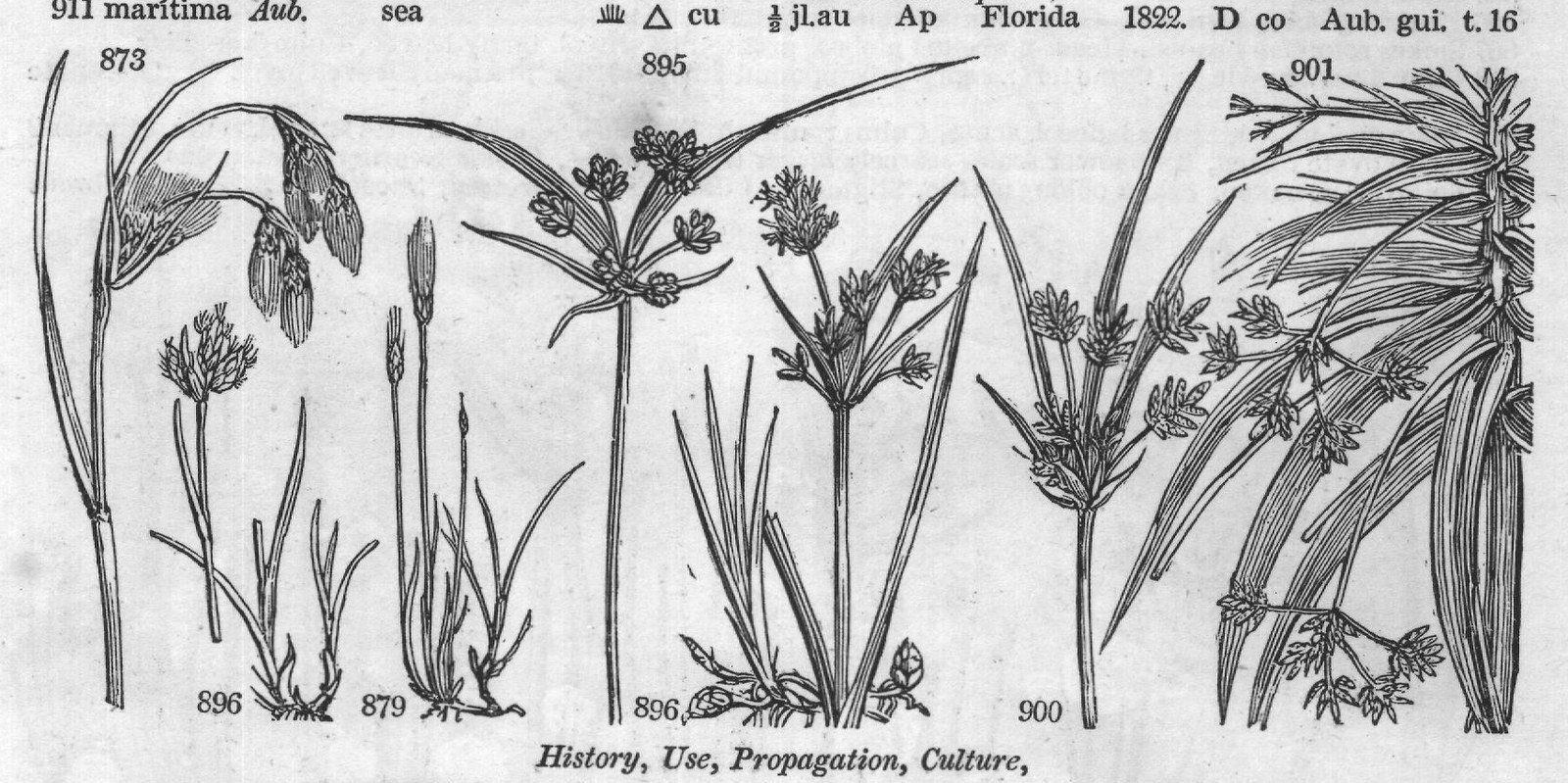
Rott. gr. t. 4. f. 2 Jac. ic. 2. t. 300 896 879 896 900 History, Use, Propagation, Culture, 125. Eriophorum. From ερiov, wool, and φερω, to bear. Its seeds are covered with silky tufts of a wool-like substance. For the same reason it is called in English cotton-grass. 126. Trichophorum. From θρiξ τρiχoς, hair, and φερω, to bear. Its inflorescence resembles a bunch of hair. This genus and Eriophorum grow in peat bogs, and have their seeds clothed at the base with a white or brown silky down or cotton-like substance, from which specimens of cloth have been made, paper, and wicks for candles; and in Sweden, pillows stuffed. Of these genera, and of the Cyperaceæ in general, it has been observed by Villars, that being mostly natives of bogs, marshes, and watery places, they have a tendency to raise and dry such spots. The roots and base of the stems rot and become peat, and thus are useful as firing or manure. 127. Cyperus. The roots of some species of this genus have eatable roots, and are considered aphrodisiacal in a high degree. It is, therefore, probable that the word derived its origin from Cypris, a name of Venus. This is a genus of sub-aquatic or marsh sedgy plants, more injurious than useful, and of little or no beauty. The root of C. longus is agreeably aromatic, warm, and bitter: those of C. esculentus (souchet comestible, Fr.) produce round tubercles about the size of peas, which are eaten in some places in France and Spain; and when boiled, taste something like chestnuts. 128. Papyrus. A word of obscure origin. P. antiquorum yields the substance used as paper by the ancient Egyptians. In Syria it is called babeer, and hence, probably, the words papyrus and paper. The flower-stalk rises about ten feet from a long horizontal thick root, the lower part clothed with long hollow sword-shaped leaves ORDER 1.
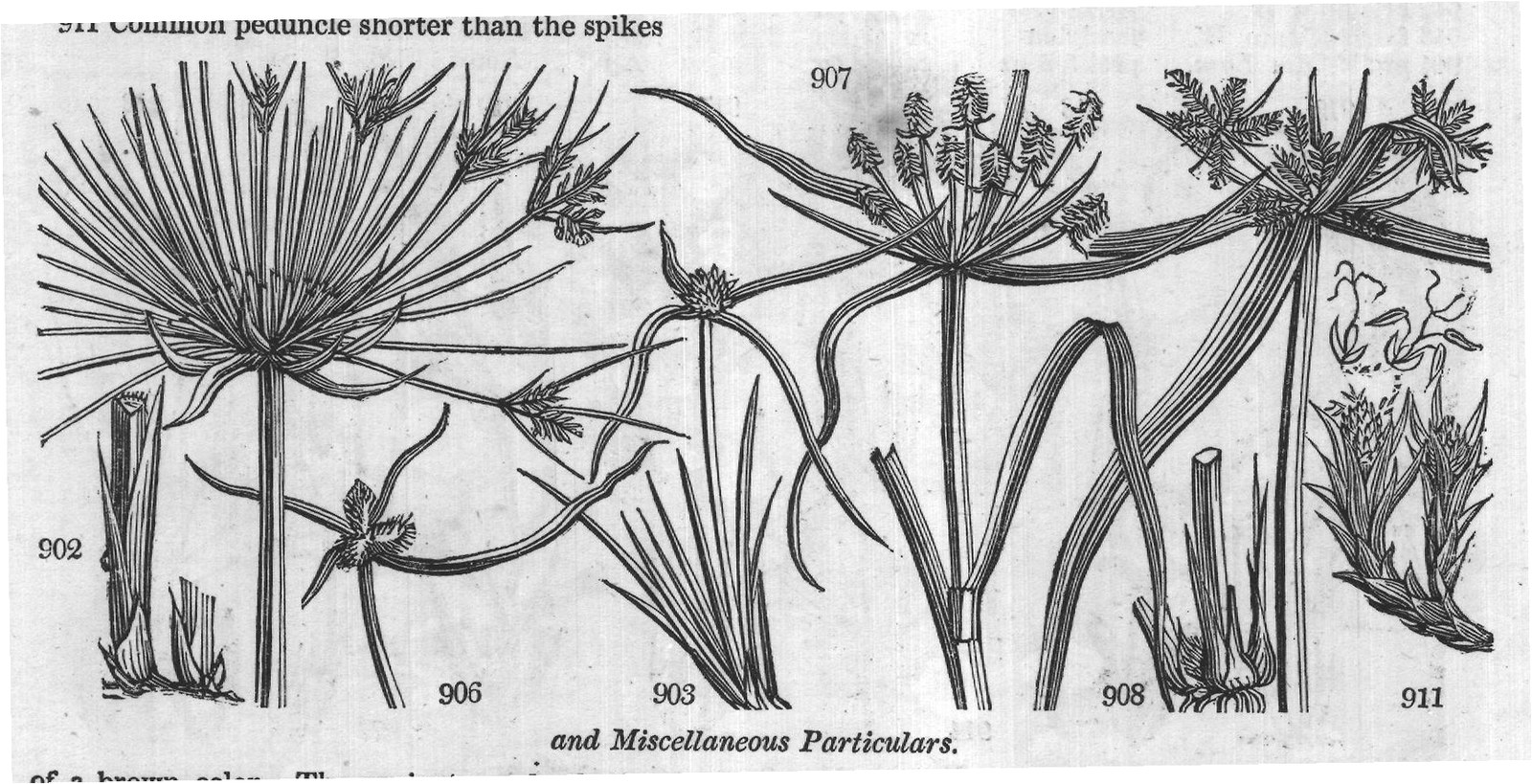
TRIANDRIA MONOGYNIA. 872 Spike solitary, Culm very smooth, Sheaths inflated 873 Spikes several, Culms 3-cornered, Leaves broadish keeled 874 Spikes several, Culms 3-cornered, Leaves very narrow setaceous 875 Spikes several, Culms round leafy, Spikes sessile clustered shorter than the involucrum 876 Spikes several, Culms 3-cornered, red, Leaves nearly filiform 3-cornered, Peduncles rough, Flowers erect 877 Spike solitary, Culms round spongy soft, Sheaths not inflated 878 Umbel compound, Culm branched 879 Spike solitary, Culms simple 3-cornered roughish 880 Head globose, Spikelets oblong convex about 8-flowered, Involucr. 4-leaved, Leaves channelled lax 881 Spikelets solitary and in pairs sessile, Involucr. 1-leaved, Culm setaceous 882 Spikelets ovate much clustered, Culm rather 3-cornered, Leaves channelled 883 Stem 3-cornered leafless ascending or decumbent, Spikelets about 5 oblong obtuse very shortly stalked 884 Heads simple and clustered ovate, Spikelets oblong, Involucr. very long 885 Spikes distichous, Spikelets spreading filiform, Florets distant, Umbel upright 886 Spikelets aggregate ovate rather squarrose in heads, Involucr. longer than umbel, Lvs. and involucr. rough 887 Umbels many rayed compound, Spikes elongate, Spikelets linearlanceolate, Involucr. 4-leaved long 888 Lvs. linear shorter than the 3-cornered culm, Invol. 3-leaved, outer leaf very long, Spikel. lanc. Scales obtuse 889 Spikelets linear-lanceolate, Umbels corymbose fascicled, Involucr. about 6-leaved 890 Culm 3-cornered naked, Umbel 3-leaved supra-decompound, Spikes clustered rounded, Spikelets subulate 891 Spikelets about 3 linear, Valves obcordate mucronate distinct spreading , Umbel loose 892 Spikelets linear-lanc. alternate clustered, Glumes obtuse, Involucr. 3-leaved longer than the trifid umbel 893 Spikelets linear-lanc. alternate very close, Valves acute, Invol. about 3 or 5-leaved very long, Umbel 3-5-fid. 894 Spikes oblong loose, Spikelets subulate alternate capitate, Invol. very long spreading, Rays of umbel altern. 895 Spikelets lanceolate roundish headed compact, Valves ovate 1 -nerved, Involucr. longer than the umbel 896 Spikelets lin.-lanc. distant acute, Rays of the umbel about 7 terminal shorter than the 3-5-leaved involucrum 897 Spikes corymb. Spikel. lin.-lanc. flattened, Invol. and rays of umbel very long corymbose with leafy stem 898 Spikes corymbose, Spikelets linear, Valves remote obtuse obovate spreading in fruit, Umbels loose 899 Spikes nearly sessile imbricated round, Spikelets ovate oblong spreading 900 Spikelets in corymbose fascicles, Spikelets linear-lanceolate dense, Invol. 3-leaved, Leaves very rough 901 Umb. 6-7-rayed compound, Heads many-spiked, Spikel. lin. many -flowered, Invol. 3-leaved reflexed rough 902 Stem tall terminated by a reflexed involucrum of many very long narrow leaves 903 Head globose sessile solitary, Involucr. very long 904 Umbel rather contracted, Invol. very long, Spikelets clustered, Valves ovate carinate acute 905 Head 1 or 3 sessile round, Invol. many leaved long, Valves carinate hooked 906 Heads about 3 sessile clustered, Spikelets very dense rather imbricated 907 Umbel compound, Spikes cylindrical imbricated backwards, Involucres many-leaved 908 Umbel compound, Spike cylindrical, Spikelets very spreading, Bractes longer than the spikelets 909 Leaves shorter than the 3-cornered culm rough at edge, Umb. contracted, Invol. many-leaved, Spikel. sub- reflexed, Scales keeled striated 910 Spikes cylindrical sessile, Spikelets oblong, Bract setaceous longer than spikelets, Invol, many-leaved 911 Common peduncle shorter than the spikes 902 906 903 907 908 911 and Miscellaneous Particulars. of a brown color. The ancients made their paper from the pellicle found between the flesh and bark of the thick part of the stalk; ribbons of which were united till they formed the size required, and then pressed and dried in the sun. The top of the stalk, with the umbel of flowers, adorned the temples, and crowned the to his fleets, before the use of spartum (Lygeum spartum, still used on the coast of Provence for small vessels, and also in Spain) was known. Pliny says, the whole plant was used for making boats; and Bruce says, they have no other boat in Abyssinia. That traveller found it growing in the rapid course of the river Jordan, and he there remarked that it constantly opposed one of the angles of its stem to the current, as if to elude the violence of the waves. Perhaps, if the observation were applied to similar plants in our own rivers, the same result would be obtained. The root was chewed for its juice, which is also practised in Abyssinia with various species of cyperus, and with those of maize. The papyrus is indigenous in Calabria as well as in Ethiopia and Egypt, in stagnant water; but only in the calishes or swamps of the Nile, and never in the stream as has been supposed. To thrive in our stoves, it requires to be placed in a cistern of water with rich mud at the bottom. Plants so treated, at White Knights, near Reading, have attained a large size, and flower freely. 129. Kyllinga. In memory of P. Kylling, a Danish botanist, who died in 1696. found. 130. Mariscus. A word derived from the Celtic mar, a marsh, in allusion to the situations in which it is 131. Remirea. The Guiana name of the plant.
E2 TRIANDRIA DIGYNIA. 132. LYGE'UM. W.
LYGEUM. 912 Spártum W. rush-leaved 133. CORNUCO'PIÆ. L.
CORNUCOPIE. 913 cucullátum W. hooded 914 lappáceus W.
Bur 915 echinátus W. 916 tribuloídes spinous Aec لا cu cu لا cu لا 134. CEN CHRUS. P.S. CENCHRUS. rough-spiked cu 2 au.d Ap 135. PENNISE TUM. Rich. PENNISETUM. 917 cenchroídes Rich. ciliated W. Indies 1691. S co N. Amer. 1818. S co Beauv. t. 14. f. 7 C. ic.5. p.39.t.462 C. ic. 5. t. 461 Gramineæ. Sp. 1. 1½ my.jn Ap Spain Gramineæ. Sp. 1. au Ap Gramineæ. Sp. 3-21. 1 jl Ap India 1776. D co CLASS III.
Clus. hist. 2. f. 2 Levant 1788. S co Fl. græc. 1. t. 51 1773. S co 1 my.au Ap Gramineæ.
Sp. 1-8. cu 1½ my.au Ap C. G. H. 1777. Sco 136. SPARTI'NA. W.
SPARTINA.
Gramineæ.
Sp. 4-8. 918 strícta W. upright cu 1 au Ap Britain sal. m. D co Eng. bot. 380 919 cynosuroides Rich. Dog's-tail cu 3 au.s Ap N. Amer. 1781. D co L. fil.fa.l.p.17.t.9 921 júncea Ph. 920 polystáchya Ph. many-spiked A cu عاد 6 au.s Ap N. Amer. 1781. D co spreading cul.au Ap N. Amer. 1781. D co 137. NAR DUS. W.
MAT-GRASS.
Gramineæ.
Sp. 1-2. 922 strícta W. upright cu 1 jn.jl Ap Britain moi. h. D m.s Eng. bot. 290 138. ORYZOP'SIS. Mich. ORYZOPSIS. 923 asperifólia M.
Gramineæ.
Sp. 1. rough-leaved cu 3 jl.au Ap N. Amer. 1822. D co DIGYNIA. 139. PASPALUM.
W. PASPALUM.
Gramineæ.
Sp.5-82. 924 scrobiculátum W. 925 paniculátum W. 926 stoloníferum W. punctured panicled purple 业 cu 1 jl.s Ap cu 3 jl.s Ap E. Indies 1778. S co Jamaica 1782. S co H.n.h.13.t.89.f.3 Sl. hist. 1. t.72. f.2 cu 2 jl.s Ap Peru 927 dístichum W. two-spiked cu 1 jl Ap 928 serotínum Fl. decumbent cu jl.au Ap 1794. Sco Jamaica 1776. S co N. Amer. 1804. S co Jacq. ic. 2. t. 302 Sw.obs.35. t.2.f.1 140. AXO'NOPUS. P. de B. AXONOPUS.
Gramineæ.
Sp. 1-4. 929 cimicinus P. de B. spotted 141. MILIUM. W.
MILLET-GRASS. 930 effúsum W. common cu لا A عللا 1 jl.s Ap India 1788. S co 931 paradóxum W. black-seeded cu 3 jn.jl Ap 3 jn.jl Ap 932 multiflórum W. en. many-flowered 933 cæruléscens Desf. blueish cu 14 jn.jl cu 1 jn.jl 934 frutéscens Lk. shrubby △ cu 1 ... 142. KNAPPIA. E. B. KNAPPIA. 935 agrostídea E. B. small cu علاا Wales 143. DIGITA'RIA. P.S. FINGER-GRASS. 936 sanguinális P. S. slender-spiked 937 villósa P. S. villous 938 ægyptíaca W.en.
Egyptian 939 ciliáris P. S. ciliated لاد اااا 940 margináta Lk. divaricate 144. PANICUM. B. P. 941 colónum W. 942 brizoídes W. 943 fasciculátum W. 944 prolíferum Lam. 912 PANIC-GRASS.
Briza-like fascicled proliferous 913 purple ag لا cu cu cu لاا Ap. jn.au Ap 917 jlau Ap jl Ap Gramineæ. jl.au Ap 1 jn.jl Ap 2 jn.jl E. Indies 1699. S co E. Indies 1801. S co Jamaica 1801. S co N. Amer. 1820. S co 919 san. pl. S s fields. S co Eng. bot. 849 1½ jl.s Ap 1 jl Ap China N. Amer. 1781. S co. 1794. S CO 1804. S co Brazil 1822. S co Sp. 18-185.
Gramineæ. Sp. 5-14.
Ap Ap Ap Gramineæ. mr.ap Ap Britain m. s. p. S m.s France 1771. S co S. Europe 1778. S co Barbary 1819. S co Crimea 1822. S co Sp. 1.
Gramineæ. Sp. 5-25. au Ap Britain Eng. bot. 1106 Host. gr. 3. t. 23 Host. gr. 3. t. 45 Desf. atl. 1. t. 12 Eng. bot. 1127 Jac. obs. 3. t. 70 Host. gr. 4. t. 15 Ehr. pic. t. 3. f.3 Pl. alm. t. 191.f.1 923 914 History, Use, Propagation, Culture, 922 132. Lygeum. From λύγω, to bend, in allusion to its flexibility. This plant is used in Spain, Provence, and other places for making ropes, baskets, nets, and for filling their paillasses or lower mattrasses. Ropes were made of it by the Romans. Esparto (spartum) is the Spanish appellation of this and other grasses used for similar purposes. 133. Cornucopice. The spike inclosed in the involucrum peculiar to the genus, resembles the " Horn of Plenty.' The leaves and flower of C. cucullatum, Sir J. E. Smith observes, are perhaps of all grasses the most singular and uncommon. It is a native of the vales about Smyrna, whence it was sent to England by Sherard, and is preserved in the Chelsea garden and at Kew. 134. Cenchrus. Kεvχρoς is the Greek name of the millet; by which, it is probable, that Setaria italica was intended. C. echinatus is the most common grass in the pastures of Jamaica, and is looked on as a wholesome and pleasant food for horses and cattle. 135. Pennisetum. From penna, a pen, and seta, a bristle; a feathery bristle, referring to the nature of the involucrum. 136. Spartina. A word altered from spartum, the specific appellation of Lygeum; the plants being similar to the latter in habit. The origin of the word spartum has not been satisfactorily explained. The Spaniards call this, and similar tough grasses, useful to them in making ropes, esparto. 137. Nardus. The term vaρδoς was applied by the Greeks to a substance possessing a peculiar per- ORDER II. 912 The only species 913 The only species TRIANDRIA DIGYNIA. 914 Branches of the panicle simple, Paleæ hispid backwards, Glumes 3-valved 2-flowered (Centotheca. Desv.) 915 Spikelets approximated, Involucres 10-parted villous 916 Spike with alternate spikelets, Involucres entire spiny 917 Culm jointed, Invol, altern. twice as long as flowers, one of the setæ bristle-chaffy longer than the others 918 Spikes term. about 2, Spikelets one-sided loosely imbricated Paleæ longer than glume, Leaves involute 919 Spikes altern. remote, Rachis ang. wavy, Glumes twice as long as paleæ, Leaves very long glaucous flat 920 Leaves broad flat, Spikes many turned all ways linear, Keels aculeate 921 Leaves distichous shortish bristly convol. Spikes few remote spreading, Glumes acuminate, Keels rough 922 Spike bristly straight one-sided 923 The only species DIGYNIA. 924 Spikes few altern. Rachis flat straight as long as spikel. Glumes roundish obtuse smooth, Upper lvs. naked 925 Spikes very num. Rachis 3-sided smooth twice as narr. as spikel. Glumes roundish obv. blunt pub. 3-nerv. 926 Spikes numerous scattered, Rachis undulated broader than spikelets, Glumes oblong corrugated, Leaves lanceolate rough at edge 927 Spikes 2 close together, Rachis flat narrower than spikelets, Glumes ovate obtuse polished length of paleæ 928 Spikes 5 close together, Rachis flat rather broader than spikelets, Glumes elliptic lanc. acute pubescent 929 Panicles umbelled, Racemes about 4, One glume fringed 930 Panicles diffuse, Florets beardless ovate dispersed 931 Pan. spreading lax few-flowered, Flowers bearded, Each glume at least 3-nerved (Piptatherum. P. de B.) 932 Panicles spreading many-flowered, Flowers bearded, Outer glume 3-5-nerved 933 Flowers panicled bearded, Beard shorter than glume 934 Stem shrubby at base, Panicle whorled, Lower rays sterile 935 The only species. The least of grasses 936 Spikes digitate erect spreading 4, Leaves and sheaths pilose, Florets oblong pubescent at edge 937 Spikes many setaceous, Leaves and sheaths very hairy 938 Spikes digitate erect 7, Leaves and sheaths hairy, Florets oblong acute smooth 939 Spikes digitate erect spreading 8, Leaves and sheaths hairy, Florets lanceolate ciliated 940 Stem decumbent, Sheaths hairy at end, Spikes divaricate, Paleæ fringed at end 941 Spikes alternate one-sided beardless ovate rough, Rachis roundish 942 Spikes alternate sessile one-sided, Glumes two much shorter than paleæ retuse, The third as long as they 943 Spikes panicled alternate erect in bunches, Spikelets one-sided roundish 944 Very smooth, Panicles oblong erect, Glumes striated largish, Stem branching 926 929 930 933 935 936 941 and Miscellaneous Particulars. fume. It is difficult to assign a reason for the name having been applied to this insignificant genus of grasses. 138. Oryzopsis. Oryza, rice, and oψiς, appearance. The plant resembles rice. 139. Paspalum. One of the Greek names for millet, πaσπaλoς. 140. Axonopus. From ἀξωv, axis, and πες, a foot, because the chief difference between this genus and Paspalum consists in the spikes being separately placed, as it were, upon little stalks or feet. 141. Milium. Derived by some from mille, a thousand, on account of its numerous grains; by others, from mil, the Celtic for a pebble, in reference to the hard shining nature of the grains. M. effusum is admired for the elegance of its panicle. M. paradoxum resembles the Arundo. 142. Knappia. Named after Mr. Knapp, an author of an illustrated work upon British grasses, not much esteemed. A minute plant, resembling an agrostis. 143. Digitaria. From digitus, a finger, on account of the singular manner in which the heads are divided; or, as the botanists express it, fingered. D. sanguinalis has its specific name, not from the color as might be supposed, but from an idle trick which the boys in some parts of Germany have of pricking one another's nostrils with its spikelets till they bleed. It abounds by the road sides in Poland and Lithuania, where its seeds are collected and boiled whole like rice, with milk, and highly esteemed 144. Panicum. Pliny says, so called, from its flowers being in a panicle; but others derive the name from E3 945 hispídulum W. 946 colorátum W. 947 répens W. 948 miliáceum W. 949 muricátum W. 950 capilláre W. 951 latifólium W. hispid 2 jl.au Ap coloured 2 jl.s Ap slender 1 jl.s Ap millet ½ jl.s Ap prickly 1 jl.s Ap hair-panicled 2 jn.au Ap broad-leaved w 5 au.s Ap TRIANDRIA DIGYNIA. لا ا علا E Indies 1804. S co Egypt 1771. S co S. Europe 1777. S co E. Indies 1596. S co E. Indies 1805. S co America 1758. S co N. Amer. 1765. S co CLASS III.
Jac. ic. 1. t. 58 Fl. græc. 1. t. 61 Host. gr. 2. t. 20 Host. gr. 4. t. 16 Mor. h. 3. t. 5. f.4 952 clandestínum W. hidden-flower'd 1 jl Ap N. Amer. 1802. S co 953 arboréscens W. tree w 50 mr.ap Ap 954 virgátum W. long-panicled w 1 au.s Ap 955 pátens P. S. spreading w 1 jl.au Ap 956 brevifólium W. short-leaved 957 divaricátum W. straddling لا د 1 jl.au Ap AP 5 jl.au Ap Pl. al. 176. t. 189 Jac.schœn.1.t.25 958 palmifólium Palm-leaved 6 jl.au Ap 145. SETA'RIA. P. de B. SETARIA. 959 verticilláta P. de B. rough Gramineæ. glaucous green Italian setose لا لاد اد 1 jl.au Ap jl.au, Ap jl.au Ap 1 jl.au Ap 2 jl.au Ap 965 germánica P. de B. 966 geniculáta Horn. silky German knee-jointed my.s Ap لا A لا a jl Ap 2 jl.au Ap 1 jl.au Ap 2 jl.au Ap Gramineæ. ag 1 jn.jl Ap Gramineæ. 2 jl.s Ap 2 jn.jl Ap Gramineæ.
E. Indies 1776. S co N. Amer. 1781. S co India 1804. S co E. Indies 1800. S co Jamaica 1800. S co E. Indies 1804. S co Sp. 11-24.
England moi. fi. S co S. Europe 1771. S co England san. fi. S co India 1816. S co W. Indies 1804. S co W. Indies 1780. S co S. Europe 1548. S co 1805. S co 1819. S co ...... ...... ......
C. G. H. 1819. S co 1820. S co E. Indies 1802. S co E. Indies 1781. S co Britain moi. fi. S co Sp. 2-6. 960 glaúca P. de B. 961 víridis P. de B. 962 itálica P. de B. 963 setósa P. de B. 964 sericea P. de B. 967 púmila Lk. dwarf 968 macrochæ'ta Lk. long-spiked 969 áspera Lk. rough 2 jl.au Ap 146. ECHINOCHLO'A.
P. de B.
PRICKLY-GRASS.
Gramineæ.
Sp. 3-15. 970 stagnína P. de B. pond لللا 971 crus córvi P. de B. crow's-foot 972 crus gálli P. de B. loose علاا لاد 3 jl.au 1 jl.au Ap Ap 1 jl.au Ap Pánicum E. B. 147. ORTHOPO'GON. B. P. ORTHOPOGON. 973 hirtéllus B. P. hairy 974 undulatifólius R.&S. wavy-leaved لا 148. PENICIL/LARIA. P. de B. PENICILLARIA. 975 ciliáta W. fox-tail لاد 976 spicáta W.
Bull-rush للد 149. LAPPA'GO. W.
LAPPAGO. 977 racemósa W. branching 150. STI PA. W.
FEATHER-GRASS. 978 pennáta W. 979 húmilis Cav. common low 980 júncea W. rush-leaved cu 981 sibírica P.S.
Siberian cu 982 capilláta W. capillary 2 jl.au 983 tenacíssima W. tough cu 151. MUHLENBER GIA. Schr.
MUHLENBERGIA. 984 diffúsa Schr. spreading 152. CHÆTU'RUS. Lk.
CHÆTURUS. 985 fasciculátus Lk. bundled 153. LAGU RUS, W. 986 ovátus W.
HARE'S-TAIL-GRASS. oval-spiked cu للاد cu 1½ jl.au Ap Gramineæ. 2 jl.au Ap 3 jl Ap 3 jl.au A or عاد cu للاد A cu لا A عاد لا Ap Ap jl.au Ap Gramineæ. my.jn Ap W.Indies 1795. S co S. Europe 1795. S co Sp. 2.
Jamaica 1748. S co India 1592. S co Sp. 1.
S. Europe 1771. S co Sp.6-37.
Britain al. roc. D s.1 S. Amer. 1802. S co France 1772. D co Siberia 1777. D co Europe 1815. D co Spain 1817. D co Sp. 1.
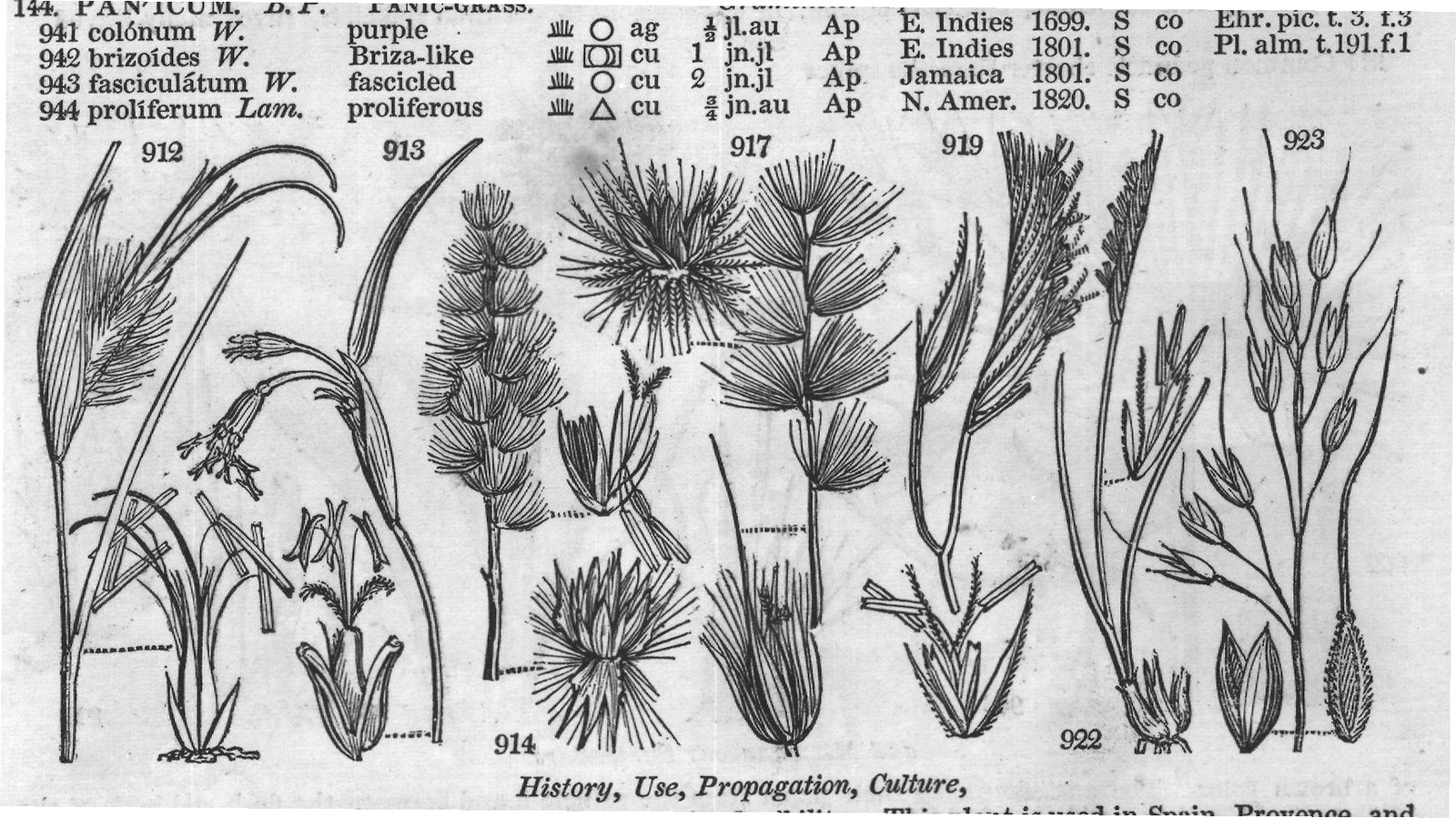
N. Amer. 1816. S co Gramineæ. Sp. 1-2. jl.s Ap Spain Eng. bot. 874 Host. gr. 2. t. 16 Eng. bot. 875 Rump.5. t.76. f.2 Host. gr. 2. t. 15 Host. gr. 3. t. 51 Eng. bot. 876 Host. gr. 3. t. 52 Pl. al. t. 92. f. 5 Pl. al. t. 32. f. 4 Host. gr. 1. t. 36 Eng. bot. 1356 C. ic. 5. t. 466. f. 1 Fl. græc. 1. t. 85 Gmel. sib.1. t.22 Host. gr. 3. t. 5 Desf. atl. 1. t. 30 Schr. gram. t. 51 1816. S co Ap 954 Guernsey bor.fi. S co Eng. bot. 1334 972 Gramineæ. Sp. 1. 1 jn 947 948 961 959 974 History, Use, Propagation, Culture, panis, bread, because of its uses as such. Of P. miliaceum there are two varieties, the brown and yellow. They are sometimes sown in this country for feeding poultry, and for having the husk taken off, to be used as rice; but the ample supplies received from the shores of the Mediterranean, render the culture of the plant unnecessary. P. arborescens, is said, by Linnæus, to contend for height with the loftiest trees in the East Indies, though the culm is scarcely thicker than a goose quill. This culm resembles that of Commelina, and shoots up through the branches of trees in woods and jungles. 145. Setaria. From seta, a bristle, on account of the bristles of the involucrum. S. italica is frequently called millet, and its seeds are used for the same purposes. S. germanica is cultivated in Hungary as food for horses, for which it is preferred before all other grasses. The seeds may be used as millet. Sparrows are remarkably fond of the seeds of S. viridis; and, according to Curtis, this and the two preceding genera, when cultivated in gardens, require to be protected from them from the time they come into flower. 146. Echinochloa. From εχivoς, a hedge-hog, and χλόη, a grass, on account of the prickly appearance of the heads of flowers. E. crus-galli is a coarse grass which grows thick and close, and stands dry weather better than most others. ORDER II.
TRIANDRIA DIGYNIA. 945 Spikes 2-3 together erect, Glumes hispid with two beards 946 Panicles spreading, Stamens and pistils coloured, Stem branching 947 Panicles twiggy, Leaves divaricating 948 Panicles lax nodding, Spikelets beardless, Leaves lanceolate pilose, Sheaths hirsute, Valves mucronate 949 Panicles spreading, Flowers solitary muricated, Stem rooting ascending 950 Panicles capillary erect spreading, Pedunc. straight, Glumes acuminate smooth, Sheaths very hairy 951 Panicles with simple lateral racemes, Leaves ovate lanceolate hairy at the neck. 952 Panicles few axillary, Stem dichotomous, Sheaths dotted 953 Panicle much branched, Leaves ovate oblong acuminate, Shrubby 954 Panicles branched diffuse, Glumes acuminate smooth gaping, Leaves reedy 955 Panicles oblong flexuose capillary spreading, Glumes two-flowered, Leaves linear-lanc. Stem creeping 956 Panicled, Sheaths of the leaves ciliated lengthwise 957 Pan. short beardless, Stem much branched divaricating, Flower-stalks 2-flow. one shorter than the other 958 Panicles simple upright, Spikelets appressed, Leaves oblong lined plaited, Sheaths pubescent 959 Pan. spiked whorl. Invol. 1-fl. with hairs in bundles toothed hispid, teeth reversed, Herm. paleæ smoothish 960 Raceme spiked cylind. Invol. 2-fl. with hairs in bundles, hispid above, Herm. paleæ wavy crosswise 961 Pan. spiked cylind. Invol. 2-fl. with hairs in bundles, hispid above, Herm. paleæ smoothish, Sheaths downy Invol. 2-fl. with hairs in bundles, hispid above, Herm. paleæ smoothish, Sheaths downy 962 Spike comp. interrupted at base nodding, Spikelets heaped, Invol. setaceous much longer than flower at base nodding, Spikelets heaped, Invol. setaceous much longer than flower 963 Spike comp. Spikelets panicled in bundles, Bristles mixed with the florets very long, Pedunc. smoothish panicled in bundles, Bristles mixed with the florets very long, Pedunc. smoothish 964 Spike round, Involucres setaceous villous 1-flowered as long as florets, Leaves flat setaceous villous 1-flowered as long as florets , Leaves flat 965 Spike compound contracted, Spikelets heaped, Invol. setaceous longer than the flowers, Rachis hairy 966 Spike elongated cylind. Invol. 2-fl. bristly, Herm. paleæ smoothish, Stem ascending, Sheaths smooth 967 Stem branched, Sheaths pubescent, Spike dense short, Setæ none, Paleæ smooth Sheaths pubescent, Spike dense short, Setæ none, Paleæ smooth 968 Spike compound erect, Clusters remote, the lowest sessile, Setæ 8 times as big as florets 969 Sheaths very rough, Spike simple with naked setæ longer than florets 970 Spikes one-sided alternate, Glumes 2-fl. bearded hispid 971 Spikes alternate one-sided, Spikelets subdivided, Glumes bearded hispid, Rachis triangular 972 Spikes alternate and in pairs, Spikelets subdivided, Glumes bearded hispid, Rachis 5-angular 973 Spike compound, Spikelets appressed alternate, Glumes torn, All the valves bearded outer largest 974 Bundles about ten, Rachis very hairy, Glumes bearded smooth a little fringed, Leaves ovate acum. wavy 975 Joints of the stem smooth, Involucres ciliated 976 Joints of the stem villous, Involucres rough 977 The only species 978 Beard feathered 979 Flowers panicled spiked nearly included in the sheaths, Beard feathered 980 Beard naked straight, Glumes longer than the seed, Leaves smooth inside 981 Panicled, Beards naked twice as long as glumes, Seeds woolly 982 Beard naked rough twisted in various directions 983 Beard hairy at base, Panicle spiked, Leaves filiform 984 Panicles branched compressed, Leaves linear smooth, Stem diffuse 985 The only species. A plant looking like a Polypogon 986 The only species 985 986 984 978 and Miscellaneous Particulars. 977 976 147. Orthopogon. Oρθos, straight, and πωγωv, a beard, because the beards of the flower are straight, and not jointed. This plant is cultivated in the low and marshy lands of Jamaica as fodder. 148. Penicillaria. From penicillus, a pencil, in allusion to the soft hairy appearance of the spikes. 149. Lappago. The flowers are rough, with little prickles like Lappa or Burdock. 150. Stipa. From 5uπη, silky or feathery material. S. pennata has beautifully feathered beards which distinguish it from all other grasses. Gerarde says, they were worn in his time by " sundry ladies instead of feathers." S. tenacissima is used in Spain for the same purposes as Lygeum spartum, and like it, is called Esis used in Spain for the same purposes as Lygeum spartum, and like it, is called Esparto. It is supposed by some to be the plant so called by the ancients. . 151. Muhlenbergia. Named in honor of Dr. Muhlenberg, an eminent North American botanist. A North American genus of grasses. 152. Chæturus. From χaiτa, a head of hair, and sea, a tail. So named by Link, from the silky appearance of the panicles. 153. Lagurus ; λaγός, a hare, and aga, a tail; hare's-tail, which its heads resemble. E 4 yellow TRIANDRIA DIGYNIA. 154. POLYPO'GON. W.en. POLYPOGON. 987 monspeliénsis Desf. panic-grass-like 155. GASTRIDIUM. P. de B. GASTRIDIUM. 988 lendígerum Milium E. B.
Gramineæ. Sp. 1-8. 1 jl.au Ap Britain CLASS III. ways. S co Eng. bot, 1704 Gramineæ. Sp. 2. ag jlau Ap Britain san. fi. S co Eng. bot. 1107 989 múticum Spr. beardless W 1in jl.au Ap Sicily 1819. S co 156. AGROSTIS. W.
BENT-GRASS.
Graminca.
Sp. 10-110. 990 Spíca-vénti w. silky W jn.jl Ap England san. fi. S s.l Eng. bot. 951 991 retrofrácta W. en. broad-leaved w 2 jl.au Ap N. Holl. 1806. S s.l 992 littoralis E. B. sea-side w 1 au Ap England sal. m. S 1 Eng. bot. 1261 993 vulgáris E. B. fine w1jl.au Ap 994 híspida W. hispid A W علا 1 jl.au Ap Britain me. pa. S 1 Europe 1805. S co Eng. bot. 1671 Lers. hrb. t.4. f.3 995 stolonífera W.
Fiorin عد ag 1 jl Ap Britain moi. m. Ch.1 Eng. bot. 1532 996 álba W. marsh W 1 jl Ap Britain mar. Sm.s Eng. bot. 1189 997 verticilláta W. whorl-flowered w 1 jn.jl Ap 998 sylvática L. wood A عللا jn.jl Ap S. Europe 1800. S co Britain woods Sm.s Lers. hrb. t.4. f.3 999 calamagróstis W. reedy 2 jl Ap Britain dit. S co 157. TRICHODIUM. Mi. TRICHODIUM.
Gramineæ.
Sp. 5-16. 1000 decúmbens Mi. decumbent ag 2 jn.jl Ap N. Amer. 1786. S co 1001 canínum W. en. brown w1jlau Ap 1002 rupéstre Schr. rock w 1 jl Ap 1003 setáceum R. & S. bristly عاد 1004 laxiflórum Mich. loose-flowered w 2 jl.au w1 jl.au Ap Ap Britain S. Europe 1815. S co Britain dr. he. S co N. Amer. 1818. S co pas. S co