Home › E › Eng (Bot HIPPU'RIS W vulg ris W)
Eng (Bot HIPPU'RIS W vulg ris W)
bot. 1691 23. HIPPU'RIS. W. 119 vulgáris W.
MARESTAIL.
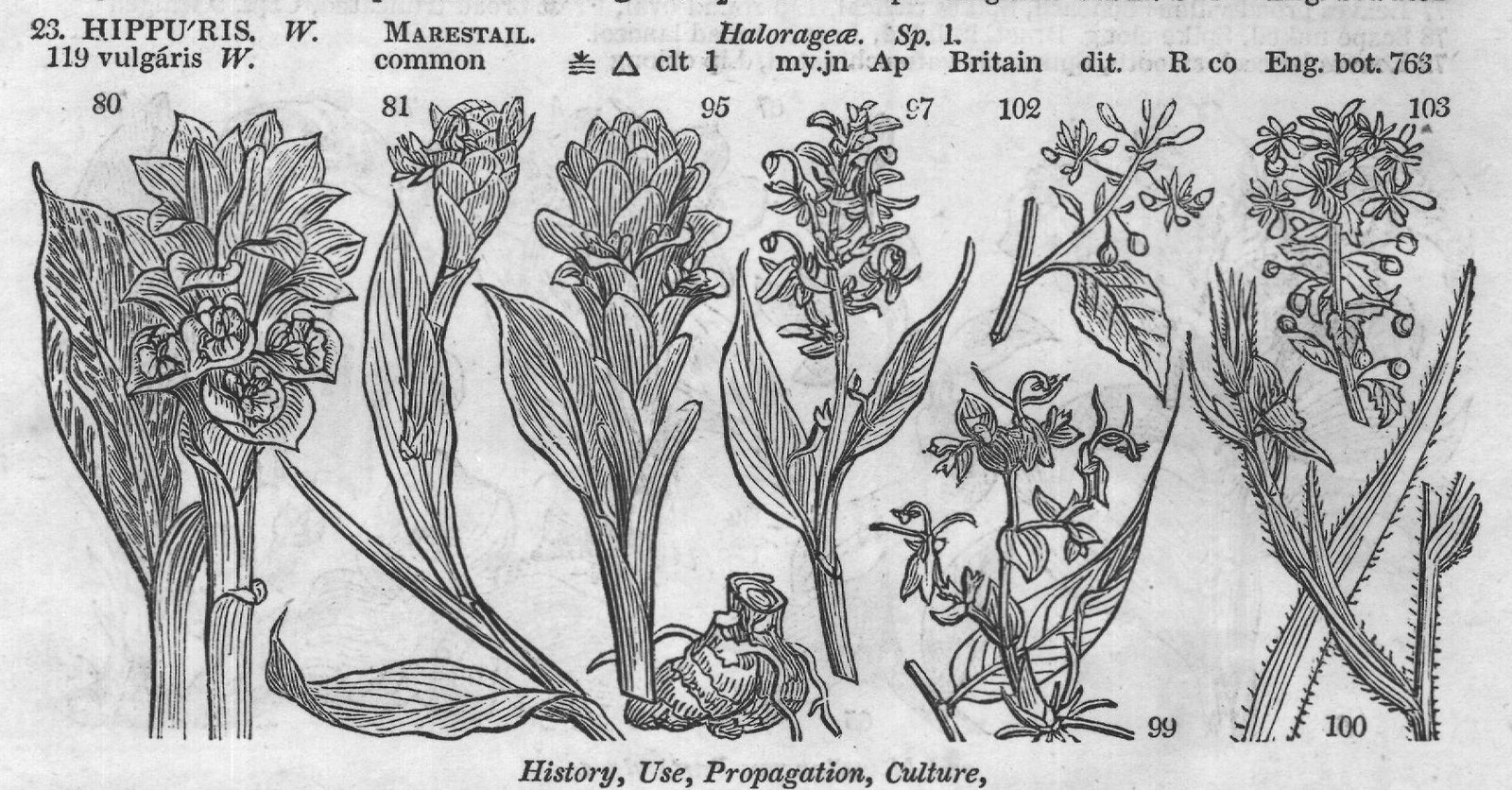
Halorageæ. Sp. 1. common clt 1my.jn Ap Britain dit. Rico Eng. bot. 763 80 81 95 97 102 103 99 100 History, Use, Propagation, Culture, 14. Curcuma. From the Arabic kurkum or hercum. Babilonischer safran, Ger. C. longa was formerly much used in cookery to give things a color, and is still so used in the East Indies, for dyeing. The root was reputed aperient and resolvent, and was given in jaundice: it tinges the urine of a deep yellow. The roots of C. zerumbet powdered and mixed with the powdered wood of Cæsalpinia Sappan is copiously thrown about by the Hindoos during their holidays in March. The tubers of many species yield a very beautiful pure starch like arrowroot, which in some places, especially Travancore, forms a large part of the diet of the inhabitants. 15. Globba. Its Indian name, and that also by which it is known in the Moluccas. Globée, Fr. Most of the species produce spikes of smoky-colored berries about the size of grapes, and which are sometimes eaten. 16. Mantisia. The flowers bear a singular resemblance to some of the insects called mantis. The name of the species is derived from a fanciful notion that the flowers are like a dancing figure attached to a wire. 17. Philydrum. Φiλoς and ύδως, a lover of water, in allusion to the places in which it grows. A pretty biennial plant, requiring but little protection from frost. 18. Lopezia. Dedicated by Cavanilles to the memory of the licentiate Thomas Lopez, a Spanish botanist, who is said to have directed his attention to the natural history of the New World. The species are chiefly elegant annuals, and well deserving of cultivation. 19. Boerhaavia. So named in honor of the famous Boerhaave of Leyden, born at Voorhoot in 1668, and died ORDER I.
MONANDRIA MONOGYNIA. 80 Spikes lateral, Bulbs small with long palm. tub. yell. inside, Leaves broad sessile silky beneath all green 81 Spikes lat. Tub. palm. pale straw-col. Leaves gr. stalk. brd. with a pur. cloud down the mid. Fl. short. than brac. 82 Spikes lateral, Roots æruginous within, Leaves stalked with a faint rusty cloud beyond their middle above 83 Spikes lat. Roots pearl col. inside, Leaves broad on winged red stalks above the sheaths: rib and scape red 84 Spikes lateral, Roots green inside palmate, Leaves narr. with a rusty cloud in middle 85 Spikes lateral clavate comose, Roots ovate pale yell. inside, Leaves all green 86 Spikes lateral, Tubers large incurved pale yellow, Leaves sessile villous beneath all green 87 Spikes lat. Roots palm. scented pale yell. inside palmd. Leaves and sheath rusty with a pale red spot in mid. 88 Spikes lat. few-flowered comose, Tubers long spreading pale inside, Leaves smooth pure green 89 Spikes lat. Tubers all yellow, Leaves sessile green broad with a purple cloud down the middle 90 Spikes lat. Leaves stalked oblong with red sheaths 91 Spikes lat. Root with pale pendulous tubers, Leaves stalked narrow, Flowers longer than bractes 92 Spikes central, Tubers palmate deep yellow, Leaves long stalked broad-lanceolate, Plant all green 93 Spikes central, Leaves on long stalks cordate, Coma lilac 94 Spikes central few-flowered, Tubers palmate pale yellow inside, Leaves broad smooth on long stalks 95 Spikes central, Roots deep orange inside, Leaves long stalked broad green 96 Leaves lanceolate, Spike terminal sub-sessile cone-shaped bulbiferous, Anther 4-horned 97 Spike whorled, Lateral segments of cor. longest, Appendage cordate, Bractes lanc. withering, Bulbiferous 98 Leaves ovate lanc. villous beneath, Racemes compound term. bulbif. Anther naked roundish 99 The only species 100 Flowers bright yellow, Leaves hairy 101 Leaves ovate villous, Stem round 102 Leaves ovate attenuate at base, with the 4-cornered stem smooth 103 Leaves shining, Stems angular, from the decurrent stalks, Corymbs leafy at the base 104 Leaves roundish cordate ciliated smooth, Branches angular 105 Stem 4-cornered smooth, Joints clammy, Flowers panicled, Leaves angular dotted with black beneath 106 Stem round pubescent, Flowers in capitate corymbs 107 Stem roundish hairy, Leaves ovate acute sub-repand, Flowers in heads diandrous 108 Stem climbing, Leaves all cordate, Flowers in umbels diandrous 109 Villous viscid, Leaves ovate acute sub-repand, Stem procumbent, Flowers in heads triandrous 110 Leaves entire lanceolate, Stem-shrubby at base, Flowers corymbose, Stamens nearly twice as long as cor. 111 Leaves linear, Stem herbaceous, Flowers corymbose, Stamens nearly thrice as long as corolla 112 Rad. leaves ovate cauline pinnatifid, Stem upright smooth, Flowers panicled 113 Stems branching declining, Flowers minute sessile in axillary heads 114 Leaves alternate sheathing obtuse gaping on one side 115 Stem erect shrubby, Joints of the young branches 2-sided, Scales of flowers truncate membranous 116 Stem shrubby procumb. rooting, Joints compressed emarg. cylindr. Spikes obl. Style deeply divided, Stam. 2 117 Herbaceous spreading, Joints emarginate compressed at end, Spikes axillary opp. stalked, Scales blunt 118 Herbaceous procumbent, Joints obconic, Branches simp. Spikes fastigiate, Stamens 2 119 Leaves whorled 10-12 linear acute 96 98 101 108 114 116 and Miscellaneous Particulars. in 1758. La Tassole, Fr. He was the first friend and protector of Linnæus. All the plants of this genus are possessed of little beauty. 20. Centranthus. From κεvτρov, a spur, and avθoς, a flower, in allusion to the calcarate corolla. 21. Pollichia. In honor of Jean Ad. Pollich, a German botanist, who published in 1776, a history of the plants of the Palatinate. The only species is an obscure herbaceous plant. 22. Salicornia. From sal, salt, and cornu, a horn; saltwort, marsh samphire. Le Christemarine, Fr. Glass schmaltz, Ger., and Erba-cali, Ital. S. herbacea is gathered when in flower, and pickled in salt and vinegar like samphire, for culinary purposes. The whole plant has a saltish taste, and is greedily devoured by cattle. All the species, excepting the S. arabica, abound on the shores of the Mediterranean, and are there burnt for soda, which is much used in the manufactures of soap and glass, especially at Marseilles. 23. Hippuris. From ἱππoς, a horse, and sea, a tail. La Pesse d'eau, or pin aquatic, Fr. Schaftholm, Ger., and Hippuride, Ital. The flower of this plant is one of the simplest among perfect plants; it has only one stamen and one pistil, unprotected by either calyx or corolla, and it produces only one seed. The situation of the leaves in whorls is not usual in European plants, excepting in the stellatæ of Linnæus. The flowers in the beginning of summer are mostly hermaphrodite, but in autumn many of them are female. By absorbing a great quantity of inflammable air, this plant is reputed to assist in purifying the putrid air of marshes. It is eaten by wild ducks. B 4 MONANDRIA DIGYNIA.
CLASS I. 24. ZOSTERA. L. SEA WRACKGRASS.