Important: Safety Warning
This page prescribes plants as medicine according to pre-modern medical theory. Several of the plants named are toxic, correct identification is difficult, and the doses given have no scientific basis. Do not ingest or apply any preparation described here.
This page presents medical treatment from an era before modern medicine. The remedies described are ineffective against the conditions named, and some of the ingredients or doses are harmful. Do not use them to treat any illness; consult a qualified medical professional.
This information has been left in for historical purposes but should not be acted upon.
Home › E › Eng (Bot my jn R Switzerl R s l Bot)
Eng (Bot my jn R Switzerl R s l Bot)
bot. 1513 3 my.jn R Switzerl. 1548. R s.l Bot. mag. 1784 3 my.jn R R s.l ...... ... 3 my.jn Pk ...... ... 3 my.jn R ...... ... 3 my.jn W R s.l Rs.1 R s.l ...... ... 3 my.jn W R s.l ...... 3 my.jn R 1823. R s.l Aor 2 my.jn Pu Rs.1 ...
Aor 2 my.jn Pu R s.l ... 2 my.jn Pk Candia ... 2 my.jn Pu Levant Rs.1 Bot. reg. 819 Rs.1 ... 3 my.jn Pu ...... ...
Rs.1 Sweet fl. gard.19 1 my.jn Pu R ... ...... 7821 arietína And.
Anderson's or 2 my.jn Pu R ...... ... 7822 decóra And. comely *or 2 my.jn Pu R ...... ... a Pallásii Pallas's *or 2 my.jn Pu Rs.1 ...... ...
B elátior tall *or 2 my.jn Pu R s.l ...... ... 7823 húmilis w. dwarf or 2 my Pu Spain 1633. R s.l Bot. mag. 1422 7824 anómala W. jagged-leaved or 2 my.jn Pk Siberia 1788. R s.l Bot. mag. 1754 laciniata Pall. ross. 2. t. 85. 7825 hýbrida W. mule or 2 my.jn R Siberia 1788. R s.l Pall, ross. 2. t.86 7826 tenuifólia W. fine-leaved * or 3 my.jn R Siberia 1765. R s.l Bot. mag. 926 TRIGYNIA. 1203. HIBBER'TIA. H. K. HIBBERTIA. 7827 volúbilis B. Rep. twining 7828 grossulariæfólia Sal. Gooseberry-lvd. 7829 dentáta R. Br. 1204. DELPHINIUM. W. LARKSPUR.
Dilleniacea.
Sp. 3-19. or or 4 my.o Y 2 mr.au Y N. S. W. 1790. C s.p Bot. rep. 126 N. Holl. 1803. C s.p Bot. mag. 1218 toothed or 3 Y ...
N. Holl. 1816. C s.p Bot. reg. 282 Ranunculacea. Sp. 26-53. 7830 chinénse Fisch.
Chinese 7831 ambíguum W. doubtful 7832 consólida W. field 7833 cuneátum Stev. wedge-shaped 7834 Ajácis W. 7835 aconiti W.
Rocket Aconite-like 7836 peregrínum W. broad-lvd.-ann. 4004000 or 2 s.o Pu Tartary 1819. S p.l Bot. cab. 71 or 3 jl.au B Barbary 1759. S p.l or 4 jn.jl B England san.fi. S r.m Eng. bot. 1839 or 4 jn.jl B Siberia 1816. D co Bot. reg. 327 or 2 jn.jl Pk Switzerl. 1573. S r.m or 1 jn.jl Pu Levant 1801. Sp.l Vahl, sym.1.t.13 or 1 jn.jl B Italy 1629. S p.1 Al. ped.2.t.25.f.3 D. junceum Dec. 7837 grandiflórum W. flore-pléno great great-flowered or 1½ jn.s D.B Siberia double-flowered or 2 jn.s D.B ...... ... 7812 78123 7813 δ 1741. D p.1 Bot. mag. 1686 D p.l 7816 7811 7817 7818 History, Use, Propagation, Culture, 7815 1201. Curatella. From curatus, worked; a name given by Aublet to the genus, because the leaves, which have a rough surface, are used in Guyana for polishing bows, sabres, and other weapons. A small tree with rough leaves, which grows well in sandy loam ; cuttings root in sand under a glass. 1202. Peonia. The physician Pæon was the first to use this in medicine. The Greek legend adds, that he it to cure Pluto of a wound inflicted by Hercules. The species are magnificent flowering plants, especially P. officinalis and moutan, with their numerous varieties. P. moutan and its different varieties are hardy enough to bear our winters in the open air ; but they do not flower in such perfection as when planted will open air; but they do not flower in such perfection as when planted out in a conservatory, or in a pit where they may be protected from the severe frost under glass: they will thrive well in any rich light soil; and ripened cuttings, slipped off, and planted in the ground, in a shady place, without cover, will root freely. (Bot. Cult. 234.) P. edulis has a more slender stem than the common Pæony. The Daurians and Mongols boil the root in ORDER II.
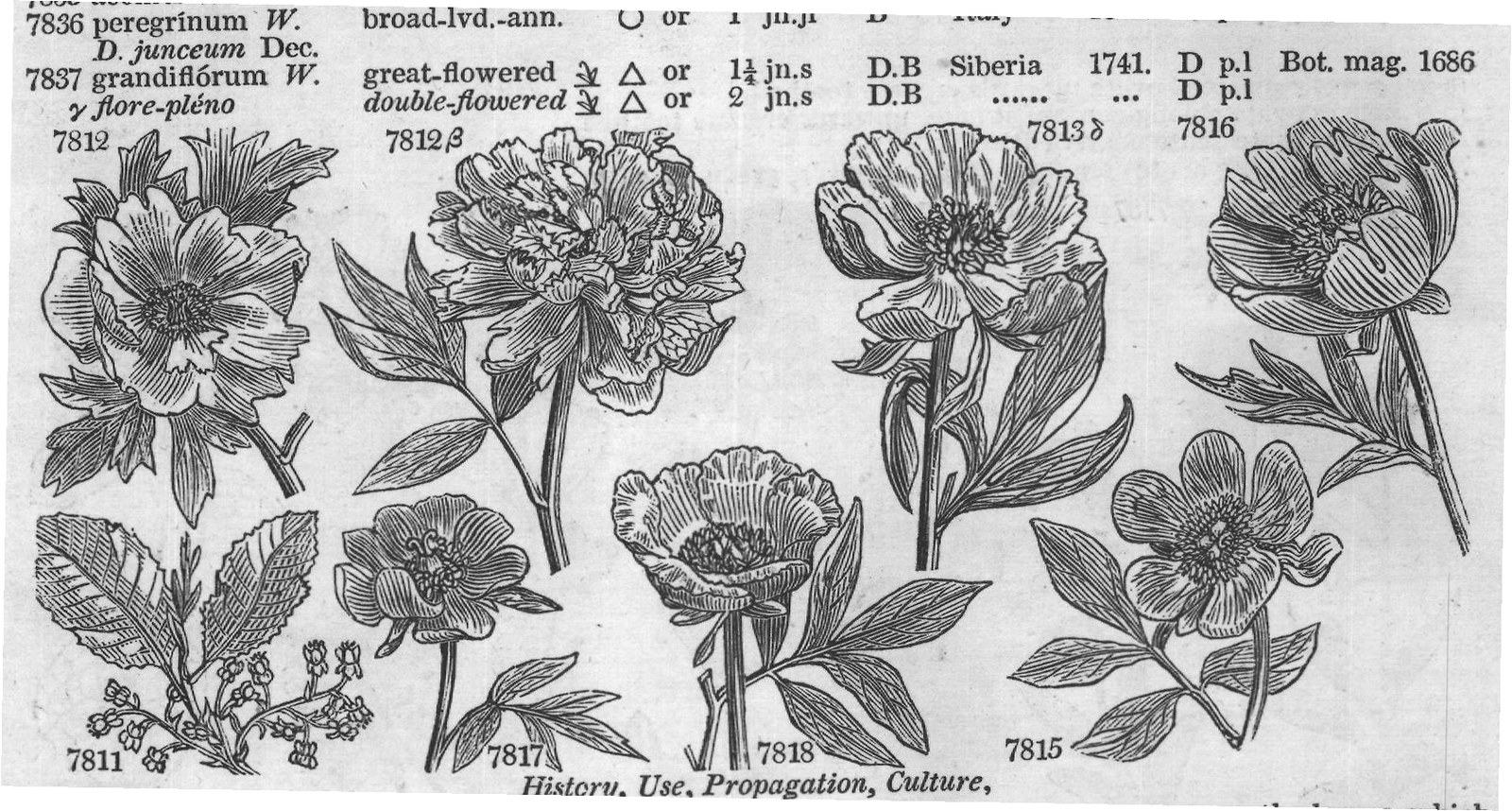
POLYANDRIA DIGYNIA. 7811 Leaves ovate subrepand toothletted rough 7812 Segments of leaves ovate obl. glaucous beneath 7813 Capsules smooth recurved, Segm. of leaves smooth shining 3-parted with ovate lanceolate lobes 7814 Capsules downy erect, Segm. of leaves glaucous beneath smooth somewhat lobed with blunt obovate lobes 7815 Capsules downy, Segm. of leaves ovate entire smooth 7816 Capsules downy nearly straight, Segments of leaves unequally cut smooth, Lobes ovate-lanceolate 7817 Caps. downy erect, Segm. of leaves 3-parted cut and entire ovate-lanc. flat hairy beneath 7818 Leaves somewhat shining blistered coriaceous glaucous and downy beneath, Ovaries woolly spreading 7819 Caps. downy straight, Segm. of leaves many-parted blunt somewhat wavy glaucous beneath hairy 7820 Caps. downy straight, Segm. of leaves oval-lanc. flat lobed imbricated beneath cæsious hairy 7821 Caps. downy arcuate spreading, Segm. of lvs. 3-lobed and pinnatifid decurrent ovate-obl. flat hairy beneath 7822 Caps. pubescent spreading, Segm. of leaves 3-parted oblong blunt hairy beneath 7823 Caps. somewhat pilose nearly erect, Segm. of leaves 3-5-parted villous beneath, Lobes obl. entire 7824 Caps. 5 smooth depressed blunt, Segm. of leaves smooth pinnated, Lobes lanc. acuminate 7825 Caps. pubescent, Segments of leaves smooth many-parted, Lobes linear 7826 Caps, downy spreading, Segm. of leaves smooth many parted, Lobes linear TRIGYNIA. 7827 Leaves obovate lanc. nearly entire mucronate pubescent beneath, Flowers sessile, Stem twining 7828 Leaves roundish crenate toothed, Fl. stalked opp. to the leaves, Stems procumbent 7829 Leaves obl. acum, smooth with awned serratures, Fl. stalked trigynous 7830 Like D. grandiflorum, from which it differs in having a more rigid stem, and a later time for flowering 7831 Stem erect velvety, Lvs. 3-5-part. Lobes pinnatifid, Racemes lax, Spur straight pubesc. shorter than cal. 7832 Stem suberect smth. with spread. branches, Fls. few loosely racem. Ped. long. than bractes, Caps. smooth 7833 Petioles not dilated at base, Lvs. cun. at base 5-7-lob. Lobes cut acute, Raceme lax branch. Calyxes smooth 7834 Stem erect smoothish nearly simple, Branches much covered with fls. Ped. length of bractes, Caps. pubesc. 7835 Stem erect branch. subpub. Lvs. pedate multifid, Ped. very long, Spur incurv. at end horiz. divid. upwards 7836 Stem erect much branch. Lvs. smooth rigid: low. multifid, Branc. and bractes lin. ent. Rac. lax. Pet. stalk. 7837 Leaves palmate many-parted, Lobes linear distant, Pedicels longer than bract, Pet. shorter than calyx 7824 7827 7828 7832 7823 7830 7837 and Miscellaneous Particulars. 7833 their broth, and grind the seeds and put them into their tea. P. officinalis was by old authors said to be of two sorts, male and female, the flowers of the former being smaller and lighter colored than those of the latter. These distinctions, however, were not indicative of sexual difference, the pæony being hermaphrodite, but merely of stronger and weaker growing varieties, according to the practice of the age. Now they are laid aside, the varieties reduced to seven or eight, of which a full account is given in the Horticultural Transactions (vol. ii. 273.). Of these, the double red, the most common, when introduced at Antwerp about the end of the sixteenth century, sold for twelve crowns a root. A useful account of the species and varieties has been published by Messrs. Anderson and Sabine, in the transactions of the Linnean Society. 1203. Hibbertia. Named after George Hibbert, Esq. who was once a distinguished English collector of plants. Twining or trailing plants of New Holland, with bright yellow flowers. 1204. Delphinium. From δελφiv, a dolphin, on account of the resemblance between the nectary of the 7842 hýbridum W. 7838 cheilánthum Fisch. Doroninsk 7839 intermédium W. palmated Bee 7840 elátum W. common Bee montanum Dec. 7841 revolútum Desf. hirsútum P. S.
POLYANDRIA TRIGYNIA.
CLASS XIII. revolute hairy 7843 mesoleúcum Link. white-eyed 7844 exaltátum W.
American 7845 azúreum Ph. azure 7846 dictyocárpum Dec. netted-capsuled સમમ સત્ર ાત્રાત or 2 jn or 8 jl or 6 jn.s D.B Siberia B Silesia B Siberia 1819. D p.l 1710. D p.l 1597. D p.1 Bot. reg. 473 Mill. ic. t. 119 Sch. han.2. t.145 or 6 jn.s P.B or 3 jn.s B Siberia D p.1 1794. D p.l or 3 jn.jl B.Y ...... 1822. D p.l or 3 jl.au B N. Amer. 1758. D p.1 Mill. ic. t.250. f.2 or 6 jl.au L.B Carolina 1805. D p.l or 4 jn.jl B Siberia 1817. D p.1 7847 tricórne Ph. three-horned or jl.au B N. Amer. 1806. D p.1 Bot. cab. 306 7848 urceolátum W. hollow-leaved or 2 jl.au B ...... 1801. D p.1 Bot. mag. 1791 7849 flexuósum Bieb. wavy or 2 jl.au B Caucasus 1820. D p.l 7850 ochroleúcum Stev. pale-yellow 7851 laxiflórum Dec. loose-flowered or 2 jn.jl W Iberia 1823. D p.l or 3 jn.jl B Siberia ...
D p.l 7852 puníceum W. scarlet-flowered or 4 jl R Siberia 1785. D p.l 7853 staphisagria W.en. Stavesacre or 2 ap.au L.B S. Europe 1596. S s.p 7854 píctum W. en. panicled or 1 ap.au L.B S. Europe 1816. S s.p 7855 Requiénii Dec. Requien's or 4 my.jn L.B Majorca orca 1824. S co 1205. ACONITUM. W. WOLF'S-BANE.
Ranunculacea. Sp. 20-22. 7856 paniculátum Lam. panicled or 3 jn.s Pa. B France 1815. D co Bot. cab. 810 7857 ochroleúcum W. pale-white or 3 jn.s L.Y Caucasus 1794.
D co Bot. mag. 7858 lycóctonum W. great-yellow or 3 jl.au Y Al. of Eur. 1596.
D co Jac. aust.4. t.380 7859 japónicum W.
Japan or 6 jn.s B 7860 variegátum W. variegated or 5 jn.au P.W 7861 An'thora W. wholesome or 1 jn.au P.Y 7862 pyrenáicum W. 7870 barbátum P. S. 7863 versícolor Stev. 7864 septentrionale W. 7865 álbum W. 7866 cam'marum W. rostratum Bernh. 7867 tortuósum W. en. 7868 neomontánum W. 7869 speciósum Otto. 7871 biflórum Fisch. 7872 Napéllus W. 7873 taúricum W. 7874 volúbile W. 7875 uncinátum W.
Pyrenean many-colored northern white or 4 jn.jl Y or 3 jn.s B.Y or 4 jl.au B rostrate twisting mountain shewy ાસ્ત્ર ાજાત Aor 4 jl.au W or 3 jn.s Pu or 6 jl.au P.B ...... or 3 jl.au B Japan 1790. D co S. Europe 1597. D co Pyrenees 1596. D co Pyrenees 1739. D co Siberia 1820. D co N. Europe 1800. D co Levant 1752. D co Switzerl. 1752. D co 1812. D co Europe 1799. D co Bot. cab. 794 Bot. mag. 2196 Jac. aust. 4. t.382 Bot. cab. 203 Barr. ic. t. 610 or 3 jl.au B 1823. D co ...... hairy or 2 jn.jl P.Y Siberia 1807. D co two-flowered Aor jn.jl P.B Siberia 1817. D co Monk's-hood pr 4 my.jl B Europe 1596. D co Taurian or 4 jn.jl B Tauria 1752. D co Jac. ic. 3. t. 492 twining or 6 jl.au B Siberia 1799 D co American or 2 jl.au B N. Amer. 1768. D co Bot. mag. 1119 PENTAGYNIA. 1206. TRACHYTEL/LA. Dec. TRACHYTELLA.
Dilleniaceæ.
Sp. 1-2. 7876 Actæ'a Dec. rough-leaved cu 6 W ...
China 1823. C p.l 7847 7848 7855 7838 7840 7844 History, Use, Propagation, Culture, 7858 plant and the imaginary figures of the dolphin. The species are shewy annuals or perennials, valuable as border flowers. The leaves are generally much divided, and the flowers in terminal spikes, blue, purple, or red; never yellow or any shade of that color.
D. consolida, (from consolidare, to unite; it being formerly reputed as a most powerful vulnerary,) Pied d'Allouette, Fr., Rittersporn, Ger., is a shewy annual, with blue, pink, purple, and white flowers, and semidouble and double. D. Ajacis, so called because some traces may be perceived in the flower of what may be likened to the letters AIA, is by some considered as only a variety of this species: both are universally grown as border annuals. D. elatum is well adapted for shrubberies. All the species are of the easiest culture. The species are extremely difficult to distinguish from each other, and are probably in many cases mere varieties. 1205. Aconitum. So called from growing about Acona, a town of Bithynia. The species are robust freeflowering plants of some beauty and consequence. The stems rise from two to six feet in height, upright, strong, furnished with many digitate or palmate leaves, and terminated by panicles or loose spikes of blue or yellow flowers.
A. Napellus, from napus, a turnip, its grumous roots resembling little turnips, is a well known poisonous plant. Linnæus says, that it is fatal to kine and goats, especially when they come fresh to it, and are not acquainted with the plant; but that it does no injury to horses, who eat it only when dry. He also relates (from the Stockholm Acts) that an ignorant surgeon prescribed the leaves, and on the patient refusing to take them, he took them himself and died. The ancients, who were acquainted with chemical poisons, regarded the Aconite as the most violent of all poisons. Some persons, only by taking in the effluvia of the herb in full flower by the nostrils, have been seized with swooning fits, and have lost their sight for two or three days. ORDER III.
POLYANDRIA TRIGYNIA. 7838 Stem erect branch. Lvs. 5-part. Lobes obl. acumin. Pet. shorter than cal. Caps. netted with color pubescent 7839 Petioles not dilat. at base, Lvs. cord. 5-7-fid: up. 3-lobed, Lobes cut serr. Ped. bract. cal. and ovaries smooth 7840 Petioles not dilated at base, Leaves downy 5-lobed, Lobes cuneate at base trifid cut, Spur inflexed 7841 Petioles not dilated at base, Lvs. orbicular cord. 5-fid, Lobes cut acute deflexed, Bractes 3, Ovaries smooth 7842 Petioles sheathing at base, Lvs. many-part. with lin. lobes, Raceme close, Spur straight longer than flower 7843 Lvs. somewhat dilated at base, Segm. cuneiform serr. cut in front, Stem upwards and peduncles pubescent 7844 Petioles not dilated at base, Lvs. flat trifid beyond the middle, Lobes cuneiform trifid at the end acuminate 7845 Pet. scar. dilat. at base, Lvs. 3-5-part. multif. with lin. lobes, Rac. straight, Pet. beard. at end: low. very vill. 7846 Pet. scar. dilat. at base, Lvs. 3-7-lob. Lobes obl. ac. cut pinnatifid: up. 3-part. Caps. nett. at keel and edge cil. 7847 Pet. smth. but scar, sheath. at base, Lvs. 5-par. Lobes 3-5-fid lin. Pet. sh. than cal. Caps. refl. from their base 7848 Petioles not dilated at base, Leaves concave beyond the middle trifid, Lobes cuneiform cut acuminate at end 7849 Petio. not dilat. at base, Lvs. 5-lob. with cut lobes, Stem flexu. and petioles hairy, Bractes lin. Caps. smooth 7850 Petioles sheathing at base, Lvs. many-par. with lin. subul. segm. Fl. pubesc. Spur acute longer than flowers 7851 Pet. not dilat. at base, Lvs. 3-7-lob. with obl. ac. cut pinnat. lobes, Rac. lax branch. Bractes and ovaries pub. 7852 Petioles sheathing at base, Lvs. many-parted in lin. lobes, Rac. long, Spur straight blunt longer than pedicel 7853 Spur very short, Bracteoles inserted at base of pedicel, Petioles hairy, Pedicels twice as long as flower 7854 Spur scarcely shorter than cal. Bracteoles inserted at base of pedicel, Petioles pubesc. Pedic. scarcely longer 7855 Spur nearly as long as calyx, Bractes inserted in the middle of pedicel, Petioles hairy [than flower 7856 Pan. divaricating, Branches tortuose, Helmet conical half circular, Spur short thick spiral [at end 7857 Fl. spiked or panic. numerous, Lvs. deeply 3-5-lobed with cuneate trifid lobes, Spur slender straight curv. 7858 Helmet conical cylindric. Spur slender spirally twisted, Lip divaricating, Lvs. palm. 3-5-lob. beyond middle 7859 Veiny smooth, Pan. smoothish with ascend. branches, Bag of hoods very large ventric. Spur thick subinvol. 7860 Pan, divaricating very smooth, Branches tortuose, Spur thick somewhat spiral, Lobes of leaves rhomboid 7861 Fls. panic. Sep. and pet. persist. Bag of hoods scarcely any, Spur thick spiral, Lvs. multif. with lin. ac. segm. 7862 All over densely pubesc. Lvs. very large palmate 3-5-lobed beyond middle pubesc. Helmet conical cylindr. 7863 Like Anthera, but flowers smoothish variegated with a low subconical helmet [compressed 7864 Like Lycoctonum, but flowers panicled, Stem peduncles and flowers villous, Ovaries smooth or hairy 7865 Ovaries 4-5, Helmet conical with a long claw, Rac, lax simple, Lvs. 3-5-parted with trifid toothed lobes 7866 Pan. lax, Helmet conical elongated abruptly mucronate in front, Spur thick spiral, Ovaries 3-5 7867 Pan. lax, Branches 1-4-fl. Spur thick long abruptly kneed, Bags of hoods inflated, Ovaries 3-5 smooth 7868 Ovaries 3 smooth, Raceme lax corymbose, Ped. smooth, Helmet very convex subconical 7869 Pan. lax, Helmet exactly conical, Spur very thick blunt very short, Bag of the hoods very large 7870 Fl. panic. Helmet conical, Spur thick blunt very short. Lvs. deeply lobed with narrow diverging segments 7871 Stem very short, Low. lvs. few on long stalks 5-part. with palm. segm. Hoods hook. blunt, Ovaries 3 villous 7872 Ovaries 3 smooth, Raceme cylindric. long, Leaves divided down to petiole with linear acute furrowed lobes 7873 Ovaries 3 smooth, Rac. cylindr. long very compact, Pedicels smooth shorter than bractes, Lvs. subpedate 7874 Stem twining with spreading hairs, Petioles ciliated, Leaves 3-5-parted with pinnatifid lobes, Ovaries 5-7 7875 Pan. lax, Branches diverging, Helmet exactly conical, Leaves 3-lobed with entire lobes, Ovaries villous PENTAGYNIA. 7876 Leaves very rough toothed 7868 7863 7861 7876 7875 7864 7866 and Miscellaneous Particulars, But the root is unquestionably the most powerful part of the plant. Matthiolus relates, that a criminal was put to death by taking one dram of it. Dodonæus gives us an instance, recent in his time, of five persons at Antwerp, who ate the root by mistake, and all died. Dr. Turner also mentions, that some Frenchmen at the same place, eating the shoots of this plant for those of masterwort, all died in the course of two days, except two players, who quickly evacuated all that they had taken by vomit. We have an account, in the Philosophical Transactions, of a man who was poisoned, in the year 1732, by eating some of this plant in a salad, instead of celery. Dr. Willis also, in his work De Anima Brutorum, gives an instance of a man who died in a few hours, by eating the tender leaves of this plant also in a salad. He was seized with all the symptoms of mania. The Aconite, thus invested with terrors, has, however, been so far subdued, as to become a powerful remedy in some of the most troublesome disorders incident to the human frame. Baron Stoerck led the way by administering it in violent pains of the side and joints, in glandulous scirrhi, tumours, ulcerous tubercles of the breast, &c. to the quantity of from ten to thirty grains in a dose, of an extract, the method of making which he describes.
Willdenow and the Dublin College consider that the plant used by Stoerck was the A. neomontanum, in which opinion Mr. Thomson agrees in his London Dispensatory. All the species are poisonous in a high degree. The limits of the species are extremely obscure, and in a very unsettled state; Decandolle in his Systema, increased the number at that time known, but in his Prodromus many of the species of the Systema are considered mere varieties. Dr. Reichenbach has, however, multiplied the species prodigiously, but with little reason. 1206. Trachytella. From τρaχύτης, roughness. These are climbing shrubs with racemose white flowers, and hard rough leaves, which are used in China for polishing metals and hard wood. POLYANDRIA PENTAGYNIA. 1207. CIMICI FUGA. Ph. BUGWORT. 7877 Serpentária Ph. Black Snakeroot Am Ranunculacea. Sp. 4-6.
CLASS XIII. 3 jn.jl W.Y N. Amer. 1732. D l.p Dill.elt. t. 67. f.78 Actæa racemosa W. 7878 fœtida W. stinking 4 jn.jl 7879 cordifólia Ph. heart-leaved cu 3 jn.jl L.Y Siberia 1777. D p.l W.Y N. Amer. 1812. D p.1 Lam. ill. 487 Bot. mag. 2069 7880 palmáta Ph. palmated cu 4 jl.au W.Y N. Amer. 1812. D p.l Bot. mag. 1630 1208. AQUILEGIA. W. COLUMBINE.
Ranunculacea. Sp. 8-13. 7881 viscósa W. clammy or 1½ my.jn Pu Montpel. 1752. D co Goua. ill.t. 19.f.1 7882 vulgáris W. common or 2 my.jl D Britain fields. D co