Home › E › Eng (Bot S sarum W)
Eng (Bot S sarum W)
bot. 1431 3598 Sísarum W.
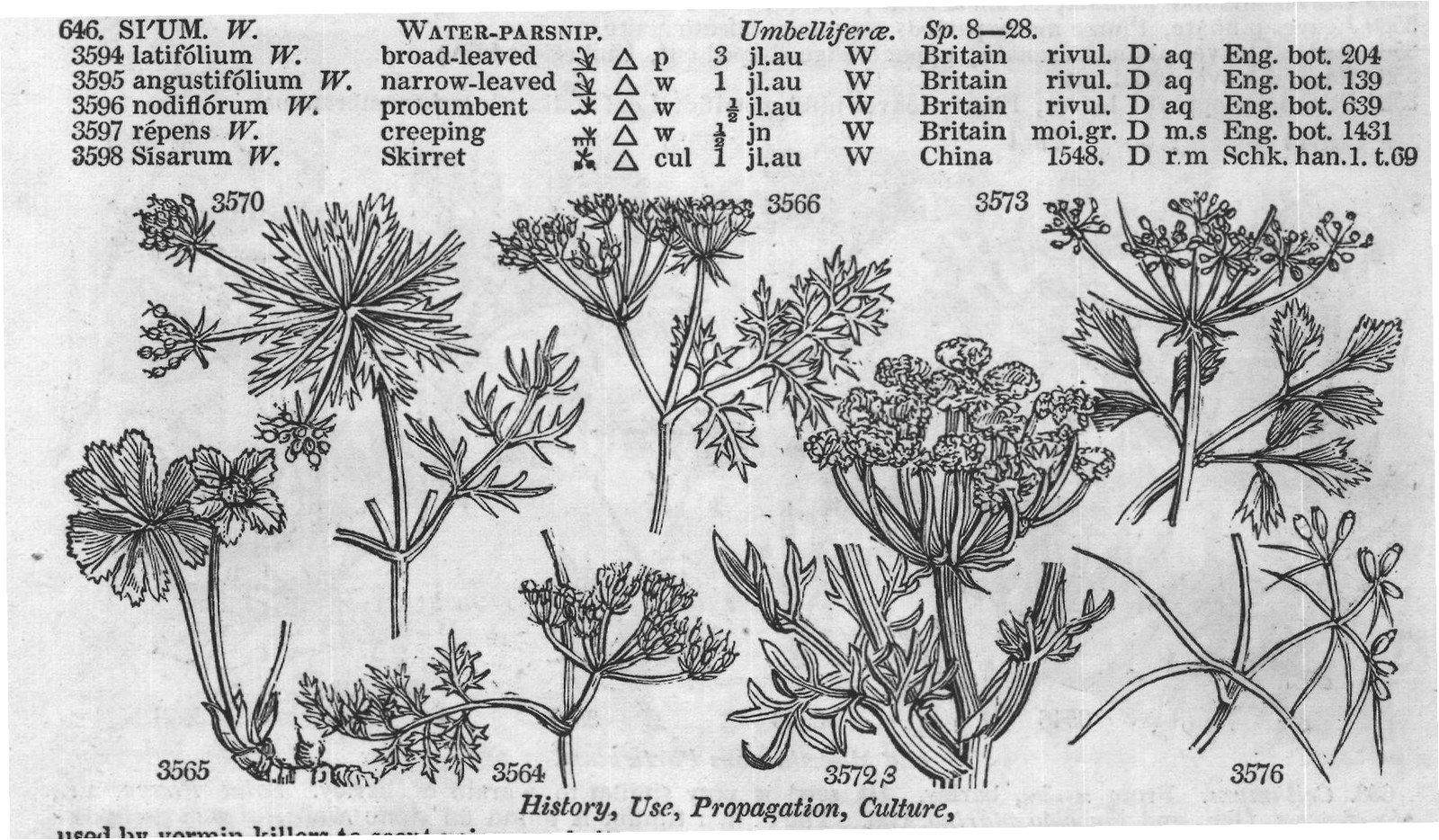
Skirret cul jl.au W China 1548. Dr.m Schk. han.1. t.69 3570 3566 3573 3565 3564 35723 3576 History, Use, Propagation, Culture, used by vermin-killers to scent poisonous baits, or to neutralize or obliterate other smells. Anise is sometimes sown in gardens for the leaves, to be used as a garnish, or for seasoning, like fennel. 636. Phellandrium. A name under which Pliny describes an umbelliferous plant, of similar nature to the one now so called. In running streams the leaves of this plant become divided, like those of Ranunculus now so called. In running streams the leaves of this plant become divided, like those of Ranunculus aquatilis in the same situation. When the plant grows in an angle, out of the rapid course of the stream, it produces its flowers; but it flowers best on the muddy banks of ditches and ponds. According to Linnæus it renders horses paralytic, the disease being brought on by a Coleopterous insect, the Curculio paraplecticus, which breeds in the stalks, and is cured by pigs' dung The 637. in the stalks, and is cured by pigs' dung The seeds are sometimes used in 637. Dondia. A curious little plant resembling Astrantia. The meaning of its name is unexplained. 638. Trachyspermum. From τρaχύς, rough, and σπερμη, seed; on account of the roughness of the seeds. Nearly related to Ammi, with which it agrees in habit. 639. Ammi. From aμμoς, sand; because it grows in sandy places. Plants with a delicate habit, very finely cut leaves, and white flowers. 640. Bubon. Bubonion is a name of Pliny's, now applied to this plant; as Pliny's was used in medicine, so is of this, the and there the resemblance ceases. B. macedonicum is put among clothes to scent them in some so this, and there the resemblance ceases. B. macedonicum is put among clothes to scent them in some parts of the East. From B. Galbanum (derivation obscure) the drug of that name is obtained, though it is not clear that it may not also be got from other species. It is collected from the spontaneous exudation of the ORDER II.
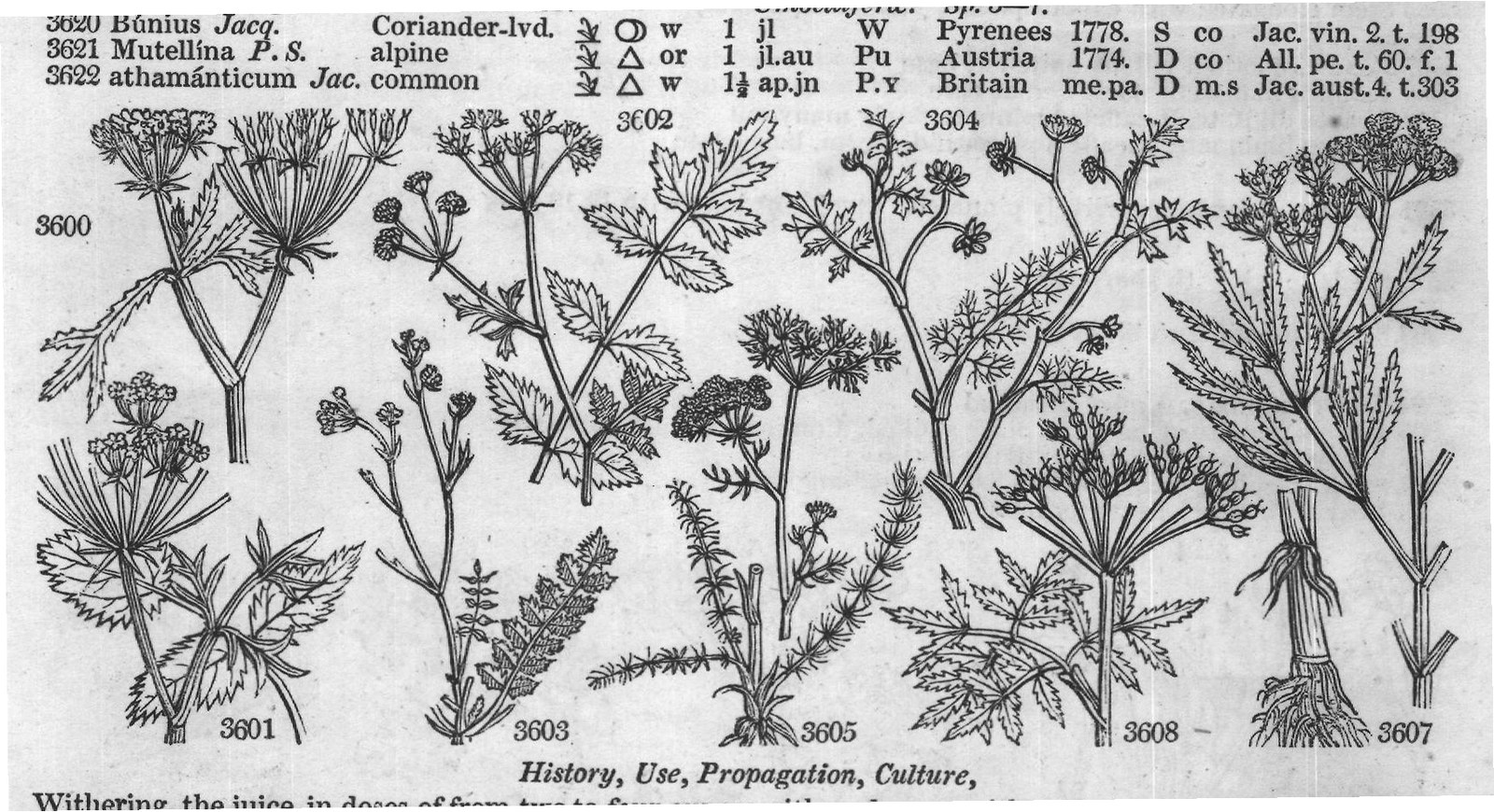
PENTANDRIA DIGYNIA. 3564 Ramifications of leaves divaricating 3565 Leaves stalked digitate 3-lobed, Scape angular with only one umbel 3566 Leaves supra-decompound, Leaflets filiform, Umbels opp. the leaves, Leaves of involucre unequal 3567 Universal umbel united at base 3568 Lower leaves pinnate lanceolate serrate; upper multifid linear 3569 Segments of all the leaves lanceolate 3570 Leaves supra-decompound, Leaflets 3-parted pinnatifid 3571 Leaves rhomb-ovate cut-toothed, Teeth acuminate, Umbels numerous, Seeds hairy 3572 Leaflets linear 3573 Leaflets ovate wedge-shaped acute finely serrate, Umbels few, Seeds smooth, Stem glaucous 3574 Leaflets lanceolate very obtusely and obscurely crenate, Seeds smooth 3575 Leaflets cut acuminate: lower broadest, Seeds smooth 3576 The only species. Lower leaves broad, Upper capillary 3577 Stem declinate, Umbels nodding 3578 Stem erect flexuose, Leaves decompound very fine, Umbels dense very downy 3579 Leaf-stalks branch-bearing membranous oblong entire, Cauline leaves very narrow 3580 Leaf-stalks branch-bearing membranous obl. entire, Leaflets single and two together channelled smooth 3581 Radical leaves with imbricated leaflets 3582 Stem tall rigid, Leaflets linear fascicled 3583 Stem procumbent branched, Leaves bipinnatifid shining, Involucels halved 3584 Involucels connate one-leaved 3585 Stem ascending, Leaves triternate very fine, Umbel nodding with long rays 3586 Stem elongated with callous points, Leaves bipinnate, Pinnæ linear distant 3587 Leaflets toothed villous united at base 3588 Leaflets many-cut narrowed at base 3589 Leaves digitate, Leaflets bipinnate finely many-cut 3590 Leaves bipinnate, Leaflets pinnatifid, Segm. lanceolate 3591 Downy, Leaves decursively pinnated, Invol, soft long with 10-18 rays 3592 Seeds rough with sharp ribs 3593 Seeds smooth with blunt ribs 3594 Leaves pinnate, Umbel terminal 3595 Leaves pinnate, Umbels axillary stalked, Common invol. pinnatifid 3596 Leaves pinnate, Umbels axillary sessile 3597 Stem creeping, Leaflets roundish toothed angular 3598 Leaves pinnate: floral ternate 3580 3584 3581 3588 3591 3597 3592 3594 and Miscellaneous Particulars. stem, or by an incision in the stalk a little above the root, from which it immediately flows, and soon becomes sufficiently concreted for gathering. Medicinally considered, this gum-resin resin is said to hold a middle place between Asafœtida and Ammoniacum; but it is far less fœtid than the former. 641. Cuminum. From the Arabic name of the plant qamoun. (Golius.) This is a dwarf fennel-looking plant, cultivated in the south of Europe and lesser Asia for its seeds, which are hot and aromatic, and used like those of Anise, Caraway, &c. 642. Seseli. Golius (p. 167.) says, a plant related to this is called Seycêlyous in Arabic. There is also a Greek σεσελi. 643. Thapsia. The Thapsia, says Dioscorides, derives its name from the isle Thapsus, where it was first discovered. Plants resembling Smyrnium in habit. 644. Actinotus. From aκτiv, a ray, in allusion to the ray-like appearance of the involucrum. Curious New Holland plants with the habit of Astrantia. 645. Trinia. Named by Hoffmann after Dr. Trinius, a celebrated Russian botanist, who has published some works upon grasses. Plants resembling Pimpinella in appearance. 646. Sium. Siw signifies water in Celtic. This is a genus of aquatic plants. S. nodiflorum bears a good deal of resemblance to the water-cress (Nasturtium officinale), and, unless when in flower, is not very easily distinguished from it by the inexperienced. It is commonly considered poisonous, though, according to Dr. P4 3599 rigidum W. 3600 Falcária W. 3601 sículum W. 647. SI'SON. W. 3602 Amómum W. 3603 ségetum W. 3604 inundátum W. 3605 verticillátum W. 3606 sálsum W. 648. CICU'TA. W. 3607 virósa W. 3608 maculáta W. 649. CO'NIUM. W. 3609 maculátum W. 3610 africánum W. 650. SMYR'NIUM. W. 3611 perfoliátum W. 3612 Olusátrum W. 3613 apiifólium W. corn Rue-leaved PENTANDRIA DIGYNIA.
CLASS V.
Virginian W 2 jl.au W Virginia 1774. D s.p Moris.s.9. t.7. f.1. decurrent Sicilian W 1 jl.au Y 2jlau W Sicily 1686. D s.p Europe 1726. D s.p Jac. aust. 3. t.257 Jac. vind.2. t.133 HONEWORT.
Umbelliferæ. Sp. 5-16. hedge water whorl-leaved fine-leaved ○○○44 W 3 jl.au W Britain W 2 jl.au W hed. Sm.s Eng. bot. 954 England ch.fi. S m.s Eng. bot. 228 W 1 my.jn W Britain dit. Saq Eng. bot. 227 W 1 jl.au W W 1 jl.au P.Y Britain m. me. D m.s Eng. bot. 395 Siberia 1804. D co P.a.p.1779t8.f1.3 COWBANE.
Umbelliferæ.
Sp. 2-5. long-leaved m 3 jl W Britain ditch. D m.s