Home › M › Meliaceæ (Sp common tm R)
Meliaceæ (Sp common tm R)
Sp. 2-3. common tm 80 R ...
W. Indies 1734. C p.l Cav. dis. 7. t. 209 Febrifuge 오 m 60 ...
R E. Indies 1796. C p.1 Rox. cor. 1 t. 17 Meliaceæ.
Sp. 1.
Cape or 20 jl.au W C. G. H. 1789. C p.1 Lam. ill. t. 358 HEYNEA.
Meliacece. Sp. 1.
Walnut-like 오 or 20 s W Nepal 1812. C 1.p Bot. mag. 1738 LIGNUM-VITE-TREE.
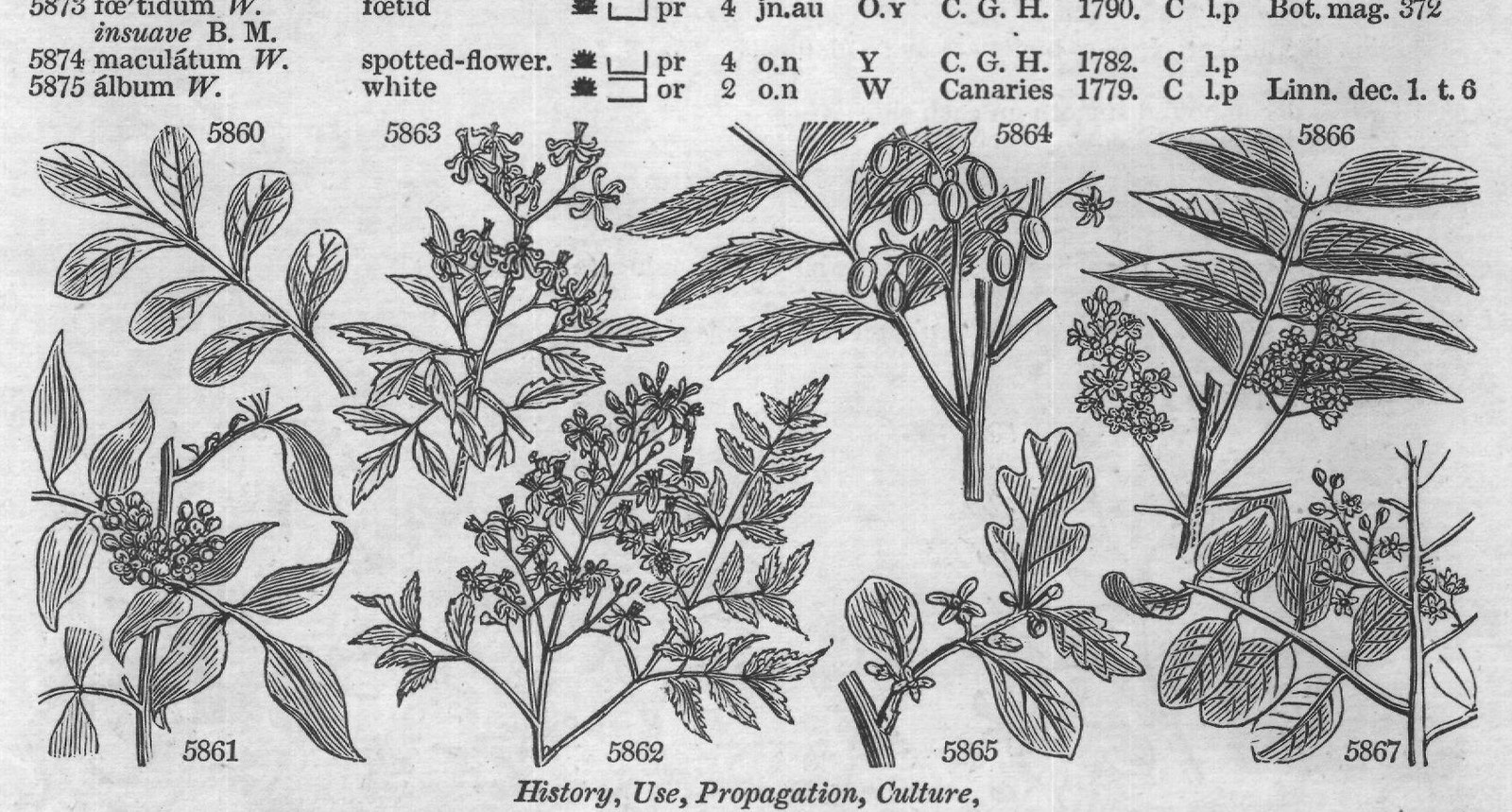
Rutacea. Sp. 1-4. officinal m 40 jl.s B W. Indies 1694. Cl.p Lam. ill. t. 342 Zygophylleæ. Sp. 8-19. heart-leaved cu 60 0 C. G. H. common fœtid * pr 4 jn.au cu 4 jl.s O.w O.Y Syria C. G. H. 1774. C 1.p 1596. C 1.p 1790. C l.p Lam.ill. t.345.f.1 Bot. mag. 372 pr 4 o.n or 2 o.n Y W C. G. H. 1782. C 1.p Canaries 1779. C l.p 5864 Linn. dec. 1. t. 6 5866 5861 5862 5865 5867 History, Use, Propagation, Culture, 987. Trichilia. From τρiχa, ternary, nearly all the parts of the plant, the leaves, the stigmas, the cells of capsule, the seeds, being produced by threes. T. glabra is a tall branching tree, with an unpleasant fœtid smell. The species are rarely seen in collections, and seldom, when cultivated, flower. 988. Melia. Mελia was the Greek name of the manna ash, from μελi, honey. This tree has been thought to resemble the ash in its foliage.
M. azedarach (azadaracht, Arab.) grows to a large tree in the south of Spain and Italy, producing long loose bunches of blue flowers, succeeded by pale yellow berries, about the size of a cherry. These berries consist of a pulp, which is poisonous in a high degree, and mixed with grease, will kill dogs, enclosing a nut which is bored and strung as beads by the Catholics.
M. sempervirens is considered by some as only a variety of the Azedarach. 989. Quivisia. The tree is called Bois de Quivi in the Isle of France. 990. Swietenia. So named by Jacquin, in honor of the illustrious Gerard L. B. Von Swieten, archiater to Maria Teresa, Empress of Germany, who at his persuasion founded the botanic garden at Vienna. S. mahagoni. The mahogany tree is a lofty branching tree, with a wide handsome head, the flower of Melia, and the fruit of Cedrela, about the size of a turkey's egg. It grows in the warmest parts of America, as in Cuba, Jamaica, Hispaniola, &c. The trees on the Bahama islands are not so large, but are more curiously veined, and are known in Europe as Madeira wood. They generally grow on the solid rock, where there seems to be no earth for their nourishment. Mahogany, like other timber, varies in durability, firmness of grain, and other circumstances, with the soil on which it is grown. The best is furnished from the ročky soils of St. Domingo and the Bahama islands.
S. febrifuga is a lofty tree, in general apearance like the Mahogany. The wood is of a dull red color, remarkably hard and heavy; it is reckoned by the natives the most durable wood they know, and on that account is used for all the wood-work in their temples; it is also very serviceable for various other purposes. The bark is internally of a light red color: a decoction of it dyes brown of various shades, according as the cloth has been prepared. Its taste is a bitter and astringent united, and very strong, particularly the bitter; at the same time not any way nauseous or otherwise disagreeable. In India it is used for the cure of intermittents with considerable advantage, and has also been found efficacious in most of the diseases in which the cinchona bark proves serviceable. (Thompson's London Dispensatory, 533.) 991. Ekebergia. Charles Gustavus Ekeberg was a Danish naturalist, who travelled in Asia from 1770 to 1771. Cuttings to succeed must have their leaves entire, and be planted in sand and covered. 992. Heynea. Named after Dr. Benjamin Heyne, a learned German botanist and physician, who travelled many years in India, where he formed a large collection of dried plants. 993. Guaiacum. From guaiac, the name given to the tree by the natives of Guiana. Gijuac, Fr., Gujakgummi, Ger., Gujaco, Ital. This tree rises forty feet high, and is four or five feet in circumference, with many divided knotted branches, greyish bark, and abruptly pinnate leaves. It has blue flowers, which are succeeded by compressed berries of a roundish form. The tree takes many years to arrive at its full growth. The roots run far into the ground perpendicularly, contrary to the usual growth of timber trees in the West Indies, which generally shoot the largest prongs of their roots in a horizontal direction, and are commonly observed to run very near the surface. The bark is thick and smooth, the wood of a dark olive color, and cross grained, the strata running obliquely into one another, in form of an X. It is a valuable timber where ORDER I.
DECANDRIA MONOGYNIA. 5860 Leaves pinnated smooth, Outer leaflets largest 5861 Leaflets lanceolate undulate, Flowers with 4 petals 5862 Leaves bipinnate, Leaflets smooth somewhat quinate 5863 Leaves bipinnate, Leaves cut rugose shining about 9, Petiole rounded at base 5864 Leaves pinnate 5865 Leaves alternate oval and obovate entire sinuate-toothed or pinnatifid, Pedicels twin axillary 1-flowered 5566 Leaves pinnate in four pairs, Leaflets ovate-lanceolate equal at base, Panicles axillary 5867 Leaves pinnate in four pairs, Leaflets elliptical roundish emarginate unequal at base, Panicle terminal 5868 The only species, Leaves pinnated with an odd one, Panicles axillary 5869 Leaves pinnated with an odd one in 3 pairs, Pan. axill. on long stalks 5870 Leaflets of 2 or 3 pairs obtuse, Capsules 2-celled 5871 Leaves simple opposite sessile roundish 5872 Leaves conjugate stalked, Leaflets obovate, Peduncles erect, Calyx smooth 5873 Leaves conjugate stalked, Leaflets obovate, Flower nodding, Calyx pubescent 5874 Leaves co jugate stalked, Leaflets linear-lanceolate 5875 Leaves conjugate stalked, Leaflets clavate fleshy with a cobweb surface 5868 5870 5869 and Miscellaneous Particulars. 5873 5872 5876 strength and duration is required, and weight no object. It takes a fine polish, turns well, and is much used for ship blocks. It is one of the most valuable trees of the West Indies; since the timber, the bark, fruit, leaves, and blossom, are all applicable to some useful purpose. The wood yields by incision the peculiar substance called Guaiacum, erroneously termed a gum, of great importance in medicine. All the parts of this tree possess medicinal qualities; but the wood and the peculiar substance afforded by it are the only parts used: the virtues of the wood depend altogether on the peculiar matter it contains. This is spontaneously exuded from the tree, and is called native gum: it concretes in tears, which are semipellucid, and very pure; but the greater part of it is obtained by making incisions into the trunk, or, as it is termed, jagging the tree. This operation is performed in May; and the juice which flows copiously, is concreted by the sun. It is also obtained by sawing the wood into billets, and boring a hole longitudinally through them; so that, when one end of a billet is laid on a fire, the guaiac melting runs through the hole from the opposite end, and is collected in a calabash. Boiling the chips or raspings in salt and water also separates the guaiac, which, as it rises to the surface, may be collected by skimming. Both the wood and the guaiac are stimulant, diaphoretic, diuretic, and purgative. The wood was introduced into Europe by the Spaniards as a remedy for lues venerea in 1508, and gained much celebrity from curing Van Hutten; but it had long before been used for the same purpose by the natives of St. Domingo. It obtained so much reputation, that the exhibition of mercury was discontinued for a considerable length of time, and even in the eighteenth century its specific powers over this disease were maintained by Boerhaave; but frequent disappointments and more correct observations have shown that it possesses no powers of eradicating the venereal virus; and that it is useful only after a successful mercurial course, for repairing the strength and vigor of the system, "and where a thickened state of the ligament, or of the periosteum, remains, or where there are foul indolent ulcers;" (Pearson's Observations, &c. p. 10.) or in suspending the progress of some of the secondary symptoms for a short time, as ulcers of the tonsils, eruptions, and nodes. The decoction of the wood has been found more useful in cutaneous diseases, scrofulous affections of the membranes and ligaments, and in ozæna. The guaiac itself is an efficacious remedy in chronic rheumatism and arthritic affections, as well as those diseases for which the decoction of the wood is usually given; and in every respect it may be regarded as the active ingredient of the wood. Its sensible effects are a grateful sense of warmth in the stomach, dryness of the mouth and thirst, with a copious flow of sweat, if the body be kept externally warm, or if the guaiac be united with opium and antimonials: but when the body is freely exposed, instead of producing diaphoresis, it augments considerably the secretion of urine. (Thomson's London Dispensatory, 318.) Lignum vitæ in the stove grows freely in loam and peat. "Cuttings," Sweet observes, " are generally supposed to be difficult to root; but I find ripened cuttings, taken off at a joint, root readily, planted thin in a pot of sand, and plunged under a hand-glass in heat. When the cuttings are rooted, which will be easily perceived by their growing at the top, they should be potted off; when great care must be taken not to break off the young roots in taking the sand from them, as they are very small and easily broken. Pot them off in very small pots, and keep them under a close glass or a few days, till they have struck fresh root, when they must be exposed to the air by degrees." (Bot. Cult. 63.) 994. Zygophyllum. From ζuγoς, a pair, and φύλλov, a leaf; all the leaves grow in pairs. Morgsana, which is the name of one species, is the Syrian name of the plant. These are plants of little ornament, generally with fleshy leaves, and flowers of a yellow or whitish yellow color. A a 5876 Morgsána W. 5877 sessilifólium W 5878 coccíneum L. 995. FAGO'NIA. W. 5879 crética W. 5880 arábica W. 996. TRIBULUS. W. 5881 máximus W. 5882 terréstris W. 5883 cistoídes W.
DECANDRIA MONOGYNIA. four-leaved sessile-leaved scarlet FAGONIA.
CLASS X. cu 3 my.s Y cu 3 jl.au Y or 3 S C. G. H.
C. G. H.
Egypt 1732. C l.p Di.elt.t.116.f.141 1713. C l.p Bot. mag. 2184 1823. C s.p Forsk. ic. t. 11 Zygophylleæ.
Sp. 2-10.
Cretan cu 1 jn.au Y Arabian cu 2 jn.au Y Candia 1739. S lt.l Bot. mag. 241 Arabia 1759. S lt.l CALTROPS.
Zygophylleæ.
Sp. 3-7. great pr 1 jn.jl Y small cu 1 jn.jl Y Jamaica 1728. S s.1 S. Europe 1596. S co Jac. ic. 3. t. 462 Lam.ill, t.346.f.1 Cistus-like pr 1 jl Y S. Amer. 1752. C lt.l Bot. reg. 791 Rutaceæ. Sp. 2. red Aor 3 my.jl Pu Germany 1596. R p.l Jac. aust.5. t.428 white or 3 my.jl W Germany 1596, R p.1 RUE.
Rutaceæ. Sp. 10-24. common 业 m 3 jn.s G.Y S. Europe 1562. C co Lam. ill. 345. t. 1 un 2 au.s G.Y 997. DICTAM'NUS. W. FRAXINELLA. 5884 Fraxinélla Link. 5885 álbus L. 998. RU'TA. W. 5886 gravéolens W. 5887 montána W. 5888 chalepénsis P. S. 5889 angustifólia P. S. 5891 pubescens W. en. 5894 macrophýlla Sol. mountain brd.-lvd.-Afric. narrow-leaved winged-leaved pubescent Flax-leaved un 2 jn.s S. Europe 1596. C co Jac. ic. 1. t. 76 G.v Africa 1722. Cr.m un 2 jn.s G.Y un 2 mr.au G.y 2 un 1 my.au G.Y Aun 1 jn.s G.Y Aun 1 jn.jl un 3 jl G.v Africa 1722. Cr.m Bot. mag. 2311 Canaries 1780. Cr.m Spain Spain Italy G.Y Africa W Nepal 1816. C co 1752. Cr.m Bot. rep. 565 1819. Cr.m Michel. gen. t. 19 1820. Cr.m Bot. mag. 2018 1823. Cr.m Hook. ex. fl. 79 5890 pinnata W. 5892 linifólia W. 5893 patavína L.
Paduan 5895 albiflóra Hook. large-leaved white-flowered pr 2 jl.au 999. CRO WEA. Sm.
CROWEA. 5896 salígna Sm.
Willow-leaved or 3 jl.d Rutaceæ. Sp. 1.
Pu 5897 Royéni W. 1002. QUAS'SIA. W. 1000. CO'DON. W. 1001. GOM'PHIA. W. 5898 nítida W. 5899 obtusifólia Dec. 5900 amára W. 5901 Simarúba W.
CODON. ....
N. S. W.
Sp. 1. 1790.
C s.l.p Bot. mag. 989 prickly cu S C. G. H. 1801.
S lt.l Bot. rep. 325 BUTTON-FLOWER.
Ochnaceæ. Sp. 2-24. glossy-leaved el 4 Y ...
Jamaica 1803. C s.l Ann. mus. t. 13 obtuse-leaved el 3 ...
Y Jamaica 1803. C s.l Ann. mus t. 8 QUASSIA.
Simarubacee. Sp. 2-4. bitter m 20 jn.jl R Guiana 1790. C p.1 Bot. mag. 497 winged-leaved or 6 R ...
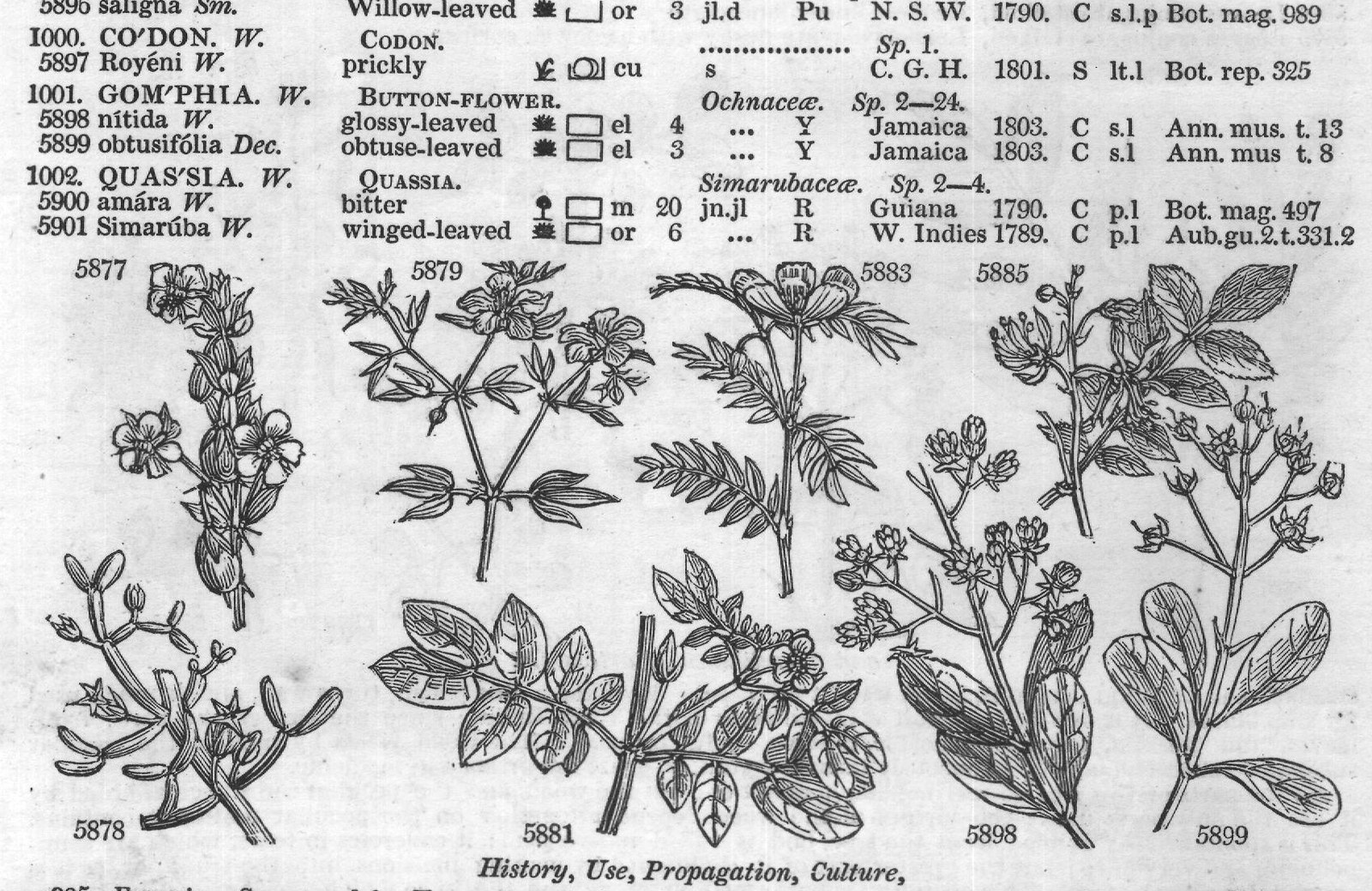
W. Indies 1789. C p.1 Aub.gu.2.t.331.2 5877 5879 5883 5885 5878 5881 5898 5899 History, Use, Propagation, Culture, 995. Fagonia. So named by Tournefort, in honor of Mons. Fagon, archiater to Louis XIV, and a great patron of botany. _ Small prickly plants of no beauty. 996. Tribulus. From τρεiς, three, and βoλoς, a point, in reference to the points of the capsules. La Croix du Chevalier, Fr. The term Caltrops is taken from the form of the fruit, which resembles the machines that were formerly cast in the way to obstruct an enemy's cavalry. It is composed of five nuts, united into a subglobular whorl armed with prickles.
T. terrestris is a native of most of the hot and temperate parts of the world: it is common about Kingston in Jamaica, where it is called Turkey blossom, and planted in gardens for the sake of its flowers, which have an agreeable smell. The fowls are observed to feed much on them, which is thought both to fatten them and heighten their flavor. In the south of Europe, it is a common weed in arable land, and is troublesome to cattle by the prickly fruit running into their feet. All the species are pretty, though seldom cultivated. 997. Dictamnus. An ancient name of what is now supposed to be the Origanum Dictamnus. Fraxinella, Fr., in allusion to the remarkable similarity which exists between the leaves of the plant and Fraxinus, the ash. The whole plant, especially when gently rubbed, emits an odor like that of lemon-peel, but when bruised it has something of a balsamic scent. This fine scent is strongest in the pedicels of the flowers, which are covered with glands of a rusty red color, exuding a viscid juice or resin, which exhales in vapor, and in a dark place may be seen to take fire. The root is used in medicine, and, it is said, with much success, as an opiate and drastic. , as an opiate and drastic. 998. Ruta. This name is nearly the same in all languages. Puτη, in Greek; Ruta, in Latin; ruz, in Runic; rude, ruta, or rutu, in Anglo-Saxon; rutiza, in Sclavonic; in French and English, rue, &c. The root of the word is beyond the ingenuity of etymologists. R. graveolens was formerly in much repute as a medicinal plant, and also as emblematical of repentance and grace. In Shakspeare and other old authors, it is called herb of grace, as rosemary is called herb of remembrance. The leaves have a powerful unpleasant odor, and a hot, bitter, nauseous taste. In the recent state they will inflame and blister the skin; but much of this is dissipated in drying. Medicinally, rue is stimulant and antispasmodic, and is supposed to possess emmenagogue powers. It was in high estimation as early as the time of Hippocrates, who frequently ordered it in female complaints. In modern practice, it is chiefly used in hysteria and flatulent colic. (Thomson's London Dispensatory, 487.) 999. Crowea. So named by the president of the Linnean Society, after his friend James Crowe of Norwich, an excellent British botanist, whose collection of willows we believe still exists. This plant continues in flower the greater part of the year. An equal mixture of sandy loam and peat is the best soil for it, and care must be taken not to over water it, or it will look yellow and unhealthy. It likes an airy situation, ORDER I.
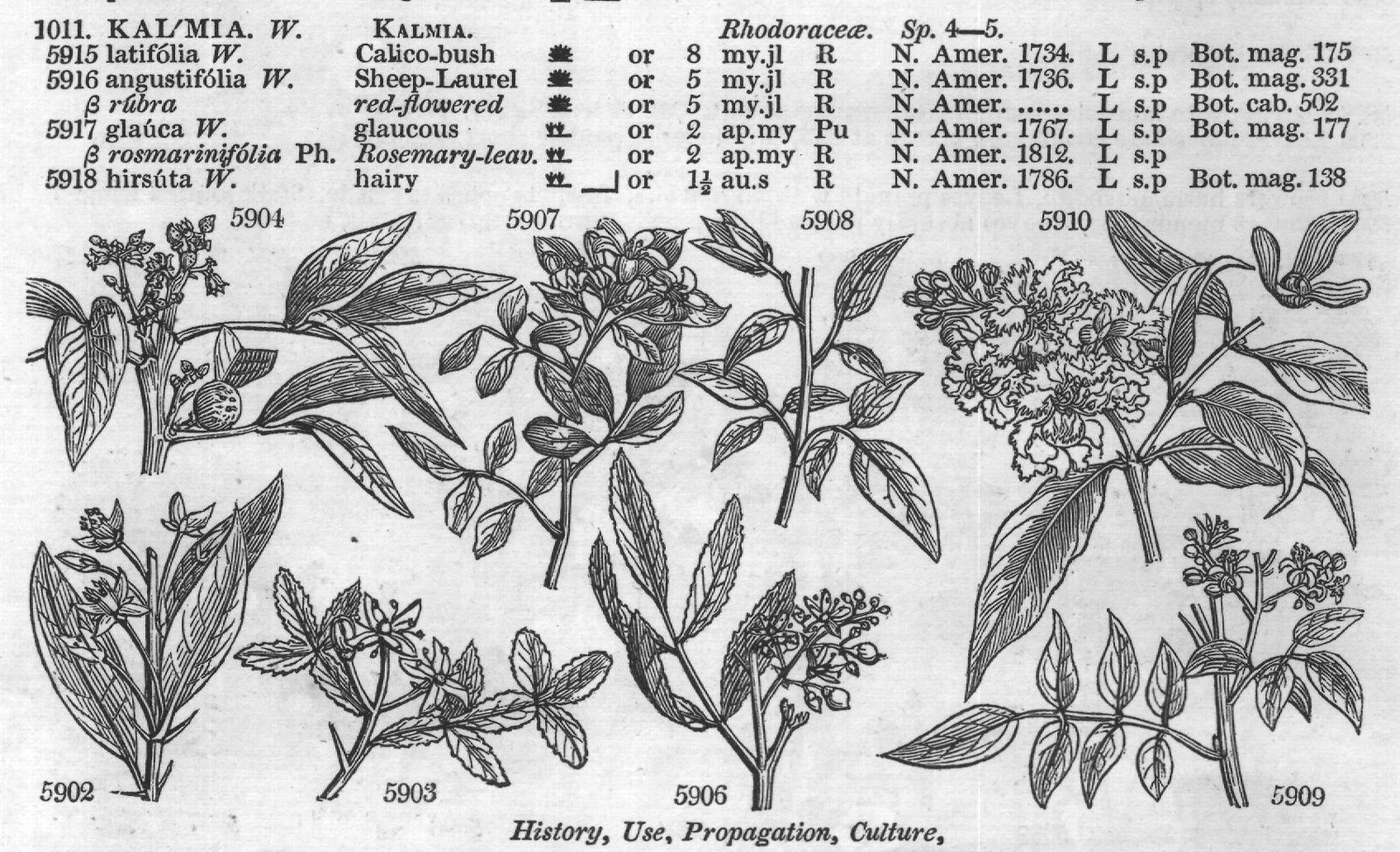
DECANDRIA MONOGYNIA. 5876 Leaves conjugate stalked, Leaflets obovate, Stem shrubby 5877 Leaves conjugate sessile, Leaflets lanceolate oval rough at edge, Stem shrubby 5878 Leaves with double leaflets stalked, Leaflets cylindrical fleshy smooth, Petals acuminate 5879 Spiny, Leaflets lanceolate flat smooth 5880 Spiny, Leaflets linear convex 5881 Leaflets in 4 pairs: the outer larger, Pericarps 10-seeded blunt 5882 Leaflets in 6 pairs nearly equal, Seeds with four horns 5883 Leaflets in 8 pairs nearly equal 5884 Leafstalk obscurely edged 5885 Leafstalk scarcely edged at all 5886 Leaves supradecompound, Leaflets oblong terminal obovate, Petals entire 5887 Leaves supradecompound, Leaflets all linear, Petals entire 5888 Leaves supradecompound oblong, Terminal leaflet obovate, Petals toothed 5889 Leaves supradecompound, Lobes oblong cuneate nearly equal, Bractes very small ovate, Petals ciliate 5890 Leaves pinnate, Leaves lanceolate attenuate at base serrate crenate, Petals entire 5891 Leaves mostly ternate lanceolate pubescent: lateral very short, Cal. and ovaries villous 5892 Leaves simple lanceolate smooth, Filaments ciliated, Stem simple herbaceous 5893 Leaves in middle ternate linear narrowed at the base entire, Calyxes villous 5894 Leaves pinnatifid, Segments oblong somewhat stalked the terminal very large, Petals ciliated 5895 Leaves bipinnate with obovate retuse leaflets, Flowers 4-petalous 8-androus 5896 The only species 5897 The only species 5898 Leaves ovate-lanceolate acuminate serrated at end, Cal. as long as cor. Berries ovate 5899 Leaves lanceolate entire very obtuse at end, Branches of panicle short angular 5900 Flowers hermaphrodite, Leaves pinnate with an odd one, Leaflets opposite sessile, Stalk jointed winged 5901 Flowers monœcious, Leaves abruptly pinnated, Leaflets alternate stalked, Stalk naked 5886 5889 5892 5894 5900 5896 5901 5897 and Miscellaneous Particulars. and not to be crowded amongst other plants. Cuttings strike root freely in sand, under a bell-glass. (Bot. Cult. 173.) 1000. Codon. From κωδωv, a bell. The corolla of this plant is globular, and formed like a bell in its upper part. A scarce Cape shrub, of which 'Thunberg speaks in terms of great delight upon finding a solitary individual growing by the side of a precipice in its native country. 1001. Gomphia. From γoμφoς, a club; but the application is not obvious. These are most beautiful tropical bushes, with long spikes of brilliant yellow flowers, and neat serrated shining entire leaves. 1002. Quassia. So named by Linnæus, in memory of Quassi, a negro slave of Surinam, who found and discovered to Rolander, a Swede, the wood of Q. excelsa, which he had employed with success as a secret remedy in the malignant endemic fevers of Surinam.
Q. amara is a lofty tree with strong branches, white light wood, their bark and leaves not unlike those of the common ash. The flowers are in terminal racemes, of a bright red. The root, wood, bark, and indeed all the parts of this tree are intensely bitter. Linnæus says that the wood of the root is a noble remedy, but that the wood of the small branches, which has since been substituted for it, is good for nothing. The wood of both is now thought to be less intensely bitter than the bark, which is at present regarded as the most powerful medicine. Quassia has no sensible odor; its taste is that of a pure bitter, more intense and durable than that of almost any other known substance: it imparts its virtues more completely to watery than spirituous menstrua, and its infusions are not blackened by the addition of martial vitriol. It is said that considerable quantities of this drug are used by the brewers instead of hops. Q. Simaruba, or mountain damson, as it is called in Jamaica, is a tall tree with alternate branches, and a smooth grey bark, maculated with yellow spots. The leaves are pinnate; the flowers are male and female on the same axillary panicles, yellowish white; the fruit consists of five smooth, ovate, black, one-celled berries, on a common receptacle, and open spontaneously when ripe. The officinal part of this tree is the bark of the root; it is inodorous, and has a bitter, but not disagreeable taste. The pieces are of a very fibrous texture, rough, scaly, warty, and of a full yellow color in the inside when fresh. Alcohol and water take up all its active matters by simple maceration, at a temperature of sixty degrees of Fahrenheit better than at a boiling heat; it is tonic, and has been employed with advantage in intermittent fever, obstinate diarrhea, dysentery, and dyspeptic affections. (Thomson's London Dispensatory, 462.) The different species of quassia flower freely in the stove; are of easy culture in loam and peat, and are increased by ripened cuttings taken off at a joint, and not deprived of their leaves, and planted in a pot of sand under a hand-glass.
Aa2 DECANDRIA MONOGYNIA.
CLASS X. 1003. LIMONIA. W.
LIMONIA. 5902 monophýlla W. 5903 crenuláta H. K. simple-leaved crenulate Aurantiaceæ. Sp. 2-11. or or W E. Indies 1777.
W E. Indies 1808.
Cr.m Rox. cor. 1. t. 83 Cr.m Rox. cor. 1. t. 86 1004. GLYCOS MIS. Corr. GLYCOSMIS. 5904 citrifólia Lindl. various-leaved Limónia parviflóra B. M.
Aurantiaceæ. Sp. 3. fr 6 ja.d W China ...
Cr.m Bot. mag. 2416 5905 pentaphýlla Corr. five-leaved 5906 arbórea Corr. tree 오오 or 20 jn.jl W or 20 my.au W E. Indies 1790.
E. Indies 1796.
Cr.m Rox. cor. 1. t. 84 Cr.m Rox, cor. 1. t. 85 1005. MURRA'YA W.
MURRAYA.
Aurantiacea. Sp. 2. 5907 exótica W.
Ash-leaved 5908 paniculáta Wall. panicled ft 8 au.s W ft 8 jl W E. Indies 1771. C lt.l Bot. reg. 434 E. Indies 1823. Cr.m Hook. ex. ft. 134 1006. COOK'IA. W.
WAMPEE-TREE. 5909 punctáta W.
Chinese fr 15 1007. GÆRTNE'RA. W. GÆRTNERA. 5910 racemósa W. clustered 오 Aurantiaceæ. Sp. 1-2.
W China 1795. C lt.l Jac.schœ.1. t. 101 Malpighiacee. Sp. 1-3. or 15 mr.ap W E. Indies 1796. C p.1 Bot. rep. 600 1008. MONOTROPA. W. YELLOW BIRD'S-NEST. ...