Murr
1778. t. 1 Bot. reg. 347 Mor.h.3. t.13.f.18 400 ægyptíaca W. 401 crética W. 402 paniculáta W. 403 africána W. 404 coloráta W. 405 officinális W.
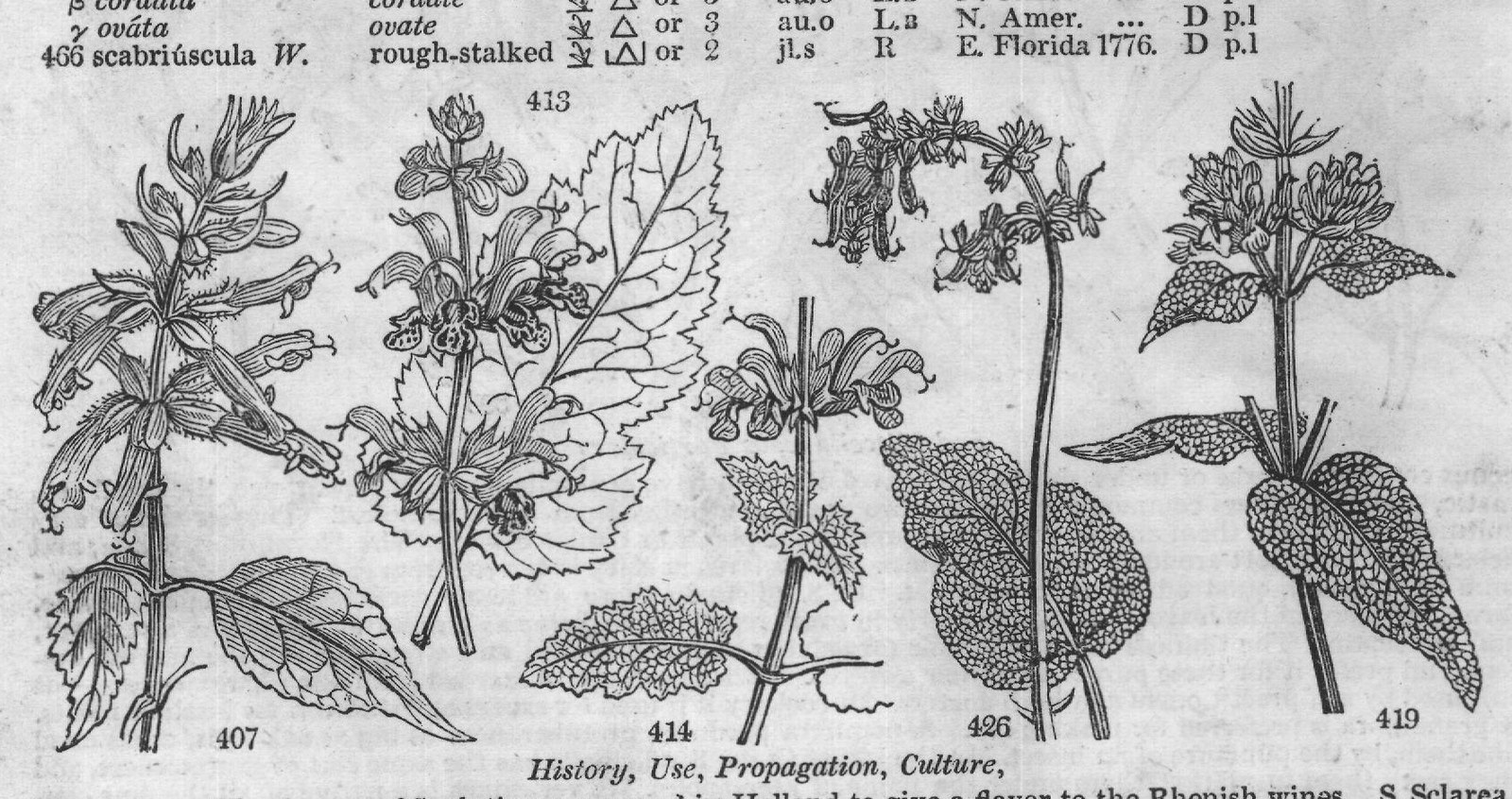
Egyptian or jn.jl W Egypt 1770. S co Jac. vind. 2. t.108 Cretan or jn.au V Crete 1760. C co Riv. mon. t. 128 panicled or 6 jn.au V C. G. H. 1758. C p.1 Mill. ic. t. 225. f.1 African or 2 ap.jn V C. G. H. 1731. C p.1 Com. hort.2. t.91 colored calyxor 6 jl.au B C. G. H. 1758. C s.p Mill. ic. t.225. f.2 garden cul 2 jn.jl R.c S. Europe 1597. 1597. C co Ger. herb.623.f.1 367 360 363 365 368 373 History, Use, Propagation, Culture, are aromatic, and resemble mint in their habits and mode of culture. The leaves of M. didyma are sometimes used as tea in North America; its flowers are of a very brilliant scarlet. 61. Rosmarinus. Two Latin words signifying dew of the sea. The shrub grows in the southern parts of Europe in the vicinity of the sea. R. officinalis yields, by distillation, a light-pale essential oil of great fragrance, which is imparted to rectified spirit. It was formerly recommended for strengthening the nervous system, headaches, &c. as well as to strengthen the memory. Hence the allusion of the poet, "there's rosemary, that's for remembrance." Rue in former times signified grace; and rosemary, repentance. Rosemary was considered as an emblem of fidelity in lovers; it was worn at weddings and funerals, and on the latter occasions is still in some parts of Wales distributed among the company, who throw the sprigs in the grave along with the corpse. It is the principal ingredient in Hungary water, and is drunk as tea for headaches, and by nervous persons. It prefers a lean dry soil, or rubbish of old buildings; and when it has established itself on a wall, will resist the greatest cold of our winters. Its introduction is beyond record, and was probably by the monks in the dark ages. 62. Salvia. From salvere, to save, on account of its supposed healing qualities. This large and very natural ORDER I.
DIANDRIA MONOGYNIA. 358 Leaves oblong lanceolate rounded and narrowed at the base villous flat, Cor. dotted 359 Leaves ovate lanc. rounded and unequal at the base pubesc. remotely serr. Flowers in heads, Bractes pale 360 Smooth, Heads large leafy, Calyx colour . bearded, Cor. long smooth, Lvs. ov. obl. coarsely serr. Stem smooth 361 Leaves ovate acuminate rounded at base and equal hairy coarsely serrated, Flowers in heads, Bractes pale 362 Leaves ovate lanceolate cordate smooth rugose 363 Leaves obl. pointed stalked ovate, Flowers in heads, Bract. smail acute, Stem square pilose, Flowers very long [bright crimson 364 Leaves ovate acum, sub-cordate closely serrated smoothish, Flowers in headed whorls, Involucres purple 365 Leaves ovate attenuated, Stems and whorls hairy, Bractes ovate as long as the calyx 366 Very hairy all over, Flowers small in whorls, Leaves ovate acuminate serrate on long stalks, Stem square 367 Leaves lanceolate remotely serrated smooth, Flowers in whorls, Bractes pale 368 Leaves sessile 369 Leaves on stalks Calyx 3-lobed, enlarged. 370 Leaves ovate lanceolate rugose crenulate undulate, Calyx blunt longer than ovate bracte 371 Leaves ovate crenate flat hoary netted with veins, Calyx 3-lobed dilated retuse with little lips 372 Leaves triangular hastate oblong crenated obtuse 373 Hoary, Lower leaves roundish truncate at base smooth: upper oblong entire, Calyx of fruit large 374 Leaves linear oblong serrate, Whorls 2-flowered, Calyx obtuse 375 Leaves interruptedly pinnate, Stem shrubby erect 376 Leaves pinnate in 2 or 3 pairs, Leaflets sess. lanceol. obtuse crenulate rugose, hoary beneath, Bract. cordate 377 Hairy viscid, Leaves interruptedly pinnate, Leaflets oblong eroded unequal-sided, Calyx inflated 378 Leaves pinnate entire, Leaflets lanceolate nearly equal: upper generally in pairs Calyx 3-toothed, sub-cylindrical. 379 Leaves lanc. obt. remotely serrate stalked beneath pub. Spike racemose winged, whorls 2-fl. Bract. lanceolate 380 All hairy, Leaves oblong ovate crenate, Flowers in spiked whorls, Bractes roundish acute 381 Leaves lanceolate: the lower serrated outwards, with the stem hoary, Lower lip very broad, Calyx acute $82 Leaves linear lanceolate the lower serrated outwards with the stem smooth, Segments of calyx rounded 383 Leaves ovate acute serrated villous on each side, Stem hairy 384 Leaves obl. ov, rugose serr. smooth dotted, Flowers in spiked whorls on one side, Bract. decid. Helmet hairy 385 Lvs. somew. rhom. ov. acum, serr. at base and apex quite ent. beneath dev. above hoary, Bract. decid, hoary 386 Leaves ovate crenate rugulose hoary, Calyx with stellate hairs, Stem decumbent 387 Leaves ov. acum. serr. beneath hoary, Spikes term. Lower whorls remote, Bract. decid. shorter than calyx 388 Leaves ovate serrate, Leaf stalks with a point on each side, Spikes imbricate, "Bract. ovate ciliated narrowed 389 Leaves sub-cordate obtuse unequally bluntly serrated, Calyx viscid villous as long as corolla 390 Leaves cordate obtuse rugose crenated hoary beneath, Calyx villous viscid as long as corolla 391 Leaves cordate rugose crenate equally serrate acute, Calyx smoothish 392 Leaves ov. serr. glaucous beneath, Racemes comp. Flowers on one side, Leaf stalks with 2 glands at base 393 Leaves cordate crenate blistered wavy at edge obtuse smooth, Bractes ovate shorter than calyx 394 Leaves cordate crenate, Flowers axillary whorled, Stem shrubby 395 Leaves cordate acute tomentose serrate, Corolla twice as long and narrower than the calyx 396 Leaves cord. acute smoothish cren.: the upper sess. whorls 6-10 fl. Helmet hairy entire the length of stamens 397 Leaves cordate crenate stalks with 2 calli, Stem and calyx clammy with hair, Bractes ovate ciliated 399 Leaves cord. ovate acuminate lucid serrat. downy beneath, Spikes numerous axillary and term. very dense Villa acuminated, Helmet entire Calyx 5-toothed, generally 3-2. 402 Leaves obovate wedge-shaped toothletted 400 Leaves linear lanceolate toothed rugose, Bract. ovate mucronate 401 Leaves linear lanceolate, Flowers nearly digynous, Cal. 2-leaved 403 Lower leaves spatulate serrate truncated at base toothed: upper oblong nearly entire, Cal. hairy 404 Leaves obl. nearly entire hoary, Cal. hairy of the fruit enlarged veiny with a membranous coloured limb 405 Leaves lanceolate ovate crenulate, Whorls few-flowered, Cal. mucronate longer than bractes 379 381 385 404 390 400 and Miscellaneous Particulars. genus consists of herbs or under-shrubs, the leaves of which have generally a rugose appearance, the smell aromatic, and the flowers commonly in spikes, two or three together from a bracte or leaf. They are all of easy culture, and some of them are ornamental as greenhouse plants or border flowers. The Horminum, Salvia, and Sclarea of Tournefort are included in this genus. The Sclarea or clary is derived from σκληρoς, stiff, and Horminum from ὁεμaω, quod ad venerem stimulat. Of S. officinalis there are many varieties, differing in the size, form, and color of the leaves. It was formerly in great repute in medicine as a sudorific, aromatic, astringent, and antiseptic. The Chinese use it as a tonic for debility of the stomach, and strengthening the nervous system, and prefer it for these purposes to their own tea. It is, however, discarded from our pharmacopeiæ, but still used by selfpractitioners and herb doctors. In cookery it is used for sauces and stuffings for luscious meats. S. grandiflora is preferred for making tea. S. pomifera produces protuberances as big as oak galls, occasioned like them, by the puncture of an insect. In the isle of Crete, S. officinalis has the same sort of excrescences, and they carry them to market there under the name of sage-apples. S. verbenaca is a native of all the four continents, and very aromatic. A mucilage is produced from its seeds, which, put under the eyelids for a few moments, envelopes any sand or dust there, and brings it out; and hence the name of officinalis christi, clear DIANDRIA MONOGYNIA. 406 Spielmánni W. en. Spielman's or 2 jn.jl B 407 spléndens Ker. splendid or 3 o.ja Sc 408 phlomoídes W. mullein-like or 2 my.jn L.B 409 urticifólia W. nettle-leaved 410 bulláta W.en. blistered A A or 3 jn.jl B or 2 jl.au R S. Europe 1813. C s.1 Mexico 1822. C s.l Spain 1805. C co N. Amer. 1799. C p.1 Portugal 1804. D co CLASS II.
Scop. del. 3. t. 15 Bot. reg. 687 R. pl. h. 1. t.1. f.1 Mor.h.3.t.13.f.31 411 rugósa W.
W. wrinkle-leaved or 2 jl.au W C. G. H. 1775. C co 412 verticilláta W. whorl-flower'dor 3 jn.n B Germany 1658. D s.l Barr. ic. 199 413 índica W.
Indian or 3 my.jl B India 1731. D co Bot. mag. 395 417 compréssa Vahl. 414 Tenórii Spr. 416 odoráta W. en. 418 móllis Donn. 419 grandiflóra W. 420 crassifólia Desf. 421 pratensis W. 422 variegáta W. en. 423 hæmatódes W. 424 viscósa W.
Tenore's or 2 my.jn B Italy 1821. D co Sw. fl. gard. t. 26 415 verbascifólia Bieb. mullein-leaved sweet-scented or 3 my.jn Y Iberia 1823. D co or 3 jl W Bagdad 1804. C s.l compressed or 2 my.jn W East 1822. D co soft or 2 jn.jl R Siberia 1823. D co Jacq. ecl. 4. t. 37 great-flowered or 2 jn.s L.B S. Europe 1616. D co Jacq. ecl. 4. t. 36 thick-leaved or 2 jn.jl S. Europe 1804. D co meadow or 4 my.n V England dr. pa. D co Eng. bot. 153 variegated or 2 jn.au P Hungary 1814. D co bloody-veined clammy or 2 jl.au P Italy 1699. D co Mor.h.3.t.14.f.15 or 1 my.jn C Italy 1773. C p.1 Jac. ic. 1. t. 5 425 disérmas W. long-spiked or 2 jl W Syria 1773. D co Ard. spec. 1. t. 1 426 nútans W. nodding or 3 jn.au V Russia 1780. C co Bot. mag. 2436 427 betonicæfólia W. betony-leaved or 3 jn.au V Russia 1804. C co 428 amplexicaúlis W. en. stem-clasping or 1½ jl.s B Levant 1813. D co 429 austríaca W.
Austrian or 1 jn.jl L.Y Austria 1776. D co Jac. aust. 2. t.112 430 syríaca W.
Syrian or 1 jl W Levant 1759. C co Bauh. prod.t.114 431 núbia W.
Nubian or 2 jn.jl B Africa 1784. C p.1