Home › M › Mor (H t f Mem petr t History Use)
Mor (H t f Mem petr t History Use)
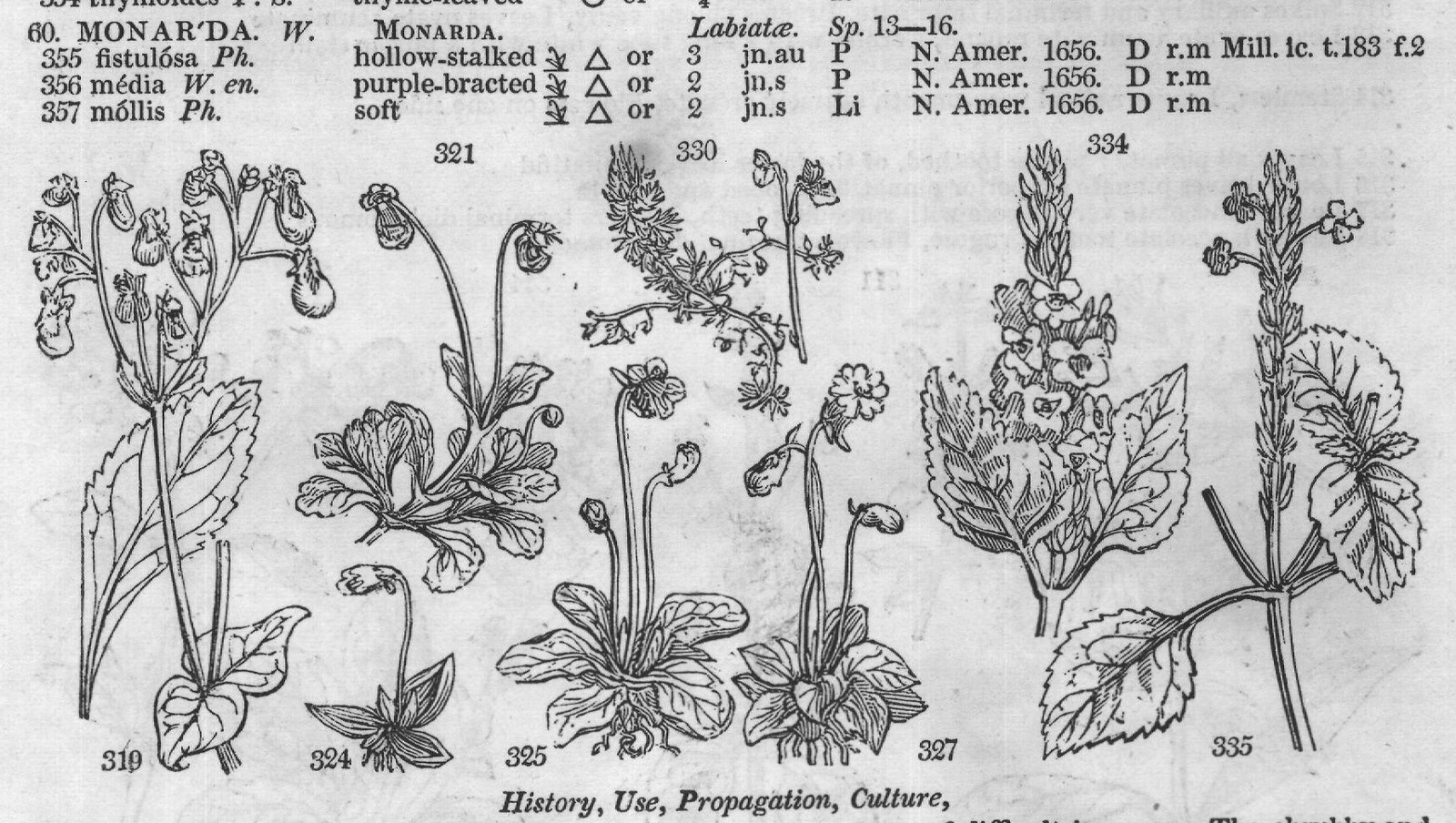
h.3. t.19. f.7 Mem. petr.2.t.11 319 324 325 327 335 History, Use, Propagation, Culture, C. corymbosa and paralia, are exceedingly beautiful herbaceous plants of difficult increase. The shrubby and branching herbaceous kinds are easily propagated by cuttings. 52. Pinguicula. From pinguis, fat, on account of the greasiness of its leaves. In P. vulgaris, the structure of the stigma, and its close application to the stamens is very remarkable. Linnæus says, that the warm milk of the rein-deer poured on the fresh leaves, and set aside for a day or two, becomes acescent; acquires consistence and tenacity, and neither the whey nor the cream separate. In this state it is considered a very grateful food in Sweden and Norway. On cows' milk it acts like common rennet. The plant eaten by sheep has been supposed to produce the liver-rot; but a flat apterous insect, the fasciola hepatica or fluke, found adhering to stones and plants in boggy grounds, as well as in the liver and biliary ducts of sheep affected by the rot, is a more likely cause, and the more especially as no animal whatever will feed on the plant. The species (except P. gra grandiflora) are cultivated with difficulty in artificial shaded morass. P. grandiflora will thrive well on a dry northern bed of bog-mould among North American shrubs. 53. Utricularia. From utricula, a little bottle, from the small inflated appendages to the root. The species are scarcely susceptible of cultivation: they are very numerous in hot countries, and there form the most elegant ornaments of rivulets and pools of water. The flowers are fugacious, and so delicate as not to be capable of preservation as dried specimens, in which state their naturally beautiful colors of purple, pink, violet, or yellow, all change to a dead and uniform black.
ORDER I.
DIANDRIA MONOGYNIA. 319 Leaves radical ovate and cordate stalked twice-crenate, Cauline cordate half embracing the stem 320 Leaves unequally toothed: the radical cuneate ; upper oblong connate with the Capsules tomentose 321 Leaves spatulate entire hairy above, Flower -stalks like a scape 1-flowered 2! 322 Nectarium conical thick at the end, obtuse shorter than the flowers, Scape villous, Capsules globose 323 Nectarium subulate nearly straight as long as the petals, Upper lip 2-lobed: lower 3-parted, Scape smooth 324 Nectarium conical recurved shorter than the petals [dilated 325 Nectarium subulate straight as long as the flower, Upper lip spreading emarg. very large: lower 3-lobed throat 326 Nectarium subulate recurved shorter than the campan , flower, Throat bearded, Lips toothed, Scape villous 327 Nectarium subulate recurved shorter than the campan. cor. 5-lobed: lobes emarg. entire, Palate prominent, [Scape pubescent 328 Nectarium conical, Upper lip entire equal to the palate, Leaves very finely divided 329 Nectarium carinate, Upper lip lip emarg. equal to the palate, Lvs. dichotomously 3-part. Cor. with throat open 330 Nectarium conical, Upper lip entire twice as long as the palate, Leaves dichotomously 3-parted 331 Leaves lanceol. obl. narrower at the base remotely toothed with stem very smooth, Bract. lin. lanceolate 332 Leaves oblong ovate tooth-serrated smooth, Branches hairy, Bractes ovate shorter than calyx 333 Leaves ovate serrate rough rugose , Stem shrubby, Bractes ovate larger than the calyx 334 Leaves serrate ovate rugose with the stem hoary, Bractes lanceolate shorter than the calyx 335 Leaves ovate obtuse serrate, Spikes lax, Bractes subulate shorter than the calyx 336 Leaves ovate crenate serrate smooth very obtuse 337 Leaves ovate acutely crenate with the stem very hairy, Spike very long, Bract. appressd smaller than the cal. 338 Leaves ovate lanceolate villous sinuate serrate 339 Leaves pinnatifid hairy, Lobes oblong somewhat toothed 340 Leaves lanceolate: the lower pinnatifid at the base: the upper remotely serrated, Stem smooth 341 Leaves pubescent ovate pinnatifid, Segments lanceolate: lowest the shortest, deeply cut at the end 342 Leaves opposite stalked 3-parted coarsely serrated smooth 343 Bractes ovate acumin. ciliate, Leaves elliptic lanceolate 344 Flowers in spiked racemes, Bractes obovate nerved acute, Leaves ovate 345 Flowers lateral, Leaves lanceolate 346 Leaves lanceolate naked nerved of one shape entire hoary, Flowers in spikes 347 Heads term. oval, Leaves ovate sub-serrate: those of the flowers nearly of the same shape entire ciliated 348 Leaves ovate acuminate nearly entire nerved, Flowers in heads, Calyx hairy pubescent at base 349 Whorls terminal and axillary close hispid, Leaves ovate sub-ciliate, Stems procumbent hairy 350 Flowers lateral, Leaves lanceolate entire ciliated, Cor. with an inflated throat twice as long as calyx 351 Leaves ovate serrate sessile, Flowers axillary and terminal, Stems erect 352 Leaves ovate acuminate, Flowers in heads, Stem decumbent 353 Pubescent, Leaves oblong serrated, Flowers axillary whorled, Lower lip of calyx with 2 ciliated bristles 354 Leaves oval entire, Flowers whorled, Stem square 355 Leaves obl. lanc. cord. pubesc. remotely and closely ser. Flowers in heads, Involucr. purple stem swollen 356 Leaves ovate oblong cordate pubesc. coarsely serrated, Flowers in heads, Involucr. purple, Stem fistular 357 Leaves obl. cord. pub. remotely serrate: upper entire, Flow. in heads, Invol. pale, Upper lip of cor, bearded 339 343 342 347 and Miscellaneous Particulars. 351 354 355 54. Stachytarpheta, saxus, a spike, and τaρφεioς, dense. The name would be better changed, as it has been by Link, to Stachytarpha. This genus is partly composed of Verbena, L. S. mutabilis is a beautiful species, and , to Stachytarpha. This genus is partly composed of Verbena, L. S. mutabilis is a beautiful species, and nearly always in flower. All of them strike readily in heat under glass. 55. Lycopus. From λuκoς, a wolf, and wες, a foot, on account of a fancied resemblance between the cut leaves and a wolf's foot. Le Marrube aquatique, Fr. Der Wolfsfuss, Ger., and Licopo, Ital. L. europæus is common in most parts of Europe in meadows, but is not eaten by cattle. It dyes black, and gives a permanent color to linen, wool, and silk. Withering says, gypsies stain their skin with it. According to Adamson, it has two barren filaments; and Pollich remarks, that there are sometimes 82 flowers in a whorl. 56. Amethystea. From aμεθuσoς, the amethyst, alluding to the color of the flower. A pretty annual, not very common in gardens. in gardens. 57. Ziziphora. Etymology uncertain. This genus, and the two following, consist of little herbaceous plants resembling thyme: they are generally pretty, and easily cultivated. It would, perhaps, have been better to unite, with some writers, Ziziphora, Cunila, and Hedeoma, in one genus. 58. Cunila. A Roman name applied by Linnæus to this genus. The plants of Pliny bore some resemblance to those which compose the Linnæan Cunila. (See No. 57.) The leaves of C. mariana are used in decoction for colds. 59. Hedeoma, ήδuoςμa, a Greek name for mint. (See No. 57.) 60. Monarda. In honor of Nicolas Monardez, a physician of Seville in the 16th century. Most of the species. 366 hirsúta Ph. 367 punctáta Ph. 358 oblongáta Ph. 359 clinopódia Ph. 360 purpúrea Ph. 361 altissima W. 362 rugósa Ph. 363 kalmiána Ph. 364 dídyma W. 365 ciliáta Ph. pub. flowered Oswego tea blue flowered hairy spotted long-leaved or 2 jl.s P wild-basil-leav. or 2 jl P.w DIANDRIA MONOGYNIA.
N. Amer. 1761. Dr.l N. Amer. 1771. D r.l CLASS II. crimson or 3 jn.au P N. Amer. 1789. Dr.l Bot. mag. 145 tall or 4 jn.au Li N. Amer. 1821. Dr.l white or 1 jl.s W N. Amer. 1761. Dr.l or 4 jn.au P N. Amer. 1813. D p.1 Pursh. fl. am. t.1 or 3 jn.au R N. Amer. 1752. Dr.l Bot. mag. 546 or 1 jl B N. Amer. 1798. Dr.l Pluk. al.t.164. f.3 or 1 jl.s P N. Amer. 1798. Dr.l or 2 jn.o Br N. Amer. 1714. S s.p Bot. reg. 87 61. ROSMARINUS. W. ROSEMARY.
Labiatæ. Sp. 2. 368 officinális W. common or 4 ja.ap P S. Europe 1548. C co Fl. græc. 1. t. 14 ẞ variegata variegated or 4 369 chilénsis W.
Chile or 4 jl P Chile 1795. C s.l 62. SA'LVIA. W.
SAGE.
Labiata. Sp. 95-170. 370 pomífera W. apple-bearing or 2 jl.au B Candia 1699. C p.1 Fl. græc. 1. t. 15 371 calycína Sm. large calyxed or 1 jl.au Pk Levant 1823. C co 372 canariénsis W. canary or 4 jn.s P Canaries 1697. C 1.p Tr. pl. rar. 2. t. 19 373 aúrea W. gold.-flowered or 3 ap.n Y C. G. H. 1731. C p.l Bot. mag. 182 374 dentata W. tooth-leaved ord.ja C. G. H. 1774. C p.l 375 interrúpta Va. ash-leaved 业 or 4 ap.s B Barbary 1798. C s.1 Schousb. 6. t. 1 376 pilántha Lk. 377 pinnáta Vahl. hairy-flowered or 2 jlau B ...... 1823. C co winged-leaved or 1 jl P Levant 1731. C s.l Boerh. 1. t. 167 378 hablitziána W.
Siberian or 1 au B Siberia 1795. C co Bot. mag. 1429 379 lanceoláta W. en. lanceolate Oor 1 my.s B 1813. S co ...... 380 hirsúta W. en. hirsute Oor 1 my.jn B 1801. S co ...... 381 angustifólia Ca. narrow-leaved or 2 jn.jl B Mexico 1806. C co 382 azúrea Ph. azure-flowered or 6 au B 383 pseúdo-coccinea W. pale scarlet or 3 jn.au P.R 384 boosiána Jacq. blue Peruvian or 2 mr.ap B S. amœna B. R. 446. 385 mexicána W.
Mexican or 2 386 chamædryoides Va. germander or 1 my.jl S jn.s B 387 cæsia W. en. grey or 2 B 388 hispánica W.
Spanish O or 1½ 389 serotína W. late-flowering or 1 au B 390 dominíca W.
Dominica 3 or jl W 391 tiliæfólia W. lime-leaved or 4 jn.au B.c 392 polystáchya W. many-spiked or 3 o.d B 393 micrántha Vahl. small-flowered or 1 my.jn B 394 formósa W. shining-leaved or 4 ap.o S 395 coccínea W. scarlet-flower'd or 2 ap.o S 396 pulchélla Dec. pretty or 2 o.f S 397 amarissima H. K. bitter or 2 jl.au B 398 glutinósa W. glutinous or 3 jn.s Y 399 lineatifólia Lag. lime-leaved or 3 B Carolina 1806. C co S. Amer. 1797. C s.p Peru 1821. C có Mexico 1724. C p.1 Mexico 1795. C p.l S. Amer. 1813. C p.l jn.s jn.au Pr.B Spain 1739. D p.1 Ohio 1803. C s.1 W. Indies 1759. C s.p S. Amer. 1793. C p.1 Mexico 1822. C co Cuba 1823. C co Peru 1783. C p.1 S. Amer. 1774. C p.1 S. Amer. 1821. C co Mexico 1803. C s.p Germany 1796. C có Mexico 1823. C co Bot. reg. 359 Jac. ic. rar. 1. t. 3 Sw. ob.18. t.1. f.1 Jac. sch. 3. t. 254 Jac. sch. 3. t. 318 Bot. mag. 376 Jac. ecl. 2. t. 13 Jac. sch. 3. t. 252 Cav. ic. t. 317 Bot. mag. 1728 Jac. ic. 2. t. 209 Jac. ecl. 1. t. 47 Cav. ic. 1. t. 26 Bot. mag. 808