Home › S › Sapindaceæ (Sp s pida H K)
Sapindaceæ (Sp s pida H K)
Sp. 1. 5104 sápida H. K.
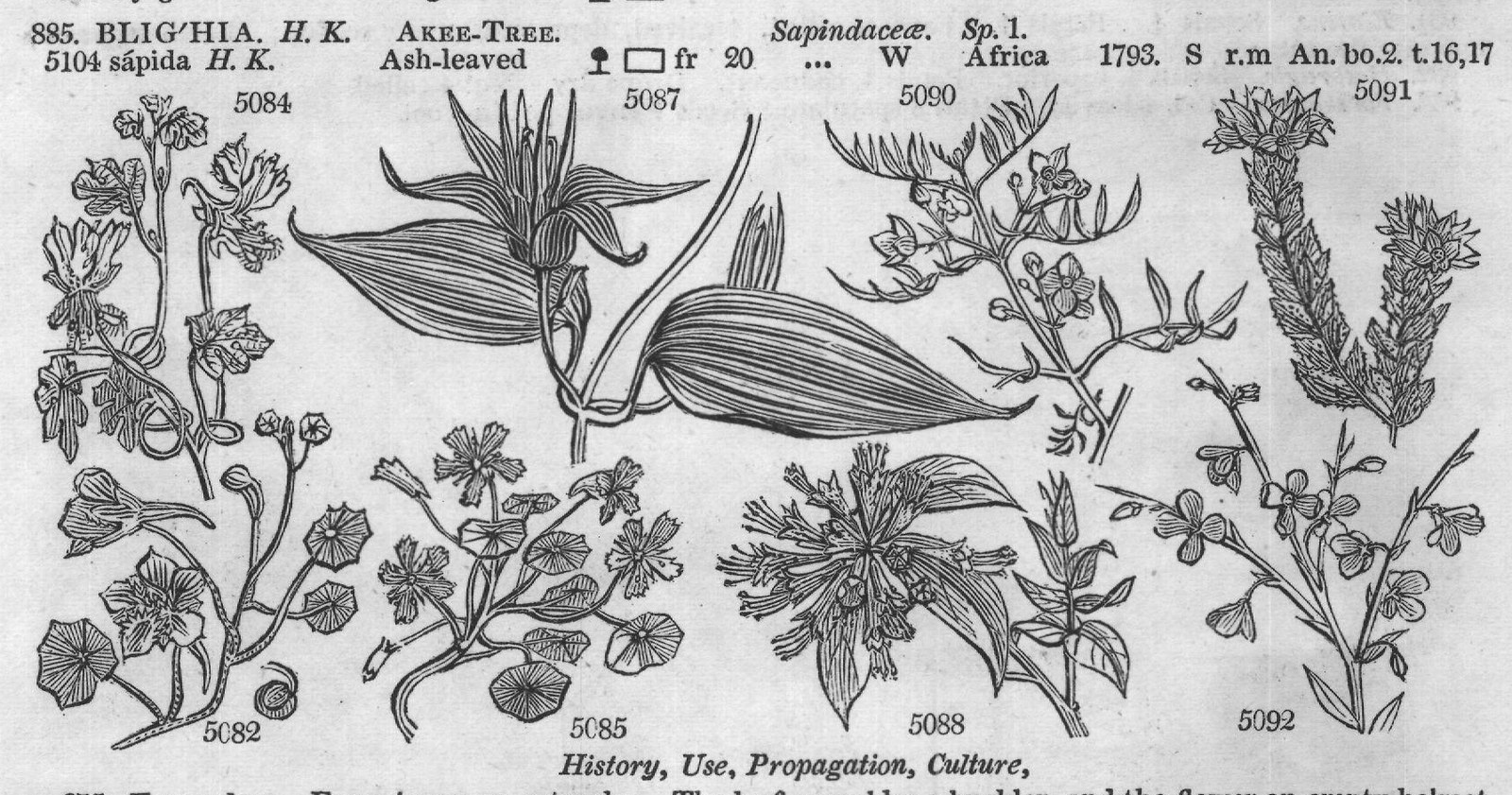
Ash-leaved fr 20 W Africa ... 5084 5087 5090 1793. Sr.m An. bo.2. t.16,17 5091 5082 5085 5088 History, Use, Propagation, Culture, 5092 875. Tropæolum. From tropæum, a trophy. The leaf resembles a buckler, and the flower an empty helmet, of which trophies were formed. T. majus is an ornamental annual, and also a culinary plant. The flowers are eaten in salads, and are very grateful: they are also used as a garnish. The seeds, which consist of three conjoined berries or nuts, with grooved wrinkled gibbous husks that become fungous when dry, are pickled in salt and vinegar, and used as a substitute for capers, to which some prefer them. In the evening the flowers emit spontaneously at certain intervals visible sparks like those of an electric machine. This was first observed by the daughter of Linnæus. 876. Roxburghia. In honor of William Roxburgh, M. D. born in Scotland, and settled in the East Indies; author of a splendid work on the plants of the coast of Coromandel. A singular plant, the natural affinities of which are yet obscure; it grows in loam and peat, and may be increased, though but slowly, by dividing at the root. 877. Grislea. So named after G. Grisley, a Portuguese surgeon, author of Viridarium Lusitanicum, 1661. A free flowering shrub of considerable beauty; it grows in loam and peat, and cuttings root in sand under a hand-glass in heat. 878. Boronia. So named after Francis Borone, an Italian servant of Dr. Sibthorp, who perished from an accident at Athens. Pretty little New Holland plants, generally with red flowers. These are valuable plants, as flowering nearly all the year. "They thrive best in sandy peat, with the pots well drained with broken potsherds. They may be propagated by layers or ripened cuttings, taken off at a joint and planted in sandy peat, and placed under a bell-glass, will strike root, if properly managed: the glass must be taken off occasionally to dry them, as they are very liable to damp off." 879. Tetratheca. From τετρa, four, and θηκη, a cell, in allusion to the four cells of the anthers, for which the plants are remarkable. Cuttings root in sand under a bell-glass. 880. Correa. So named after Joseph Correa de Serra, a learned Portuguese, who, without publishing much, was one of the most profound theoretical botanists of this age. He died at Lisbon in 1823. "Ripened cuttings ORDER I.
OCTANDRIA MONOGYNIA. 5082 Leaves peltate repand mucronate, Petals acute 5083 Leaves peltate repand, Petals obtuse 5084 Leaves peltate 5-lobed palmate toothed, Petals jagged 5085 Leaves peltate, Lobes obtuse unequal, Flowers pinnate 5086 Leaves peltate 5-lobed, Lobes obtuse repand, Petals cuneate toothed at end 5087 Leaves cordate many-nerved 5088 Leaves minute tomentose beneath, Corymbs axillary spreading 5089 Leaves linear lanceolate entire tomentose beneath 5090 Leaves pinnated with an odd one in 2-4-pairs very smooth, Leaflets linear acute, Pedunc, dichotomous 5091 Leaves simple trapeziform acute serrulate at end smooth 5092 Leaves alternate few lanceolate and branches smooth 5093 Leaves ovate downy beneath, Teeth of calyx small acute distant 5094 Leaves ovate obtuse beneath rusty with down, Flowers erect, Calyx truncate 5095 Leaves ovate-oblong cordate, Flowers pendulous, Calyx with 4 acute teeth 5096 Leaves alternate ovate acuminate 5097 Leaves alternate clustered at the ends of the branches oblong very obtuse 5098 Leaves alternate obovate emarginate, Flowers hexandrous 5099 Leaves ternate rough, Leaflets stalked ovate acuminate serrate, Racemes simple 5100 Leaves ternate, Leaflets stalked oblong narrowed at each end pubescent beneath, Racemes compound 5101 Leaves pinnated, Leaflets flat acute, Fruit scaly, Flowers apetalous 5102 Leaves pinnated, Leaflets rugose blunt, Fruit hispid, Flowers pentapetalous 5103 The only species 5104 The only species 5094 5096 5099 5101 5093 5097 5103 5104 and Miscellaneous Particulars. will root freely in sand under a bell or hand-glass. The cuttings must not be planted too thick, or they will be liable to damp. C. speciosa has generally been reckoned difficult to strike from cuttings, but it roots as freely as the others if properly managed, and requires the same treatment." 881. Mimusops. From μiμoς, an ape, and oψiς, figure. The flowers are thought to resemble the countenance of a monkey. Ripened cuttings root readily in sand under a hand-glass. of a monkey. Ripened cuttings root readily in sand under a hand-glass. 882. Ornitrophe. From oevis, a bird, and τρoφη, nourishment. Its fruit is much eaten by small birds. In the Isle de France it is called bois de merle, or thrush-wood. Cuttings root in sand under a hand-glass. de France it is called bois de merle , or thrush-wood. Cuttings root in sand under a hand-glass. 883. Dimocarpus. From δiδuμoς, double, and κaρπoς, fruit; its fruit grows in pairs. These are fruit-bearing trees, cultivated in China. The fruit is a berry in bunches of a red color, and rather larger than the grape. , cultivated in China.
The fruit is a berry in bunches of a red color, and rather larger than the grape. The bunches are small; the skin of the berry is tough and leathery; the pulp is colorless, semitransparent, and of a slightly sweet subacid taste. The fruit of D. Litchi is frequently brought to England dried like raisins; that of D. Longan has been ripened by John Knight, Esq. of Lee Castle, in a lofty stove, erected for the purpose of growing tropical fruits. A bunch was presented to the Horticultural Society, in September 1816, "supposed to be the only one ever produced in Europe, and which persons well acquainted long-yen in its native places of growth, pronounced to be quite as good as those grown within or near the ted with the tropics." (Hort. Trans. tropics." (Hort. Trans. ii. 408.) 884. Melicocca. From μελi, honey, and κoκκoς, fruit; its fruit, which resembles the yolk of an egg, has a very sweet flavour mixed with a little acid. This tree is cultivated in some parts of South America and in sweet flavour mixed with a little acid.
This tree is cultivated in some parts of South America and in Jamaica for its fruit, which grows to the size of a large plum, and is very mellow. The natives suck it for the sake of the salivation which it produces. In our stoves it thrives well in light loamy soil, and cuttings root in sand under a hand-glass in heat. 885. Blighia. Named in honor of the famous Captain Bligh, who first carried the bread-fruit to the West Indies. This is an esteemed African fruit tree with a reddish or yellow pome, about the size of a goose's egg, 오 tm 60 오 AMYRIS.
XIMENIA.
American 오 or 15 BECKIA.
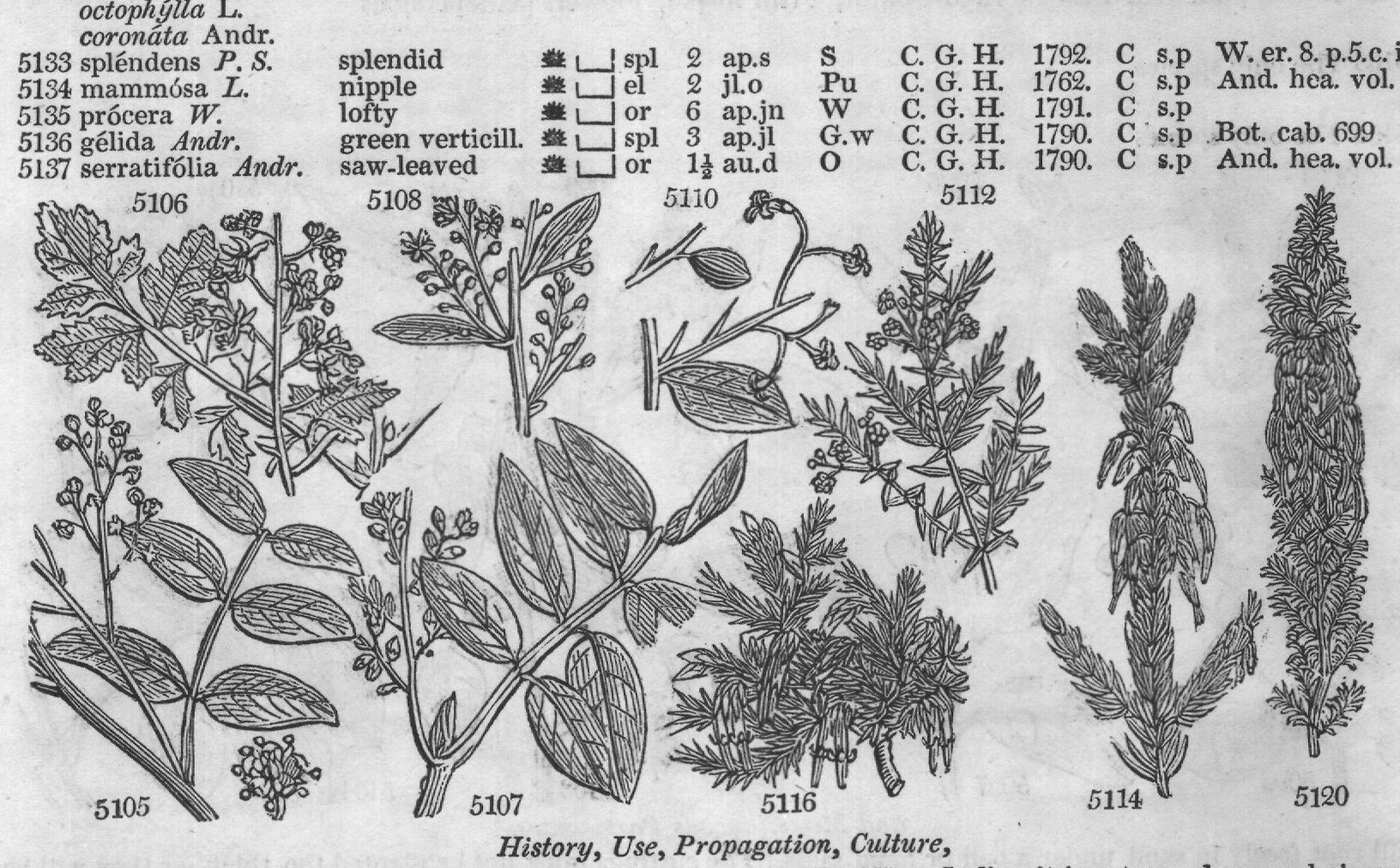
Chinese twiggy # pr 3 s.d. W close-leaved pr 886. METAI'BA. Aubl. 5105 guianensis Aubl.
Ephielis fraxinea W. 887. KÖLREUTE RIA. 5106 paniculáta W. 888. GUA'REA. W. 5107 trichilioídes W. 889. AMY'RIS. W. 5108 polýgama W. 5109 sylvática W. 890. XIMENIA. W. 5110 americána W. 891. BÆC KIA. Sm. 5111 frutéscens Sm. 5112 virgáta Sm. 5113 densifólia Sm.
OCTANDRIA MONOGYNIA.
METAIBA.
Ash-leaved W. KÖLREUTERIA. panicled GUAREA.
Ash-leaved simple-leaved wood