Home › S › Sower (T fuscipes cast neus Bull)
Sower (T fuscipes cast neus Bull)
t. 344. fuscipes 15971 castáneus Bull.
Chesnut-color. gregarious 15969 Cúcumis Pers. Cucumber-scented strong smell. 3 au, oc. Pu.Br woods 15970 Armeníacus Schæff. Apricot-color. softish 3 jl. nov. Pa. Br woods Schæff. t. 81 Bulliard, t. 268 2 jl. nov. Ches. woods 15972 hýbridus Sowerby 15973 testáceus With. hybrid variable 2 my.no. Or testaceous crooked 15974 flávidus Sowerby yellowish soft 4 sept. Y 2 sept. fir leaves plantations Sowerby, t. 221 Ysh among grass Sowerby, t. 366 §21. PHOLIO TA. Fries. 15975 aúreus Sowerby golden subcæspitose 6 sep. oc. Fulv. damp earth Sowerby, t. 77 15976 caperátus Pers. pale solitary 5 jul.oct. Lem. 15977 aurivéllus Batsch 15978 squarrósus Pers. filamentous squarrose solitary 3 oc. no. Y mount. woo. Fl. dan. t. 1675 old trees Schæ.t.209.filamentosus cæspitose 2 au.dec. Ferr. roots of trees Gre.cryp. fl.t.2.floccosus 15979 flammans Batsch flame-colored elegant 3 jul.oct. Y pine trees Batsch el. f. 30 muricated variable 2 jul.oct. Dl. Y commons unequal variable 2 jul.oct. DI. Y commons eatable 3 my.no. Pa. Ci. on trees Bolt. t. 50. luteus Schæff. t. 9 rheoides With. 15980 muricátus Fries scariósus With.
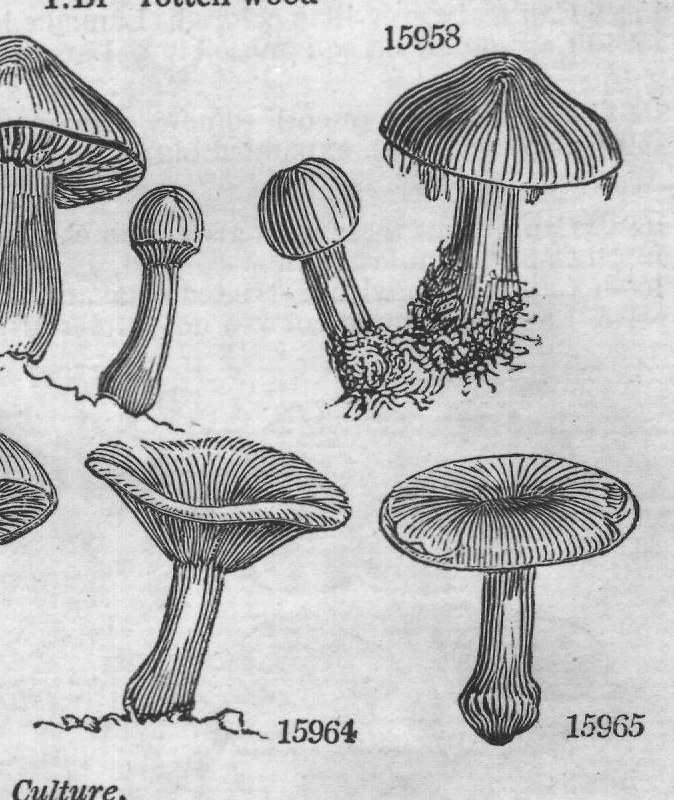
ẞ inæquális Batt. 15981 mutábilis Schaff: changeable 15982 constric'tus With. contracted watery 15955 15956 sept. Y.Br rotten wood 15957 15955 15956 15958 15963 15960 History, Use, Propagation, Culture, 15964 15965 § 18. Telamonia. So named on account of their gigantic stature. The species are among Agarics what Ajax Telamonius was among men. Large, terrestrial, firm species, none of which are eaten. The species of this and the next subgenus are extremely difficult to determine; not only on account of their size, but of their colors, which vary exceedingly at different periods of their growth, as well as according to their situation. Their colors are also intermediate between fulvous, testaceous, cinnamon, &c., which are very difficult to describe The most constant marks are, first, smell; second, surface of pileus being fibrous or viscid; third, the situation of the lamellæ, whether they are compact or distant; and fourth, their color in the young state, in which it must be observed, that they are always described.